August 10, 2026

36
min read
ISO 27001 Compliance Software: 10 Platforms Ranked (2026)
The 10 best ISO 27001 compliance software platforms for 2026 — Strac Comply, Vanta, Drata, ISMS.online +6 — ranked by what certification bodies actually check.
Last updated: July 2026
ISO 27001 compliance software automates building and running an ISMS (information security management system) — it scopes controls against Annex A, collects evidence continuously, manages your risk assessments and Statement of Applicability, and keeps you audit-ready between certification cycles.
If you're shopping for ISO 27001 compliance software in 2026, you've probably noticed a quiet shift in the market. ISO 27001:2022 — released October 2022 with a three-year transition window that ended October 2025 — is now the only valid version of the standard. Every certification audit happening today uses the new control structure: 93 controls organized into 4 themes (Organizational, People, Physical, Technological), down from 114 controls in 14 categories in the 2013 version.
Looking for the fastest path to ISO 27001 certification? Strac Comply is AI-native compliance automation built for ISO 27001, SOC 2, HIPAA, GDPR, and PCI DSS — and because ISO 27001:2022 pushes most of its weight into the Technological theme (Annex A.8), the platform that actually secures your data is the one that proves your Annex A controls. Strac is the only platform that pairs compliance automation with continuous data security across SaaS, cloud, endpoint, and AI agents. Start at comply.strac.io →
That structural change matters because it concentrates more controls into the Technological theme — which is where data security, DLP, DSPM, and access governance live. The 2022 version added 11 brand-new controls, and 8 of them are technology controls (threat intelligence, ICT readiness for business continuity, configuration management, information deletion, data masking, data leakage prevention, monitoring activities, web filtering). One of them — A.8.12 Data Leakage Prevention — explicitly named DLP for the first time in any major compliance standard.
That's the reason the ISO 27001 software market is splitting into two camps. The traditional GRC platforms (Vanta, Drata, Secureframe, ISMS.online) excel at the ISMS governance layer — Statement of Applicability, internal audit cycles, management review minutes, evidence collection. They don't do A.8.12. The newest generation (Strac Comply being the most fully realized example) bundles the ISMS layer with the actual technology controls — DLP, DSPM, SSPM, OAuth governance, secure share, vendor questionnaires, pen test orchestration — that A.8.12 and the other 7 new technology controls now require.
This post compares the 10 most-considered ISO 27001 compliance software platforms across both dimensions: the ISMS governance layer (does it generate the certification package?) and the technology control layer (does it actually run A.5–A.8 controls, or just attest to them?).
Quick answer: The best ISO 27001 compliance software in 2026 is Strac Comply (iso 27001 + active data security in one platform), Vanta (first-time iso 27001 + parallel soc 2 evidence collection), Drata (iso 27001 + multi-framework programs with cleanest ux) — with the full ranked shortlist of 10 platforms, auditor criteria, and a comparison table below.
Last updated: June 2026
ISO 27001 compliance software is any platform that helps organizations build, operate, and certify an Information Security Management System (ISMS) under the ISO/IEC 27001:2022 standard. ISO 27001 is the international gold standard for information security — recognized by every major economy, often required for European enterprise procurement, and increasingly the parallel requirement to SOC 2 for B2B SaaS doing global business.
A modern ISO 27001 compliance platform should cover:
The first three platforms (Vanta, Drata, Secureframe) cover the ISMS governance layer well and most of policy/training. ISMS.online is the specialist for the governance-only layer. The newer generation (Strac Comply) covers all of these — including the technology control layer (A.5.13 information classification, A.7.10 storage media, A.8.10 information deletion, A.8.11 data masking, A.8.12 DLP, A.8.16 monitoring) that the 2022 update concentrated more deeply.
A tool that only collects evidence will leave you certification-ready, but it will not stop your auditor from finding that customer credentials are sitting unencrypted in a public Slack channel. With A.8.12 now an explicit named control, that's harder to wave off than it used to be.
The October 2022 update introduced structural changes that directly affect how compliance software earns its keep.
| Change | What it means | Software impact |
|---|---|---|
| 114 → 93 controls | Some controls merged; 11 new controls added | Vendors had to rebuild their control libraries. Most did this in 2023; if a vendor still references "114 controls" or the 2013 numbering in their docs, they're behind. |
| 14 categories → 4 themes | Organizational (37), People (8), Physical (14), Technological (34) | Technology controls now make up 37% of the Annex; software stack matters more. |
| 11 new controls | Threat intelligence, ICT readiness, configuration management, information deletion, data masking, DLP, monitoring activities, web filtering, secure coding, ICT supply chain, cloud services use | 8 of 11 are technology controls. A.8.12 DLP is the headline. |
| 3-year transition window | Ended October 2025 | Every audit happening now is on the 2022 version. |
| Annex A.5–A.8 reorganization | Cleaner mapping to operational vs technology controls | Easier to map to other frameworks (SOC 2 CC6, NIST CSF, GDPR Article 32). |
The 11 new controls — and especially the 8 technology controls — are the part of ISO 27001:2022 that "compliance software" tools handle worst. Vanta and Drata can attest that you have a DLP. They cannot attest that the DLP is working. ISMS.online generates the SoA documentation but doesn't run any controls. The newest generation (Strac Comply) runs the controls and generates the evidence at the same time — closing the operating-effectiveness gap that the 2022 update concentrated.
| Theme | # Controls | Examples | What software does for you |
|---|---|---|---|
| A.5 Organizational | 37 | Information security policies (A.5.1), threat intelligence (A.5.7), supplier relationships (A.5.19–22), incident management (A.5.24–28) | Policy templates, vendor questionnaires, IR runbooks, threat intel feeds |
| A.6 People | 8 | Screening (A.6.1), terms of employment (A.6.2), awareness training (A.6.3), disciplinary process (A.6.4) | Background-check evidence, training acknowledgments, HR system integration |
| A.7 Physical | 14 | Physical entry (A.7.2), securing offices (A.7.3), storage media (A.7.10), secure disposal (A.7.14) | Less software-driven — badging, cameras, asset disposal trails |
| A.8 Technological | 34 | User endpoints (A.8.1), privileged access (A.8.2), info access restriction (A.8.3), source code (A.8.4), authentication (A.8.5), capacity (A.8.6), malware (A.8.7), vulnerability mgmt (A.8.8), config mgmt (A.8.9), info deletion (A.8.10), data masking (A.8.11), DLP (A.8.12), backup (A.8.13), redundancy (A.8.14), logging (A.8.15), monitoring (A.8.16), clock sync (A.8.17), privileged utility (A.8.18), software installation (A.8.19), networks (A.8.20–23), cryptography (A.8.24), dev lifecycle (A.8.25–34) | The bulk of where software earns its keep. GRC + IAM + DLP + DSPM + SIEM + EDR + vuln scanning + pen test |
A.8.10, A.8.11, and A.8.12 are the three controls that the 2022 update added or strengthened that "ISO 27001 compliance software" tools systematically skip:
The newest generation (Strac Comply) does all three natively — discovery, masking, deletion, OAuth revocation, public-access removal — without bolting on a separate DLP product.
We compared each platform on nine dimensions that matter to a working ISMS — based on vendor documentation, public datasheets, customer reviews on G2 and Gartner Peer Insights, and direct hands-on time with the platforms our team has access to:
The pattern that emerges: most legacy compliance platforms cover #1, #2, #3 well — but not the data-security capabilities (#4–#7) that ISO 27001:2022 newly demands. The newest generation (Strac Comply) bundles both layers in one platform.
We tried to be honest about what each platform is and isn't. There's no single platform that's "best at everything" — but there is one new generation that does meaningfully more than collect evidence for the SoA. Below: ranked by total capability for an active ISMS (not just an audit checkbox).
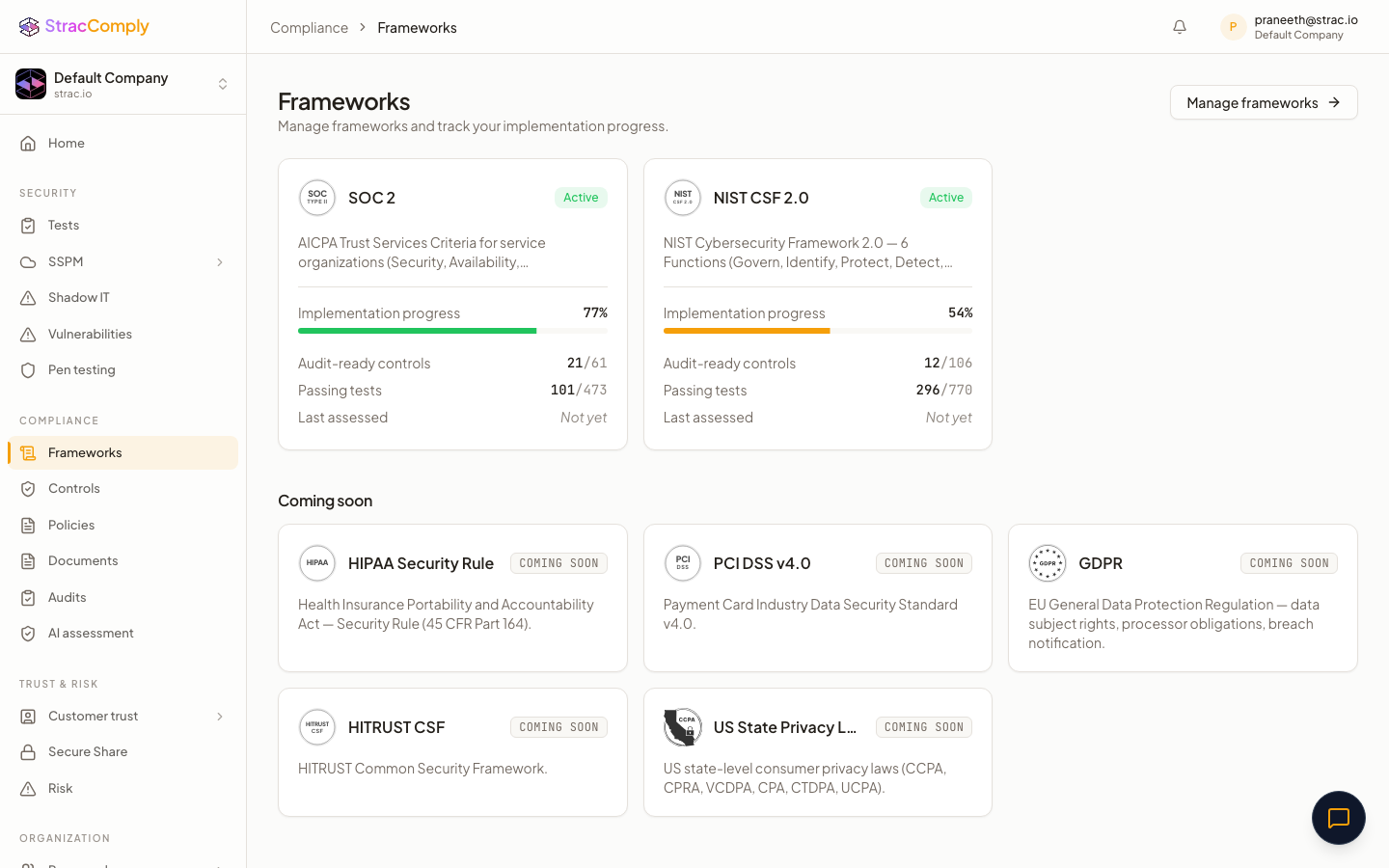
Strac Comply is the newest generation of compliance automation: instead of stopping at evidence collection, it bundles ISMS governance + control mapping + audit reporting with the actual security capabilities that ISO 27001:2022 explicitly named — DLP (A.8.12), data masking (A.8.11), information deletion (A.8.10), monitoring (A.8.16), configuration management (A.8.9), web filtering (A.8.23), threat intelligence (A.5.7), SSPM, secure share, and vendor risk questionnaires. Said differently: traditional ISO 27001 platforms tell you what to do; Strac Comply does it.
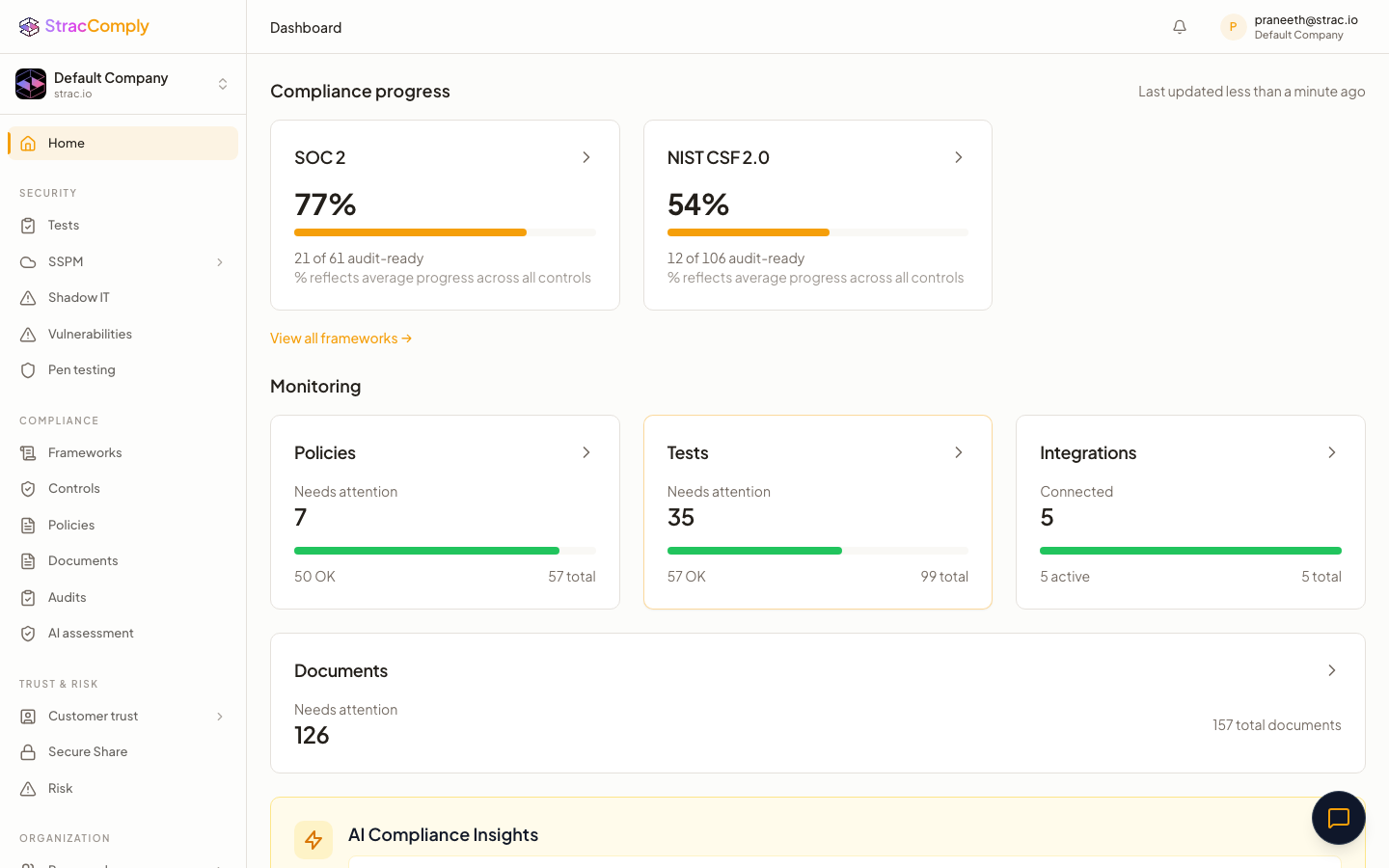
ISO 27001 is one of three native frameworks in Strac Comply today (alongside SOC 2 and NIST CSF 2.0). The platform ships with the full Annex A 2022 control library mapped, evidence templates per control, and continuous tests (146 automated checks at last count) that map directly to the controls your auditor will examine.
What's included in Strac Comply:
- ISMS governance — Statement of Applicability builder, risk register, risk treatment plan, internal audit cycles, management review templates, certification-ready evidence packages
- Control mapping + evidence collection for ISO 27001:2022 Annex A, SOC 2 Trust Service Criteria + Common Criteria, NIST CSF 2.0 — with PCI DSS, HIPAA, and GDPR rolling out throughout 2026
- Continuous control monitoring — alerts when MFA is missing, access reviews are overdue, encryption settings drift, audit log retention is misconfigured, root account is used
- DLP + DSPM (built-in, not an add-on) — directly satisfying A.8.12 — discovers and classifies PII, PHI, PCI, secrets, and any custom-defined sensitive data across SaaS, cloud, and endpoint sources via 100+ integrations
- Data masking and anonymization (A.8.11) — automated masking of sensitive fields in Slack, Zendesk, Salesforce, Notion; tokenization for high-value PII
- Information deletion (A.8.10) — automated deletion / OAuth revocation / public-access removal when data is found in violation of policy
- Browser DLP for AI tools (A.8.12 + A.8.23 web filtering) — blocks employees from pasting sensitive data into ChatGPT, Claude, Gemini, Copilot, Perplexity, Cursor at the browser layer in real time
- OCR + ML-based detection inside images, PDFs, DOCX, XLSX, ZIP archives — finds sensitive data inside JPEG screenshots, scanned PDF invoices, embedded Excel attachments, ZIP'd backups
- Full-spectrum remediation — redact, mask, label, alert, delete, revoke OAuth access, remove public-link access, remove external collaborators, all automated
- SSPM (SaaS security posture management) — A.5.19–A.5.23 — continuously discovers third-party SaaS apps and risky OAuth permissions connected to your Google Workspace and M365
- Pen test orchestration for A.8.8 + A.8.29
- Vendor risk + security questionnaires (A.5.19–A.5.23) — outbound vendor reviews, inbound customer questionnaires (SIG, CAIQ, custom), AI-drafted answers from your evidence library
- Trust portal — public-facing certification posture for sales enablement
- Secure share — send ISO 27001 certificates and audit attestations to customers and auditors with end-to-end encryption
- AI Compliance Insights — proactive recommendations on which controls to prioritize and which evidence is going stale before your auditor catches it
Capabilities at a glance:
- ISO 27001:2022 framework: ✅ Native — full Annex A 2022 mapping (4 themes, 93 controls), Statement of Applicability builder, 146 tests, risk register, internal audit cycles
- Evidence automation: ✅ Auto-collected from 100+ integrations with continuous monitoring
- Data discovery: ✅ Slack, Google Workspace, M365, Zendesk, Salesforce, Notion, Jira, GitHub, Box, Dropbox, Intercom, HubSpot, AWS S3, Azure Blob, GCS, endpoint
- Format coverage: ✅ JPEG, PNG, PDF (text + scanned via OCR), DOCX, XLSX, ZIP, embedded files, chat messages, email
- Real-time prevention: ✅ Browser DLP for ChatGPT, Claude, Salesforce, Notion, Jira, custom apps; email DLP for Gmail, M365
- Remediation (A.8.10, A.8.11, A.8.12): ✅ Native, automated, policy-driven
- SSPM + third-party OAuth: ✅ Native
- Vendor questionnaires: ✅ Inbound + outbound, AI-drafted
- Secure share: ✅ E2E encrypted
- Integrations: 100+
- Deployment: agentless API-based; under 10 minutes per integration
Where it covers ISO 27001:2022:
- A.5 Organizational (37 controls): Policy library, vendor questionnaires + sub-processor monitoring, IR runbooks + post-mortem templates, threat intel via integration with major TI feeds
- A.6 People (8 controls): Background check evidence (HR integration), training acknowledgments, disciplinary process tracking
- A.7 Physical (14 controls): Less software-driven; integrates with badge / asset systems where present
- A.8 Technological (34 controls): This is where Strac differentiates most heavily. Native DLP for A.8.12, data masking for A.8.11, information deletion for A.8.10, monitoring for A.8.16, web filtering for A.8.23, secure config drift detection for A.8.9, vulnerability + pen test orchestration for A.8.8 + A.8.29.
Pair with:
- A vulnerability scanner (Qualys, Tenable, Rapid7) for CVE-level scanning, alongside Strac's pen test orchestration
- An EDR (CrowdStrike, SentinelOne, Microsoft Defender) for A.8.7 endpoint malware
Best for: Mid-market and enterprise SaaS, fintech, healthcare, and any organization that wants its compliance platform to also be its data security platform. Especially powerful for teams pursuing ISO 27001 certification alongside SOC 2 and that want one tool that covers A.8.10, A.8.11, and A.8.12 natively rather than bolting on a separate DLP.
Vanta added ISO 27001:2022 framework support in 2023. It's excellent for the audit-readiness layer: control mapping, automated evidence collection from 375+ integrations, vendor risk reviews, employee training acknowledgments, certification-body portal handoff. Most companies that pass their first ISO 27001 audit on a parallel SOC 2 timeline use Vanta.
Capabilities at a glance:
- ISO 27001:2022 framework: ✅ Native, with strong certification-body handoff
- ISMS governance: ✅ SoA builder, risk register, internal audit workflow
- Evidence automation: ✅ Strong — control mapping, evidence requests
- Data discovery (DLP for A.8.12): ❌ Vanta scans configuration metadata, not file or message content
- Real-time prevention: ❌ Not in scope
- SSPM / OAuth governance: ⚠️ Limited — basic third-party app discovery in Google Workspace
- Vendor questionnaires: ✅ Inbound + outbound
- Integrations: 375+
Best for: Companies pursuing ISO 27001 certification alongside SOC 2 on a tight timeline who want the fastest path to auditor-ready evidence and have a data-security stack already in place to fill the A.8.10–A.8.12 gap.
Drata's strength is the same as Vanta's (GRC + evidence collection) with slightly stronger automation around control monitoring and a cleaner UX. Multi-framework users (ISO 27001 + SOC 2 + HIPAA) often prefer Drata's unified control library.
Capabilities at a glance:
- ISO 27001:2022 framework: ✅ Native
- ISMS governance: ✅ SoA, risk register, internal audit
- Evidence automation: ✅ Strong, cleanest continuous-monitoring UX
- Data discovery (DLP): ❌ Same architectural category as Vanta
- SSPM: ⚠️ Limited
- Real-time prevention: ❌
- Vendor questionnaires: ✅
- Integrations: 200+
Best for: ISO 27001 + SOC 2 teams that want continuous control monitoring, a single GRC pane, and cleaner UX than Vanta — paired with a separate DLP for A.8.12.
Secureframe targets SMB and lower mid-market with a focus on bundled employee training, vendor risk, and trust portal. The training experience is the most polished of the major three for A.6.3 evidence.
Capabilities at a glance:
- ISO 27001:2022 framework: ✅ Native
- ISMS governance: ✅
- Evidence automation: ✅ Strong
- Data discovery (DLP): ❌
- Vendor questionnaires: ✅
- Trust portal: ✅
- Integrations: 175+
Best for: SMB SaaS pursuing ISO 27001 certification with bundled employee training and trust portal.
Sprinto is positioned for startups (Series A through C) that need ISO 27001, SOC 2, and HIPAA evidence quickly with an opinionated onboarding flow. Sprinto's first-certification-success metric is one of the highest in the category.
Capabilities at a glance:
- ISO 27001:2022 framework: ✅ Native (opinionated)
- ISMS governance: ✅
- Evidence automation: ✅ Workflow optimized for first-audit speed
- Data discovery (DLP): ❌
- Vendor questionnaires: ✅
- Integrations: 175+
Best for: Founders with no security team who need their first ISO 27001 certification quickly. You'll still need a DLP for A.8.12.
ISMS.online is the specialty platform for ISO 27001 — built around the standard rather than around generic GRC. The platform's depth on Annex A control mapping, internal audit workflows, and management review documentation is unmatched in the category. Less integration breadth than Vanta/Drata, but stronger ISMS-specific workflows.
Capabilities at a glance:
- ISO 27001:2022 framework: ✅ Native + deepest specialty support
- ISMS governance: ✅ Best-in-class
- Evidence automation: ✅
- Data discovery (DLP): ❌ Not in scope
- Vendor questionnaires: ✅
- Integrations: 50+
Best for: Companies committed to ISO 27001 as the primary framework (vs SOC 2 + ISO parallel) and prioritizing depth of ISMS workflows.
Thoropass (formerly Laika) bundles GRC software with auditor services — they help you prepare for and pass the certification audit, not just collect evidence. The bundled model removes the back-and-forth of vendor-auditor handoffs.
Capabilities at a glance:
- ISO 27001:2022 framework: ✅ Native + bundled certification body services
- ISMS governance: ✅
- Evidence automation: ✅
- Data discovery (DLP): ❌
- Vendor questionnaires: ✅
- Integrations: 100+
Best for: Companies that want their compliance software vendor to also be their certification body. Not a substitute for a DLP — but eliminates one vendor handoff.
AuditBoard is the enterprise GRC heavyweight — used by large enterprises for internal audit, SOX compliance, ESG, and broader enterprise risk programs. ISO 27001 is one of dozens of frameworks it supports.
Capabilities at a glance:
- ISO 27001:2022 framework: ✅ Supported via the broader compliance module
- ISMS governance: ✅
- Evidence automation: ✅ Strong, with deep workflow capabilities
- Data discovery (DLP): ❌ Not in scope
- Vendor questionnaires: ✅ Strong
- Integrations: 200+
Best for: Public companies, regulated enterprises, and anyone with a dedicated internal audit team running ISO 27001 + SOX + ESG + ERM in parallel.
Hyperproof is a mid-market GRC platform with strong ISO 27001 support and a focus on continuous compliance workflows. Less SaaS-native than Vanta/Drata; more operations-heavy.
Capabilities at a glance:
- ISO 27001:2022 framework: ✅ Native
- ISMS governance: ✅
- Evidence automation: ✅ Strong with workflow automation
- Data discovery (DLP): ❌
- Vendor questionnaires: ✅
- Integrations: 70+
Best for: Mid-market companies that already have a security team and want a workflow-heavy GRC platform.
OneTrust GRC (formerly Tugboat Logic) supports ISO 27001 alongside the broader OneTrust privacy management suite. Strong overlap between ISO 27001 information classification (A.5.13) and GDPR data classification — useful when both are in scope.
Capabilities at a glance:
- ISO 27001:2022 framework: ✅ Native
- ISMS governance: ✅
- Evidence automation: ✅
- Data discovery (DLP): ❌ separate OneTrust modules
- Vendor questionnaires: ✅ Industry-leading
- Integrations: 200+
Best for: Companies with significant privacy obligations (GDPR + CCPA) that also need ISO 27001 in one vendor.
| Platform | ISO 27001:2022 native | ISMS governance | DLP / data discovery (A.8.12) | Browser DLP | SSPM + OAuth | Integrations | AI agent (MCP) |
|---|---|---|---|---|---|---|---|
| Strac Comply | ✅ Native | ✅ | ✅ Full (OCR + ZIP) | ✅ | ✅ Native | 100+ | ✅ Read + write |
| Vanta | ✅ Native | ✅ | ❌ | ❌ | ⚠️ Basic | 375+ | ⚠️ Chat only |
| Drata | ✅ Native | ✅ | ❌ | ❌ | ⚠️ Basic | 200+ | ⚠️ Chat only |
| Secureframe | ✅ Native | ✅ | ❌ | ❌ | ⚠️ Basic | 175+ | ⚠️ Chat only |
| Sprinto | ✅ Native | ✅ | ❌ | ❌ | ❌ | 175+ | ❌ |
| ISMS.online | ✅ Specialist | ✅ Best | ❌ | ❌ | ❌ | 50+ | ❌ |
| Thoropass | ✅ + audit | ✅ | ❌ | ❌ | ❌ | 100+ | ❌ |
| AuditBoard | ✅ Enterprise | ✅ | ❌ | ❌ | ❌ | 200+ | ❌ |
| Hyperproof | ✅ Native | ✅ | ❌ | ❌ | ❌ | 70+ | ❌ |
| OneTrust GRC | ✅ Native | ✅ | ❌ separate | ❌ | ❌ | 200+ | ❌ |
All 10 platforms support ISMS governance, evidence collection, and vendor questionnaires. The differences above are the technology controls (A.8.10, A.8.11, A.8.12, A.8.16, A.8.23) that the 2022 update concentrated and that most "ISO 27001 compliance software" tools quietly skip.
Use this checklist on every demo. The vendors that don't have good answers are the vendors that fail you in your A.8 walkthrough.
Every Annex A control mapped to the evidence an auditor expects to see — plus the 15 questions to ask any ISO 27001 platform before you sign. We’ll email it to you.
No spam. Unsubscribe anytime.
Based on what working ISO 27001 lead auditors publicly write, post-engagement debriefs, and patterns in published certification-body guidance, the disconnect between what compliance software sells and what auditors actually flag is significant — and the 2022 update widened it.
What vendors emphasize in marketing:
- Number of integrations (200+, 300+)
- Pre-built control libraries
- Automated evidence collection
- Trust portal as a side benefit
What ISO 27001 lead auditors actually flag in real surveillance audits:
1. Sensitive data in non-classified systems — by far the #1 A.5.13 + A.8.12 finding. Customer data found in Slack, in Jira tickets, in Confluence wikis, in customer support email replies. The vendor's "automated ISO 27001 compliance" said nothing about it because the vendor never looked.
2. A.8.10 deletion gaps — retention policy exists; deletion evidence does not.
3. A.8.11 masking gaps — masking policy exists; masked-field implementations are inconsistent across SaaS.
4. AI tool usage with sensitive data — agents using ChatGPT, Claude, or Copilot to "summarize this customer issue" and pasting full PII into the prompt. A 2025 audit observation that's now common.
5. Vendor scope drift — your scope at certification time included sub-processor X. Two years later, a team also added sub-processor Y. Your ISO 27001 software didn't know.
6. Stale risk register — risk register that "happened" but with no evidence of monthly review or treatment progress.
7. Configuration drift (A.8.9) — secure baselines that drift over time without alerting.
8. A.5.7 Threat Intelligence — no documented process for consuming threat intelligence and feeding it into risk assessment.
The pattern: 5 of 8 of the top auditor findings are findings that GRC-only platforms (Vanta, Drata, Secureframe, ISMS.online) cannot find because they don't look at content. That's the gap a real DLP fills — and the gap A.8.12 explicitly named in 2022.
Certification lasts 3 years with annual surveillance audits. The ISMS must operate effectively the whole time. Software helps with monitoring (Drata, Vanta, Strac Comply for the GRC layer; Strac DLP for continuous data scanning).
The SoA documents which controls apply. Operating effectiveness proves they work. Auditors increasingly test the second, not just the first — the 2022 update concentrated this expectation in the technology controls.

The certification audit covers your full SoA. If A.8.10–A.8.12 are in your SoA but no operating-effectiveness evidence exists, that's a non-conformity. Either include them in scope from day one with real evidence, or document a justified exclusion (which most certification bodies will challenge).
The 2022 update strengthened A.5.23 Use of Cloud Services and added A.8.23 Web Filtering. AI / ML systems are cloud services; ChatGPT, Claude, Copilot, Gemini are all common destinations for accidentally-pasted sensitive data. Browser DLP is the only practical control.
A.6.3 expects effective awareness, not just attendance. If an employee gets a real-time prompt ("you just tried to paste customer data into ChatGPT — here's why we blocked it"), that's far more effective evidence of awareness than an annual e-learning module.
Internal audits are required at planned intervals. Most companies do this once a year, days before the surveillance audit, and present a single-batch report. Auditors flag this as insufficient — the standard expects a rolling internal audit program with month-on-month evidence.
Even fully remote companies have physical controls — laptop disposal (A.7.14), media handling (A.7.10), home office policy. The SoA should explicitly address these or document justified exclusions.
You connect a SaaS app to Google Workspace; it asks for "read all Gmail" or "manage all calendars." Nobody reviewed it. Two years later, your auditor's A.5.19–A.5.23 walkthrough finds 30 third-party apps with broad scopes that haven't been reviewed since onboarding. The SSPM and OAuth-discovery layer in Strac Comply catches this drift continuously.
For full context on Strac's ISO 27001 capabilities, see our ISO 27001 Compliance & DLP page.
The short version of how Strac Comply approaches ISO 27001:2022:
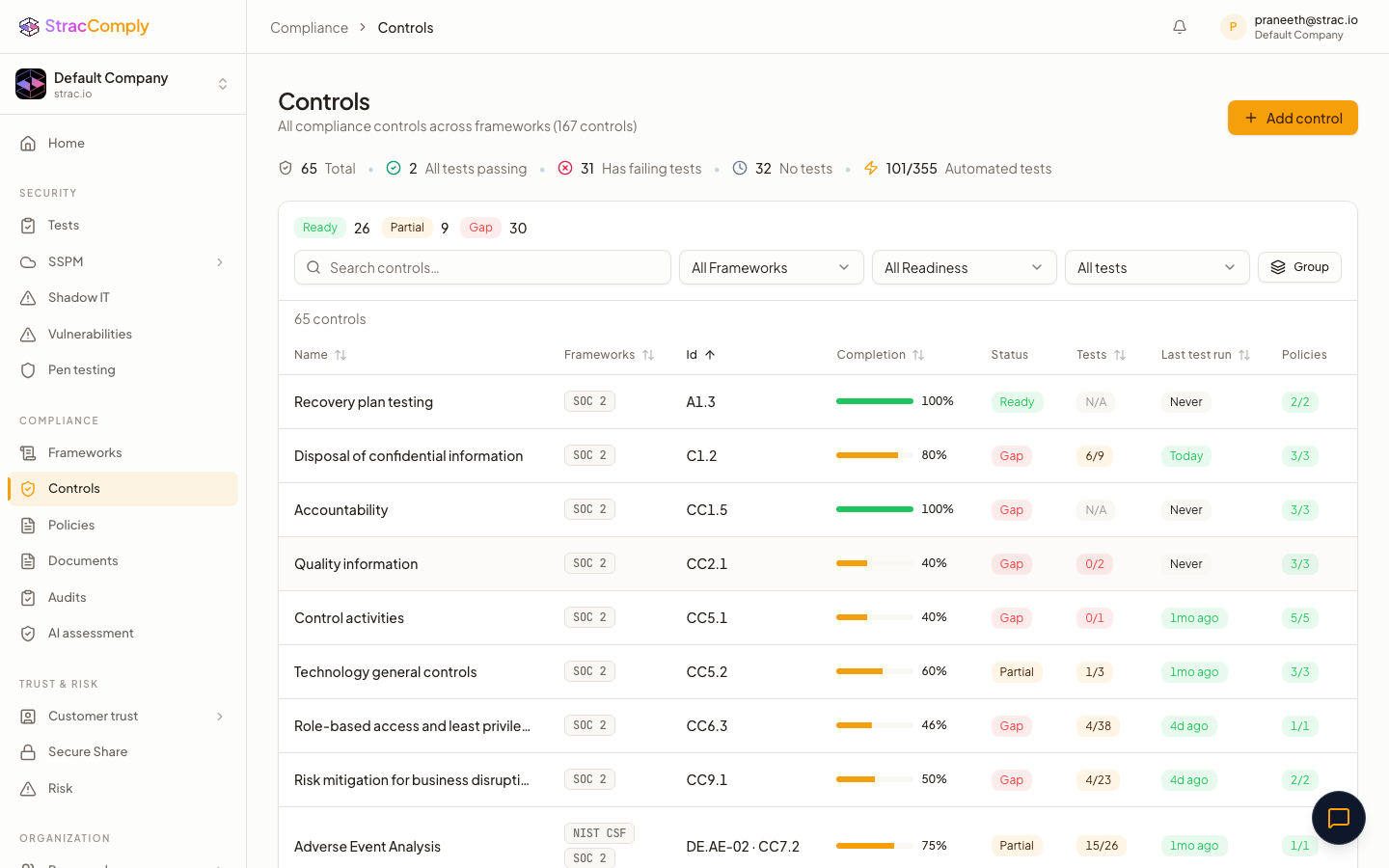
1. Define ISMS scope and build the Statement of Applicability. Strac Comply ships with the Annex A 2022 control library mapped (4 themes, 93 controls). The SoA builder lets you mark each control as included / justified-exclusion and ties each included control to the integrations and tests that produce its evidence.
2. Connect every SaaS app, cloud account, and endpoint where customer or sensitive data could flow. Under 10 minutes per integration, fully agentless: Slack, Google Workspace, M365, Zendesk, Salesforce, Jira, Notion, GitHub, Box, Dropbox, Intercom, HubSpot, AWS S3, Azure Blob, GCS, and more — 100+ integrations in total.
3. Run the risk assessment and treatment plan. Strac Comply's risk register links each risk to specific Annex A controls and treatment activities, with monthly review prompts that produce the operating-effectiveness evidence Clause 6 expects.
4. Continuous data discovery (A.5.13, A.8.12, A.8.16). Strac scans every message, file, ticket, and attachment — including inside PDFs, JPEGs, PNGs, DOCX, XLSX, ZIP archives, and even chat messages and emails — for PII, PHI, PCI, secrets, and any custom-defined sensitive data. Detection uses regex + validation logic, an OCR engine, and an ML classifier.
5. Real-time prevention at the entry point (A.8.12, A.8.23). Browser DLP blocks employees from pasting sensitive data into ChatGPT, Claude, Gemini, Copilot, Salesforce, Notion, Jira, custom apps. Email DLP catches sensitive data leaving via Gmail or M365. Slack DLP catches it in DMs and channels. Endpoint DLP catches it in copy/paste and file uploads.

6. Data masking and information deletion (A.8.10, A.8.11). When sensitive data is found in violation of policy, Strac can redact, mask, label, alert, delete, revoke OAuth access, remove public-link access, or remove external collaborators. Operating-effectiveness evidence is generated continuously, not annually.
7. Audit-ready evidence collection. Strac Comply maps continuous DLP findings, MFA enforcement, access reviews, training completions, vendor attestations, change-management records, and policy approvals against your full Annex A 2022 control library. The platform tracks 93 required documents (org chart, background checks, IR runbooks, BCDR plans, threat intelligence subscriptions) with each document tied to specific Annex A controls.


8. SSPM + third-party OAuth governance (A.5.19, A.5.20, A.5.23). Strac continuously discovers third-party SaaS apps and OAuth permissions connected to your Google Workspace and M365 — catching scope creep and risky third-party grants before your auditor does.
9. Vendor risk + security questionnaires (A.5.19–A.5.22). Send outbound questionnaires to your vendors. Receive and respond to inbound customer questionnaires (SIG, CAIQ, custom). AI-drafted answers from your evidence library cut response time by 70–80%.


10. Pen test orchestration (A.8.8 + A.8.29). Bundled or BYO pen test firm; findings flow directly into your control evidence and remediation tracking.
11. Internal audit cycles (Clause 9.2) + management review (Clause 9.3). Internal audit scheduling, evidence collection, finding tracking, and management review templates built in.
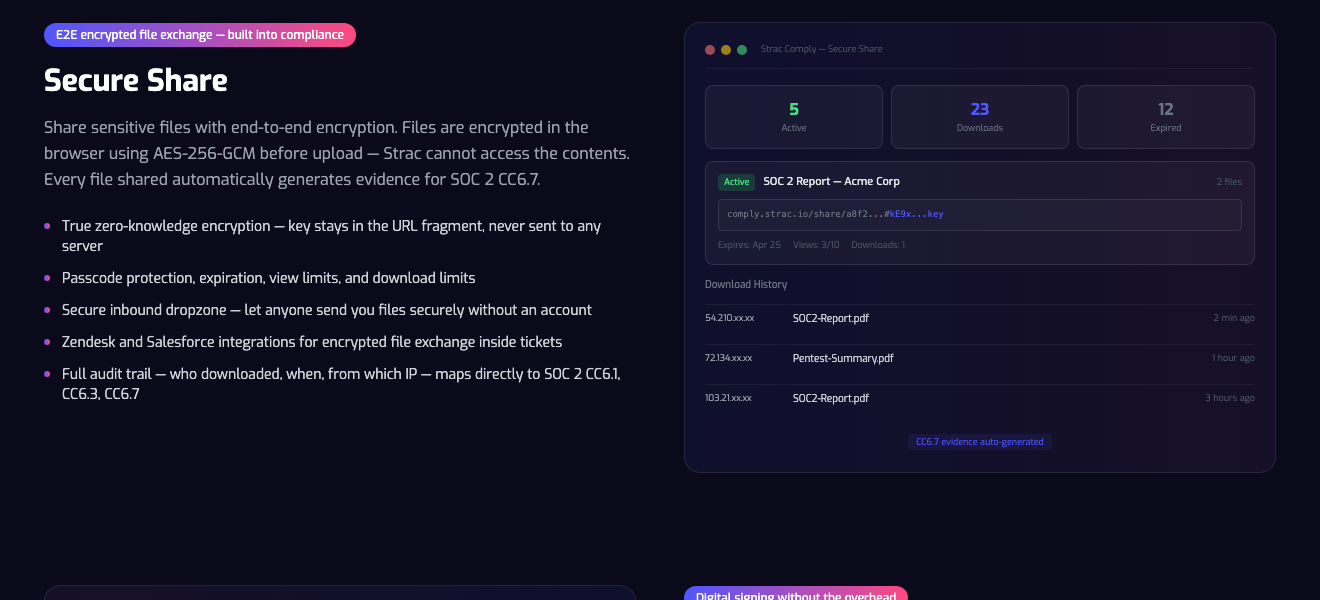
12. Trust portal + secure share. Public trust portal at comply.strac.io/trust-portal/{slug} for customer-facing certification posture. Secure share for sending ISO 27001 certificates and audit reports to customers and auditors with end-to-end encryption.
For a deep walkthrough on adjacent compliance use cases, see our companion posts on SOC 2 compliance software and PCI DSS compliance software.

An ISO 27001 ISMS lives or dies on upkeep — the Statement of Applicability, Annex A control evidence, internal audits, management reviews. Strac Comply runs that upkeep headless: your AI agent — Claude Code, Cursor, or Claude Desktop — connects straight to your ISMS and works it. Ask “which Annex A controls are still missing evidence?” and it reads your live SoA, controls, and test results, then answers from your real ISMS instead of a generic checklist. Tell it to draft an A.5 information-security policy or attach evidence to A.8.12 (data leakage prevention), and it writes into your binder while you stay in your editor.
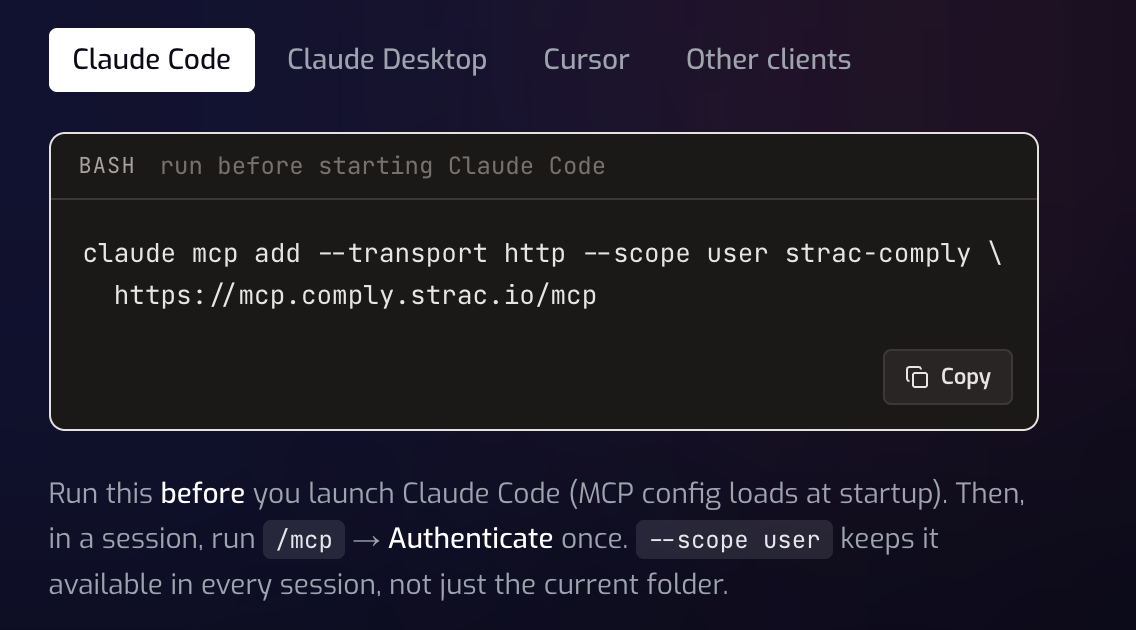
This isn’t a chatbot stapled to a GRC dashboard. It’s the Model Context Protocol (MCP) exposing your ISMS as real tools the agent can call. One line connects it:
claude mcp add --transport http --scope user strac-comply \
  https://mcp.comply.strac.io/mcp
Every change — a drafted policy, evidence attached to an Annex A control, a control marked Not Applicable in your SoA with a justification — lands in an append-only audit log stamped with the AI’s identity. Scopes are granular and revocable (OAuth 2.1), so the agent only touches what you grant. For ISO 27001, where an auditor traces every control decision back to a record, that attribution is the whole point.
Connect once and your agent carries the ISMS busywork — evidence collection, policy drafts, SoA upkeep, internal-audit prep — across ISO 27001, SOC 2, GDPR, and HIPAA from a single server. Explore the Strac Comply MCP server, the 27-tool reference, or how the same approach works for SOC 2 compliance software.
The companies that fail ISO 27001 surveillance audits are almost always the ones that did the work in the last 30 days before the audit. The ones that pass have been running continuous controls since Stage 2.
You have two real options for how to structure your ISO 27001 stack:
Option A — Buy a traditional GRC platform + bolt on separate security tools.
- A traditional GRC platform (Vanta, Drata, Secureframe, Sprinto, ISMS.online, Hyperproof, etc.) for the ISMS governance + evidence layer.
- A separate DLP / DSPM platform for A.8.10, A.8.11, A.8.12 operating effectiveness.
- A separate SSPM platform for A.5.19, A.5.20, A.5.23 third-party OAuth governance.
- A separate vendor-risk platform for inbound and outbound questionnaires.
- A separate secure-share tool for customer-facing certificate delivery.
- A vulnerability scanner for A.8.8.
- An endpoint EDR for A.8.7.
This works, and large enterprises run it. The cost is integration overhead — your team becomes the connective tissue between 6 platforms — and gaps in coverage when one tool's findings don't flow into another's evidence library.
Option B — Buy one platform that does ISMS + active data security.
This is what Strac Comply is built for. One platform that maps controls, collects evidence, scans your actual data, prevents real-time leaks, governs third-party OAuth access, runs vendor questionnaires, orchestrates pen tests, and lets you secure-share the resulting certificate. You still need a vulnerability scanner and an endpoint EDR — but the ISMS + data security + vendor + SSPM stack collapses to one tool.
Most fast-growing SaaS companies we work with choose Option B. A typical stack: Strac Comply + an EDR (CrowdStrike, SentinelOne, Microsoft Defender) + a vulnerability scanner (Qualys, Tenable, or Rapid7). Three tools, full ISO 27001:2022 coverage including the operating-effectiveness layer of A.8.10–A.8.12, one pane of glass for everything that requires active security work.
The choice that fails most often is choosing only a traditional GRC platform and assuming that "automated ISO 27001 compliance" includes the operating-effectiveness of A.8.12. It doesn't — and that's the gap your auditor will close for you, painfully, during your Stage 2 audit.
Strac Comply maps live evidence straight onto the 93 Annex A controls, with continuous DLP-grade monitoring across every SaaS, cloud, endpoint, and AI surface in your ISMS. The same Strac platform that protects your data is the platform that proves your certification — no screenshot collection, no spreadsheet trackers.
Building your ISMS? These go deeper:
See how AI closes the last-mile evidence across frameworks in AI-native compliance automation software.
With Strac Comply, yes. Via its MCP server, an agent like Claude Code reads your Statement of Applicability, Annex A controls, and test results, then writes policy drafts and evidence back into the ISMS. Every write is scoped, revocable, and recorded in an append-only audit log attributed to the AI — exactly the traceability an ISO 27001 auditor expects from a managed ISMS. Where most GRC tools can only describe your posture, Strac lets the agent maintain it under your control. See the tool reference.
ISO 27001 is an international certification standard issued by ISO; the audit is conducted by accredited certification bodies. SOC 2 is a US-originated attestation issued by AICPA-licensed CPA firms. ISO 27001 is more globally recognized; SOC 2 is more common in US B2B SaaS. Many companies pursue both — the underlying controls overlap heavily.
The 2022 version reorganized Annex A from 14 categories with 114 controls to 4 themes with 93 controls. Eleven new controls were added (most notably A.8.12 Data Leakage Prevention). The 3-year transition window ended October 2025; every audit since then is on the 2022 version.
Technically yes; practically no. The continuous evidence collection requirements (logs of MFA, access reviews, vendor reviews, training, change management, internal audit cycles, management review minutes — all timestamped and retrievable on demand) are what software does in seconds and what spreadsheets break under within a quarter.
ISO 27001 compliance software (GRC + ISMS) generates and collects evidence to satisfy your certification body. DLP scans your actual data to find and protect sensitive information — directly satisfying A.8.12 Data Leakage Prevention. You typically need both. Strac Comply is the only platform that bundles both.
Strac Comply is the only compliance automation platform that bundles all of these into one product:
Most traditional ISO 27001 vendors are evidence-collection only — and require you to stitch in separate DLP, DSPM, SSPM, vendor-risk, and secure-share tools.
With modern compliance software (continuous evidence collection): 6–9 months from cold to certificate for a mid-market SaaS. Without software, the calendar is similar but the team-time required is 3–5x — most companies that try it without software fail Stage 1 on documentation gaps.
Direct: the cost of corrective actions plus a re-audit (typically $25K–$80K all-in). Indirect: lost EU and global enterprise deals (most procurement teams in Europe require ISO 27001), and brand damage in security-sensitive markets.
ISO 27001 is the core ISMS standard. ISO 27017 adds cloud-specific controls (recommended for cloud SaaS). ISO 27018 adds cloud-PII protection (recommended for cloud SaaS handling personal data). Many cloud SaaS pursue all three — the surveillance audits combine.
Yes — with the right software stack and either bundled audit services (Thoropass) or a fractional vCISO. The combination of ISMS automation (ISMS.online / Vanta / Drata / Strac Comply) + automated DLP (Strac) + a focused certification body can take a 30-person company through ISO 27001 certification in 6–9 months without a full-time security engineer.
No. "ISO 27001 ready" means a vendor or tool has been pre-configured to support ISO 27001 controls. "ISO 27001 certified" means an accredited certification body has audited your environment and issued a certificate. Vendors saying "we make you ISO 27001 certified" are sloppy with the term — what they mean is they make you certification-ready.
Most modern ISO 27001 platforms support cross-framework mapping. A control that satisfies ISO 27001 A.9.2 (User access provisioning) often satisfies SOC 2 CC6.1, NIST CSF 2.0 PR.AC-1, and PCI DSS Req 7.1 simultaneously. Strac Comply, Vanta, Drata, and OneTrust GRC all support shared-evidence cross-framework workflows.
A.8 (Technological controls) grew from a fragmented set across multiple A.x.y categories to a single, comprehensive theme with 34 controls. Eight new controls were added (A.8.9 configuration management, A.8.10 information deletion, A.8.11 data masking, A.8.12 DLP, A.8.16 monitoring activities, A.8.23 web filtering, A.8.28 secure coding, plus new placement of A.8.29 security testing). All eight are areas where the pre-2022 standard had gaps and where modern software earns its keep.
Six things, none of which the traditional GRC-only or ISMS-only vendors do:
Certificates are valid for 3 years with annual surveillance audits. The work between audits is continuous — internal audit cycles, management review meetings, evidence refresh. Compliance software is most valuable here: the platform that ran your continuous controls for the past 12 months becomes the platform that produces the surveillance evidence in days, not weeks.
Ready to see what sensitive data is hiding in your SaaS apps — and how Strac Comply collapses your ISO 27001:2022 + DLP + SSPM + vendor risk + secure share stack into one platform?
Most companies find sensitive data in 5–12 places they didn't know about within the first 10 minutes of connecting Strac. → Book a 30-minute demo or explore Strac's ISO 27001 solution.
.avif)


.gif)


.webp)