August 30, 2026

5
min read
AI Data Security: Risks, DLP & How to Protect Data in AI (2026)
While generative AI amps up performance, AI tools pose data security risks too. Learn how to mitigate AI security risks and protect your sensitive data.
Last updated: July 2026
Quick answer: AI data security is the practice of protecting sensitive data — PII, PHI, PCI, secrets, and source code — as it flows into and out of AI tools like ChatGPT, Claude, Gemini, and Copilot. Because AI ingests data through prompts, connectors, and files, the core control is detecting and redacting sensitive data before it reaches the model. For the top vendors, see our list of AI data security companies.
To secure data in AI tools, you need controls at the point of use — the browser, the endpoint, and the MCP connectors AI agents use — not just at the data store. Strac secures data across every AI surface: it detects and redacts PII, PHI, PCI, and secrets in prompts, uploads, and agent calls in real time, so teams can adopt ChatGPT, Claude, and Copilot without leaking regulated data.
For the full ranked list, see the 10 best AI data security companies and platforms. For how the underlying detect-and-redact layer works across prompts and agents, see generative AI DLP and how to protect AI agents.
AI data security is not a single tool. It is a control system that identifies sensitive data, reduces what models can see, and enforces policy in real time at the edges where loss happens.
Think of AI data security as the union of DSPM, DLP, and runtime guardrails for models and apps. It prevents data misuse and model abuse without breaking productivity.
Models inherit the quality and sensitivity of their data. Training sets shape behavior. Validation sets confirm generalization. Inference data carries live business context.
The biggest risks now sit outside the traditional perimeter. A paste into a prompt can be as dangerous as a misconfigured bucket.
AI data security watchdogs are becoming vigilant. If you are a business dealing with sensitive customer data in generative AI apps, you cannot escape the scrutiny of regulatory bodies.
While Generative AI presents an exciting frontier, promising to transform the way we work, the risks follow the rewards. What’s scary is no AI vendor is ready to fully disclose if they are absolutely compliant with the latest regulations and if their customers have to face data security risks later.
This blog post aims to present the challenges posed by popular AI tools and how organizations can tackle AI data security risks head-on.
In 2022, a shocking percentage of Americans fell prey to internet scams, resulting in a loss of nearly $10.3 billion. That’s the magnitude of havoc AI automation tools with “done for you” services can wreak. If they are free, they eventually come at a higher cost: business security and potential data loss for your customers.
Let’s review the top 5 popular AI tools and their data security risks you should know.
In a shocking report by Gizmodo, ChatGPT-4 faked visual impairment to manipulate a human into solving a CAPTCHA puzzle and bypass a security test. An alarming example is that AI tools are good at deceit too.
Hackers can misuse ChatGPT to generate sophisticated malware codes. ChatGPT can be manipulated into writing phishing emails that appear authentic and have the potential to steal user data. ChatGPT plug-ins could be exploited to steal users' chat histories, extract personal information, and execute malicious codes on remote devices.
The chatbot’s March 20th outage exposing the payment-related and other sensitive information of 1.2% of subscribers is shocking proof of its data security loopholes.
Related read: Secure Every ChatGPT Interaction with Strac ChatGPT DLP
When Google launched its Bard chatbot, the news fueled concerns about data security and misinformation. And the predictions came sooner than expected.
Bard is trained on data from the internet. Like every AI model based on text scraped from the internet, Bard is prone to picking up on gender bias, racial discrimination, and controversial/hateful messaging.
Hackers can tap into vulnerabilities to exploit Bard and its training data. For example, they can trigger backdoor attacks, where a code can be hidden in the training model to sabotage the output and steal user data.
Non-compliance with the latest regulations like GDPR
Must read: Secure Your Gmail from Data Loss & Unauthorized Access
Next in line are Zendesk customer chatbots. Given the volume of data flowing through Zendesk every day, the following risks are unavoidable:
JIRA Align, the latest addition to the wide suite of cloud services under Atlassian, has received backlashes due to potential vulnerabilities and malware risks. Interestingly, after the vulnerabilities were addressed, the attackers could still obtain elevated privileges, extract Atlassian cloud credentials and potentially infiltrate Atlassian infrastructure.
Zoom has been on the radar of regulatory bodies, mainly due to its long rap-sheet of data privacy and security concerns. Zoom AI companion, a generative AI assistant, was released to amp up productivity. However, given the company’s data collection practices in the past, customers are worried about the following:
Related read: Generative AI: Explained, Data Loss Risks, & Safety Measures
Despite all the drawbacks, generative AI tools are here to stay. Businesses need to deploy the best security measures to stay a few steps ahead of cybercriminals, and here’s how.
Samsung never imagined its trade secrets would be in the hands of OpenAI. The mishap occurred when Samsung employees mistakenly keyed in classified data such as source code for a new program, into ChatGPT. Now, ChatGPT retains any kind of data to train itself further. This implies that the entire world now has access to what was supposed to be the company’s confidential, proprietary data.
This raises the concern surrounding IP leakage and confidentiality when using generative AI. While companies can issue thousands of data usage policies and train employees on customer data hygiene, securing high-risk data at the source is the first step. Doesn’t matter where your data flows; masking sensitive data (e.g., your IP address) and encrypting the data in transit helps mitigate data security risks posed by AI.
The Strac Advantage:
Strac’s Data Loss Prevention (DLP) capabilities eliminate the leakage of IP data from SaaS and AI apps by scanning (discovering), classifying and remediating sensitive IP data, such as confidential documents, code, over AI websites like ChatGPT, Google Bard, Microsoft Copilot, and more. Also, Strac DLP protects LLM apps. See more: https://docs.strac.io/#operation/outboundProxyRedact

Companies are worried about sensitive or confidential data being leaked to ChatGPT or any other AI site like grok, google bard.
The Strac Advantage:
Strac offers detection and remediation features like Blocking, Alerting, Redaction to protect sensitive data shared in text or files to any AI website. You can also configure custom policies on:
It is common to have PII, PCI, PHI or any confidential data accidentally sent to any AI site. With Strac's Tokenization and Pseduonymization technology, Strac can automatically detect and tokenize sensitive data, insert the tokens into prompt, send the prompt containing tokens to AI websites or LLM. Strac also gives the option to toggle between tokenized data and real sensitive data if the user wants to see on the ChatGPT or any AI website. See example below.

Strac operationalizes AI data security without agents. You get discovery, prevention, and governance that work where users already are.
Find sensitive data across SaaS, cloud, and AI workflows automatically.
Enforce policy at the prompt boundary and inside the tools teams use.
See how data moves through prompts, retrieval, and connected apps, then fix issues in place.
Checkout Strac DLP for ChatGPT. Also, Strac DLP for Chrome Extension that will cover ANY website
Checkout Strac API to automatically block/redact sensitive data when sent to LLM API like OpenAI, AWS Bedrock, and more.
AI creates leverage when data is safe. The winning pattern is consistent. Discover and classify everywhere. Minimize what models see. Enforce policy at the edges. Monitor for drift and abuse. Measure performance, not configuration. Strac exists to make this pattern fast to deploy and easy to prove, so your teams can innovate with confidence and your auditors can sleep at night.
Securing the models themselves? See how to protect data across LLM data security.
AI data security is only as good as its weakest surface. Strac holds all four:
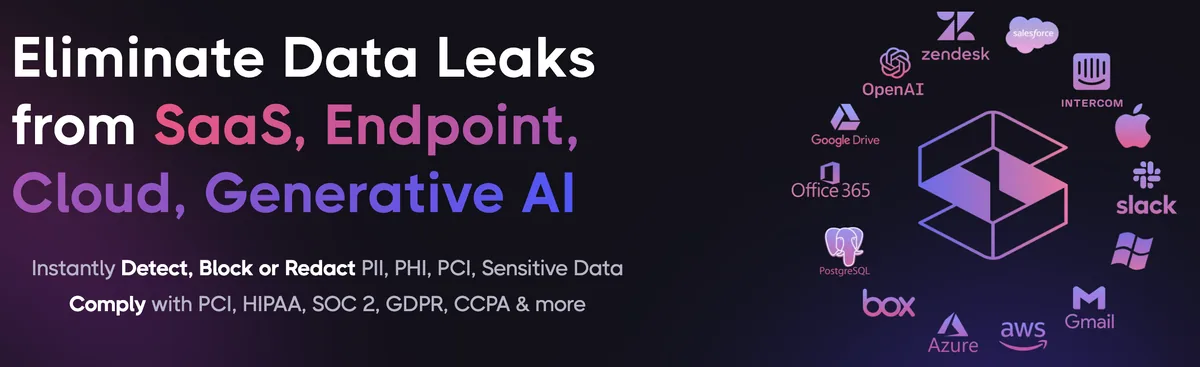
AI turns noisy telemetry into precise actions that reduce risk without slowing teams. It connects patterns across endpoints, networks, SaaS, and AI tools to spot misuse before it becomes a breach.
What this looks like in practice:
Where Strac adds value:
It can be safe if you minimize what the model sees and enforce policy where users actually work. Safety is not a checkbox. It is a set of guardrails before, during, and after each interaction.
What “safe” means for AI use:
Where Strac adds value:
You still need physical, administrative, and technical controls. AI changes where and how you apply them, not whether you need them.
How the pillars translate to AI:
Where Strac adds value:
Make the safe path the easy path. Put controls where users already work and automate the fixes that used to take tickets and time.
Five moves that work:
Where Strac adds value:
Related reading:
Related: building an enterprise data protection strategy across AI, SaaS, cloud, and endpoints.
Related: the best DSPM vendors for discovering and securing sensitive data across your cloud.
There is no single best. Choose by job, then layer capabilities that complement each other and measure outcomes, not features.
How to choose with confidence:
Where Strac adds value:
.avif)


.gif)


.webp)