A practical AI compliance checklist for 2026 — inventory AI, classify data, control agent access, redact sensitive data, monitor, and map to ISO 42001, NIST AI RMF, and the EU AI Act. Plus how Strac automates the data-protection controls.
AI compliance means proving your AI use is governed: you know what AI is running, what data it touches, who can access it, and that sensitive data is protected — mapped to ISO 42001, NIST AI RMF, and the EU AI Act.
The hardest items are the data ones — discovering shadow AI, controlling agent access, and remediating sensitive data before it reaches a model. Policies are easy; evidence is hard.
This 12-step checklist covers inventory, data, access, remediation, monitoring, vendors, and audit — and where Strac automates the data-protection controls.
✨ Why You Need an AI Compliance Checklist
AI moved faster than governance. Employees adopted ChatGPT, Claude, and Copilot; engineers wired agents to data via MCP; and the controls auditors and customers now ask about — ISO 42001, NIST AI RMF, the EU AI Act — didn't exist when most security programs were built. A checklist turns "we should govern AI" into concrete, evidenced steps.
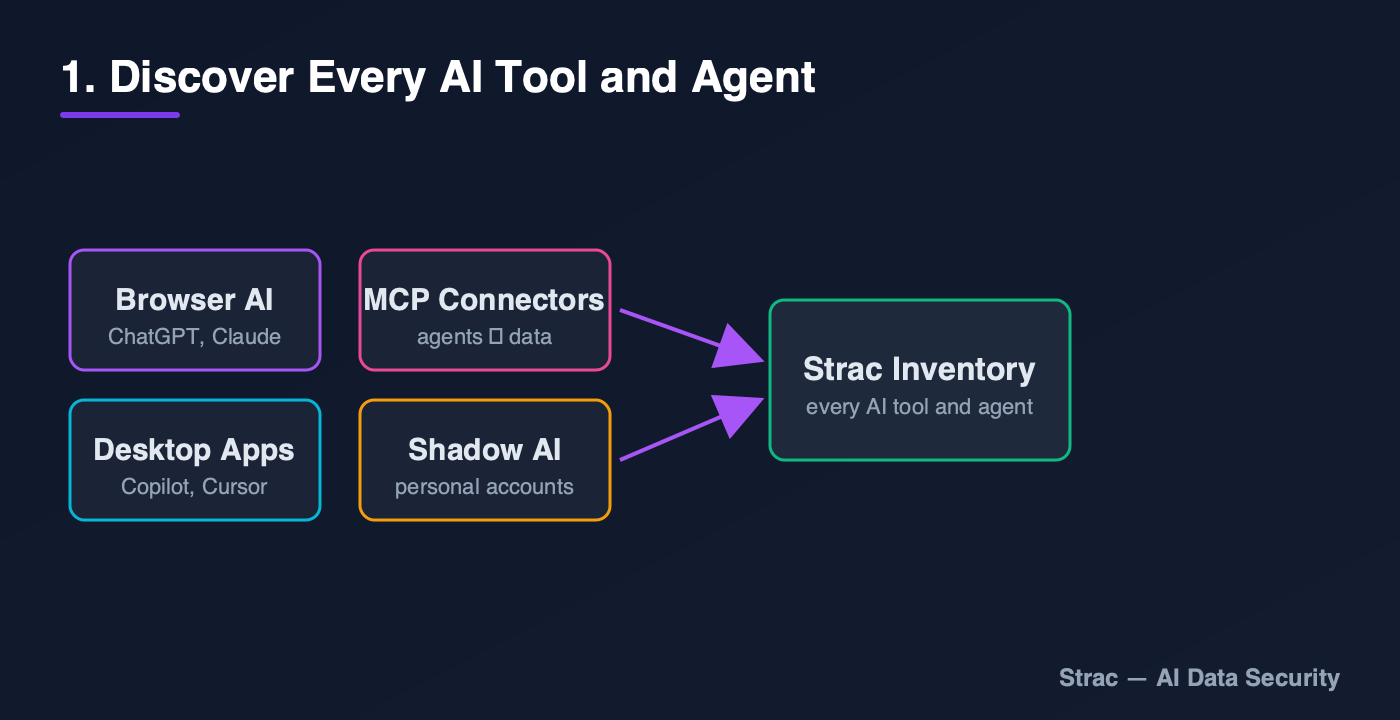
You cannot govern AI you cannot see. Inventory every AI tool and agent — browser AI, desktop apps, and MCP connectors — including shadow AI running on personal accounts. See discover AI agents.
Strac surfaces every AI tool, agent, and MCP connector — including shadow AI on personal accounts.
✨ 2. Map the Data Each AI Can Reach
For every agent, map which SaaS apps, cloud stores, and databases it connects to — and what sensitive data flows through those connections. This is the access graph the rest of the checklist depends on.
Map each AI's reach across SaaS, cloud, and databases — and the sensitive data that flows through.
✨ 3. Classify Data Sensitivity
Label what each source holds: PII, PHI, PCI, secrets, source code, and regulated records. Classification is what turns "an agent can read this bucket" into "an agent can read 4,000 SSNs."
Strac classifies PII, PHI, PCI, secrets, and source code across every AI-reachable source.
4. Scope AI Agent Access
Apply least privilege per agent and per tool — no blanket access. An agent that only needs read access to one project should not hold write access to your whole warehouse.
5. Enforce Allow / Block and Approvals
Block high-risk actions — writes, deletes, bulk exports — or route them for human sign-off. Enforcement at the tool-call layer is what separates governance from a policy PDF.
✨ 6. Govern Third-Party AI Vendors
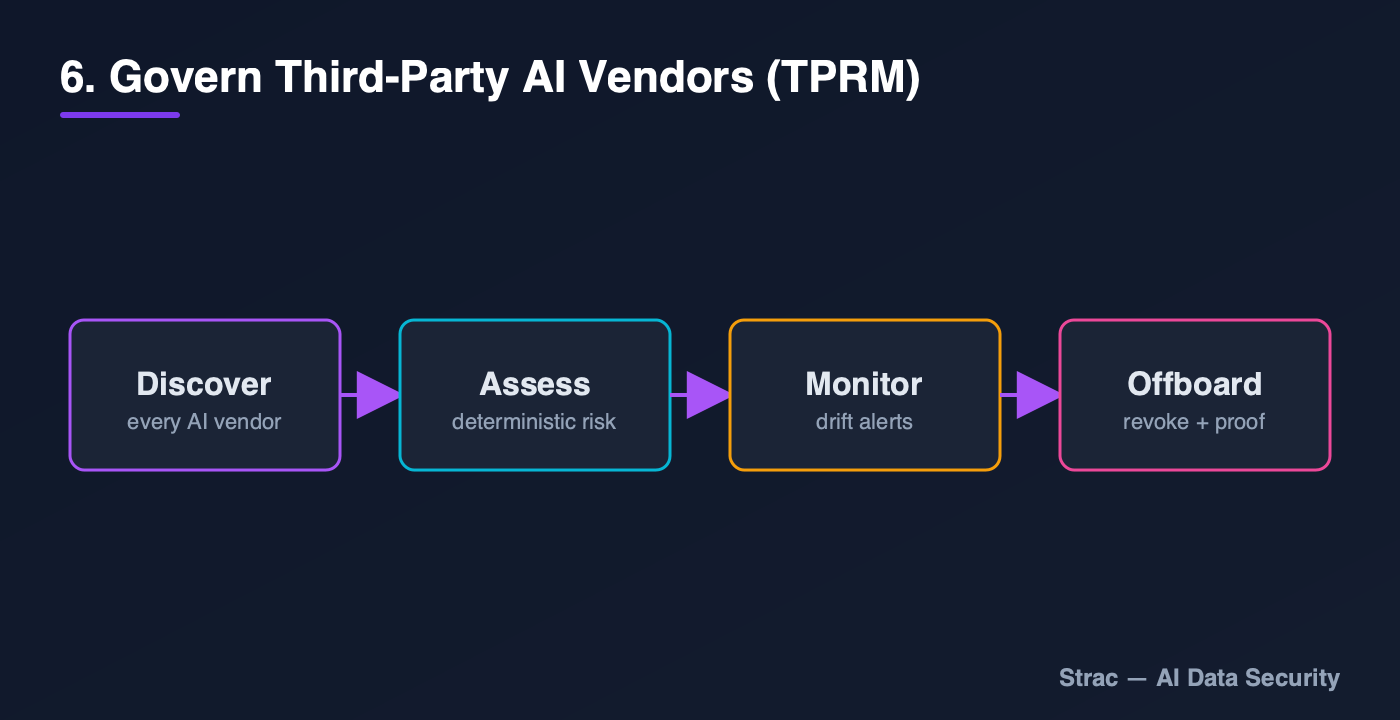
Assess and continuously monitor the AI vendors and sub-processors your team adopts as part of AI TPRM — discover, assess, monitor, and offboard each one with evidence, not a one-time questionnaire.
AI-era TPRM: discover every AI vendor, score deterministic risk, monitor drift, and offboard with proof.
✨ 7. Remediate Sensitive Data In-Flight
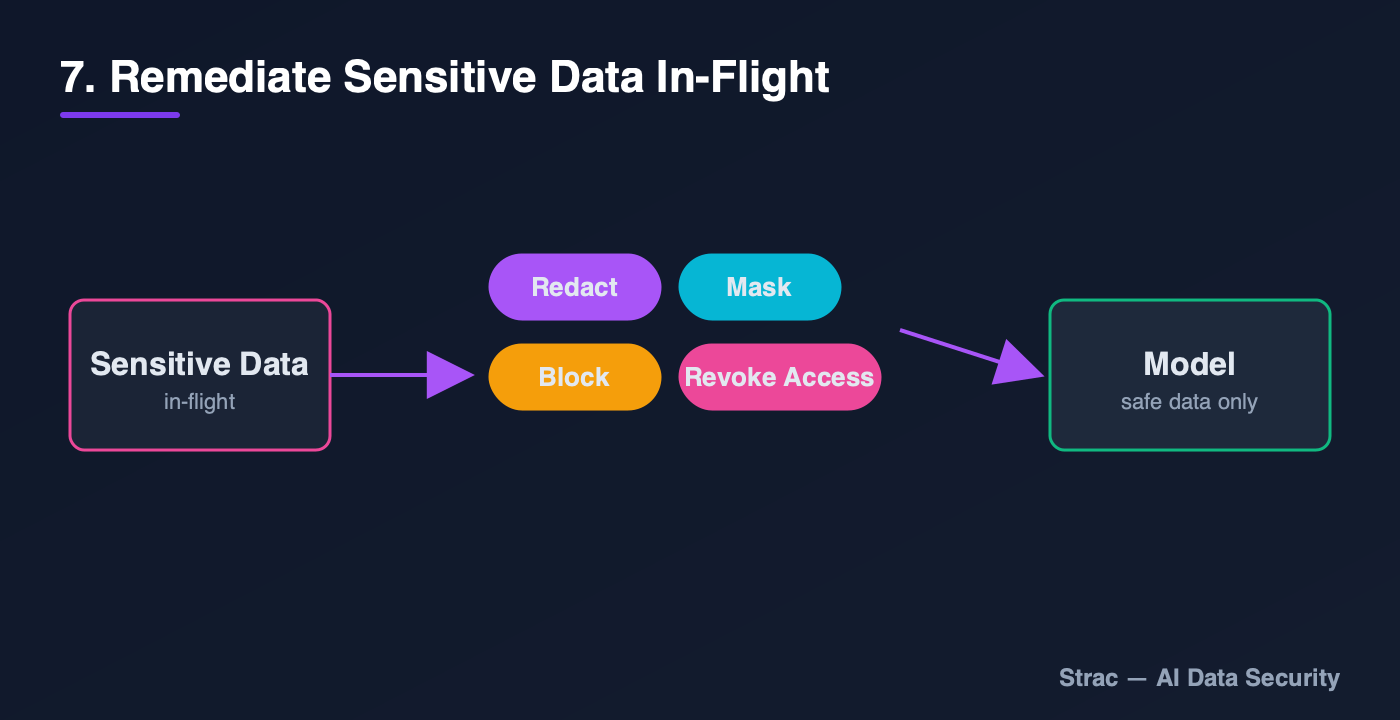
Redact, mask, block, or revoke access to sensitive data before it ever reaches a model — in the browser, on endpoints, and at the MCP layer. This is the control that actually prevents exposure.
Redact, mask, block, or revoke access in-flight — so only safe data reaches the model.
8. Cover Every Surface (Browser to MCP)
Govern AI across browser, endpoint, SaaS, and cloud — not just one surface. Data leaks through whichever path you left uncovered, so coverage has to be end to end.
9. Monitor AI Activity Continuously
Log every AI interaction — who, which agent, which tool, what data, what action — and stream it to your SIEM (Splunk, Sentinel, or Datadog) for real-time monitoring and alerting.
10. Prove It: Evidence and Audit Trail
Turn those logs into auditor-ready evidence. This is the step most programs fail — see how Strac Comply automates it in the section below.
11. Map Controls to SOC 2 / ISO 42001
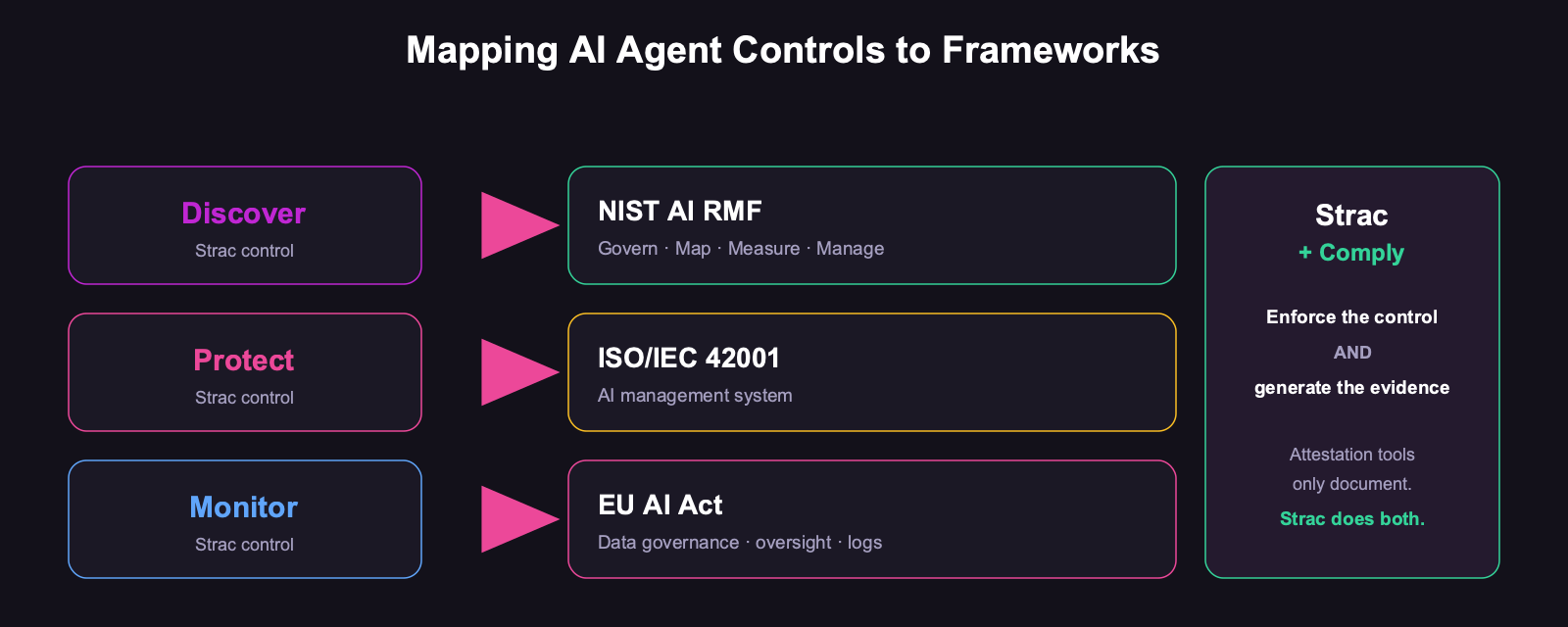
Map each control to the frameworks auditors and customers expect: ISO 42001, NIST AI RMF, and the EU AI Act, alongside SOC 2, HIPAA, PCI, and GDPR — collect once, reuse across all of them.
12. Operationalize the AI Checklist
Maintain living AI policies — acceptable-use, model governance, and data-handling — and review them on a schedule. A checklist worked once is a snapshot; operationalized, it is a control.
✨ How Strac Automates the Hard (Data) Steps
Steps 1-3, 7-10 are where teams stall — they require actually seeing and protecting data, not writing a policy. Strac's AI data governance platform does this across every surface: it discovers shadow AI and agents, controls and blocks access, remediates sensitive data inline, and logs every action as audit evidence.
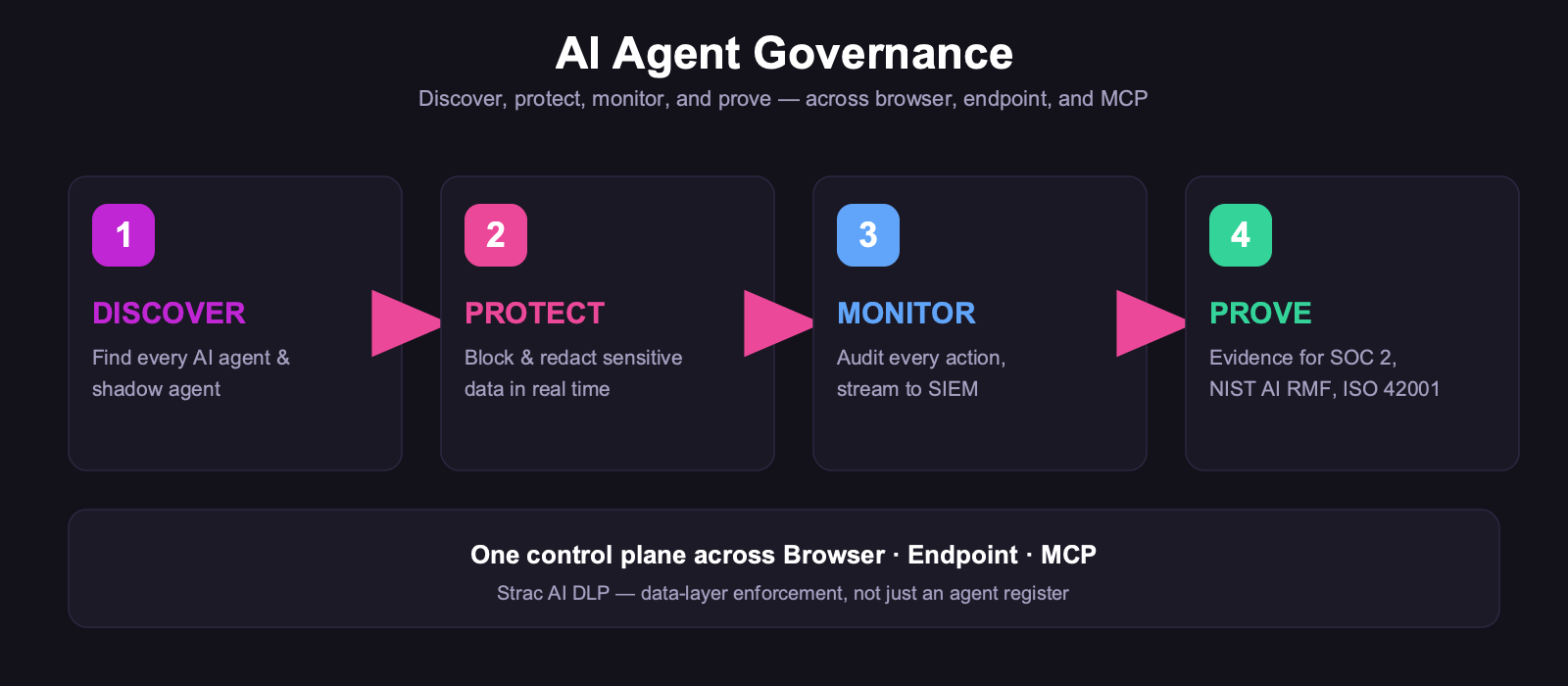
See → Control → Protect → Prove across browser, endpoint, SaaS, and MCP — see AI agent governance.
Turning the Checklist Into a Running System with Strac Comply
A checklist tells you what to prove; it does not collect the proof. Strac Comply operationalizes the AI-governance items above into continuous controls. The first problem on any AI checklist — knowing which AI tools your organization actually uses — is solved by shadow-AI discovery: Comply reads the third-party authorizations in your Google Workspace, so every ChatGPT, Claude, Perplexity, or Copilot a user connected shows up automatically, deduped against your managed register.
From there, the TPRM module scores each AI vendor with a deterministic risk engine weighted by the data it can reach, and Strac's underlying DLP stops sensitive data from flowing into those tools in the first place — the data-security control your ISO 42001 and AI-governance evidence depends on. The AI Evidence Agent then captures the manual proof, and cross-framework dedup maps each AI control back to SOC 2, ISO 27001, and GDPR so you are not re-collecting the same evidence per framework.
Inventory of AI tools and agents, the data they can reach, data classification, agent access controls, in-flight data remediation, monitoring and logging, AI vendor risk, framework mapping (ISO 42001, NIST AI RMF, EU AI Act), and AI policies.
What frameworks govern AI compliance?
The core ones are ISO 42001 (AI management system), NIST AI RMF (risk management), and the EU AI Act (regulation), alongside data-protection frameworks SOC 2, HIPAA, PCI, and GDPR.
What's the hardest part of AI compliance?
The data controls — discovering shadow AI, knowing what data agents touch, and remediating sensitive data before it reaches a model. Policies are easy to write; evidence is hard to produce, which is what Strac automates.
How do I start an AI compliance program?
Start with discovery (step 1): you can't govern AI you can't see. Inventory every AI tool and agent and the data they reach, then layer on control, protection, and proof.
Automate the proof. Strac Comply's AI Evidence Agent captures evidence from any app you can log into, and its headless compliance MCP server lets your AI agent write that evidence into your binder — turning steps 9-11 from a screenshot marathon into an automated loop. See Strac Comply.
The Bottom Line
AI compliance isn't a policy document — it's evidence that AI is governed end to end. Work this checklist, and lean on Strac for the data-protection steps that are hardest to prove: discover, control, remediate, and audit AI's access to your data.
Inventory of AI tools and agents, the data they can reach, data classification, agent access controls, in-flight data remediation, monitoring and logging, AI vendor risk, framework mapping (ISO 42001, NIST AI RMF, EU AI Act), and AI policies.
What frameworks govern AI compliance?
The core ones are ISO 42001 (AI management system), NIST AI RMF (risk management), and the EU AI Act (regulation), alongside data-protection frameworks SOC 2, HIPAA, PCI, and GDPR.
What's the hardest part of AI compliance?
The data controls — discovering shadow AI, knowing what data agents touch, and remediating sensitive data before it reaches a model. Policies are easy to write; evidence is hard to produce, which is what Strac automates.
How do I start an AI compliance program?
Start with discovery (step 1): you can't govern AI you can't see. Inventory every AI tool and agent and the data they reach, then layer on control, protection, and proof.
Discover & Protect Data on SaaS, AI, MCP, Endpoints & Cloud
Strac provides end-to-end data loss prevention for all SaaS and Cloud apps. Integrate in under 10 minutes and experience the benefits of live DLP scanning, live redaction, and a fortified SaaS environment.


.webp)









.avif)



.gif)
