Is DeepSeek Safe? Security, Privacy & Enterprise Risk (2026)
Is DeepSeek safe to use? Here are the documented security incidents, the data-to-China privacy concerns, the government bans — and how to discover, block, or redact DeepSeek use across browser, endpoint, SaaS, and MCP with Strac.
DeepSeek carries materially higher data-security risk than ChatGPT or Claude — it has a documented public database exposure, undisclosed data transfers to China, and bans across multiple governments. For corporate or regulated data, the honest answer is no, not without strict controls.
But your employees may already be using it — it's free, fast, and popular. The enterprise problem isn't "should we adopt DeepSeek," it's "how do we control the shadow DeepSeek usage already happening."
Strac handles both ends: it discovers who is using DeepSeek, and it either blocks it outright or redacts sensitive data before any prompt reaches it — in the browser, on endpoints, across your SaaS, and at the MCP/API layer.
Deployment is agentless and takes under 10 minutes.
Is DeepSeek Safe? The Short Answer
For casual, non-sensitive personal use, it's a capable model. For corporate, customer, or regulated data, it is not safe by default — and it is riskier than its Western counterparts. DeepSeek has a real, documented track record of security and privacy problems (below), its data is stored in China under PRC jurisdiction, and numerous governments have banned it on official devices.
If employees are pasting company data into DeepSeek, treat it as data leaving your control to a high-risk destination. The practical path isn't to pretend it won't happen — it's to see it, and control it. The same data-control logic applies to ChatGPT and Claude, but DeepSeek raises the stakes.
This isn't speculation — these are reported events:
A publicly exposed database (Wiz, Jan 2025). Security firm Wiz found two DeepSeek ClickHouse databases left open with no authentication, exposing over a million log entries — including plaintext chat history, API keys, and backend secrets. (SiliconANGLE coverage of the Wiz finding)
Undisclosed data transfer to China. Researchers at Feroot Security reported hidden code in DeepSeek's apps transmitting user data to China Mobile, a state-controlled telecom, undisclosed to users. (BankInfoSecurity)
Data stored in China. DeepSeek's own policy stores user prompts and personal data on servers in the PRC, under Chinese data-access law.
Government and agency bans. Italy pulled it from app stores over GDPR concerns; Australia and Taiwan banned it on government systems; the US Navy and NASA prohibited it. (Cybersecurity Dive)
For any organization handling PII, PHI, payment data, or IP, that's a profile that warrants blocking — or, at minimum, hard controls.
Why DeepSeek's Risk Is Different
ChatGPT and Claude secure their own infrastructure, sign DPAs/BAAs, and offer enterprise no-training guarantees. DeepSeek's concerns are more structural: data residency in China, state-linked data transfers, a demonstrated exposure incident, and far weaker enterprise governance tooling. The risk isn't only "an employee pastes something" — it's where that data goes and who can reach it once it's there.
That's why, with DeepSeek, discovery and blocking matter even more than redaction. You first need to know it's being used at all.
✨ Discover Shadow DeepSeek Use — Strac Discovery
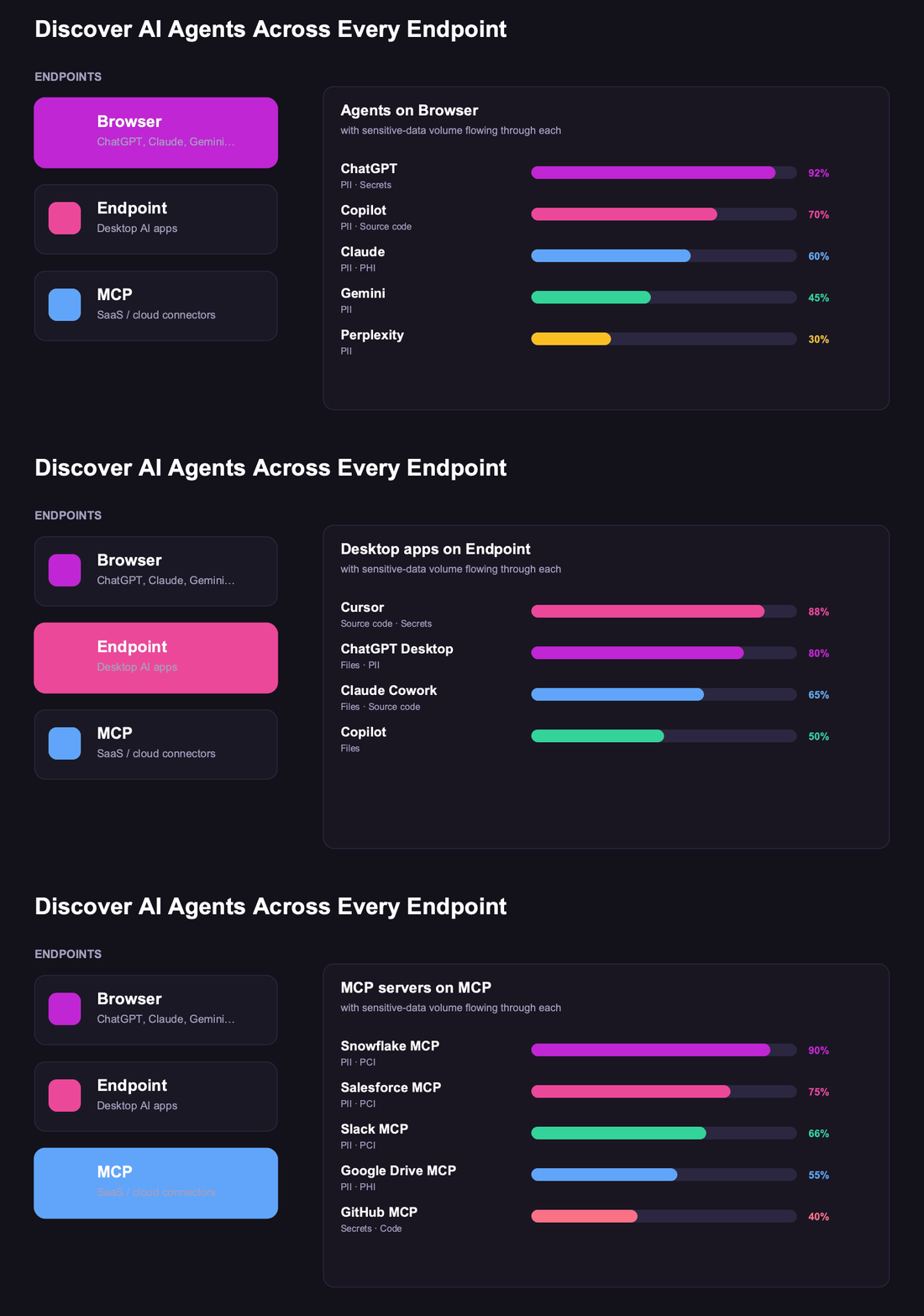
You can't control what you can't see. Strac discovers unmanaged AI usage — including personal DeepSeek accounts on unmanaged browsers and devices — across the browser, endpoints, OAuth grants, and SaaS logs, and quantifies the sensitive data flowing through each.
Strac surfaces shadow DeepSeek and other AI usage across every surface — the first step to controlling it. See [discover AI agents](https://www.strac.io/blog/discover-ai-agents) and [shadow AI](https://www.strac.io/blog/shadow-ai).
✨ Block or Redact DeepSeek in the Browser — Strac Browser DLP
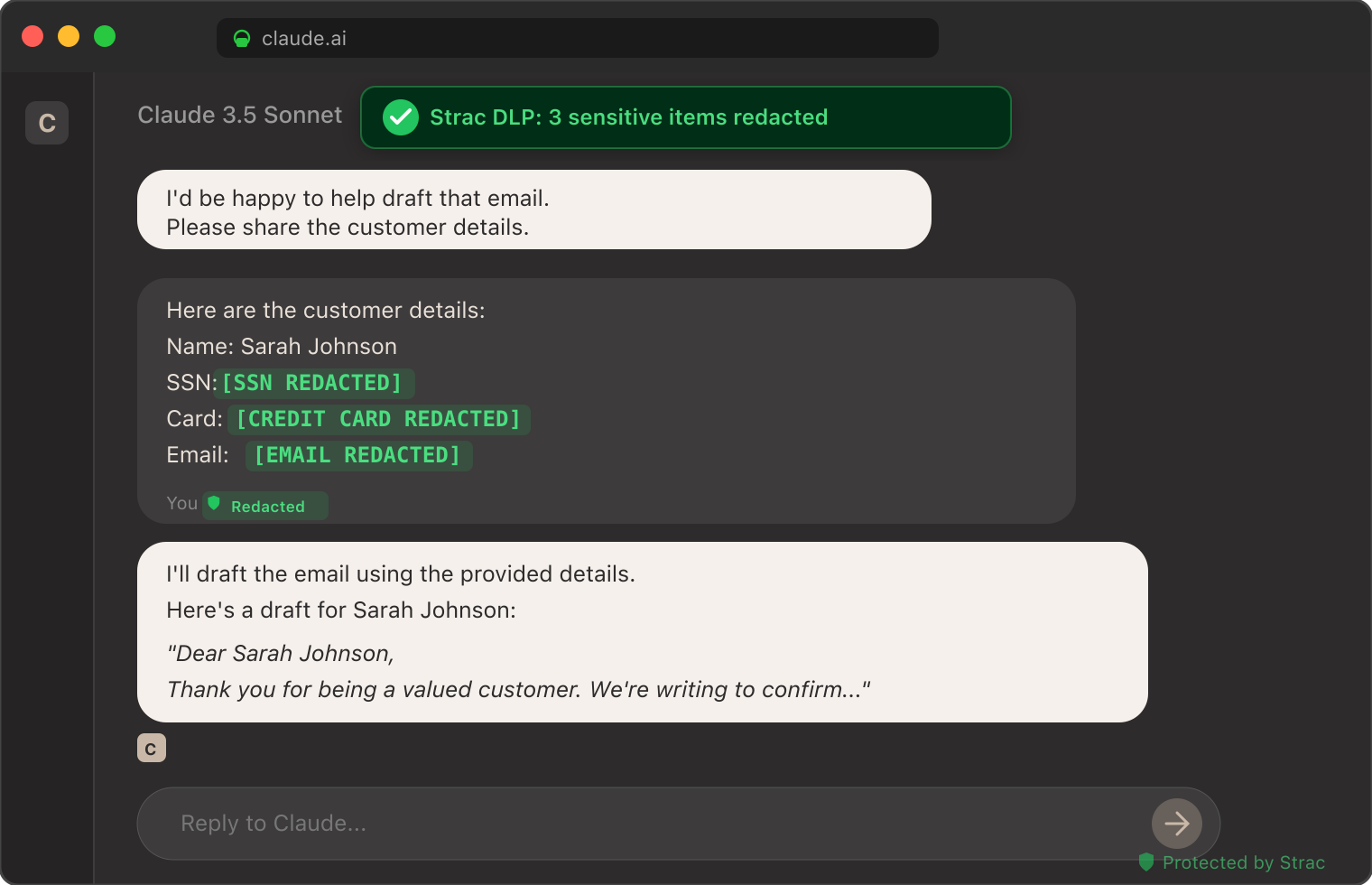
Once you can see it, you decide the policy. Strac's browser DLP can block DeepSeek entirely for your organization, or — if you choose to allow it — redact every sensitive element before the prompt is ever sent: SSNs, card numbers, PHI, API keys, and source code, in real time.
Strac inspects every prompt in the browser — block the AI tool outright, or redact secrets and PII so the model never sees them. More in [GenAI DLP](https://www.strac.io/blog/ai-dlp).
✨ Redact Sensitive Data Before DeepSeek Sees It
If DeepSeek is allowed for some teams, Strac's content-level detection redacts PII, PHI, PCI (Luhn-checked cards), 48+ secret patterns, and source code — including text inside images via OCR — before anything is submitted.
Sensitive elements tokenized inline before the model sees them — the same inspection Strac runs on every GenAI tool.
✨ Endpoint & Monitoring
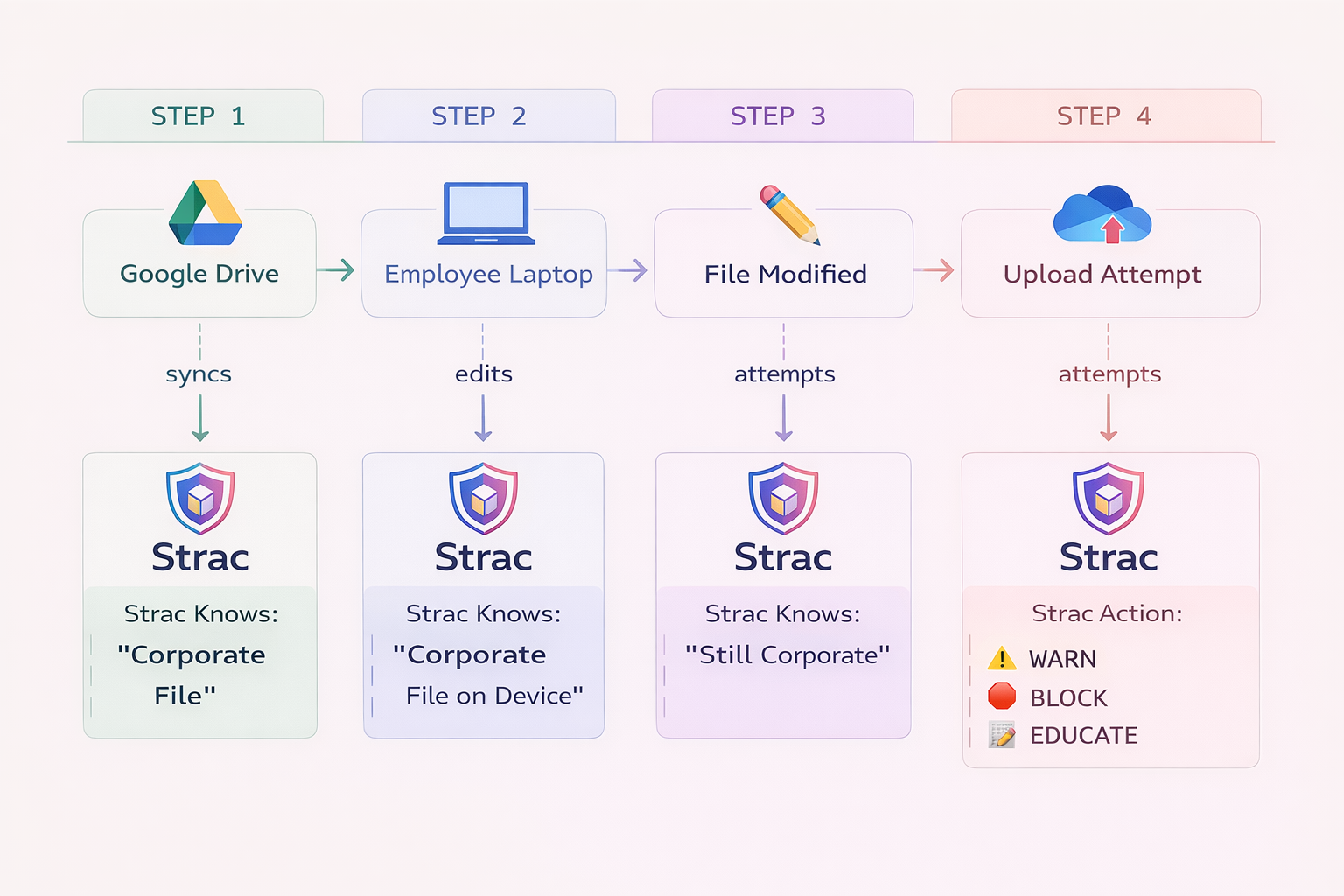
DeepSeek desktop apps and local model runners live on endpoints. Strac's endpoint DLP protects data in local AI tools and monitors every interaction — who used DeepSeek, what data was involved, and what was blocked or redacted — so you have a continuous record for security and compliance reviews.
Per-user, per-action visibility on the endpoint — see [monitor AI agents](https://www.strac.io/blog/monitor-ai-agents).
✨ DeepSeek via API & MCP — the Ingress Risk
DeepSeek's open models are increasingly wired into agents and apps via the API and the Model Context Protocol. That flips the risk to ingress — an agent backed by a DeepSeek model can pull data in from your SaaS, databases, and warehouses automatically, with no human pasting anything.
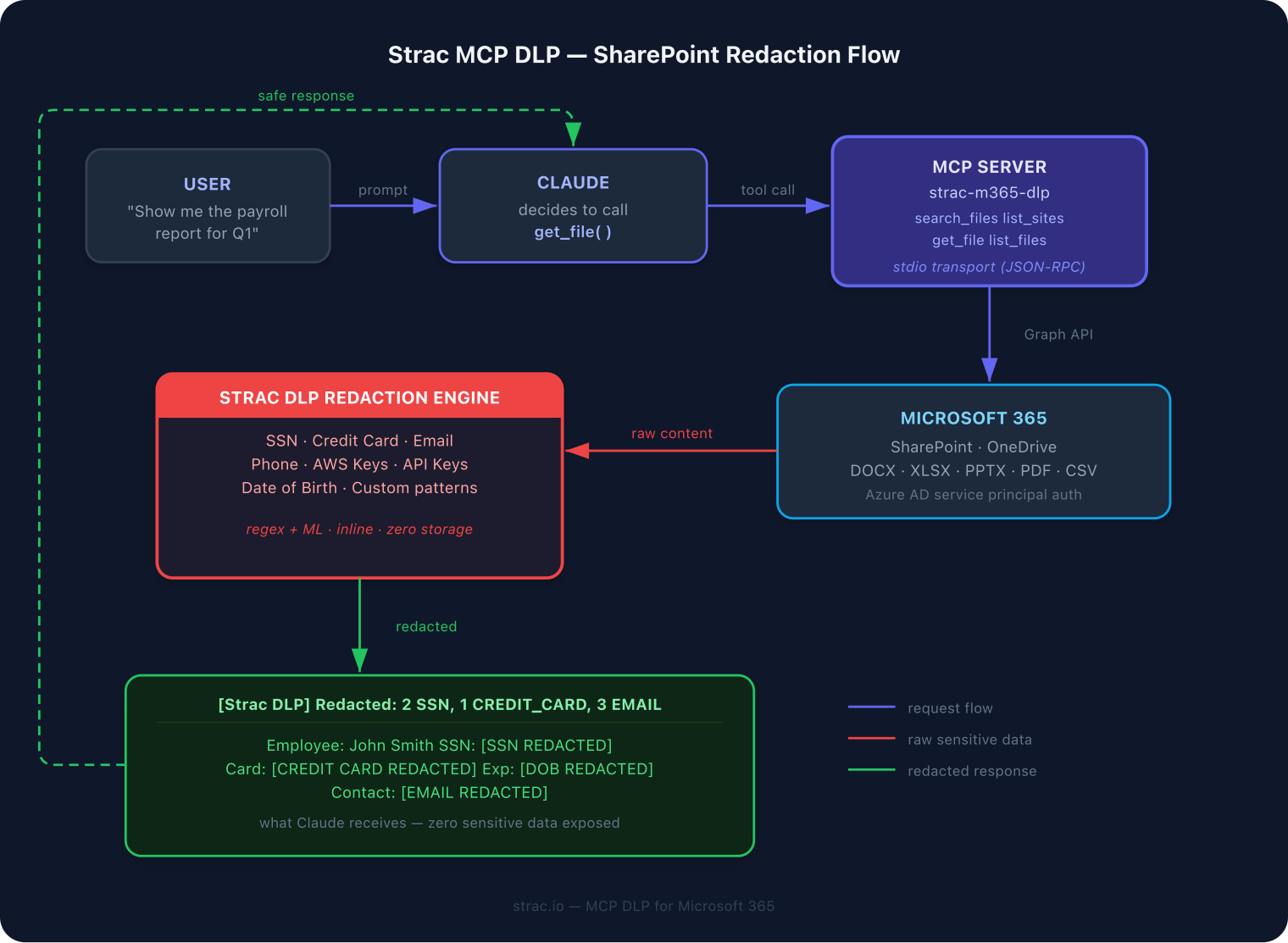
Strac sits as a gateway on every MCP tool call — see, control, redact, and log before any data reaches a DeepSeek-backed agent.
Strac's MCP DLP governs every tool call between an AI agent and your systems, across the full MCP connector directory — Snowflake, Salesforce, Jira, Slack, Google Drive, and more.
✨ SaaS DLP: Protect the Data Behind the Models
DeepSeek (or any agent it powers) is only as contained as the data in the SaaS apps it can reach. Strac's SaaS DLP discovers and redacts sensitive data at rest across 50+ apps, so regulated data is classified and protected before any AI tool touches it.
One control plane across SaaS, cloud, GenAI, browser, and endpoints. Browse [all integrations](https://www.strac.io/integrations).
DeepSeek Safety by Use Case
Corporate/regulated data: Not safe by default; block, or redact before every prompt.
Engineering: High risk of secrets and source code exposure to a PRC-jurisdiction service; redact secrets and source-code fingerprints, or block.
Healthcare/finance: Treat as out-of-policy for PHI/PCI unless fully redacted; no BAA comparable to enterprise Western vendors.
Personal, non-sensitive research: Lower risk, but still subject to data-residency concerns.
Strac: Make DeepSeek Safe — or Safely Block It
Strac gives you one control plane to govern DeepSeek (and every other AI tool) with the See → Control → Protect → Prove model:
See — discover shadow DeepSeek use across every surface.
Control — block DeepSeek org-wide, or allow it with guardrails per team, tool, and action.
Protect — redact, mask, tokenize, or vault sensitive data in the browser, on endpoints, across SaaS, and on every MCP/API call.
Prove — log every event as audit evidence mapped to SOC 2, HIPAA, PCI, GDPR, the EU AI Act, and ISO 42001.
One inline pass before anything reaches the model — five actions, your policy:
Detect — finds the company data an employee pastes in: PII, PHI, PCI, secrets, and source code, including text inside screenshots via OCR.
Redact or mask — replaces the sensitive elements inline so DeepSeek still answers and never sees the raw data.
Block or warn — stops the prompt, or warns the user before it is sent, by policy.
Alert — notifies your security team and streams the event to your SIEM (Microsoft Sentinel, Datadog, Splunk).
Audit — logs the user, the AI tool, the data involved, and the action taken — evidence for PCI DSS, SOC 2, HIPAA, and GDPR.
Bottom Line
Is DeepSeek safe? For sensitive or corporate data, no — not by default, and it's riskier than ChatGPT or Claude given its exposure history and data-to-China concerns. But banning a tool you can't see doesn't work. Put Strac in front of your AI usage: discover who's using DeepSeek, then block it or redact every sensitive element before a prompt is sent — and prove the control to auditors. That's how you remove the risk while staying in control.
🌶️ Spicy FAQs for Is DeepSeek Safe
Is DeepSeek safe to use?
For casual non-sensitive use, it's a capable model. For corporate or regulated data, it is not safe by default — DeepSeek had a documented public database exposure, transfers data to China, and is banned on many government systems. Use Strac browser DLP to block it or redact sensitive data before any prompt is sent.
Is DeepSeek a security risk for companies?
Yes. Beyond the usual "employees paste sensitive data" risk, DeepSeek adds data residency in China, undisclosed state-linked data transfers, and a real exposure incident. Most enterprises should block it or strictly control it — Strac does both, and shows you who's already using it.
Has DeepSeek been banned?
Yes — Italy removed it from app stores over GDPR concerns, and Australia, Taiwan, the US Navy, and NASA have restricted it on official systems, citing data-security and national-security risks.
Can I use DeepSeek safely with company data?
Only if sensitive data never reaches it. Strac redacts PII, PHI, PCI, secrets, and source code in the browser and on endpoints before a prompt is submitted — or blocks DeepSeek entirely if that's your policy. See GenAI DLP.
How is DeepSeek's risk different from ChatGPT or Claude?
ChatGPT and Claude secure their own infrastructure, offer enterprise no-training guarantees, and sign DPAs/BAAs. DeepSeek's data is stored in China under PRC law, it had a documented exposure, and its enterprise governance is far weaker — so discovery and blocking matter even more. Compare is ChatGPT safe and is Claude AI safe.
How does Strac control DeepSeek usage?
Strac discovers shadow DeepSeek use, then blocks it org-wide or redacts sensitive data before any prompt reaches it — across the browser, endpoints, SaaS, and MCP — logging every event as compliance evidence. Agentless, under 10 minutes.
For casual non-sensitive use, it's a capable model. For corporate or regulated data, it is not safe by default — DeepSeek had a documented public database exposure, transfers data to China, and is banned on many government systems. Use Strac browser DLP to block it or redact sensitive data before any prompt is sent.
Is DeepSeek a security risk for companies?
Yes. Beyond the usual "employees paste sensitive data" risk, DeepSeek adds data residency in China, undisclosed state-linked data transfers, and a real exposure incident. Most enterprises should block it or strictly control it — Strac does both, and shows you who's already using it.
Has DeepSeek been banned?
Yes — Italy removed it from app stores over GDPR concerns, and Australia, Taiwan, the US Navy, and NASA have restricted it on official systems, citing data-security and national-security risks.
Can I use DeepSeek safely with company data?
Only if sensitive data never reaches it. Strac redacts PII, PHI, PCI, secrets, and source code in the browser and on endpoints before a prompt is submitted — or blocks DeepSeek entirely if that's your policy. See GenAI DLP.
How is DeepSeek's risk different from ChatGPT or Claude?
ChatGPT and Claude secure their own infrastructure, offer enterprise no-training guarantees, and sign DPAs/BAAs. DeepSeek's data is stored in China under PRC law, it had a documented exposure, and its enterprise governance is far weaker — so discovery and blocking matter even more. Compare is ChatGPT safe and is Claude AI safe.
Discover & Protect Data on SaaS, AI, MCP, Endpoints & Cloud
Strac provides end-to-end data loss prevention for all SaaS and Cloud apps. Integrate in under 10 minutes and experience the benefits of live DLP scanning, live redaction, and a fortified SaaS environment.


.webp)





.avif)



.gif)
