November 5, 2026

3
min read
How to find shared files in google drive?
A Guide to Managing Access and Ensuring Google Drive Data Security
A shared file is any Drive file that someone other than its owner can open. That covers a file sent to a named person, a group, or your whole domain, along with a file set to “Anyone with the link.”
The right search depends on the direction of the share. “Shared with me” answers what others gave you. Operators answer what you gave others. Admin tools answer what your organization did.
The first two are personal housekeeping. The third is a security job, because one person’s Drive search will never show you what the rest of the company has exposed.
Drive sharing is easy to grant and rarely taken back. A vendor gets access for one contract, a contractor keeps a folder after the work ends, and an old link sits in a support ticket. Each one made sense on the day it was created.
Three things keep the risk hidden. Access outlives its purpose, and that is sharper when employees leave. File names reveal little, so “Q3 notes” can hold patient records or card numbers. And AI assistants connected to Drive can read what a user can reach, so old sharing mistakes get new readers.
That is why this audit supports SOC 2, HIPAA, PCI DSS, and GDPR work. You cannot control access you have never listed.
Open Google Drive and select Shared with me in the left menu. The view lists files and folders shared with you, plus files you opened from a shared link.
To narrow the list, type one of these in the search bar:
to:me finds documents shared with you.from:bob@example.com finds documents that person shared with you.owner:bob@example.com finds documents that person owns.sharedwith:me finds documents your account can access, excluding those you own.Files stored in a shared drive belong to the organization, so check Shared drives as well. Shared drive files follow different ownership rules, and Google Drive sharing permissions explains how those rules work.
Drive has no “Shared by me” page, so search does the work. These operators cover the common cases:
owner:me to:bob@example.com finds files you own and shared with that person.from:me finds documents you shared.owner:me sharedwith:external finds your files that people outside your organization can access, where your account supports it.For public links, click the People filter chip in the search bar and select Anyone with the link. The full walkthrough is in how to find public links in Google Drive.
To check a single file, right-click it and choose Share. The dialog lists each person with access and the general access setting, and you can remove anyone who no longer needs it.
One limit to remember: Google said in 2021 that from: and to: do not return files shared before February 2021. Older shares need another route.
Google Workspace admins can search sharing activity across the domain. In the Admin console, go to Menu > Reporting > Audit and investigation > Drive log events, add a Visibility filter, select Shared externally, and click Search.
Enterprise Plus, Enterprise Standard, and Education Plus editions also get the security investigation tool, under Security > Security center > Investigation tool.
These tools are useful, and their limits are worth knowing before you rely on them:
The Google Drive API suits teams that want a recurring report and have engineers to maintain it. Create a Google Cloud project, enable the Drive API, and set up credentials. Domain-wide coverage needs a service account with domain-wide delegation, granted by an admin.
Then call files.list with a query such as:
visibility = 'anyoneWithLink' for files anyone with the link can open.visibility = 'anyoneCanFind' for files discoverable on the web.sharedWithMe for files in the user’s “Shared with me” collection.Request the permissions and owners fields for each file, schedule the script, and write the results to a sheet or database.
The script gives you a list, and the list still needs an owner. You must handle pagination and API quotas, review the results, and write the logic that fixes them. A script can find every public link and still have no idea which one holds a Social Security number.
Every native method answers one question: who has access? The question that sets your priorities is different: what is in the file?
A public link to a marketing one-pager is a tidy-up task. A public link to a customer export is an incident. Search, logs, and API results rank them the same, so your team reviews thousands of shares by hand or stops reviewing them at all.
Sharing data tells you a file is reachable. Content inspection tells you whether that matters. How to find sensitive files in Google Drive and Google Drive data classification cover that second half.
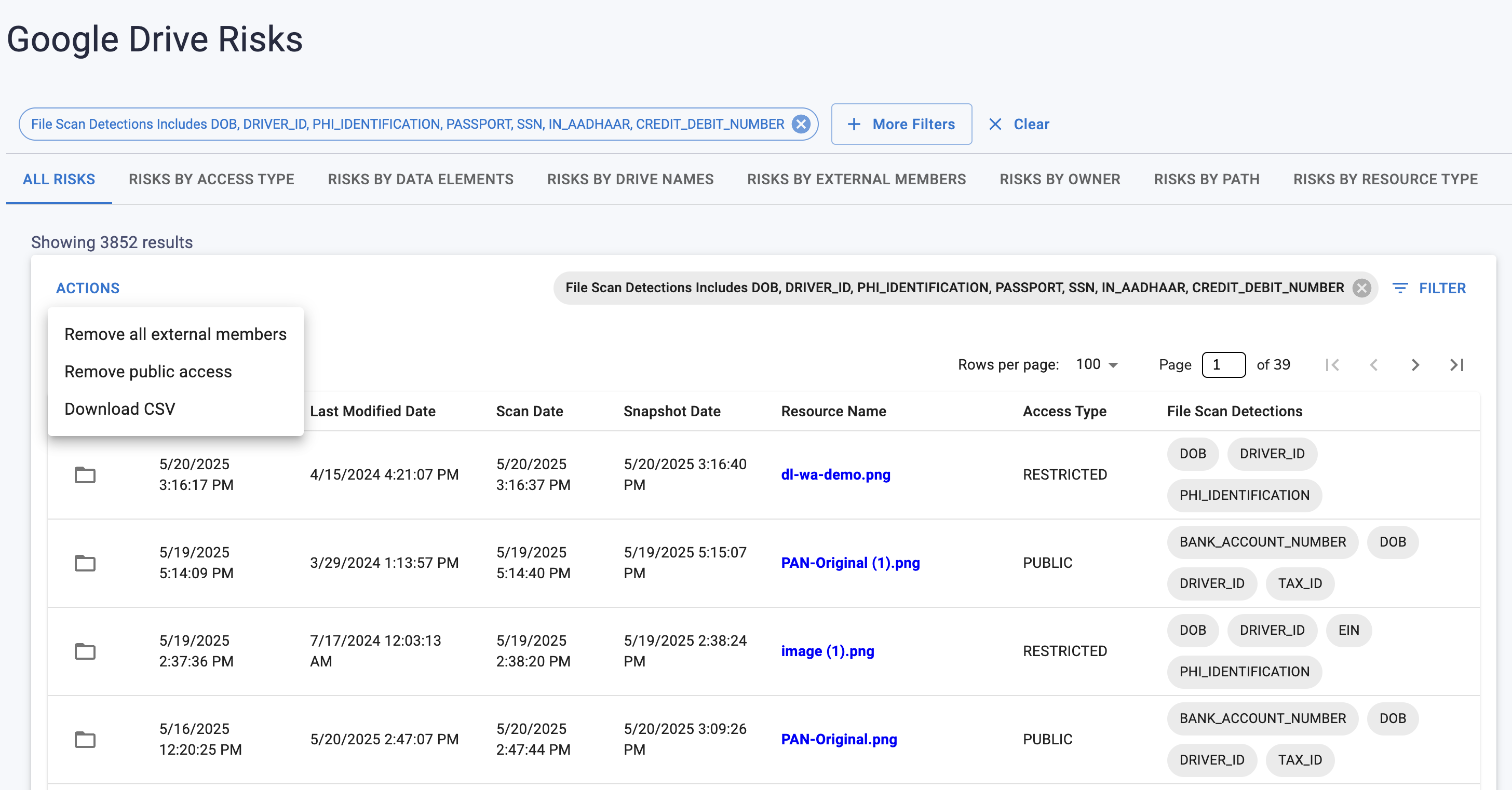
Strac connects to Drive through an agentless API integration. Google Drive DSPM (data security posture management) scans existing files in My Drive and shared drives, using optical character recognition for PDFs and screenshots, and classifies PII, PHI, PCI data, secrets, and intellectual property.
It then maps each file to its exposure: public links, external domains, personal Gmail accounts, and files owned by departed employees. The result is a ranked list instead of a raw sharing report.
A report does not close a public link. Google Drive DLP acts on what discovery finds, and Strac’s remediation options cover the data and the permission:
Strac also uses last-accessed dates to show users who no longer need a file, so access reviews rest on evidence rather than guesswork. The same policy reaches SaaS DLP, endpoint DLP, AI DLP, and MCP DLP, so a file locked down in Drive does not simply leave through a download or a prompt.
Related reading:
Strac closes the gap between a sharing list and a fix. Start at Google Workspace DLP, or read Google Drive security and how to prevent downloads in Google Drive.
Search, sharing settings, and access reviews all fail eventually: a link outlives its purpose, an exception becomes permanent, and a contractor keeps a folder nobody remembers. The data layer is the backstop. Know what each shared file holds, redact the sensitive fields, and revoke the access that should not exist, and a bad share never becomes a breach.
Book a demo to see Strac find and fix risky sharing in your Google Drive.
“Shared with me” lists individual files and folders others have given you, and those files usually stay owned by a person. Shared drives are team spaces where the organization owns the content. An audit needs to cover both, along with My Drive.
They record sharing activity, not the sensitivity of each file. A log can show that a file was shared externally, but it cannot tell a payroll export from a lunch menu. You still have to work out which events matter and fix them.
No. Turning it off stops legitimate work with vendors and customers, and it pushes people toward personal accounts. Strac lets you redact sensitive fields and revoke risky links, so normal sharing continues while the sensitive data stays protected.
No. Once someone downloads a file or photographs a screen, Drive permissions no longer apply. Strac reduces that risk by protecting the data itself, with discovery in Drive and endpoint DLP controls on managed devices.
It is the first step. You list the exposure, classify the contents, fix the riskiest files, and then enforce policy on new shares. See Google Workspace DLP for the full program.
“Don’t just alert on problems, fix them.”
Scott Roberts, Chief Information Security Officer, UiPath









Customers include