September 14, 2026

31
min read
GDPR Compliance Software: 10 Platforms Ranked (2026 Guide)
The 10 best GDPR compliance software platforms for 2026 — Strac Comply, OneTrust, Vanta, Securiti +6 — for DSARs, Article 32, DPIAs & cross-border transfers.
If you're shopping for GDPR compliance software in 2026, here's the trap: most of the platforms ranking on page one of Google solve about a third of the problem. You can buy a great consent banner / cookie management tool that does nothing about Article 32 security. You can buy a great DSAR automation tool that doesn't help with DPIAs. You can buy a comprehensive privacy management suite (OneTrust) that costs $200K+ and still doesn't scan your actual data for unauthorized PII.
Want one platform for the whole GDPR program, not a third of it? Strac Comply is AI-native compliance automation built for GDPR, SOC 2, HIPAA, ISO 27001, and PCI DSS — covering data discovery, DSAR handling, DPIAs, and Article 32 security in one place, with DLP/DSPM that actually scans your live data for unauthorized personal information. Strac is the only platform that combines compliance automation with continuous data security across SaaS, cloud, endpoint, and AI agents. Start at comply.strac.io →
GDPR compliance software is not one product — it's seven of them, and the question is how many your single platform actually covers.
The seven jobs of a real GDPR program:
Most "GDPR compliance software" products excel at jobs 2–5. Almost none cover job 1 (real data discovery) and job 6 (security operating-effectiveness) — those are the jobs DLP and DSPM platforms do, and they're the jobs the next generation of compliance platforms (Strac Comply being the most fully realized example) bundle in.
This post compares the 10 most-considered GDPR compliance software platforms across all seven jobs.
Quick answer: The best GDPR compliance software in 2026 is Strac Comply (gdpr article 32 + dspm + compliance evidence in one platform), OneTrust (enterprise privacy management (dsar, dpia, ropa, consent)), Vanta (gdpr + soc 2 evidence collection on one platform) — with the full ranked shortlist of 10 platforms, auditor criteria, and a comparison table below.
Last updated: June 2026
GDPR compliance software is any platform that helps organizations meet the General Data Protection Regulation — the EU privacy law that applies to any business processing personal data of EU residents, regardless of where the business is based. The fines (up to €20M or 4% of global revenue, whichever is higher) make it the most consequential privacy law on the planet, and the one that triggered every other privacy law in its image (CCPA, LGPD, PIPEDA, India's DPDP, the UK GDPR, etc.).
A modern GDPR compliance platform should cover:
The legacy privacy platforms (OneTrust, Securiti, TrustArc) built their products in a pre-cloud / pre-LLM era and excel at workflow management — DSAR routing, DPIA templates, vendor questionnaires — but treat data discovery as a separate (often very expensive) module. The legacy GRC platforms (Vanta, Drata, Secureframe) added GDPR frameworks to their existing SOC 2 evidence engine, which works for Articles 5, 30, 32-attestation but not for actual data scanning.
The newest generation (Strac Comply) bundles the Article 32 security layer (DLP, DSPM, OAuth governance) with the compliance evidence layer in one platform — the layer that actually finds and remediates the unauthorized PII your DPA cares about.
A tool that only collects evidence will leave you DPA-letter-ready, but it will not stop a regulator from finding that German customer email addresses are sitting unencrypted in a public Slack channel. That's the gap this comparison is about.
The mistake most buyers make: they evaluate GDPR software like it's one product. It's not. The DPO who needs DSAR automation, the security engineer who needs Article 32 evidence, and the marketing team that needs cookie consent are buying for three different jobs. The right answer depends on which of these jobs you're trying to consolidate.
| # | Job | What software does | Vendor archetypes |
|---|---|---|---|
| 1 | Data discovery + inventory | Find personal data across SaaS, cloud, email, endpoints, and unstructured stores | DLP / DSPM platforms (Strac, BigID), specialty data discovery |
| 2 | Lawful basis + RoPA | Record processing activities, legal bases, retention policies | Privacy management (OneTrust, Securiti), GRC (Vanta, Drata) |
| 3 | Cookie consent | Collect and prove consent at web/app layer | Consent management (Cookiebot, Termly, Usercentrics, Didomi) |
| 4 | DSAR automation | Intake, identity verification, fulfillment workflow | Privacy management (OneTrust, Securiti), DSAR specialists |
| 5 | DPIA / TIA / RoPA workflows | Risk-rated assessment templates and approval workflow | Privacy management (OneTrust, Securiti), GRC (Vanta, Drata) |
| 6 | Article 32 security | Encryption, pseudonymization, DLP, DSPM, ongoing testing | DLP/DSPM (Strac), GRC (Vanta, Drata for evidence layer) |
| 7 | Breach detection + 72-hour notification | SIEM correlation + classification + notification workflow | DLP (Strac), SIEM, IR platforms |
The platforms that try to do all seven jobs are rare. OneTrust comes closest at the enterprise level but charges for each module separately and skips real data discovery. Strac Comply is the closest in the mid-market — it bundles 1, 5, 6, 7 natively and integrates the rest.
We compared each platform on nine dimensions that matter to a working GDPR program — based on vendor documentation, public datasheets, customer reviews on G2 and Gartner Peer Insights, and direct hands-on time with the platforms our team has access to:
The pattern: each platform excels at 2–4 of these dimensions. The strongest GDPR programs use 2–3 platforms in combination. The newest generation (Strac Comply) collapses the security + discovery dimensions (#2, #6, #7) into one platform alongside the workflow layer (#4, #5).
We grouped these by the primary job each platform is built for. There's no single "best" GDPR platform — there's a best one for your gap.
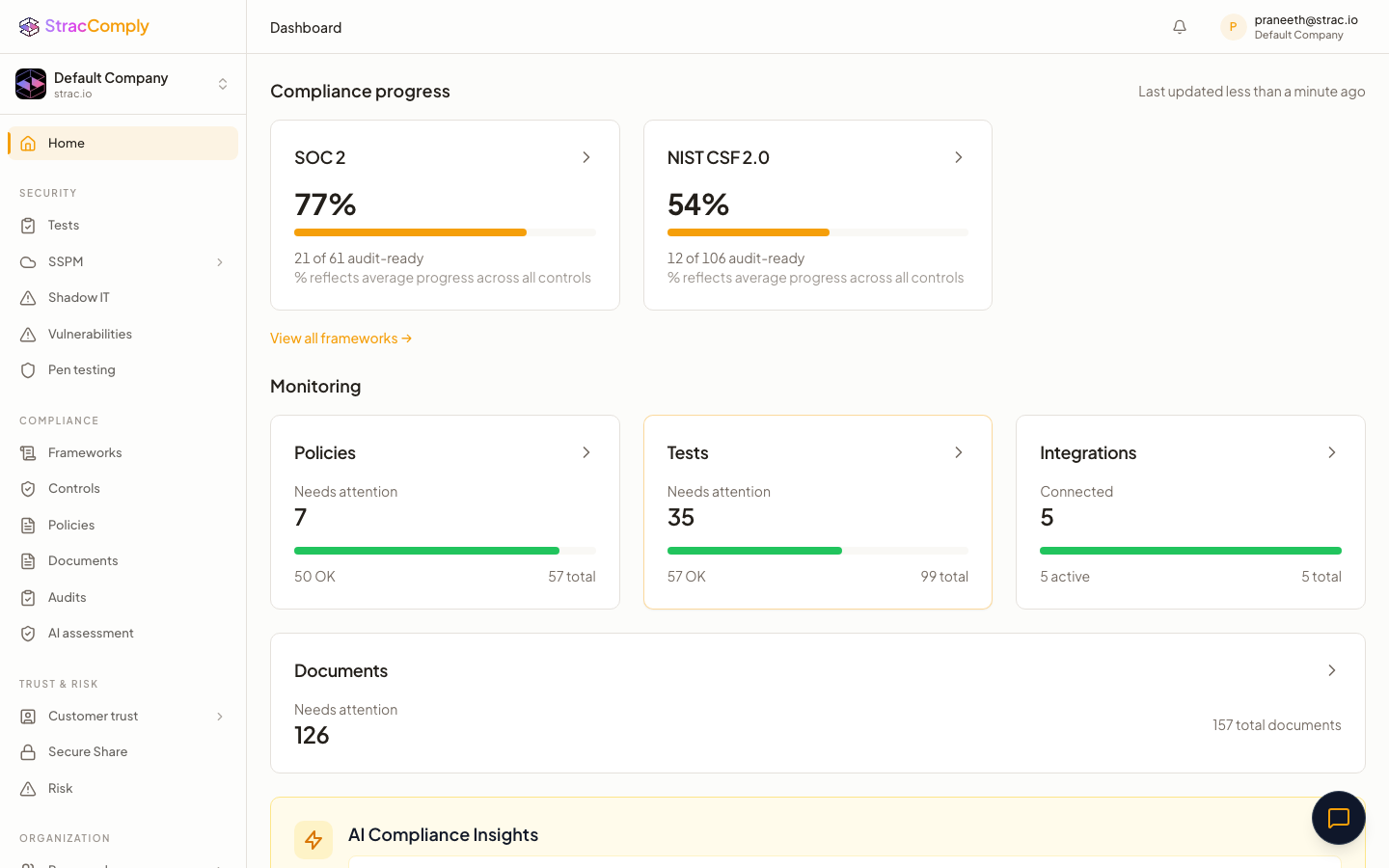
Strac Comply is the newest generation of compliance automation: it bundles the Article 32 security layer (DLP, DSPM, SSPM, third-party OAuth governance) with the compliance evidence layer (control mapping, RoPA-ready data inventory, evidence collection, vendor questionnaires) in one platform. Said differently: where most GDPR software helps you demonstrate compliance, Strac Comply also enforces it.
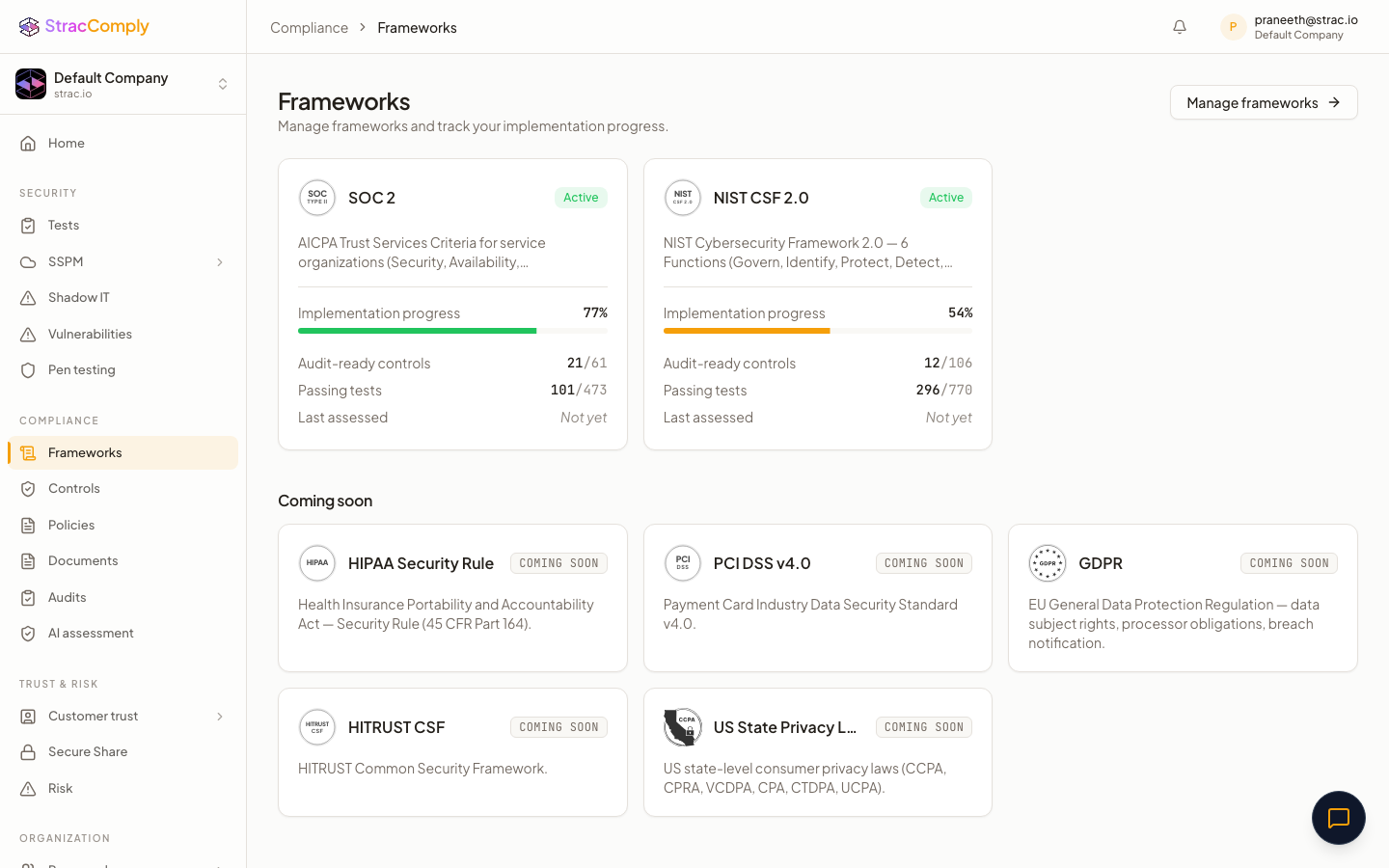
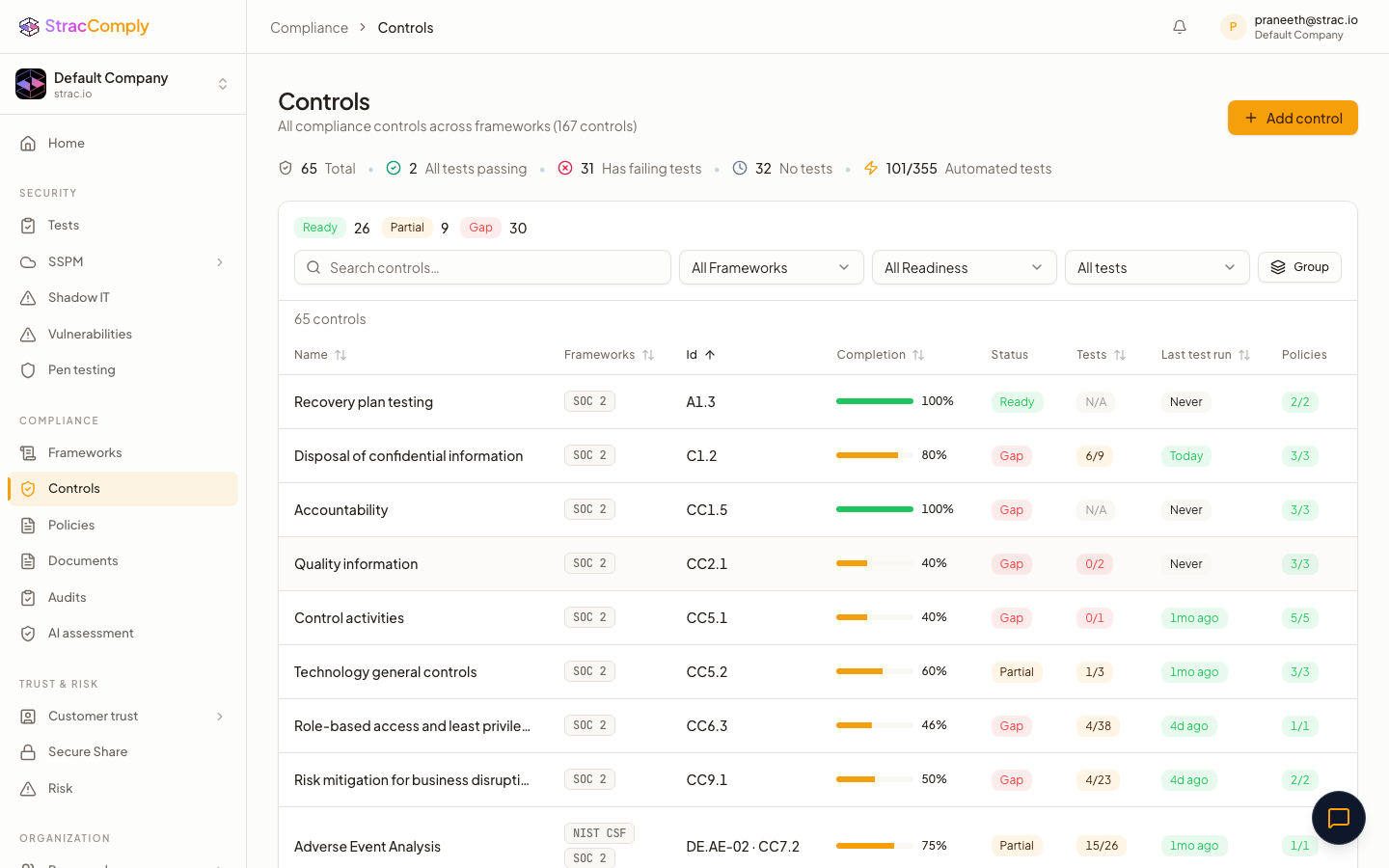
GDPR is rolling out as a native framework in Strac Comply throughout 2026. Today, Strac maps directly to the SOC 2 / NIST CSF 2.0 / ISO 27001 control libraries that already cover most of GDPR's Article 32 requirements (encryption, access control, pseudonymization, ongoing testing). The native data-discovery layer covers the part of GDPR that legacy GRC tools cannot — the actual unauthorized personal data that triggers DPA findings.
What's included in Strac Comply for GDPR:
- Data discovery + DSPM (built-in, not an add-on) — discovers and classifies personal data (names + email pairs, addresses, government IDs, IBAN, IP addresses, device IDs, sensitive special-category data) across SaaS, cloud, and endpoint sources via 100+ integrations. Article 30 (RoPA) becomes a generated artifact, not a manual exercise.
- Browser DLP for AI tools — blocks employees from pasting customer PII into ChatGPT, Claude, Gemini, Copilot, Perplexity, Cursor at the browser layer in real time. Article 32 in real time, not a quarterly attestation.
- OCR + ML-based detection inside images, PDFs, DOCX, XLSX, ZIP archives — finds personal data inside JPEG screenshots, scanned PDF contracts, embedded Excel attachments, ZIP'd backups. Most legacy DLPs cannot do this.
- Full-spectrum remediation — redact, mask, label, alert, delete, revoke OAuth access, remove public-link access, remove external collaborators, all automated.
- SSPM (SaaS security posture management) — continuously discovers third-party SaaS apps and risky OAuth permissions connected to your Google Workspace and M365. Article 28 sub-processor monitoring on autopilot.
- Evidence collection for compliance frameworks (SOC 2, NIST CSF 2.0, ISO 27001 today; PCI DSS, HIPAA, GDPR rolling out throughout 2026).
- Continuous control monitoring — alerts when MFA is missing, encryption settings drift, third-party OAuth grants become risky, audit log retention is misconfigured.
- Pen test orchestration for Article 32 ongoing testing.
- Vendor risk + Article 28 DPA tracking — outbound vendor reviews, inbound questionnaires (SIG, CAIQ), AI-drafted answers from your evidence library.
- Secure share — send DPIA reports, sub-processor lists, and audit attestations to customers and regulators with end-to-end encryption.
- Trust portal — public-facing privacy posture and DSAR submission link.
Capabilities at a glance:
- GDPR framework: ⏳ Native framework rolling out in 2026 (SOC 2, NIST CSF 2.0, ISO 27001 active today). Most Article 32 controls already covered via the bundled DLP / DSPM.
- Data discovery: ✅ Native, real-time, OCR-capable
- DSAR automation: ⚠️ Data discovery powers DSAR fulfillment; workflow integrates with OneTrust / Securiti where deeper case management is needed
- DPIA / TIA / RoPA workflows: ⚠️ Foundational templates available; integrates with OneTrust / Securiti for full DPIA case management
- Cookie consent: ❌ Not in scope; integrate with Cookiebot, Usercentrics, or Didomi
- Article 32 security: ✅ Best-in-class
- Breach notification: ✅ Detection + classification; integrates with your IR platform for the 72-hour workflow
- Cross-border transfer: ⚠️ Tracks SCC presence in vendor library; not a full TIA tool
- Integrations: 100+
Where it covers GDPR:
- Articles 5–6 (lawful processing): Data classification + retention policy enforcement at the storage layer.
- Article 13–14 (transparency): Trust portal + privacy notice publishing.
- Article 17 (right to erasure): Discovery surfaces every location of a data subject's data; remediation deletes / redacts at scale.
- Article 25 (data protection by design): Continuous DLP findings + remediation policies enforce data-minimization at runtime.
- Article 28 (processors): Vendor questionnaires + sub-processor monitoring + DPA tracking.
- Article 30 (RoPA): Auto-generated from continuous data discovery — every data store, processing activity, and lawful basis surfaced.
- Article 32 (security): This is where Strac differentiates most heavily. Real DLP, real DSPM, real SSPM, real OAuth governance — operating-effectiveness evidence, not a policy attestation.
- Articles 33–34 (breach notification): Detection + classification at content-find time; integrates with your IR platform for the 72-hour clock.
- Article 35 (DPIA): Foundational templates; for complex case workflows, pair with OneTrust or Securiti.
Pair with:
- A consent management platform (Cookiebot, Usercentrics, Didomi, or Termly) for cookie consent.
- OneTrust or Securiti for full DPIA / DSAR case management at enterprise scale.
Best for: Mid-market and enterprise SaaS, fintech, healthcare, and any organization processing EU personal data that wants its compliance platform to also be its data security platform. Especially powerful for teams that buy DLP, DSPM, GRC, vendor management, and SSPM separately today and want to consolidate — pairing the result with a focused consent and DSAR tool.
OneTrust is the heavyweight in privacy management. The platform covers DSAR automation, DPIA workflows, RoPA, vendor risk, consent management, and cookie scanning at enterprise scale. Most Fortune 1000 GDPR programs run on OneTrust. The cost is real (six-figure ACV typical) and the implementation is non-trivial (3–6 months for full deployment).
Capabilities at a glance:
- GDPR framework: ✅ Native, with deepest control library in the category
- Data discovery: ⚠️ Available as a separate module (OneTrust Data Discovery); not included in the privacy management bundle
- DSAR automation: ✅ Industry-leading workflow
- DPIA / TIA / RoPA: ✅ Best-in-class
- Cookie consent: ✅ Built-in (formerly CookiePro)
- Article 32 security (real DLP): ❌ Not in scope (separate OneTrust modules)
- Breach notification: ✅ Workflow templates included
- Cross-border transfer: ✅ SCCs + TIA workflows
- Integrations: 200+
Best for: Large enterprises with significant privacy program complexity (multi-regulation: GDPR + CCPA + LGPD + UK GDPR), in-house DPO + privacy team, and the budget to support six-figure platform spend.
Vanta added GDPR framework support in 2023. It excels at the evidence-collection layer for Articles 5, 30, 32 attestation — the GRC half of GDPR. Vanta does not do DSAR automation, cookie consent, or DPIA case management at the depth a privacy-only tool does.
Capabilities at a glance:
- GDPR framework: ✅ Evidence-collection oriented (Articles 5, 30, 32 attestations)
- Data discovery: ❌ Not in scope
- DSAR automation: ⚠️ Basic workflow; integrates with OneTrust / Securiti for case management
- DPIA workflows: ⚠️ Foundational templates
- Cookie consent: ❌
- Article 32 security: ⚠️ Evidence layer only — relies on integrations to attest the underlying control
- Cross-border transfer: ⚠️ SCC tracking via vendor library
- Integrations: 375+
Best for: SaaS companies that need GDPR evidence collection alongside SOC 2 and ISO 27001 — paired with a focused DSAR / consent tool.
Drata's GDPR support has the same shape as Vanta's — evidence-collection oriented, with the cleanest continuous-monitoring UX in the GRC category. Multi-framework users (GDPR + SOC 2 + ISO 27001 + HIPAA) often prefer Drata's unified control library.
Capabilities at a glance:
- GDPR framework: ✅ Evidence-oriented
- Data discovery: ❌
- DSAR automation: ⚠️ Foundational
- DPIA workflows: ⚠️ Templates available
- Cookie consent: ❌
- Article 32 security: ⚠️ Evidence layer
- Integrations: 200+
Best for: Mid-market SaaS running GDPR + SOC 2 + ISO 27001 in parallel and prioritizing UX over depth-of-privacy-features.
Securiti is the strongest pure privacy management platform after OneTrust, with a stronger AI / autodiscovery story than the legacy players. The platform combines data discovery, DSAR automation, DPIA workflows, and consent management. Cost is closer to OneTrust than Vanta.
Capabilities at a glance:
- GDPR framework: ✅ Native
- Data discovery: ✅ Real, native (less deep on unstructured/SaaS than Strac)
- DSAR automation: ✅ Strong
- DPIA workflows: ✅ Strong
- Cookie consent: ✅ Built-in
- Article 32 security: ⚠️ Discovery layer covered; remediation depth less than Strac
- Cross-border transfer: ✅
- Integrations: 200+
Best for: Mid-market and large enterprises that want a unified privacy management + data discovery platform without OneTrust pricing.
Termly targets SMB and lower mid-market with bundled privacy notice generation, cookie consent, and basic DSAR workflow. The platform is the most affordable of the privacy specialists ($10–$200/month tiers).
Capabilities at a glance:
- GDPR framework: ✅ For SMB scope
- Data discovery: ❌
- DSAR automation: ✅ Basic
- Cookie consent: ✅
- Article 32 security: ❌
- Integrations: 30+
Best for: SMB SaaS, e-commerce, and content sites that need GDPR + CCPA basics without enterprise pricing.
Usercentrics is the European-headquartered consent management leader. The platform handles cookie consent, granular preferences, audit trails, and integrates with most analytics and ad tech tools. Usercentrics was selected by many enterprises after Google's 2024 consent mode deadlines.
Capabilities at a glance:
- GDPR framework: ⚠️ Consent + preference management focus
- Data discovery: ❌
- DSAR automation: ❌
- Cookie consent: ✅ Best-in-class
- Article 32 security: ❌
- Integrations: 2,000+ (consent / ad tech)
Best for: Marketing and product teams that need a robust consent management platform — pair with a separate GRC and DLP for the rest of GDPR.
Didomi is the other European consent management leader, with a stronger UX focus than Usercentrics and broader consent-orchestration capabilities (consent across mobile, CTV, gaming).
Capabilities at a glance:
- GDPR framework: ⚠️ Consent + preference focus
- Data discovery: ❌
- DSAR automation: ⚠️ Basic
- Cookie consent: ✅ Strong
- Article 32 security: ❌
- Integrations: 1,000+
Best for: European-headquartered companies prioritizing consent UX across web, mobile, and CTV.
BigID is an enterprise data-discovery and DSPM platform with strong privacy mapping capabilities. The product was originally built for Fortune 500 data discovery and has grown into broader privacy and security postures. Cost and complexity are enterprise-scale.
Capabilities at a glance:
- GDPR framework: ✅ Strong data inventory + classification
- Data discovery: ✅ Enterprise-strong
- DSAR automation: ⚠️ Foundational; pair with OneTrust or Securiti
- DPIA workflows: ⚠️
- Cookie consent: ❌
- Article 32 security: ⚠️ Discovery + classification; remediation less integrated than Strac
- Integrations: 200+
Best for: Fortune 1000 enterprises with complex on-premise + cloud data estates that need deep data discovery + classification.
Cookiebot (now part of Usercentrics) is the simplest cookie consent platform with strong cookie scanning and a clean banner UX. Most SMB sites that need GDPR cookie consent and nothing more end up here.
Capabilities at a glance:
- GDPR framework: ⚠️ Cookie + tracker scope
- Data discovery: ❌
- DSAR automation: ❌
- Cookie consent: ✅ Simple, effective
- Article 32 security: ❌
- Integrations: 100+
Best for: SMB SaaS, content sites, and e-commerce that need a cookie consent banner that works — and nothing more.
| Platform | GDPR native | Data discovery | DSAR | DPIA / RoPA | Cookie consent | Article 32 (real DLP) | AI agent (MCP) |
|---|---|---|---|---|---|---|---|
| Strac Comply | ⏳ 2026 | ✅ | ⚠️ | ⚠️ | ❌ | ✅ Best | ✅ Read + write |
| OneTrust | ✅ | ⚠️ separate | ✅ | ✅ | ✅ | ❌ | ❌ |
| Vanta | ✅ Evidence | ❌ | ⚠️ | ⚠️ | ❌ | ⚠️ Evidence | ⚠️ Chat only |
| Drata | ✅ Evidence | ❌ | ⚠️ | ⚠️ | ❌ | ⚠️ Evidence | ⚠️ Chat only |
| Securiti | ✅ | ✅ | ✅ | ✅ | ✅ | ⚠️ | ❌ |
| Termly | ✅ SMB | ❌ | ✅ | ⚠️ | ✅ | ❌ | ❌ |
| Usercentrics | ⚠️ Consent | ❌ | ❌ | ❌ | ✅ | ❌ | ❌ |
| Didomi | ⚠️ Consent | ❌ | ⚠️ | ❌ | ✅ | ❌ | ❌ |
| BigID | ✅ | ✅ | ⚠️ | ⚠️ | ❌ | ⚠️ | ❌ |
| Cookiebot | ⚠️ Cookie | ❌ | ❌ | ❌ | ✅ | ❌ | ❌ |
The honest read: no single platform covers all seven jobs. Strong GDPR programs combine 2–3. The newest generation (Strac Comply) collapses the data-security half (Articles 5, 25, 28, 30, 32, 33–34) into one platform — pair with OneTrust / Securiti for case-management depth and Cookiebot / Usercentrics / Didomi for consent.
Use this checklist on every demo. The vendors that don't have good answers are the vendors that fail you in your DPA letter.
Build an Article 30 record of processing that holds up to a regulator — plus the 15 questions to ask any GDPR platform before you sign. We’ll email it to you.
No spam. Unsubscribe anytime.
Based on what European DPAs publish in their enforcement decisions, what supervisory authorities flag in formal investigations, and what the EDPB has emphasized in its 2023–2025 guidance, the disconnect between what "GDPR software" sells and what regulators flag is significant.
What vendors emphasize in marketing:
- Number of integrations (200+, 300+)
- Pre-built DPIA templates
- Automated DSAR workflows
- Cookie consent banner customization
What DPAs actually flag in real enforcement actions:
1. Personal data in non-purposed systems — by far the #1 finding. EU customer email addresses found in Slack, in Jira tickets, in Confluence wikis, in customer support email replies. The vendor's "automated GDPR compliance" said nothing about it because the vendor never looked.
2. Insufficient lawful basis documentation — companies rely on "legitimate interest" without doing the LIA (legitimate interest assessment).
3. Cookie consent dark patterns — "Accept all" prominent, "Reject all" buried. The CNIL, ICO, and Garante have issued €1M+ fines for this in 2024–2025.
4. DSAR fulfillment delays — failing the 30-day clock because the team can't find every location of a subject's data fast enough.
5. AI tool usage with EU personal data — agents using ChatGPT, Claude, or Copilot to "summarize this customer issue" and pasting PII into the prompt. The Italian Garante's 2023 ChatGPT ban set the precedent; enforcement has continued.
6. Cross-border transfer failures — relying on outdated SCCs or no TIA after Schrems II (July 2020).
7. Sub-processor mismanagement — adding a sub-processor without DPA, without notification, without prior approval where required.
8. Breach notification delays — 72-hour clock missed because the team didn't have the detection or classification workflow.
The pattern: 5 of 8 of the top DPA findings are findings that GRC-only or workflow-only platforms cannot find because they don't look at content. That's the gap a real DSPM + DLP fills.
GDPR is seven jobs. Buying one tool to do all seven leaves gaps; buying seven tools leaves integration overhead. The right answer: a unified data security + compliance platform (Strac Comply) for jobs 1, 5, 6, 7 + a privacy management platform (OneTrust, Securiti) for jobs 2, 4 + a consent management platform (Cookiebot, Usercentrics, Didomi) for job 3.
Article 30 expects an accurate RoPA. If your data flows are documented in a spreadsheet that's updated quarterly, your RoPA is wrong by Friday. Continuous data discovery (DSPM) generates the RoPA automatically; the privacy team's job becomes review, not authoring.

The workflow tool routes the request and tracks the clock. Finding every location of a data subject's data — across Slack, Salesforce, Zendesk, your data warehouse, S3 buckets, employee laptops — is a separate problem. Companies that fail DSARs almost always fail at discovery, not at workflow.
EU AI Act (in force 2026) and existing GDPR guidance treat AI / ML systems handling personal data as in-scope. ChatGPT, Claude, Copilot, Gemini are all common destinations for accidentally-pasted EU customer PII. Browser DLP is the only practical control.
"Accept all" prominent, "Reject all" buried, pre-checked legitimate-interest categories — all explicitly enforced against by CNIL, ICO, Garante, and the EDPB's 2023 guidance. Modern consent management platforms ship with compliant templates; using them is the cheapest path to avoiding €1M+ fines.
Most companies still use the pre-Schrems II SCCs or have not run TIAs on US-based sub-processors. EDPB's 2024 enforcement priorities include TIA validation. Update SCCs to the 2021 templates and document a TIA per US-based sub-processor.
Articles 33–34 require notification within 72 hours of becoming aware — and "aware" is a defined term. Companies fail this not because of detection latency but because of classification delay (is this a notifiable breach or a non-event?). Pre-defined classification rules + a runbook + automated regulator template are the difference between meeting the clock and missing it.
GDPR Article 17 (erasure) and CCPA right to delete look similar but have different timelines, different exception scopes, and different verification requirements. Modern multi-regulation platforms (OneTrust, Securiti) handle the differences; spreadsheet-based programs don't.
For full context on Strac's GDPR capabilities, see our GDPR Compliance & DLP page.
The short version of how Strac Comply approaches GDPR:
1. Connect every SaaS app, cloud account, and endpoint where personal data could flow. Under 10 minutes per integration, fully agentless: Slack, Google Workspace, M365, Zendesk, Salesforce, Jira, Notion, GitHub, Box, Dropbox, Intercom, HubSpot, AWS S3, Azure Blob, GCS, and more — 100+ integrations in total.
2. Continuous data discovery (Articles 5, 25, 30, 32). Strac scans every message, file, ticket, and attachment — including inside PDFs, JPEGs, PNGs, DOCX, XLSX, ZIP archives, and even chat messages and emails — for personal data: names + email pairs, addresses, government IDs, IBAN, IP addresses, device IDs, and special-category data. Detection uses regex + validation logic, an OCR engine, and an ML classifier.
3. Real-time prevention at the entry point (Article 32). Browser DLP blocks employees from pasting EU customer PII into ChatGPT, Claude, Gemini, Copilot, Salesforce, Notion, Jira, custom apps. Email DLP catches PII leaving via Gmail or M365. Slack DLP catches PII in DMs and channels. Endpoint DLP catches PII in copy/paste and file uploads.

4. Full-spectrum automated remediation (Articles 17, 25, 32). When personal data is found, Strac can redact, mask, label, alert, delete, revoke OAuth access, remove public-link access, or remove external collaborators — based on policies you set. Article 17 erasure becomes minutes, not weeks.
5. Auto-generated RoPA (Article 30). The continuous discovery layer surfaces every data store, processing activity, and lawful basis. Your privacy team reviews and approves; nobody hand-authors a RoPA again.
6. SSPM + third-party OAuth governance (Articles 28, 32). Strac continuously discovers third-party SaaS apps and OAuth permissions connected to your Google Workspace and M365 — catching scope creep and risky third-party grants before they become Article 28 / sub-processor failures.
7. Vendor risk + Article 28 DPA tracking. Send outbound questionnaires to your vendors. Receive and respond to inbound customer questionnaires (SIG, CAIQ, custom). Track DPAs, sub-processor lists, and SCC versions for every vendor. AI-drafted answers from your evidence library cut response time by 70–80%.


8. Audit-ready evidence collection. Strac Comply maps continuous DLP findings, MFA enforcement, access reviews, encryption attestations, training completions, vendor reviews, and policy approvals against compliance frameworks. GDPR framework support rolls out in 2026 alongside HIPAA and PCI; today, Strac natively supports SOC 2, NIST CSF 2.0, and ISO 27001 — most of which already overlap with GDPR Articles 5, 25, 28, 30, 32.

9. Pen test orchestration (Article 32 ongoing testing). Bundled or BYO pen test firm; findings flow directly into your Article 32 evidence and remediation tracking.
10. Trust portal + secure share. Public trust portal at comply.strac.io/trust-portal/{slug} for customer-facing privacy posture and DSAR submission. Secure share for sending DPIAs, sub-processor lists, and audit attestations to customers and regulators with end-to-end encryption — no more uploading to Dropbox.
For a deep walkthrough on adjacent compliance use cases, see our companion posts on SOC 2 compliance software and PCI DSS compliance software.

Most GDPR work is records that drift the moment you stop updating them — your Article 30 record of processing (RoPA), DPIAs, processor lists, retention schedules. Strac Comply keeps them current headless: your AI agent — Claude Code, Cursor, or Claude Desktop — connects to your compliance workspace and does the maintenance. Ask “which processing activities are missing a lawful basis?” and it reads your live records and answers from your real data map, not a template. Tell it to draft a data-retention policy or attach evidence to your Article 32 security controls, and it writes straight into your binder.
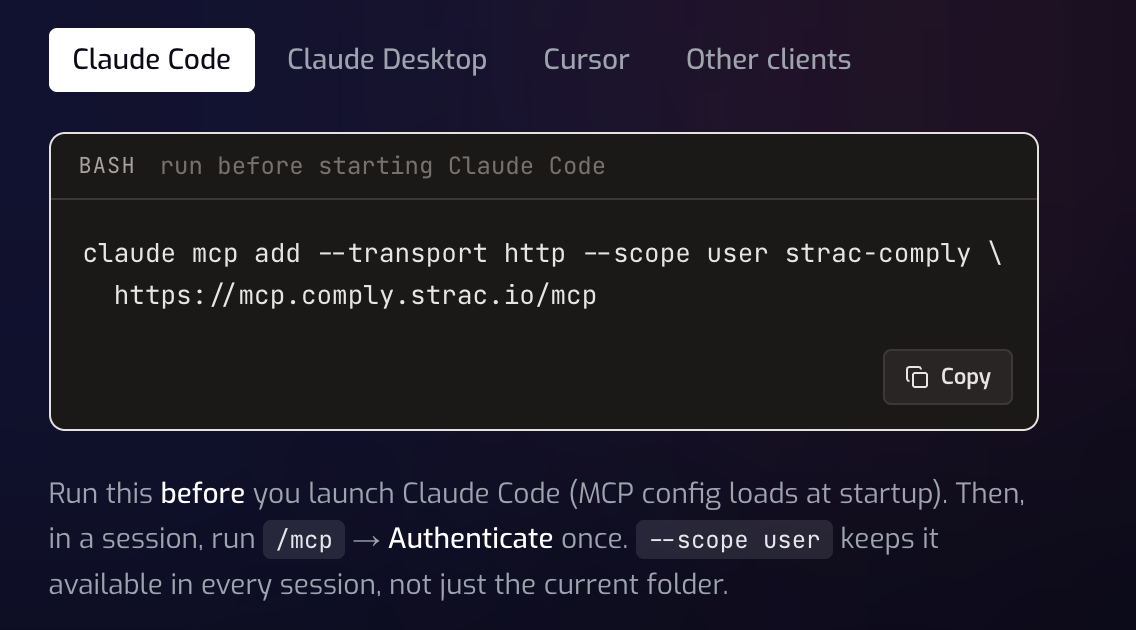
This isn’t an AI assistant bolted onto a privacy tool. It’s the Model Context Protocol (MCP) exposing your tenant as real tools your agent can call. Connecting is one line:
claude mcp add --transport http --scope user strac-comply \
  https://mcp.comply.strac.io/mcp
Every write — an updated RoPA entry, a drafted policy, evidence attached to an Article 32 control — lands in an append-only audit log stamped with the AI’s identity. Access is scoped and revocable (OAuth 2.1), so the agent only ever touches what you authorize. For a regulation built on accountability and demonstrable records, that audit trail is the feature, not a nice-to-have.
Connect once and your agent handles the privacy busywork — records upkeep, policy drafts, Article 32 evidence — across GDPR, SOC 2, ISO 27001, and HIPAA from one server. Browse the Strac Comply MCP server, the 27-tool reference, or how it maps to SOC 2 compliance software.
You have three real options for how to structure your GDPR stack:
Option A — Buy one enterprise privacy suite (OneTrust or Securiti).
- Best for Fortune 1000 with in-house DPO + privacy team.
- Covers DSAR, DPIA, RoPA, consent management, and vendor risk in one platform.
- Doesn't include real DLP — pair with a DSPM (Strac, BigID).
- Six-figure ACV; 3–6 month implementation.
Option B — Buy a focused stack (recommended for mid-market).
- Strac Comply for data discovery + DSPM + Article 32 + RoPA + sub-processor monitoring.
- Cookiebot / Usercentrics / Didomi for cookie consent.
- A focused DSAR / DPIA tool (OneTrust modular, Securiti, or simpler players for SMB).
- Three tools, full GDPR coverage including the operating-effectiveness layer of Article 32.
Option C — Bolt GDPR onto an existing GRC platform (SMB).
- Vanta or Drata for GDPR + SOC 2 evidence.
- A separate DLP / DSPM for content scanning.
- A separate consent management platform.
- A simple DSAR workflow tool.
- Works for sub-€10M ARR companies; the gaps appear when you scale into enterprise customers that audit your GDPR posture deeply.
Most fast-growing SaaS companies we work with choose Option B. A typical stack: Strac Comply + Cookiebot + a focused DSAR tool. Three tools, full GDPR coverage including the data-security layer of Articles 5, 25, 28, 30, 32.
The choice that fails most often is choosing a workflow-only platform (any of OneTrust, Securiti, Vanta, Drata, Termly without a paired DSPM/DLP) and assuming "automated GDPR compliance" includes finding the personal data your DPA will examine. It doesn't.
Strac Comply delivers continuous Article 32 evidence, real data discovery for Articles 30 and 5, and DSAR automation — backed by DLP/DSPM that finds personal data across every SaaS, cloud, endpoint, and AI surface before a regulator does. The same Strac platform that protects personal data is the platform that proves your GDPR compliance.
Running a multi-framework privacy program? These go deeper:
Article 30 records start with knowing what personal data you hold. GDPR data discovery software compares the options.
Related reading:
Need the record itself? See our data inventory & RoPA guide — auto-generated from real scans instead of a manual spreadsheet.
With Strac Comply, yes. Through its MCP server, an agent like Claude Code or Cursor reads your live processing records and control posture and writes updates, policy drafts, and Article 32 evidence back into your binder. Every write is scoped, revocable, and logged in an append-only audit trail attributed to the AI — the demonstrable accountability GDPR Article 5(2) actually asks for. Most privacy tools only answer questions about your records; Strac lets the agent maintain them, under your control. See the tool reference.
Yes, if you process personal data of EU residents — which includes serving EU customers, marketing to EU prospects, or hiring EU employees. The GDPR's territorial scope (Article 3) applies extraterritorially. Most US SaaS companies with any international presence are in scope.
Privacy management software (OneTrust, Securiti) handles the workflow layer of GDPR: DSAR routing, DPIA templates, vendor questionnaires, consent records. DLP scans your actual data to find personal data and prevent leaks. You typically need both — and the newest generation (Strac Comply) bundles the DLP/DSPM half with compliance evidence collection.
Strac Comply is the only compliance automation platform that bundles all of these into one product:
Most traditional GDPR vendors are workflow / evidence only — they require you to stitch in separate DLP, DSPM, and SSPM tools.
Most modern multi-regulation platforms (OneTrust, Securiti) handle the workflow differences across regulations. Strac Comply's data security layer is jurisdiction-agnostic — the same DLP that finds EU personal data finds California PII and Brazil LGPD data. The workflow differences (different timelines, different exceptions, different verification rules) are a privacy-tool concern, not a DLP concern.
With modern compliance + privacy software: 60–120 days for a working program from cold. Without software, the calendar is similar but the team-time required is 5–10x — most companies that try GDPR without software fail at Article 30 (RoPA accuracy) within the first quarter.
Direct: up to €20M or 4% of global annual turnover (whichever is higher). Indirect: customer churn (B2B contracts increasingly require GDPR attestations), brand damage in EU markets, individual liability for executives in some jurisdictions, and the operational cost of a regulator-imposed remediation plan.
A Data Protection Impact Assessment (Article 35) is required when processing is "likely to result in a high risk to the rights and freedoms of natural persons." In practice: any new AI feature touching personal data, any new high-volume processing, any new sub-processor in a non-adequate jurisdiction, any large-scale processing of special-category data. Modern DPIA tools generate templates from your data-flow inventory.
The 2020 Schrems II decision invalidated the EU-US Privacy Shield. The EU then issued new Standard Contractual Clauses in 2021 that include a Transfer Impact Assessment (TIA) requirement for any non-adequate country. The 2023 Data Privacy Framework restored a US-specific transfer mechanism (Privacy Shield 2.0), but most companies still need SCCs and TIAs for non-DPF-certified US sub-processors.
Yes — DPO appointment is mandatory only for public bodies, companies whose core activities require regular monitoring of data subjects on a large scale, or those processing special-category data on a large scale. Most B2B SaaS startups are not required. They are still required to designate someone responsible for privacy and to handle DSARs / breaches within the windows.
Six things, none of which the traditional GRC-only or workflow-only vendors do:
The EU AI Act (in force 2026) treats AI systems handling personal data as a special category — both GDPR and AI Act apply simultaneously. The AI Act adds requirements for transparency, human oversight, and risk classification for "high-risk" AI systems. Modern DLP platforms (Strac) provide the data-layer controls; AI governance platforms (specialty tools) handle the AI-specific risk classification.
The UK GDPR (effective 2021) is substantively similar to EU GDPR with minor divergences. Most companies treat the two as a unified program. The ICO (UK regulator) has been more active in 2024–2025 enforcement than several EU DPAs combined.
Articles 33–34 require notification to the supervisory authority within 72 hours of becoming aware of a personal data breach (and to data subjects "without undue delay" if high risk). The 72-hour clock has three phases: detection, classification, and notification. DLP / DSPM platforms (Strac) provide detection. Privacy management platforms (OneTrust, Securiti) provide the classification and regulator-template workflow.
Ready to see what EU personal data is hiding in your SaaS apps — and how Strac Comply collapses your Article 32 + DSPM + sub-processor + vendor risk + secure share stack into one platform?
Most companies find EU personal data in 5–12 places they didn't know about within the first 10 minutes of connecting Strac. → Book a 30-minute demo or explore Strac's GDPR solution.
.avif)


.gif)


.webp)