September 3, 2026

5
min read
NIST Data Loss Prevention: 800-53, CSF 2.0 & 800-171 Controls (2026)
Learn how to implement DLP best practices for NIST CSF
The National Institute of Standards and Technology's Cybersecurity Framework (NIST CSF) is a set of voluntary standards, guidelines, and best practices designed to help organizations manage and reduce cybersecurity risk better. The CSF provides a structure for organizations to describe their current cybersecurity posture, their target state for cybersecurity, identify and prioritize improvement opportunities, assess progress towards the target state, and foster communication amongst internal and external stakeholders about cybersecurity risk.
The CSF is structured around five core functions covering cybersecurity management's breadth: Identify, Protect, Detect, Respond, and Recover. Each function is divided into categories and subcategories that provide a structured and detailed approach to cybersecurity.
While the NIST CSF was initially developed to enhance cybersecurity in critical infrastructure sectors like power plants and water treatment facilities, it is versatile enough to be implemented by organizations of various sizes, complexities, and sectors. NIST Data Loss Prevention is essential to the CSF, providing organizations with guidelines and best practices to prevent data loss and protect sensitive information. It offers a common language that can be used to communicate and manage cybersecurity risk both internally and with external partners.
From multinational corporations to small-and-medium-sized businesses, to government agencies and nonprofit organizations, any entity that has a need to manage cybersecurity risk can use the NIST CSF. It benefits organizations that are part of the critical infrastructure sector, as defined by the Department of Homeland Security.
Data Loss Prevention (DLP) is an approach to cybersecurity that focuses on preventing the unauthorized access or transfer of sensitive information out of an organization's network. To prevent any unauthorized access or transfer sensitive data, one needs to know where the sensitive data is.
The Identify function assists in developing an organizational understanding of managing cybersecurity risk to systems, assets, data, and capabilities. The best practice for implementing the Identify function:
a. Asset Management: Catalogue all hardware and software assets within the organization. Having a clear inventory makes it easier to manage and secure these assets.
Strac's Sensitive Data Discovery helps businesses understand where all sensitive data is present and how much sensitive data exposure a business has. This Data Disovery helps businesses prioritize which SaaS apps, Cloud services, or on-premise technology must be protected.
Specifically, the "Protect" function of the CSF includes a category called "Data Security" that involves implementing appropriate safeguards to ensure the delivery of critical infrastructure services. This may include measures to control access to systems and data, protect information in transit and at rest, and manage data security risk through protective technology. As such, DLP practices can play a key role in achieving the outcomes identified in this section of the CSF.
NIST never publishes a single “DLP standard” — instead, data-loss-prevention requirements are spread across the control families in NIST SP 800-53, the Cybersecurity Framework (CSF) 2.0, and SP 800-171 (for Controlled Unclassified Information and CMMC). To pass an audit, your DLP program has to satisfy the specific controls below — not just “have a DLP tool.” Here is how the requirements map:
| NIST control | What it requires | How DLP satisfies it |
|---|---|---|
| AC-4 Information Flow Enforcement | Control where regulated data is allowed to move | DLP inspects and blocks/redacts sensitive data in email, chat, uploads, and AI prompts |
| AC-6 Least Privilege | Limit access to sensitive data | Revoke public/external over-sharing; scope AI-agent access |
| SC-7 Boundary Protection | Protect data at system boundaries | Enforce policy at the browser, endpoint, and MCP boundary — not just the network |
| SC-28 Protection of Info at Rest | Discover & protect stored sensitive data | DSPM finds and classifies PII/PHI/PCI at rest across SaaS and cloud |
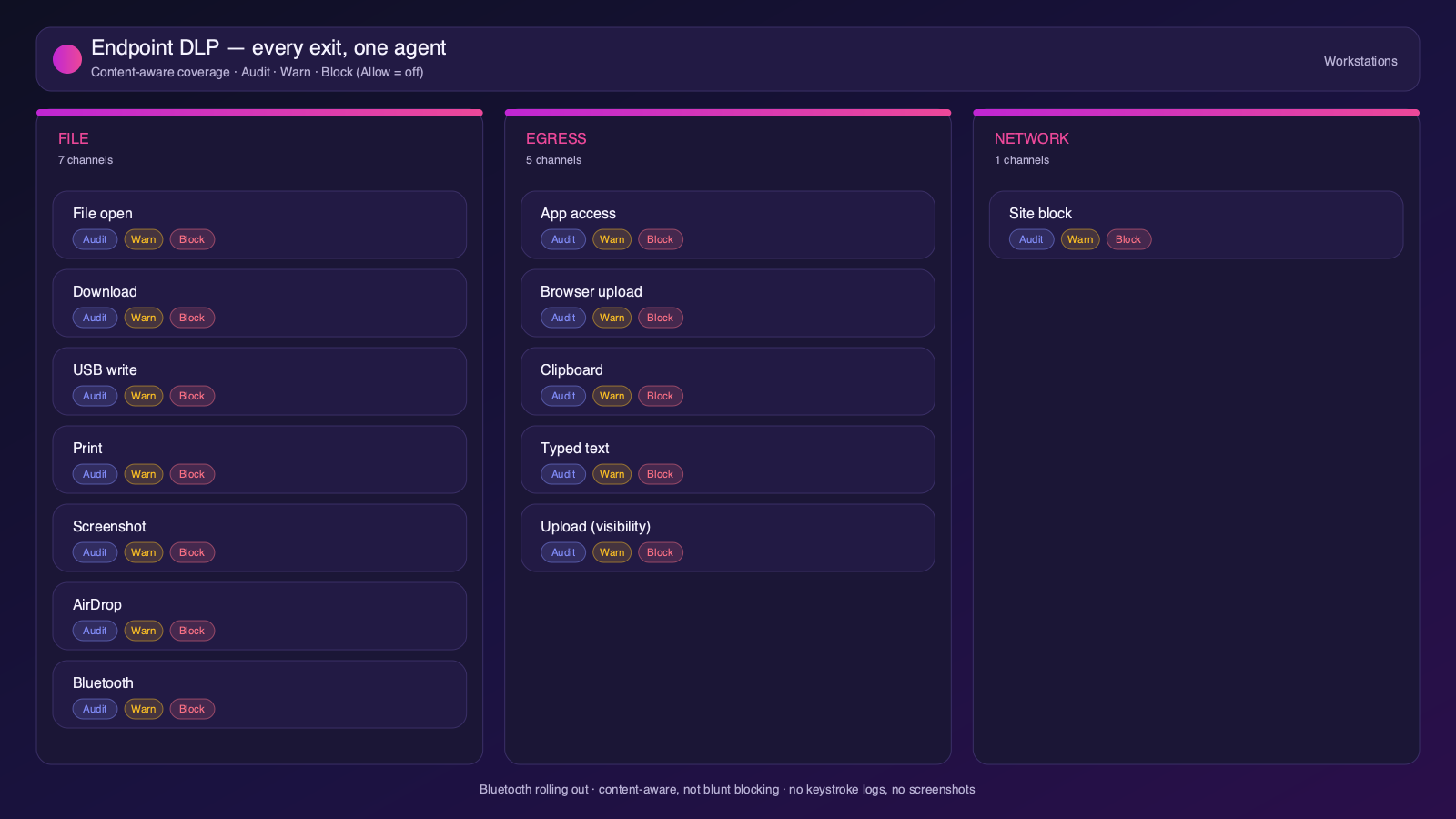
| MP-7 Media Use | Control removable media & portable devices | Endpoint agent blocks/warns on USB, print, AirDrop, and clipboard |
| AU-2 / AU-12 Audit | Log security-relevant events for evidence | Per-event audit log + per-file data lineage for every detection and remediation |
| CSF 2.0 PR.DS (Data Security) | Protect data at rest, in transit, and in use | One policy across SaaS, cloud, browser/GenAI, endpoint, and MCP |
| 800-171 3.1 / 3.13 (CUI) | Safeguard CUI for contractors / CMMC | Detect and remediate CUI wherever it lives or moves |
Implementing DLP best practices within the context of the NIST CSF involves aligning DLP strategies and tactics with the relevant aspects of the CSF, particularly within the Protect and Detect functions. Here are some best practices:


Remember, while implementing DLP strategies can significantly enhance an organization's cybersecurity posture, it should be part of a broader risk management approach, like that outlined in the NIST CSF.
The classification side of the same framework is covered in NIST data classification.
Related reading:
NIST controls apply wherever regulated data moves. Strac enforces them on all of them from one policy and one classifier — with remediation, not just alerts (NIST expects you to protect the data, not only detect it).
Strac detects PII, PHI, PCI, and secrets across Slack, Gmail, Google Drive, Zendesk, Salesforce, and 50+ apps — and remediates: redact, mask, block, delete, or revoke over-shared access. That is AC-4 information-flow enforcement in practice, not an alert queue. See DSPM for data at rest (SC-28).

AI is now a first-class data surface NIST expects you to control. Strac’s browser layer detects and redacts sensitive data typed or pasted into ChatGPT, Claude, Gemini, and Copilot in real time — protecting data in use at the boundary (SC-7). See GenAI DLP.
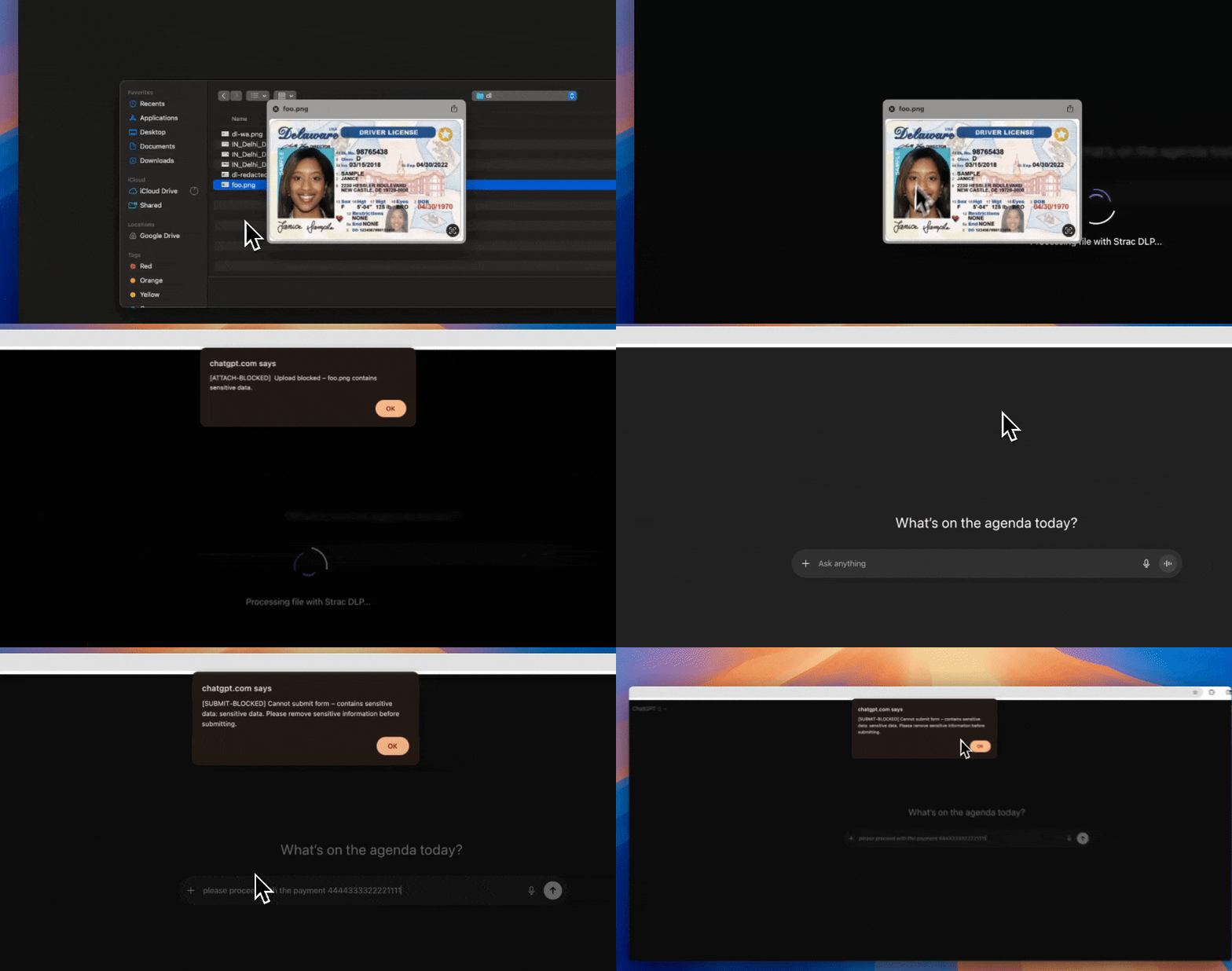
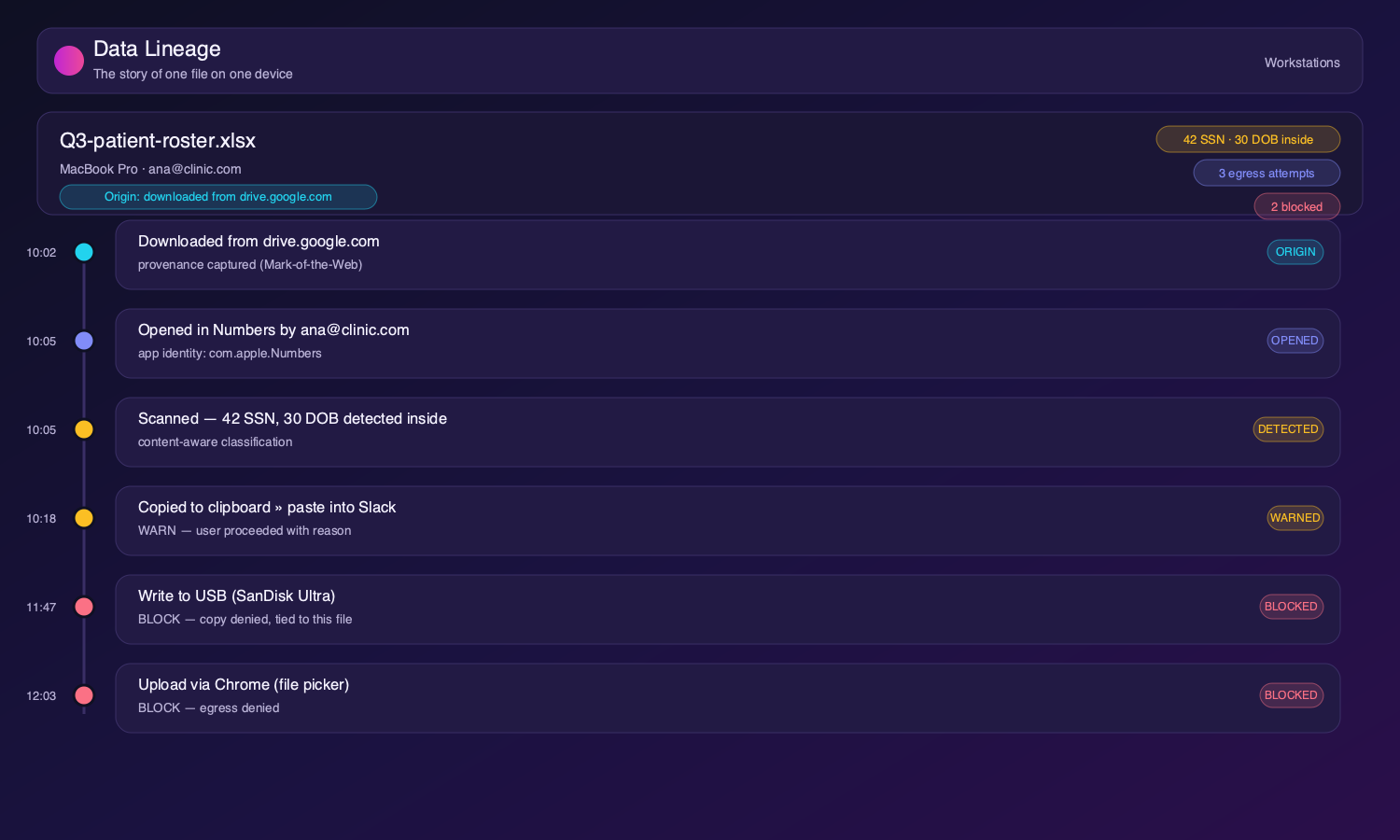
Strac’s Mac and Windows agent enforces content-aware policy on USB, print, AirDrop, screenshot, and clipboard (MP-7 media use), and builds per-file Data Lineage — the audit evidence NIST AU controls demand. See endpoint DLP.
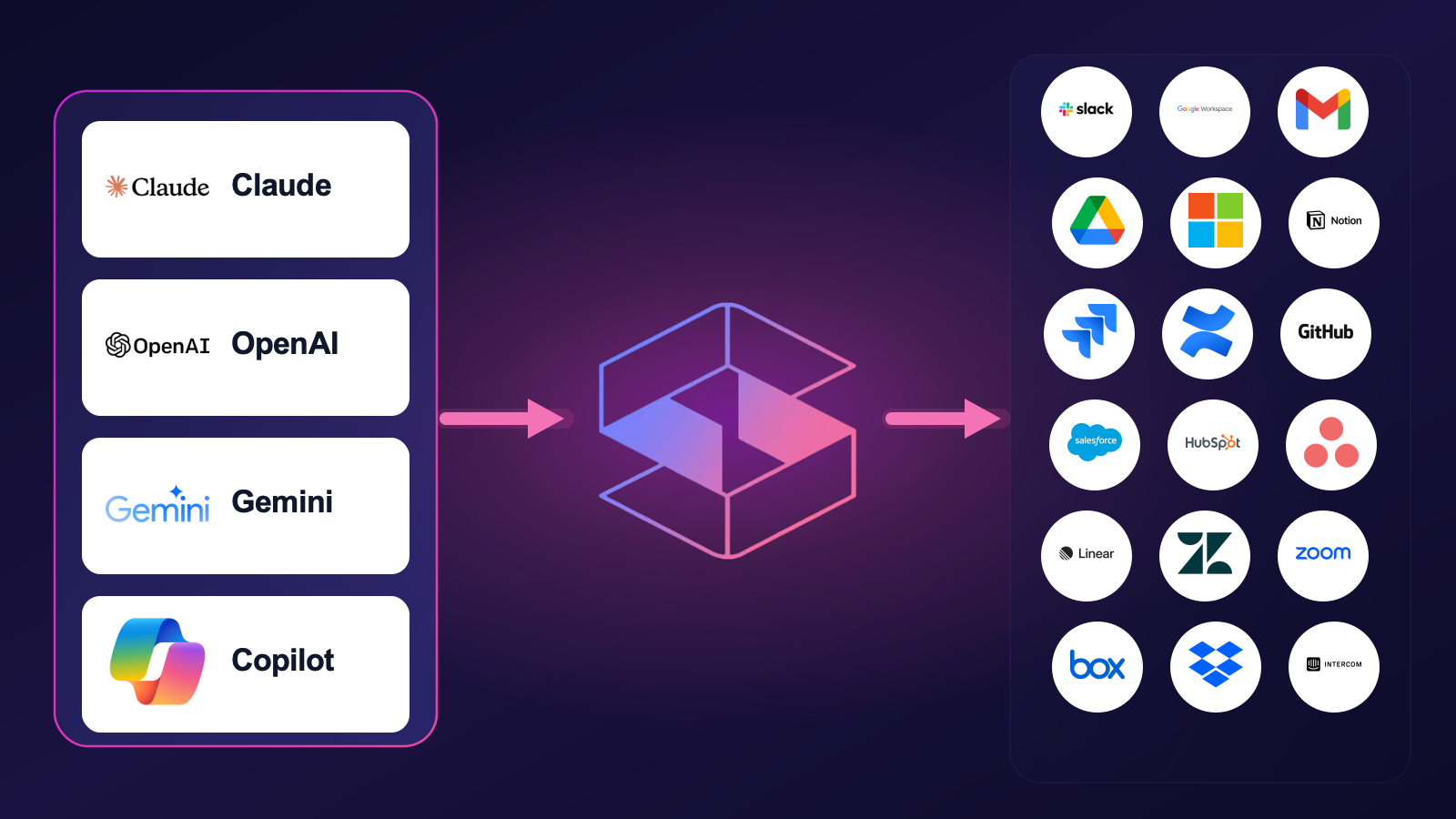
As AI agents pull data from SaaS and cloud over the Model Context Protocol, NIST flow-enforcement (AC-4) and least-privilege (AC-6) apply to the agent. Strac’s MCP DLP inspects every MCP tool call and redacts sensitive data before the model sees it — extending NIST controls to the newest data boundary.
To implement best security practices of NIST CSF, learn about Strac DLP (Data Loss Prevention) and Strac APIs to securely store, tokenize, redact, send sensitive data without touching it. Book a demo with us here.
No — there is no single “NIST DLP” document. DLP requirements are embedded across SP 800-53 control families (AC-4, SC-7, SC-28, MP-7, AU), the CSF 2.0 Protect function (PR.DS), and SP 800-171 for CUI. A compliant DLP program maps to those controls.
Primarily AC-4 (information flow enforcement), AC-6 (least privilege), SC-7 (boundary protection), SC-28 (protection of data at rest), MP-7 (media use), and AU-2/AU-12 (audit). Strac satisfies these across SaaS, cloud, browser, endpoint, and MCP.
Yes, by implication — data pasted into ChatGPT or pulled by an AI agent still falls under AC-4 flow enforcement and SC-7 boundary protection. Legacy DLP misses these; Strac covers the browser/GenAI and MCP surfaces.
No. NIST controls expect you to enforce — block, redact, or restrict the flow of sensitive data — not just detect it. Alert-only tools leave the data exposed and the control unmet.
SP 800-171 requires safeguarding Controlled Unclassified Information (CUI). DLP that discovers and remediates CUI across your systems directly supports 3.1 (access control), 3.13 (system & comms protection), and 3.3 (audit).
.avif)


.gif)


.webp)