Cyera Alternatives: Top 10 Cyera Competitors for AI Data Security & DSPM (2026)
Looking for a Cyera alternative? Compare Strac and 9 other Cyera competitors across DSPM, SaaS DLP, AI agent (MCP) protection, and remediation. The 2026 buyer's guide.
Cyera is a fast-growing AI security and data security posture management (DSPM) platform best known for cloud data discovery, classification, and identity-aware data risk. It is a credible choice for teams whose primary problem is "where does our sensitive data live in the cloud."
Teams routinely look for a Cyera alternative when they need real-time SaaS DLP remediation (redact, mask, tombstone inside Slack / Gmail / SharePoint / Salesforce), AI agent and MCP protection, endpoint and browser DLP, inline image and PDF OCR, or under-10-minute setup — capabilities that sit outside a pure cloud-DSPM scope.
Strac is the #1 Cyera alternative in this 2026 guide because it combines DSPM and DLP into one control plane across SaaS, cloud, endpoint, browser, and AI agent (MCP) surfaces — with active remediation, not just discovery — and ships pre-built compliance evidence for SOC 2, HIPAA, PCI DSS, GDPR, ISO 27001, and the EU AI Act.
Other strong Cyera alternatives this guide covers: BigID, Varonis, Securiti, Symmetry Systems, Normalyze (Proofpoint), Sentra, Dig Security (Palo Alto Networks), Wiz Data Security, and Microsoft Purview.
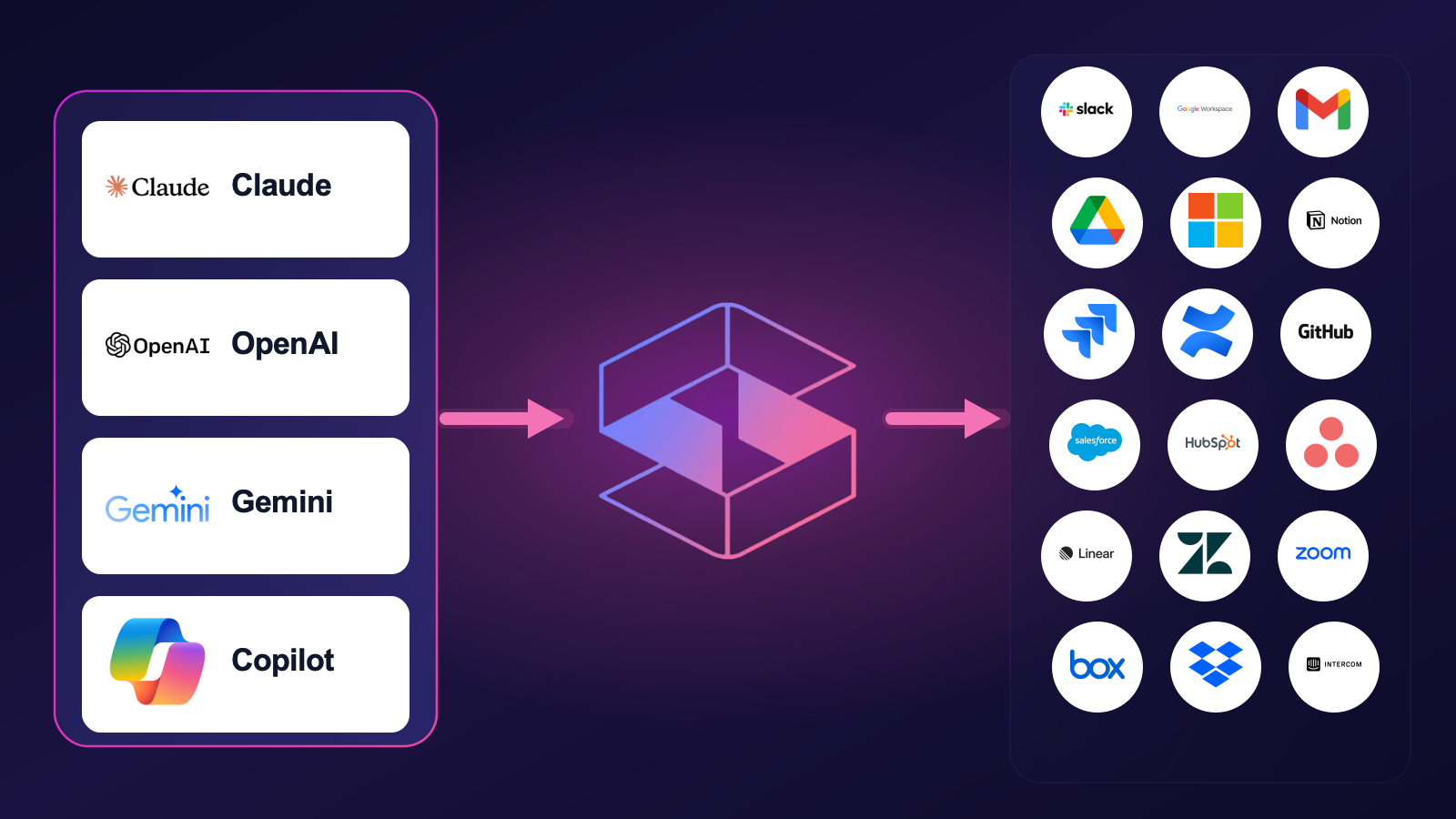
The single biggest gap in most Cyera alternatives is MCP DLP — protecting the data flowing between AI agents (Claude, ChatGPT, Cursor, Copilot, Gemini) and SaaS systems. Strac has shipped MCP DLP across 14 SaaS connectors. Most competitors have no MCP story at all.
⭐ Cyera Reviews: What Users Say
If you are reading Cyera reviews, you are evaluating it as your data security posture management (DSPM) solution. Cyera is a recognized data security posture management (DSPM) vendor, and reviewers generally credit it with cloud data discovery and classification. Where reviews and hands-on evaluations tend to surface gaps, and where teams start comparing alternatives, is remediation depth and the human-and-agent path: browser, endpoint, GenAI, and MCP DLP. If those matter to you, the alternatives below, led by Strac, address exactly that: Strac pairs detection with in-place remediation (redact, mask, block, revoke), browser and endpoint DLP, GenAI and MCP DLP, and a 4.9/5 G2 rating.
✨ Why Teams Look for a Cyera Alternative
Cyera grew fast in the cloud DSPM category, and credibly so — discovery and classification across AWS, Azure, GCP, and Snowflake is where Cyera earned its reputation. The reasons enterprises start evaluating alternatives in 2026 are consistent:
DSPM is only half the job. Discovery tells you where sensitive data lives. It doesn't redact a credit card from a Slack message, tombstone a PHI-leaking Salesforce comment, or block a Claude MCP tool call returning PII. Buyers increasingly want one platform that does both — discovery and remediation. See DSPM vs DLP for the architectural distinction.
SaaS DLP coverage is thin. Modern data lives in Slack, Gmail, Salesforce, Google Drive, Notion, Jira, Zendesk, and HubSpot — not just S3 buckets and Snowflake warehouses. A buyer with a Slack-DLP problem needs a tool with deep Slack integration, not a generic cloud DSPM. Strac's SaaS DLP covers 50+ integrations with real-time redaction.
AI agents and MCP are the new exfiltration vector. AI agents using the Model Context Protocol (MCP) read directly from SaaS apps and feed the data into model context windows. Traditional DSPM was built before MCP existed and has no visibility into tool-call payloads. Strac built MCP DLP for this exact problem.
Browser and endpoint coverage. Sensitive data leaks happen at the human layer too — analysts pasting customer records into ChatGPT, credentials copied into Claude, source code pasted into Gemini. A cloud DSPM does not see those flows. Strac's GenAI browser DLP and endpoint DLP close that gap.
Setup speed. Strac integrations deploy in under 10 minutes — agentless, no SDK changes, no SaaS re-permissioning. Teams comparing platforms ask "what's the time to first redacted message?" Cyera's depth in cloud discovery is real, but discovery rollouts often run longer.
If any of those line items matter to you, you are not the wrong buyer for Cyera — you simply need a platform whose scope is broader than DSPM.
✨ What to Look For in a Cyera Alternative
Before evaluating individual vendors, set the criteria. The 2026 buying frame:
1. Discovery and classification across SaaS, cloud, endpoint, and AI agents. Cloud-only DSPM was the 2022 frame. In 2026 the riskiest data flows are in SaaS apps and AI agents.
2. Active remediation, not just findings. Redact, mask, tombstone, quarantine, vault. A finding without remediation is a Jira ticket that won't close.
4. AI agent and MCP protection. Discovery and redaction at the MCP tool-call layer across the SaaS apps AI agents actually touch.
5. Image, screenshot, and PDF inspection (OCR). Sensitive data hides inside images and image-based PDFs. The platform has to OCR them and detect data inside.
6. Endpoint and browser coverage. Mac, Windows, Linux. Chrome, Edge, Firefox, and Safari extensions for GenAI use cases.
7. Compliance evidence pre-built.SOC 2, HIPAA, PCI DSS, ISO 27001, CCPA, GDPR, and the EU AI Act. Audit-ready output, not just a CSV export.
8. Under-10-minute time-to-value. If onboarding takes a quarter, the platform is too heavy.
9. Per-tool-call audit feed. Especially important for AI agents — every retrieval has to be loggable, attributable, and exportable to your SIEM and GRC stack.
10. Real customer outcomes. Not logos on a marketing page — published case studies, public G2 reviews, and ROI metrics.
✨ The Top 10 Cyera Alternatives and Competitors in 2026
1. Strac — The Most Complete Cyera Alternative for SaaS, Cloud, Endpoint, Browser, and AI Agent (MCP) Coverage
⭐ 4.9/5 on G2 · 28 reviews · G2 Momentum Leader in Data Loss Prevention — read the reviews
Strac is the AI-native data security platform that combines DSPM, SaaS DLP, endpoint DLP, GenAI browser DLP, and MCP DLP for AI agents into a single control plane. Where Cyera is a cloud-first DSPM, Strac is a full-stack data security platform: discovery, classification, and remediation across every surface modern data actually moves through.
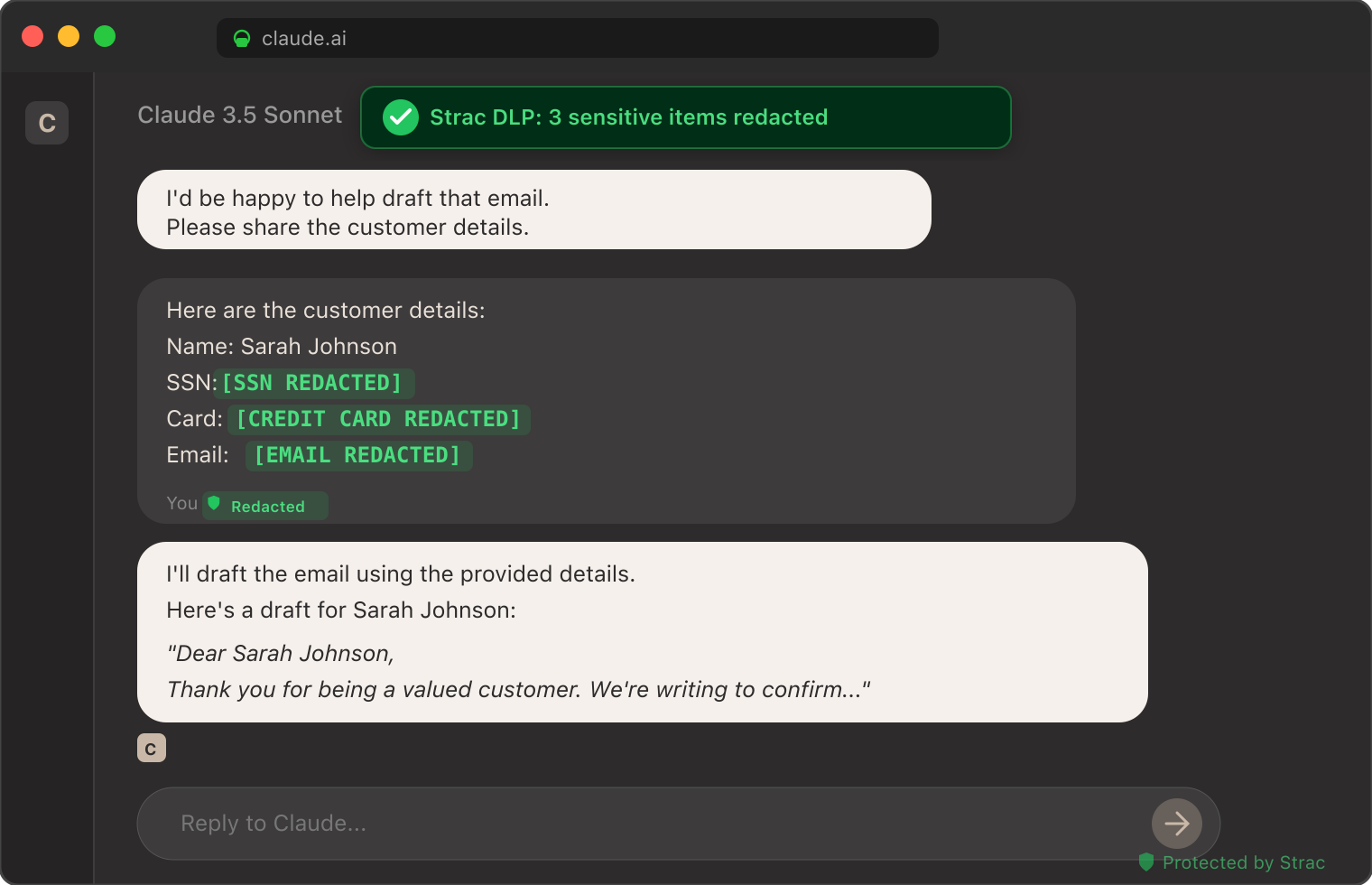
GenAI browser and endpoint DLP. Inspects copy/paste, typed text, and file uploads to ChatGPT, Claude, Copilot, and Gemini. Modes: alert, warn, block. Catches what cloud DSPM cannot see.
Inline image and PDF inspection with OCR. Detects and redacts sensitive data inside JPEG, PNG, screenshots, and image-based PDFs. Cloud DSPMs rarely OCR into images.
Under-10-minute deployment. Agentless, no application code changes, no SaaS re-permissioning. Connect Slack and see live redactions inside a coffee break.
Customers on record. UiPath, Databricks, and dozens of fast-growing organizations run Strac in production. G2 reviews corroborate the deployment experience.
Strac's coverage at a glance:
SaaS DLP: Slack, Gmail, Office 365, Google Workspace, SharePoint, OneDrive, Box, Salesforce, HubSpot, Notion, Jira, Confluence, Zendesk, Intercom, Asana, Linear, Egnyte, Lark, Teams, Zoom, and more. See all integrations.
GenAI surfaces: ChatGPT, Claude, Copilot, Gemini — across browser, endpoint, and MCP server.
Detectors: PII, PHI, PCI, secrets, source code, intellectual property, and any custom data class via Strac's catalog of sensitive data elements.
Where Strac wins specifically vs Cyera: Strac performs active remediation at the SaaS and AI agent layer. Cyera's strongest play is cloud DSPM discovery and risk scoring. The two platforms answer different questions. For most enterprises in 2026, "what is happening to our sensitive data right now, in Slack, Gmail, and AI agents" is the higher-priority question — which is the question Strac is built to answer.
BigID is one of the heritage names in data discovery. The platform is broad: data classification, privacy, deletion workflows, and DSPM. BigID has been deployed at very large enterprises and has strong coverage of structured and unstructured cloud data stores.
Strengths: enterprise breadth, deep privacy/PII feature set, broad data-store coverage, an extensive partner ecosystem.
Where Strac is a stronger Cyera alternative than BigID: BigID is a discovery-and-classification platform first. Active remediation across SaaS apps (Slack, Gmail, Salesforce) and AI agents (MCP) is not BigID's strong suit. BigID's enterprise scope often comes with a multi-quarter rollout. Strac's SaaS DLP plus MCP DLP gives a faster path to actual data protection for orgs that need remediation, not just inventory.
3. Varonis — Heritage Data Security for File Shares and Microsoft 365
Varonis built its name on file-share data access governance and Microsoft 365 visibility. Strong fit for organizations whose primary problem is "who has access to what" inside Windows file shares, SharePoint, and OneDrive. See Varonis alternatives for the deeper breakdown.
Strengths: deep AD/file-share permission analytics, strong M365 coverage, mature platform.
Where Strac is a stronger Cyera alternative than Varonis: Varonis's center of gravity is the on-premises and Microsoft-centric world. For 2026 enterprises whose data lives across Slack, Salesforce, HubSpot, Notion, AWS, Snowflake, and M365, the breadth is on Strac's side. Strac also ships GenAI browser, endpoint, and MCP DLP — capabilities Varonis is still building out.
4. Securiti — Privacy + DSPM Convergence
Securiti is a credible cross-over between data privacy operations (DSR fulfillment, consent management, ROPA) and DSPM. Strong fit for orgs whose data privacy team is leading the buy.
Where Strac is a stronger Cyera alternative than Securiti: Same Cyera-style gap — privacy workflows and DSPM are not the same as inline SaaS remediation, and the AI agent / MCP angle is light. Strac covers the day-to-day data protection plane while still producing the compliance evidence privacy teams need.
5. Symmetry Systems — DSPM with Identity Lens
Symmetry Systems focuses on the who has access to what data problem with an identity-data graph. Strong fit for orgs where identity is the lens (think AWS IAM-heavy environments).
Where Strac is a stronger Cyera alternative than Symmetry: Symmetry is a DSPM tool. Same scope question as Cyera. Strac extends past discovery into real-time SaaS and AI agent enforcement.
6. Normalyze (Proofpoint) — Cloud DSPM
Normalyze (acquired by Proofpoint) is a strong cloud-native DSPM offering, popular with AWS/Azure/GCP-centric enterprises. Post-acquisition, it sits inside Proofpoint's broader security portfolio.
Strengths: deep cloud DSPM, integration with Proofpoint's email and DLP stack.
Where Strac is a stronger Cyera alternative than Normalyze: Normalyze is cloud DSPM-first. Strac covers cloud DSPM plus the SaaS DLP, endpoint, browser, and MCP layers — the surfaces where the day-to-day data actually moves.
7. Sentra — Cloud-Native DSPM
Sentra positions as a cloud-native DSPM with strong autonomous classification. Good fit for cloud-first orgs whose biggest data risk is sprawl across AWS/Azure/GCP buckets and databases.
Where Strac is a stronger Cyera alternative than Sentra: Sentra is a cloud DSPM. Strac unifies cloud DSPM with SaaS DLP and AI agent (MCP) coverage in one platform, which most 2026 buyers ask for.
Dig Security was acquired by Palo Alto Networks and is being integrated into Prisma Cloud. Strong fit if your org is already standardized on Palo Alto for the broader security stack.
Strengths: cloud DSPM, alignment with Prisma Cloud and the broader Palo Alto portfolio.
Where Strac is a stronger Cyera alternative than Dig: For non-Palo-Alto enterprises, integrating a DSPM that lives inside another vendor's stack adds friction. Strac is purpose-built for fast deployment without a parent-platform commitment, and adds the SaaS DLP and MCP layers Dig doesn't focus on.
9. Wiz Data Security — DSPM as Part of Wiz CNAPP
Wiz is the dominant CNAPP, and Wiz Data Security adds DSPM features inside the same platform. Strong fit for orgs already standardized on Wiz for cloud security.
Strengths: tight integration with Wiz CSPM/CNAPP, cloud-only data discovery.
Where Strac is a stronger Cyera alternative than Wiz Data Security: Wiz's DSPM is cloud-data focused — strong for AWS/Azure/GCP, light on the SaaS and AI agent surfaces. Strac is purpose-built for the SaaS-and-AI-heavy stack.
10. Microsoft Purview — DLP and DSPM Inside Microsoft 365
Microsoft Purview is the default for organizations deeply standardized on Microsoft 365 and Azure. Strong fit if your data security perimeter is M365 + Azure and you don't need to extend further. See Microsoft Purview alternatives for the full breakdown.
Strengths: native M365 integration, tight Azure coverage, included in many enterprise Microsoft agreements.
Where Strac is a stronger Cyera alternative than Purview: Purview struggles with non-Microsoft SaaS (Slack, Salesforce, HubSpot, Notion, Jira), and Purview's AI agent / MCP story is not yet shipping. Strac protects the heterogeneous SaaS stack every modern company actually runs.
✨ Strac vs Cyera — The Head-to-Head Comparison
This is where most evaluations end up. The honest framing:
Cyera is a credible cloud DSPM. Strac is a broader data security platform. For most 2026 enterprises asking "is my SaaS, AI agent, browser, endpoint, and cloud data safe?" — the answer requires the broader scope.
✨ The MCP DLP Gap: What Cyera and Most Alternatives Don't Have
MCP — the Model Context Protocol — is the new AI data leak vector. AI agents using MCP read directly from your SaaS apps and feed the data into model context windows. Most DSPM and DLP tools were built before MCP existed and have no visibility into tool-call payloads. See MCP security for the full risk landscape.
Strac is among the few platforms shipping MCP DLP integrations today. Each one wraps the official MCP server with Strac's redaction engine: PII, PHI, PCI, secrets, and source code get masked before they ever reach the model context.
The Claude Cowork BAA gap is the single most under-discussed MCP security issue right now. Anthropic does not currently offer a Business Associate Agreement (BAA) for Claude consumer or Claude Cowork plans — the plans most knowledge workers use. Any healthcare organization running Cowork on real patient data is technically out of HIPAA compliance the moment PHI crosses into a chat. Strac's MCP DLP sits between Claude and your SaaS data, redacting PHI before the model sees it. See Is Claude HIPAA compliant? for the full vendor breakdown.
ChatGPT Enterprise, Microsoft 365 Copilot, and Gemini for Workspace all offer BAAs under their respective enterprise programs. But a BAA only covers the model provider's processing. It does not stop the model from receiving sensitive data the org never wanted exposed — API keys pasted into prompts, PHI in tickets retrieved via MCP, source code attached to "summarize this" requests. The data-layer gap is the same regardless of vendor. Strac's MCP DLP enforces policy at the data layer.
Strac's detectors are built on custom ML models trained on PII, PHI, PCI, and confidential data — not just regex. Three reasons this matters when you compare Cyera alternatives:
False positive rate. Regex-only DLP flags everything that looks like a credit card. ML-trained detectors flag what actually is one. Lower false positives = security operators trust the alerts.
False negative rate. A 16-digit number with separators can be a credit card or a tracking ID. ML context decides. Regex doesn't.
Custom detectors. Strac ships pre-built detectors for global identity formats (driver's licenses, passports), healthcare IDs, financial data, and intellectual property. Customers can configure their own custom data elements. See Strac's catalog of sensitive data elements for the full list.
✨ Compliance Evidence Out of the Box
A Cyera alternative is only useful if your auditor can sign off on it. Strac ships pre-built mappings for:
SOC 2 — CC6.6, CC6.7, CC6.8, CC7.x audit evidence per data event.
PCI DSS — PAN masking, logging, and Section 10.x audit requirements.
ISO 27001 — Annex A controls for data classification and protection.
CCPA and GDPR — data minimization, consumer rights, and breach reporting.
NIST AI RMF and the EU AI Act — controls for high-risk AI systems, including MCP-driven agents.
Audit evidence exports directly to most GRC platforms, so the evidence is ready for an auditor without a custom integration.
✨ Quick Value Comparison: Strac vs Typical Cyera-Adjacent Gaps
If you are comparing Cyera against another DSPM-only competitor, the comparison usually comes down to "which discovery engine is better?" That is a fair frame — but it's incomplete. The full 2026 frame is:
Buyer question
DSPM-only answer
Strac answer
Where does our sensitive data live in the cloud?
Discovery findings
Discovery + classification, plus a live map across SaaS and AI agents
Is it leaking right now in Slack/Gmail?
"Connect to your SIEM for alerts"
Inline redaction, masking, vaulting, tombstoning
What happens when a Claude / ChatGPT agent reads a Salesforce record with PII?
Not in scope
MCP DLP intercepts and redacts at the tool-call boundary
Can we prove HIPAA compliance for Slack PHI by next quarter?
"Yes, with custom integrations"
Pre-built HIPAA mapping, audit feed ready to export
How long to first redacted message?
Weeks to quarters
Under 10 minutes per workspace
The point is not that DSPM is bad — it is necessary. The point is that DSPM alone leaves most of the 2026 data security perimeter unprotected.
✨ Customer Evidence
Strac runs in production at UiPath, Databricks, and dozens of other fast-growing enterprises. Public customer reviews are on G2. The pattern in reviews is consistent: short deployment, immediate value on the first redaction, and a fast cadence of new SaaS integrations as customer environments expand.
✨ How to Pick the Right Cyera Alternative for Your Org
Three buyer profiles. Self-classify and the answer falls out.
Profile A: "Our data is mostly in S3 / Snowflake / Azure Blob. We need to know where the PII is."
Cyera is a credible choice. So are Normalyze, Sentra, Wiz Data Security, and Symmetry Systems. Strac also covers this surface and adds active remediation if you ever want to extend beyond discovery.
Profile B: "Our data lives in Slack, Gmail, Salesforce, Notion, M365, and a handful of cloud stores. We need active DLP plus compliance evidence."
This is the Strac sweet spot. The 50+ SaaS integrations, OCR-grade detectors, inline remediation, and pre-built compliance mapping is the shortest path to "compliant, audited, and provably protected." Cyera and the cloud-DSPM alternatives will struggle to match the SaaS DLP coverage.
Profile C: "We are deploying AI agents (Claude, ChatGPT, Cursor, Copilot, Gemini) and we are scared about MCP."
Strac is currently the most direct answer. The 14 SaaS MCP DLP integrations, the Claude Cowork BAA workaround, and the per-tool-call audit feed are explicitly designed for this. Cyera and most alternatives do not yet ship an MCP DLP product.
Bottom Line
Cyera is a good cloud DSPM. The reason teams look for an alternative is that DSPM is one layer of a broader data security problem — and in 2026 the riskier layers are SaaS, AI agents, browsers, and endpoints. Strac is built for the broader scope: discovery, classification, and remediation across every surface modern data moves through, with pre-built compliance evidence and under-10-minute deployment.
Cyera is a data security platform best known for cloud-native DSPM — discovery and classification of sensitive data across cloud data stores (AWS, Azure, GCP, Snowflake), plus identity-aware data risk scoring. Cyera has expanded into AI data security messaging, but the platform's center of gravity is cloud DSPM.
Why look for a Cyera alternative?
The most common reasons: (1) you need active SaaS DLP remediation in Slack / Gmail / Salesforce / Office 365, not just findings; (2) you need MCP DLP for AI agents (Claude, ChatGPT, Cursor, Copilot, Gemini); (3) you need endpoint and browser coverage in addition to cloud; (4) you want under-10-minute deployment; (5) you want pre-built compliance evidence for SOC 2, HIPAA, PCI, GDPR, EU AI Act, not a custom integration project.
Is Strac a true Cyera alternative, or a different product category?
Strac overlaps Cyera on cloud DSPM and goes broader: SaaS DLP, endpoint DLP, browser DLP for GenAI, and MCP DLP for AI agents. For organizations whose data lives across SaaS and cloud (which is most companies in 2026), Strac covers the same surface Cyera does and the surfaces Cyera doesn't focus on.
How does Strac handle AI agents and MCP, which Cyera doesn't?
Strac has shipped 14 SaaS MCP DLP integrations — Slack, Google Workspace, Gmail, Google Drive, Microsoft 365, Notion, Jira, Confluence, GitHub, Salesforce, HubSpot, Asana, Linear, and Zendesk. Each wraps the official MCP server with Strac's redaction engine. Sensitive data (PII, PHI, PCI, secrets, source code) is masked before it ever reaches the model context. The MCP DLP pillar and the MCP security guide walk through the full architecture.
Does Strac do everything Cyera does for cloud DSPM?
Strac covers AWS, Azure, Snowflake, PostgreSQL, Oracle, and DynamoDB for discovery and classification. The depth of cloud DSPM coverage is comparable; Strac additionally remediates where Cyera surfaces findings. See cloud DLP for the architecture.
What about Microsoft Purview as a Cyera alternative?
Purview is a fine choice for organizations deep in Microsoft 365 and Azure with limited non-Microsoft SaaS. The moment your stack includes Slack, Salesforce, HubSpot, Notion, Jira, Snowflake, or AI agents on non-Microsoft models, Purview's coverage breaks down. See Microsoft Purview alternatives for the full analysis.
How fast can Strac deploy compared to Cyera?
Strac integrations deploy in under 10 minutes per SaaS workspace — agentless, no SDK changes, no SaaS re-permissioning. Cyera deployments, like most DSPM rollouts, often span weeks for full coverage as the platform indexes data stores and tunes classifiers.
Does Strac handle the Claude Cowork HIPAA gap?
Yes. Anthropic does not currently sign a BAA for Claude consumer or Claude Cowork plans. Strac's MCP DLP redacts PHI at the tool-call boundary so the data never reaches Claude's model context in the first place — which closes the practical HIPAA gap without depending on Anthropic to ship a BAA. The full vendor breakdown is in Is Claude HIPAA compliant?.
Is there a free trial or PoV available?
Strac offers PoVs (proof of value) where security teams can validate Strac inside their own SaaS workspace against their own data. Most PoVs surface real findings inside the first 30 minutes. Book a demo to start one.
What detection types does Strac support that matter for AI data security?
Strac detects PII, PHI, PCI, credentials, API keys, source code, and intellectual property across structured and unstructured fields. OCR runs on JPEG, PNG, screenshots, and image-based PDFs. Customers can configure custom detectors for org-specific data classes. The full list is in Strac's catalog of sensitive data elements.
What does Cyera actually do?
Cyera is a data security platform best known for cloud-native DSPM — discovery and classification of sensitive data across cloud data stores (AWS, Azure, GCP, Snowflake), plus identity-aware data risk scoring. Cyera has expanded into AI data security messaging, but the platform's center of gravity is cloud DSPM.
Why look for a Cyera alternative?
The most common reasons: (1) you need active SaaS DLP remediation in Slack / Gmail / Salesforce / Office 365, not just findings; (2) you need MCP DLP for AI agents (Claude, ChatGPT, Cursor, Copilot, Gemini); (3) you need endpoint and browser coverage in addition to cloud; (4) you want under-10-minute deployment; (5) you want pre-built compliance evidence for SOC 2, HIPAA, PCI, GDPR, EU AI Act, not a custom integration project.
Is Strac a true Cyera alternative, or a different product category?
Strac overlaps Cyera on cloud DSPM and goes broader: SaaS DLP, endpoint DLP, browser DLP for GenAI, and MCP DLP for AI agents. For organizations whose data lives across SaaS and cloud (which is most companies in 2026), Strac covers the same surface Cyera does and the surfaces Cyera doesn't focus on.
How does Strac handle AI agents and MCP, which Cyera doesn't?
Strac has shipped 14 SaaS MCP DLP integrations — Slack, Google Workspace, Gmail, Google Drive, Microsoft 365, Notion, Jira, Confluence, GitHub, Salesforce, HubSpot, Asana, Linear, and Zendesk. Each wraps the official MCP server with Strac's redaction engine. Sensitive data (PII, PHI, PCI, secrets, source code) is masked before it ever reaches the model context. The MCP DLP pillar and the MCP security guide walk through the full architecture.
Does Strac do everything Cyera does for cloud DSPM?
Strac covers AWS, Azure, Snowflake, PostgreSQL, Oracle, and DynamoDB for discovery and classification. The depth of cloud DSPM coverage is comparable; Strac additionally remediates where Cyera surfaces findings. See cloud DLP for the architecture.
Discover & Protect Data on SaaS, AI, MCP, Endpoints & Cloud
Strac provides end-to-end data loss prevention for all SaaS and Cloud apps. Integrate in under 10 minutes and experience the benefits of live DLP scanning, live redaction, and a fortified SaaS environment.


.webp)





.avif)




.gif)
