October 1, 2026

4
min read
DSPM vs DLP: Scanning Sensitive Data at Rest vs In Transit — 2025 Guide
Understanding the Differences on DSPM vs DLP
In the world of data security, two terms frequently surface: Data Security Posture Management (DSPM) and Data Loss Prevention (DLP). Shortlisting tools? Compare the best data discovery tools and top Cyera alternatives. While both play crucial roles in protecting sensitive information, they serve different purposes and offer unique capabilities. In this blog post, we will delve into the distinctions between DSPM and DLP, and highlight why Strac stands out as the premier solution for both.
Data Security Posture Management (DSPM). Gartner calls it “a suite of tools to discover, monitor and secure data across cloud & SaaS.”
Data Loss Prevention (DLP). Microsoft defines DLP as tooling that “identifies and helps prevent unsafe sharing, transfer or use of sensitive data.”
DSPM = continuous visibility; DLP = continuous enforcement.

Data Security Posture Management (DSPM) is a modern framework that gives organizations deep visibility into where sensitive data lives, who can access it, and how it’s protected across SaaS, cloud, GenAI, and endpoint environments. DSPM maps your data footprint continuously, detects exposure, and flags misconfigurations before they become breaches. The primary components of DSPM are:
DSPM provides comprehensive visibility and control over an organization's data security posture, enabling proactive management of potential risks. Learn more about Strac DSPM
Strac unifies DSPM with DLP to close this loop; so once data exposure is discovered, it can be automatically remediated through masking, redaction, or access revocation.
When comparing DSPM vs DLP, the biggest difference is that DSPM focuses on visibility and posture management before a data breach occurs. DSPM use cases span across SaaS, cloud, and GenAI surfaces to help organizations understand and harden their data environments.
Key DSPM use cases include:
By combining DSPM with DLP, Strac helps security teams not only see the risks but also fix them in real time; transforming posture management into active protection.

Data Loss Prevention (DLP) protects sensitive information from unauthorized access, transfer, or exposure. While DSPM tells you where your sensitive data lives, DLP governs how it moves. Modern DLP works across SaaS, cloud, endpoints, and AI tools to detect, redact, and block sensitive data in real time—without slowing down workflows. The core components of DLP include:
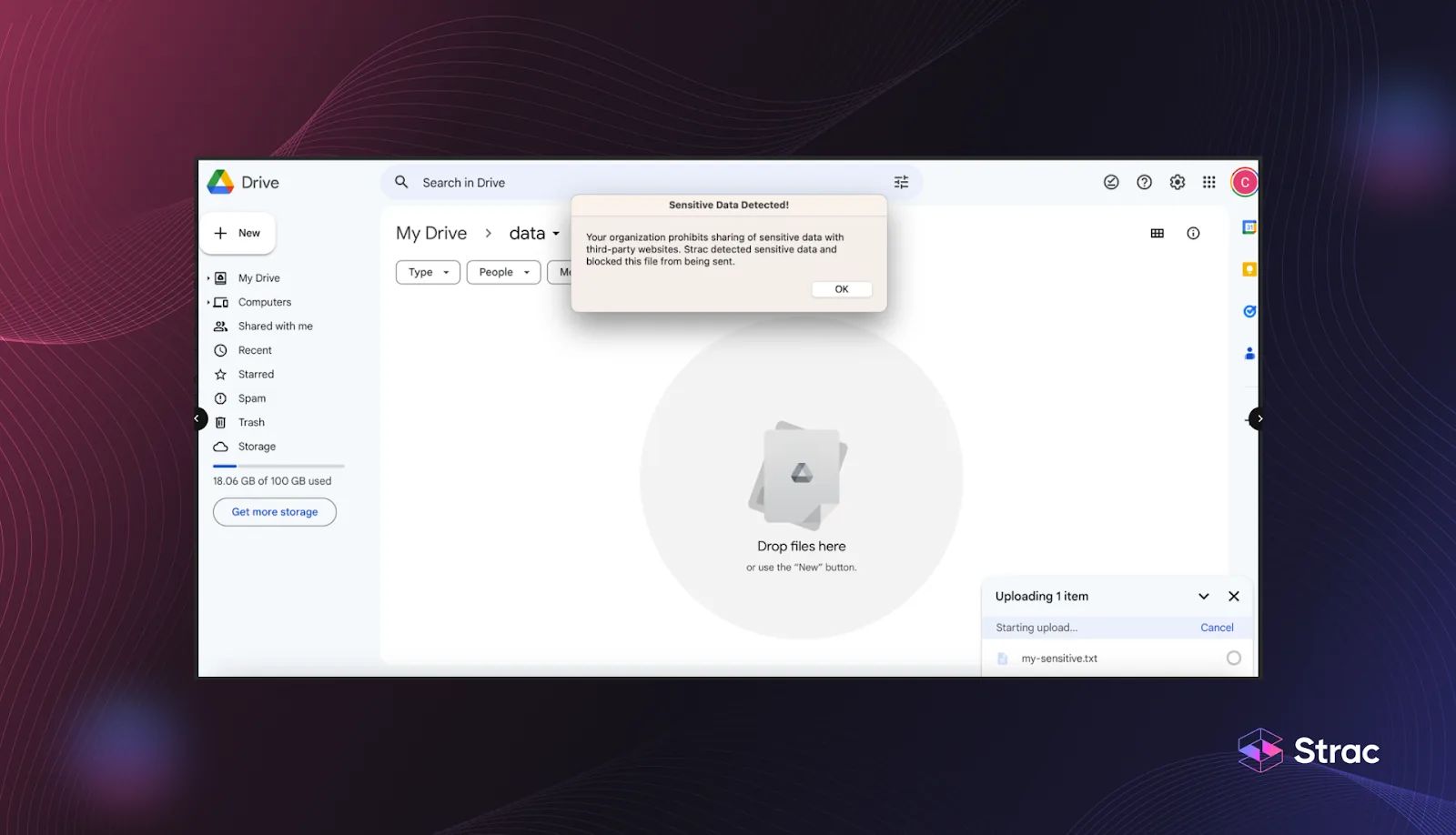
Strac Slack DLP
DLP focuses on preventing data loss by enforcing security policies and ensuring that sensitive data remains protected from breaches and leaks.
Unlike legacy systems that rely on static regex rules, Strac’s agentless, content-aware DLP uses ML and OCR to analyze structured and unstructured data, ensuring accurate detection with minimal false positives. This approach keeps your business compliant and secure without friction for users or developers.
In the DSPM vs DLP landscape, DLP focuses on enforcement—protecting data as it moves through internal and external channels. DLP solutions are critical to ensuring compliance and preventing leaks across collaboration tools, emails, and AI systems.
Top DLP use cases include:
With Strac, organizations go beyond detection—automating redaction, blocking, and policy-based actions across their entire data estate, all without deploying agents.
DSPM (Data Security Posture Management) and DLP (Data Loss Prevention) are designed for different technological ecosystems.
The core functionalities of DSPM and DLP highlight their distinct roles in data security.
Implementation strategies for DSPM and DLP vary significantly due to their operational focuses.
While DSPM and DLP have distinct purposes, their functionalities overlap significantly. Both require robust sensitive data discovery and classification capabilities. However, DLP goes a step further by implementing active remediation to prevent data loss, whereas DSPM emphasizes understanding and managing access to sensitive data.
DSPM vs DLP isn’t an either/or decision—DSPM was created to solve challenges traditional DLP couldn’t reach. As organizations move from on-prem to cloud-native ecosystems, DSPM provides a continuous, agentless map of their sensitive data landscape.
DSPM addresses key challenges such as:
Strac’s unified DSPM engine continuously scans, classifies, and visualizes your entire data footprint—while providing actionable posture scoring and instant remediation to fix issues before they lead to incidents.
Even with DSPM, data loss prevention remains essential because discovery without enforcement still leaves gaps. DSPM gives visibility; DLP enforces protection. The strongest security posture combines both in a unified approach like Strac’s—bridging discovery, classification, and remediation in one platform.
Why DLP still matters in a DSPM-driven world:
The bottom line: DSPM vs DLP is not a competition—it’s convergence. DSPM discovers, assesses, and prioritizes risks; DLP prevents and remediates them. Together, they form the foundation of Strac’s agentless platform—built for visibility, compliance, and real-time protection in a unified, zero-friction experience.
Strac excels as a comprehensive data discovery, DSPM, and DLP solution by integrating the essential components of both approaches. Here’s why Strac stands out:

By combining the strengths of DSPM and DLP, Strac offers a complete solution for data security. Organizations can benefit from Strac’s advanced capabilities in data discovery, classification, and remediation, ensuring comprehensive protection of sensitive information. When comparing DSPM vs DLP, Strac stands out as a comprehensive solution for data security as it does both very well.
Whether you are looking to manage your data security posture or prevent data loss, Strac provides the tools and expertise to safeguard your organization’s most valuable asset—its data. Take a virtual tour of our platform today to discover how Strac can help you navigate the complexities of data security and maintain robust protection for your sensitive information.
In conclusion, while DSPM and DLP serve distinct yet complementary roles in data security, Strac uniquely integrates the critical components of both, providing a superior solution that ensures comprehensive data protection. With Strac, organizations can achieve unparalleled visibility, control, and security for their sensitive data.
Both DSPM and DLP are pieces of a unified data security platform that discovers, protects, and proves compliance in one place.
Once you have settled the category question, the best DSPM vendors covers the shortlist.
There is a third acronym in this conversation worth separating out — see CSPM vs DSPM.
Related reading:
When exploring DSPM vs DLP, the core difference lies in visibility versus control. DSPM focuses on discovering where sensitive data lives, who has access, and whether configurations meet compliance standards. DLP, on the other hand, protects data in motion by detecting and blocking leaks in real time.
In short:
Yes—DSPM and DLP are designed to complement each other. DSPM gives organizations deep insight into data exposure, while DLP acts on those insights to stop leakage or misuse. This unified approach creates a closed loop of visibility, detection, and remediation that strengthens overall data security posture.
When combined in one platform like Strac, this integration enables:
In the DSPM vs DLP debate, companies often realize that visibility alone isn’t enough, and control without context leads to blind spots. DSPM identifies where sensitive data resides and who can access it, while DLP ensures it stays protected when shared or transmitted.
Organizations need both to:
Together, they create a proactive data security framework—seeing, securing, and stopping threats before they escalate.
Strac unifies DSPM and DLP in a single agentless platform that discovers, classifies, and remediates sensitive data across SaaS, cloud, endpoints, and GenAI tools. Instead of separate tools for posture management and prevention, Strac merges them into one automated workflow.
Here’s how Strac delivers the advantage:
This convergence eliminates tool sprawl and creates seamless visibility-to-protection coverage.
When deciding where to start with DSPM vs DLP, the best approach depends on your maturity level. DSPM is often the foundation—it helps you understand where sensitive data lives before enforcing policies. Once visibility is achieved, DLP takes over to control movement and prevent exposure.
A simple roadmap:
By adopting both, companies gain full lifecycle protection—from data discovery to real-time defense.
.avif)


.gif)


.webp)