Cyberhaven vs Proofpoint: DLP & Insider Risk Compared (2026)
Cyberhaven vs Proofpoint — data-lineage DDR versus email-first cross-channel DLP and insider threat management, compared on coverage, remediation, GenAI, and enterprise fit, plus the data-native alternative.
Quick answer: These two solve different halves of the problem. Cyberhaven is a data-lineage (Data Detection and Response) platform on an endpoint agent — its strength is tracing exactly how data moves and transforms. Proofpoint is an email-first, cross-channel DLP and insider-threat suite — its strength is the email channel plus a unified DLP/ITM program across email, cloud, and endpoint.
Pick Cyberhaven for lineage-driven insider investigations; pick Proofpoint if email is your dominant risk channel and you want DLP consolidated into a large information-protection suite.
Where both leave a gap: SaaS data at rest, browser-level GenAI prompts, and AI-agent (MCP) traffic get uneven, add-on treatment rather than native, remediation-first coverage. That's the lane Strac is built for — detailed below.
Cyberhaven vs Proofpoint: Who Each One Is
Cyberhaven is known for data lineage / DDR: an endpoint agent that follows a data element through its whole life so insider-risk teams get the "where did this come from and everywhere it went" context. It's analytical and investigation-oriented, strongest at the endpoint.
Proofpoint comes from email security and has built one of the more mature cross-channel DLP offerings — its DLP unifies email, cloud, and endpoint, augmented by Insider Threat Management (from its ObserveIT heritage) and recent GenAI-aware DLP capabilities. If your data risk is dominated by outbound email and you want DLP inside a broad information-protection platform, Proofpoint is the incumbent answer.
The honest framing: Cyberhaven is deepest on endpoint lineage; Proofpoint is broadest on channels with email at the core. But both are anchored to their origins — Cyberhaven to the endpoint agent, Proofpoint to email — and neither was designed data-first for the SaaS-at-rest and AI-agent surfaces that now dominate exposure.
Head-to-Head Comparison
Dimension
Cyberhaven
Proofpoint
Core model
Data lineage / DDR
Email-first cross-channel DLP + ITM
Deployment
Endpoint agent
Email gateway + cloud + endpoint agents
Signature strength
Tracing data movement
Email DLP + insider threat management
Channel breadth
Endpoint-centric
Email, cloud, endpoint
SaaS data at rest
Partial
Partial (cloud module)
Inline remediation
Limited
Block/quarantine, channel-dependent
GenAI / browser prompts
Limited
Emerging (add-on)
AI agents (MCP)
No
No
Best for
Lineage-led investigations
Email-dominant enterprises wanting a suite
Verdicts by Use Case
Best for endpoint lineage and insider investigations → Cyberhaven. The data-movement graph is the reason to buy.
Best for email-dominant risk and suite consolidation → Proofpoint. If most of your exposure leaves via email and you want one big information-protection vendor, it fits.
Best for enterprise use across every surface with real remediation → Strac (below). When the requirement is one platform covering SaaS, cloud, endpoint, browser, and AI — and removing the sensitive data, not routing an alert — a data-native platform wins the multichannel test.
✨ The Data-Native Alternative: Strac
Cyberhaven is endpoint-native. Proofpoint is email-native. Strac is data-native — it starts from the sensitive data itself and follows it everywhere it lives or moves, remediating inline. That framing is why Strac closes the multichannel and AI gaps both incumbents leave open.
The full picture of what Strac does:
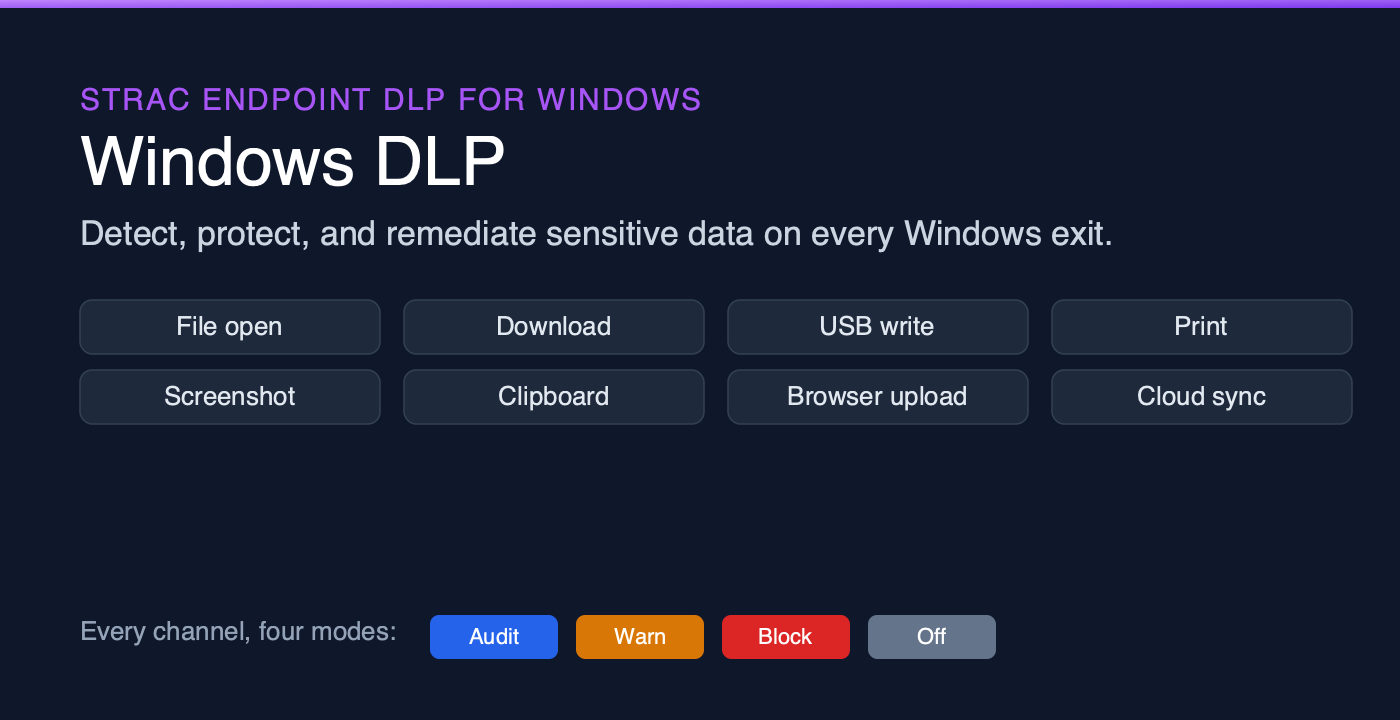
Unified DLP + DSPM across every surface.Strac protects SaaS, Cloud, Endpoint, Browser/GenAI, and AI agents from one console — 60+ SaaS integrations (Slack, Gmail, Google Drive, O365, OneDrive, SharePoint, Salesforce, Zendesk, Intercom, Notion, Jira, Box…), the major clouds (AWS S3/RDS/CloudWatch, Azure, GCP), and endpoint DLP for Mac, Windows, and Linux.
Email DLP that redacts, not just quarantines. For the channel Proofpoint owns, Strac does inline email redaction on Gmail and Microsoft 365 — masking or removing PII, PHI, and PCI from message bodies and attachments rather than blocking the whole email.
Remediation-first by design.redact, mask, tokenize, block, warn, delete, revoke access, quarantine, label — every action applied to the data at the point of exposure, across channels.
High-accuracy detection. Custom ML with low false positives, Luhn-validated cards, 48+ secret patterns, OCR on images/PDFs, all file formats, and custom detectors/regex for your own identifiers.
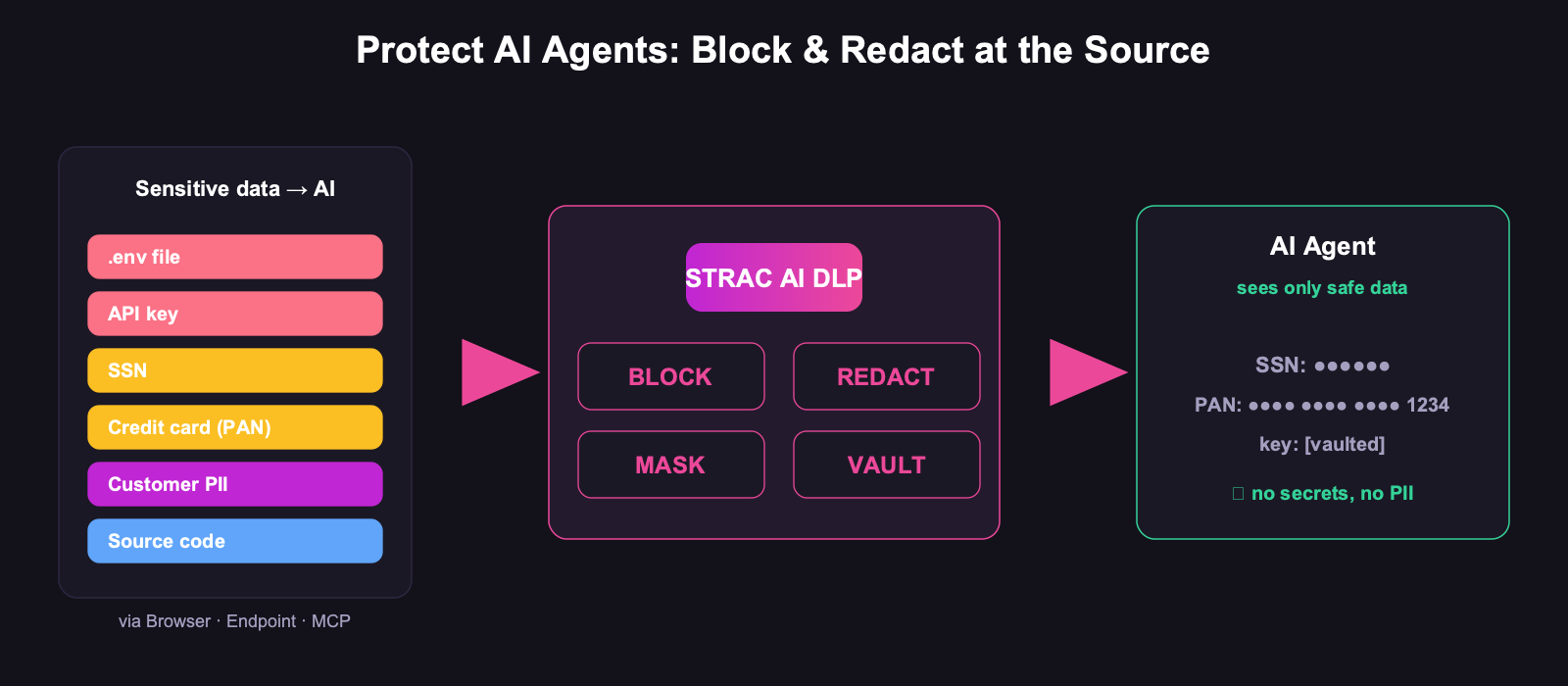
The AI surfaces both incumbents bolt on later, Strac was built for. Redact or block sensitive data in ChatGPT, Claude, Gemini, Copilot, and Perplexity before submission (Chrome, Edge, Firefox, Safari extensions), and redact inside AI-agent tool calls across 41 MCP connectors.
Compliance evidence built in — PCI, SOC 2, HIPAA, ISO 27001, CCPA, GDPR, NIST — with under-10-minute deployment and production proof at UiPath, Crypto.com, and Underdog Fantasy.
Strac redacts sensitive data inside email — the channel Proofpoint is known for — rather than quarantining the whole message.And on the AI surfaces neither incumbent was built for, Strac redacts before the model or agent ever sees the data.
🌶️ Spicy FAQs for Cyberhaven vs Proofpoint
Which is better, Cyberhaven or Proofpoint?
It depends on your dominant risk. Cyberhaven wins for endpoint data-lineage and insider investigations; Proofpoint wins when email is the primary channel and you want DLP inside a large information-protection suite. If you need enterprise-wide coverage across SaaS, cloud, endpoint, browser, and AI with inline remediation, a data-native platform like Strac addresses more of the surface than either.
Cyberhaven vs Proofpoint for insider threat detection — which wins?
Both are credible: Cyberhaven via data lineage, Proofpoint via its ObserveIT-derived Insider Threat Management. Cyberhaven gives richer "how did the data move" context on the endpoint; Proofpoint ties insider signals into a broader email/DLP program. Neither, however, redacts the sensitive content inline — worth noting if remediation, not just detection, is the goal.
Which has faster remediation, Cyberhaven or Proofpoint?
Both center on detection and response workflows more than inline content remediation. Proofpoint can block or quarantine (channel-dependent); Cyberhaven is investigation-led. For remediation measured as "the sensitive data is removed at the moment of exposure," evaluate a platform that redacts, masks, or tokenizes in place — that's Strac's model.
Do Cyberhaven or Proofpoint cover GenAI and AI agents?
Cyberhaven's coverage is limited; Proofpoint has added GenAI-aware DLP capabilities to its cross-channel offering. But native protection for browser prompts across all major AI tools and for AI-agent MCP traffic is where AI-first platforms like Strac lead, since it's the design center rather than an add-on.
Cyberhaven vs Proofpoint for enterprise — which scales better?
Proofpoint has the larger enterprise footprint and channel breadth; Cyberhaven scales as a focused endpoint-lineage layer. For enterprises consolidating onto one data-security platform across SaaS, cloud, endpoint, browser, and AI, Strac is built to be that single layer with remediation and compliance evidence included.
The Bottom Line
Cyberhaven vs Proofpoint comes down to endpoint-lineage depth versus email-first channel breadth — two strong tools anchored to their origins. Both are thinner where 2026's exposure is concentrating: SaaS data at rest and AI. If you want a platform that is data-native — following the sensitive data across every surface and removing it inline, not just alerting — Strac belongs on the evaluation.
Book a 30-minute demo to see data-native DLP across email, SaaS, endpoint, browser, and AI in one platform.
It depends on your dominant risk. Cyberhaven wins for endpoint data-lineage and insider investigations; Proofpoint wins when email is the primary channel and you want DLP inside a large information-protection suite. If you need enterprise-wide coverage across SaaS, cloud, endpoint, browser, and AI with inline remediation, a data-native platform like Strac addresses more of the surface than either.
Cyberhaven vs Proofpoint for insider threat detection — which wins?
Both are credible: Cyberhaven via data lineage, Proofpoint via its ObserveIT-derived Insider Threat Management. Cyberhaven gives richer "how did the data move" context on the endpoint; Proofpoint ties insider signals into a broader email/DLP program. Neither, however, redacts the sensitive content inline — worth noting if remediation, not just detection, is the goal.
Which has faster remediation, Cyberhaven or Proofpoint?
Both center on detection and response workflows more than inline content remediation. Proofpoint can block or quarantine (channel-dependent); Cyberhaven is investigation-led. For remediation measured as "the sensitive data is removed at the moment of exposure," evaluate a platform that redacts, masks, or tokenizes in place — that's Strac's model.
Do Cyberhaven or Proofpoint cover GenAI and AI agents?
Cyberhaven's coverage is limited; Proofpoint has added GenAI-aware DLP capabilities to its cross-channel offering. But native protection for browser prompts across all major AI tools and for AI-agent MCP traffic is where AI-first platforms like Strac lead, since it's the design center rather than an add-on.
Cyberhaven vs Proofpoint for enterprise — which scales better?
Proofpoint has the larger enterprise footprint and channel breadth; Cyberhaven scales as a focused endpoint-lineage layer. For enterprises consolidating onto one data-security platform across SaaS, cloud, endpoint, browser, and AI, Strac is built to be that single layer with remediation and compliance evidence included.
Discover & Protect Data on SaaS, AI, MCP, Endpoints & Cloud
Strac provides end-to-end data loss prevention for all SaaS and Cloud apps. Integrate in under 10 minutes and experience the benefits of live DLP scanning, live redaction, and a fortified SaaS environment.


.webp)





.avif)




.gif)
