
Cart(
0
)
No items found.
Product is not available in this quantity.



.webp)


.avif)

Windows Data Loss Prevention (DLP) is a security solution that monitors, detects, and prevents the unauthorized transfer of sensitive data from Windows endpoints. It covers channels like USB drives, email, cloud uploads, browsers, and AI tools — providing visibility and control over how corporate data moves.
Microsoft Purview focuses primarily on data within the Microsoft 365 ecosystem. It has limited visibility into third-party apps, browser-based uploads to non-Microsoft services (like personal Gmail or ChatGPT), USB activity, and file lineage across the local file system. Strac fills these gaps with deeper endpoint-level inspection and broader application coverage.
Yes. Strac's deep content inspection engine decrypts and re-encrypts SSL traffic to inspect data flowing through browsers — catching uploads to personal cloud services and AI tools that traditional network DLP would miss.
Absolutely. Strac's endpoint agent runs locally on each Windows machine, so protection is active regardless of whether the employee is on-site, working from home, or connected to a public Wi-Fi network.
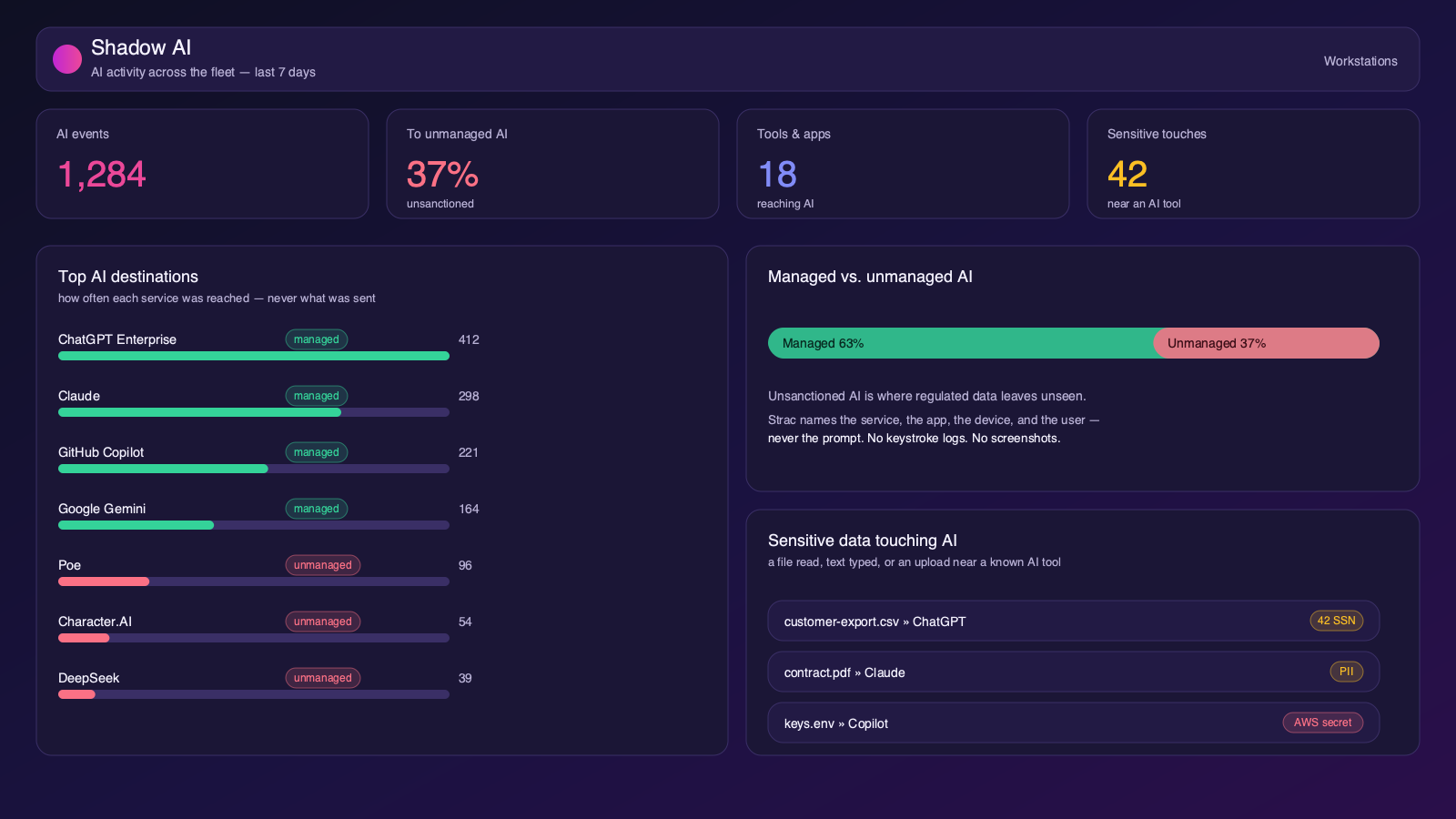
Yes. Strac detects when employees attempt to upload files or paste sensitive data into browser-based AI tools — including ChatGPT, Claude, Google Gemini, Microsoft Copilot, and others — and can warn, educate, or block based on your policies.
Strac detects over 100 built-in sensitive data types, including SSNs, credit card numbers, bank account numbers, passport numbers, medical record identifiers, source code, API keys, driver's license numbers, and custom patterns defined by your team.
Strac uses behavioral anomaly detection to establish baselines for each user's normal activity. Deviations — like a sudden spike in file downloads, after-hours access, or bulk USB transfers — trigger alerts for the security team to investigate.
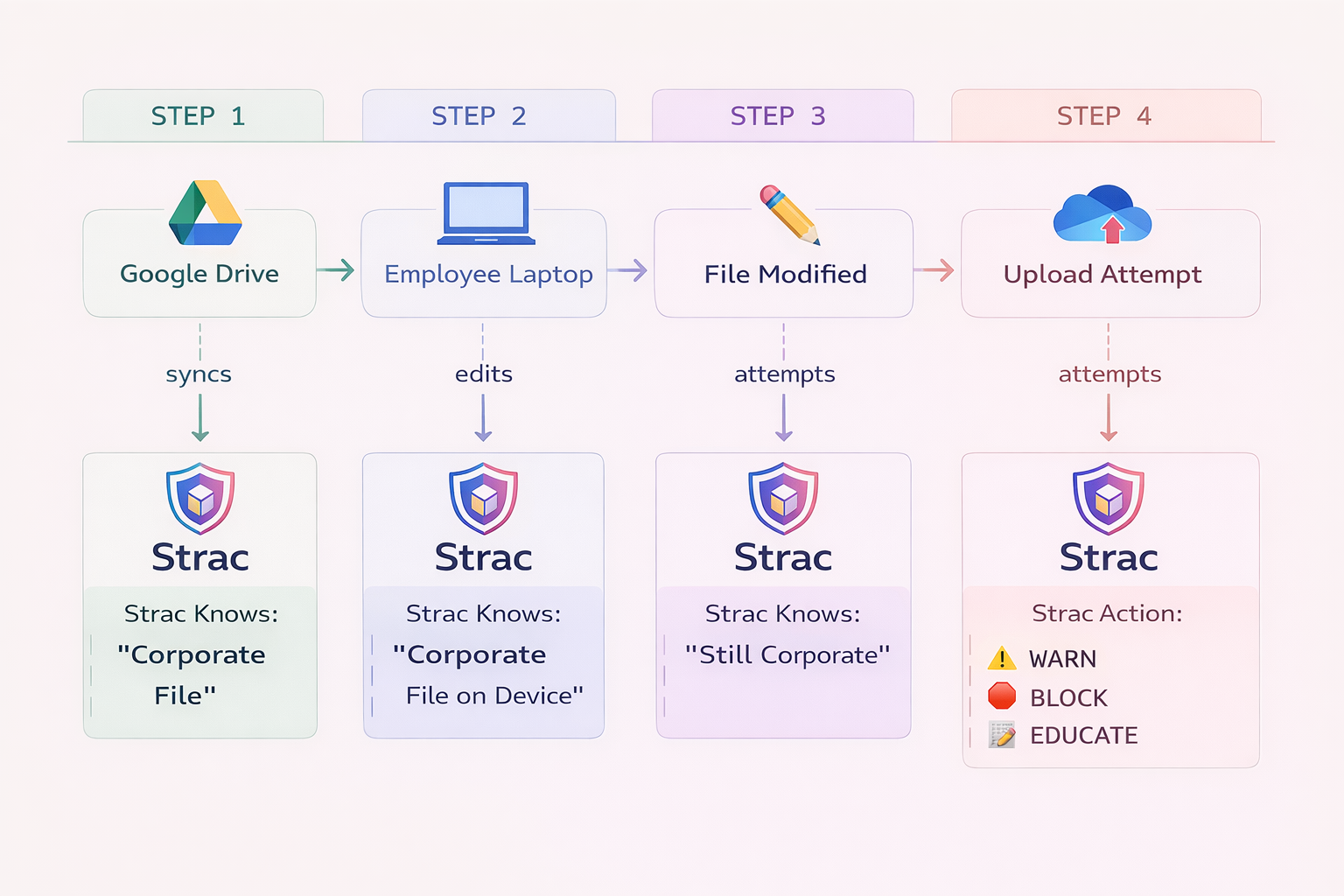
Data Lineage DLP is Strac's capability to track files from their corporate origin (e.g., a file synced from SharePoint) through all downstream actions — even if the file is renamed, copied, or edited on a Windows endpoint. This prevents disguised exfiltration that content-only scanning would miss.
Most organizations are fully operational within hours to a few days. Strac's lightweight agent deploys via your existing MDM or endpoint management tools (Jamf, Intune, SCCM), with no complex infrastructure changes required.
No. The Strac agent is engineered for minimal resource consumption. Users won't notice it running in the background — no slowdowns, no pop-ups unless a policy is triggered.
Strac supports HIPAA, PCI DSS, SOC 2 Type II, GDPR, ISO 27001, CCPA, ITAR, and GLBA — with pre-built detection rules and automated audit reporting for each.
Yes. Strac integrates with leading SIEM platforms, ticketing systems (Jira, ServiceNow), and cloud DLP tools — so Windows endpoint events flow into your existing workflows without creating alert fatigue.
Both. Strac is used by mid-market security teams that need enterprise-grade protection without the implementation complexity or cost of legacy DLP vendors — and by larger enterprises that need scalable, cloud-native endpoint coverage.
Legacy DLP vendors like Symantec and Forcepoint require complex infrastructure, long deployment cycles, and significant tuning. Strac deploys in hours, offers modern GenAI protections that legacy tools weren't built for, and provides a significantly better cost-to-value ratio.


.webp)

.webp)

.webp)
.webp)
.webp)
.webp)
.webp)

.webp)
.webp)
.webp)
.webp)


.webp)

.avif)
Hear from companies who leveraged Strac to secure and accelerate their business


