Generative AI Data Governance: Prompts, RAG, Fine-Tuning & Outputs (2026)
Generative AI data governance controls the sensitive data flowing through prompts, RAG, fine-tuning, and outputs — the paths traditional governance and DLP never watched.
Generative AI data governance is the practice of controlling the sensitive data that flows into and out of generative AI — prompts, retrieval (RAG) sources, fine-tuning sets, and model outputs.
It is data governance for generative AI specifically: the same goal as classic governance, but the data now moves through prompts and embeddings, not just tables and reports.
Traditional governance and DLP miss it because they inspect data at rest, not the content a person pastes into ChatGPT or an agent pulls over MCP.
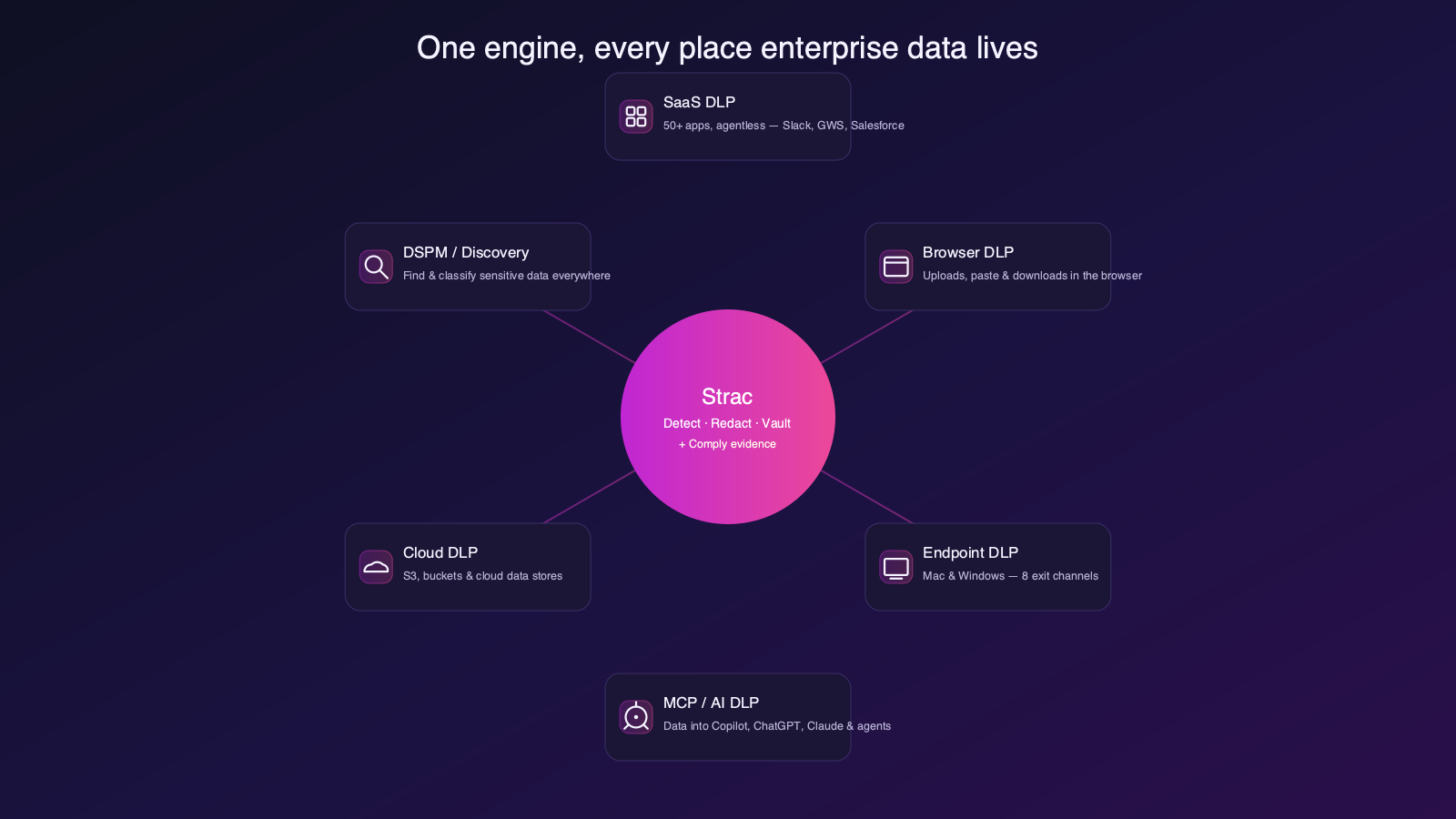
Strac governs the generative-AI data path directly — AI DLP in the browser, MCP DLP on agent tool calls, and DSPM for training and RAG sources.
Generative AI data governance — also written as data governance for generative AI — is the set of policies and controls that keep sensitive data safe as it moves through generative AI systems. Classic data governance asked “who can access this table?” Generative AI asks a harder question: what happens when an employee pastes a customer record into a prompt, when a RAG pipeline retrieves a document full of PHI, or when an agent writes model output back into a system of record? It is AI data governance applied to the generative era.
Generative AI data governance has to follow data across prompts, RAG, fine-tuning, and outputs — every surface at once.
Why Generative AI Breaks Traditional Data Governance
Traditional governance and DLP were built for structured data at rest — databases, warehouses, file shares. Generative AI moves sensitive data through channels those tools never watch: a prompt typed into ChatGPT, an embedding created from a confidential document, a fine-tuning set assembled from support tickets, an answer an agent pastes into Slack. The data is in motion and unstructured, so a scanner that checks tables on a schedule sees none of it. See why legacy DLP fails for AI.
The Four Data Paths in Generative AI
Governing generative AI means governing four distinct data flows, each with its own risk:
Data path
The governance risk
Prompts (input)
Employees paste PII, PHI, secrets, or source code into a model that may sit outside your boundary
Retrieval / RAG
A retrieval pipeline surfaces documents full of regulated data into the model's context
Fine-tuning / training
A training set silently bakes sensitive records into a model that is hard to unlearn
Outputs
The model generates or echoes sensitive data into a new system, chat, or ticket
✨ Governing the Prompt: Browser and GenAI DLP
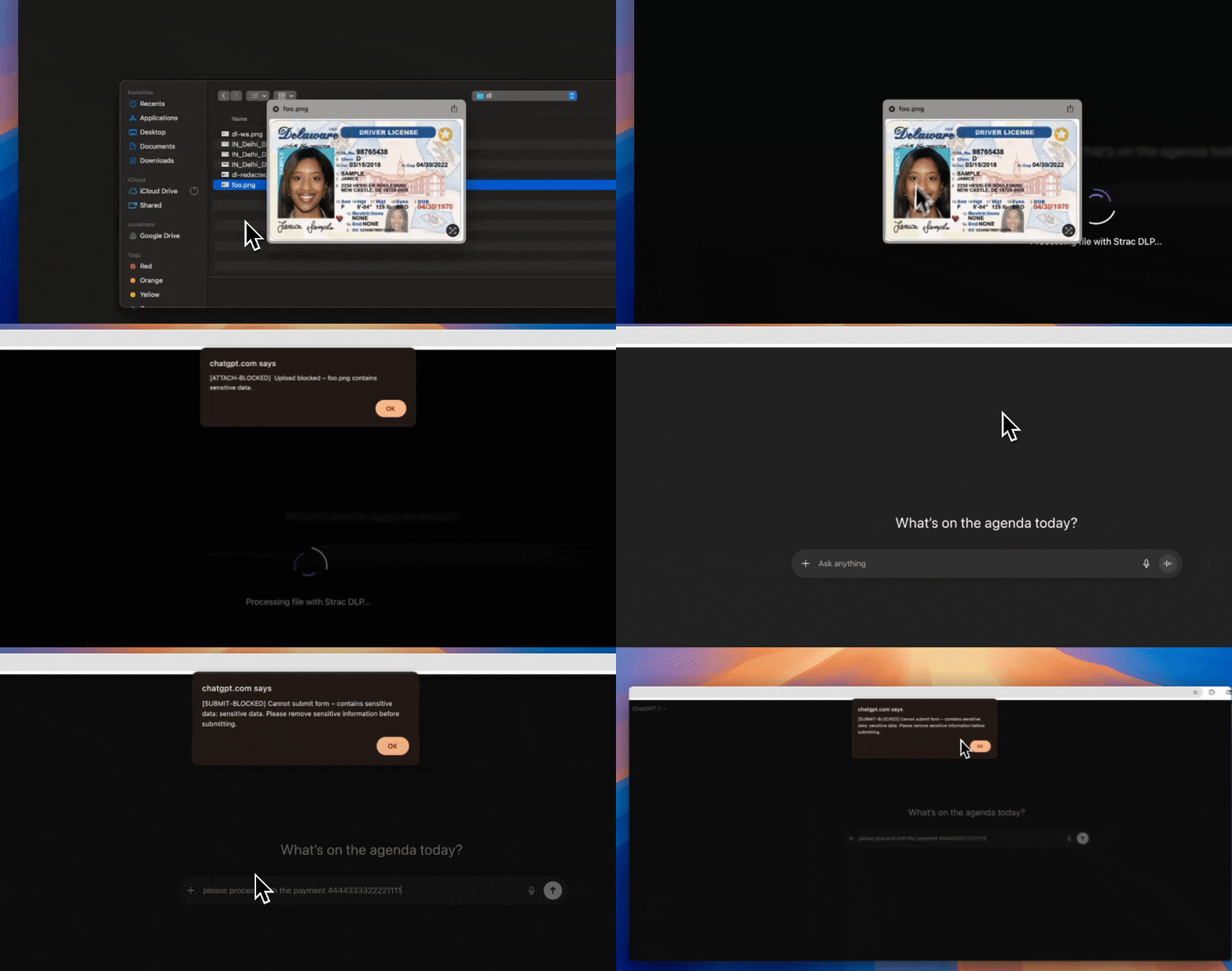
The most common leak is the simplest: someone pasting regulated data into a generative AI tool. Strac’s browser layer inspects prompts and uploads to ChatGPT, Claude, Gemini, and Copilot in real time and blocks, warns, or redacts sensitive data before it is ever sent — governance at the exact moment of risk. This is AI DLP in practice.
Strac redacts sensitive data from a generative AI prompt before it leaves the browser.
Governing Retrieval and RAG Pipelines
Retrieval-augmented generation is a governance blind spot: the model only sees what the pipeline hands it, and that pipeline can surface a document full of PHI or secrets into the context with no human in the loop. Governance here means classifying source content, redacting sensitive fields before they enter the index, and enforcing on the retrieval call itself — so the model is grounded in data that has already been governed.
✨ Governing Agent Access over MCP
Generative AI increasingly acts through agents that pull data from your SaaS and cloud over MCP. That is a live governance surface: an agent can retrieve a customer record or a database row on an authenticated tool call and feed it straight into a model. Strac’s MCP DLP inspects every MCP call and redacts PII, PHI, PCI, and secrets before the model sees them, vaulting the original for authorized use.
Generative AI data governance is a loop: classify the source, redact in motion, govern the output, and prove it.
🎥 Governing the Output and Training Data
Two paths are easy to forget. Model outputs can contain or echo sensitive data and land in a new system — govern them the same way you govern any egress. And training or fine-tuning data can bake regulated records into a model permanently, so it must be classified and redacted before it ever reaches the training pipeline. Strac inspects data on both paths so nothing sensitive is memorialized or leaked.
Strac detects and redacts sensitive data in real time across generative AI inputs and outputs.
A Framework for Generative AI Data Governance
Put it together into a repeatable framework:
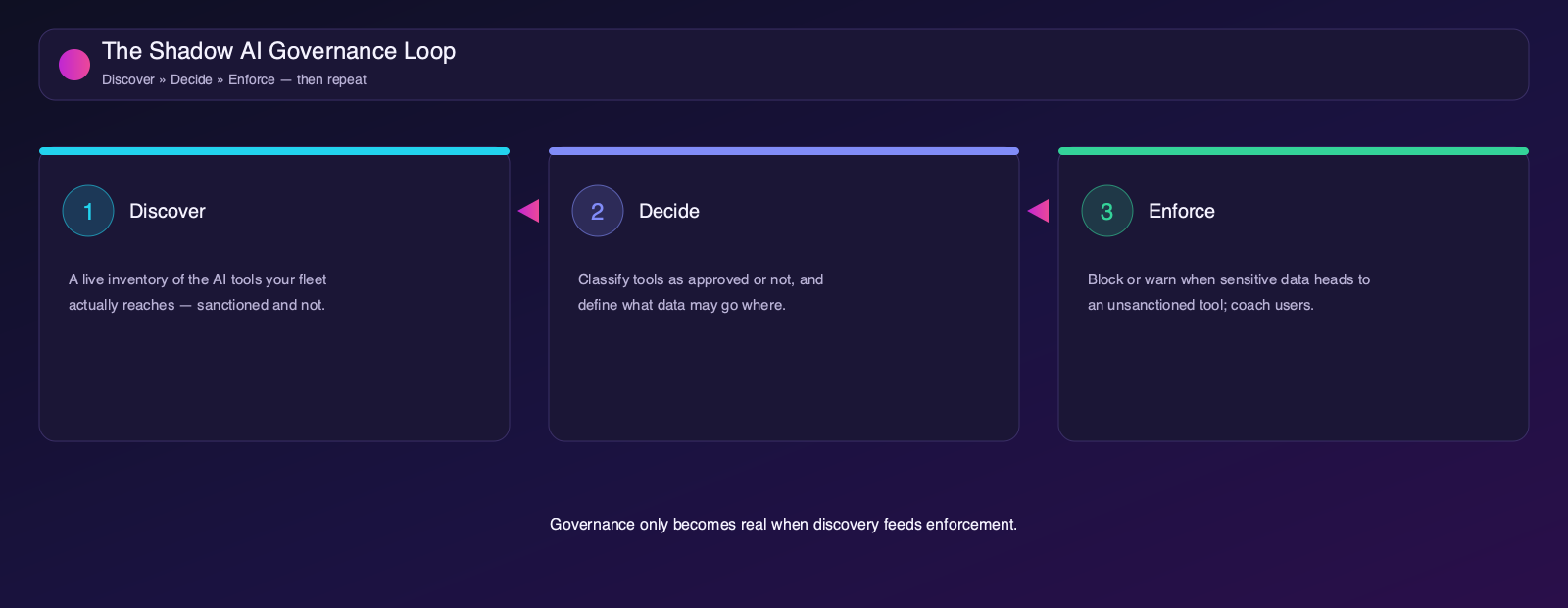
Discover: find where generative AI touches data — prompts, RAG sources, training sets, agent connections.
Classify: know what is sensitive across all four data paths.
Protect: redact or block sensitive data in prompts, retrieval, outputs, and MCP calls.
Prove: log every detection and remediation as evidence for SOC 2, ISO 42001, and the EU AI Act.
✨ How Strac Governs Data Across Generative AI
Strac is one platform for the whole generative-AI data path: browser and AI DLP for prompts, MCP DLP for agent retrieval, and DSPM for the documents and datasets behind RAG and fine-tuning — all under one policy and classifier. You govern generative AI without blocking it, because redaction and vaulting let the model work on safe content while sensitive values stay protected.
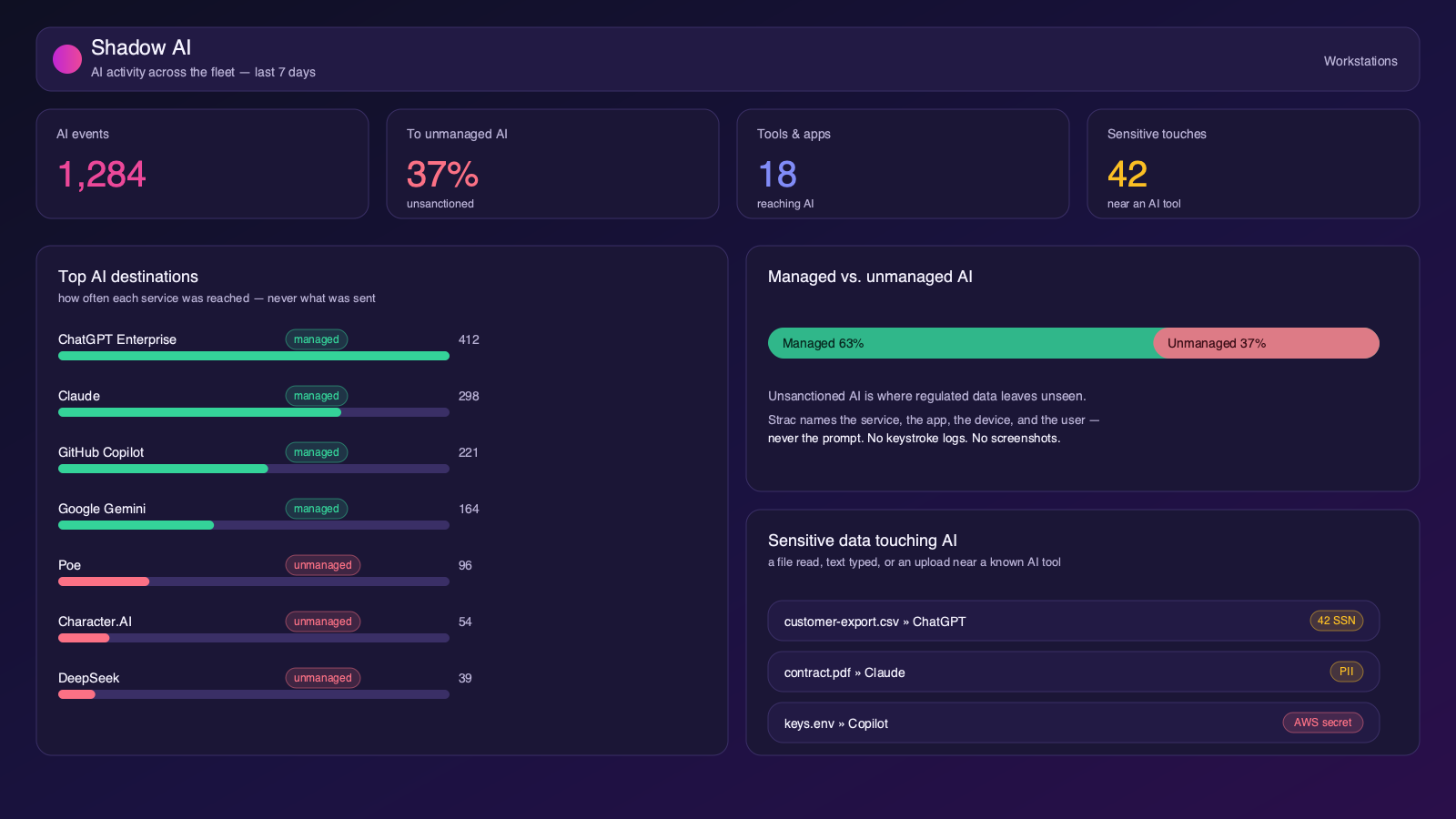
Strac shows which generative AI tools are in use and the sensitive data at risk in each — the basis for governance.
🌶️ Spicy FAQs for Generative AI Data Governance
Is generative AI data governance different from AI data governance?
It is the generative-AI slice of it. AI data governance covers all AI; generative AI data governance focuses on the prompt, RAG, fine-tuning, and output paths that generative models introduce.
Why doesn't our existing DLP cover generative AI?
Legacy DLP inspects data at rest on a schedule. Generative AI leaks happen in motion — a prompt, a retrieval, an output — which those tools never see. You need data-layer controls at the point of use.
Can we govern generative AI without banning it?
Yes. Redaction and vaulting let employees and agents keep using generative AI on safe content while sensitive values are stripped, so governance does not mean a ban.
What about data used to fine-tune a model?
Classify and redact it before it enters the training pipeline — sensitive data baked into a model is very hard to remove later.
How does this map to compliance frameworks?
Log every detection and remediation and map it to SOC 2, ISO 42001, and the EU AI Act, so generative-AI governance is provable, not just asserted.
The Bottom Line
Generative AI moves sensitive data through prompts, retrieval, training, and outputs — paths traditional governance never watched. Generative AI data governance closes them with data-layer controls that inspect content in motion. Strac governs all four across the browser, MCP, and your data stores from one platform. Book a demo to govern the data your generative AI touches.
Is generative AI data governance the same as AI data governance?
It is the generative-AI slice of AI data governance — focused on the prompt, RAG, fine-tuning, and output data paths that generative models introduce.
Why doesn't legacy DLP cover generative AI?
Legacy DLP inspects data at rest on a schedule. Generative AI leaks happen in motion — prompts, retrieval, outputs — which those tools never see.
Can we govern generative AI without banning it?
Yes. Redaction and vaulting let people and agents keep using generative AI on safe content while sensitive values are stripped.
What about fine-tuning data?
Classify and redact it before it enters the training pipeline — sensitive data baked into a model is very hard to remove.
How does it map to compliance?
Log every detection and remediation and map it to SOC 2, ISO 42001, and the EU AI Act to make governance provable.
Discover & Protect Data on SaaS, AI, MCP, Endpoints & Cloud
Strac provides end-to-end data loss prevention for all SaaS and Cloud apps. Integrate in under 10 minutes and experience the benefits of live DLP scanning, live redaction, and a fortified SaaS environment.


.webp)



.avif)




.gif)
