August 10, 2026

min read
Data Anonymization: Techniques, GDPR, and vs Pseudonymization (2026)
.webp)

Last updated: August 2026
Data anonymization irreversibly transforms data so no individual can be re-identified — by removing or generalizing identifiers. Unlike pseudonymization, it cannot be reversed, which makes it stronger for privacy but weaker for utility.
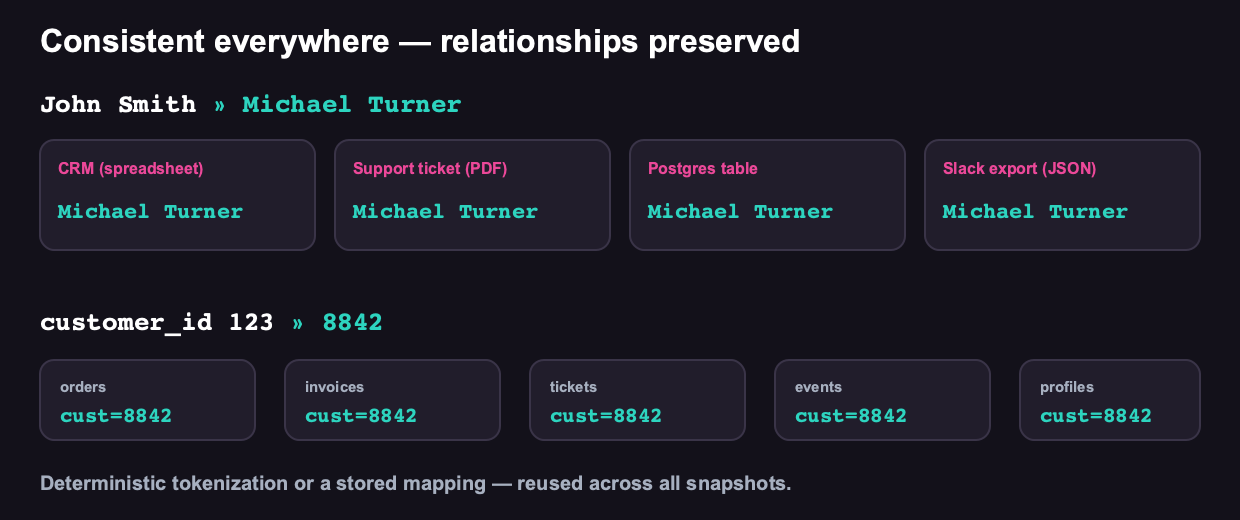
Anonymization removes the link between data and a person for good. Techniques include suppression (deleting identifiers), generalization (age 34 → age 30-40), aggregation, and adding statistical noise (as in differential privacy). Because it is irreversible, truly anonymized data falls outside regulations like GDPR — but achieving genuine anonymization is harder than it looks, since quasi-identifiers (ZIP + birthdate + gender) can re-identify people even without a name.
| Anonymization | Pseudonymization | |
|---|---|---|
| Reversible | No | Yes (secure mapping) |
| Under GDPR | Outside scope | Still personal data |
| Data utility | Often reduced | Preserved (realistic + joins intact) |
| Best for | Public release, research | Testing, analytics, AI |
For most internal use cases — testing, analytics, feeding SaaS data to AI — pseudonymization is the better fit because it keeps data usable. Anonymization is the right tool when data must be truly non-personal.
Strac's detection engine finds every identifier and quasi-identifier across your data — the first, hardest step in any anonymization or pseudonymization program — and can suppress, generalize, or replace them consistently across all formats.
Only if quasi-identifiers are handled too. Combinations like ZIP + birthdate + gender can re-identify individuals, so real anonymization must account for them — which is why detection quality matters so much.
Usually pseudonymize — it keeps the data realistic and useful for the model while removing real identities. Anonymize only when the output must be fully non-personal.
.avif)


.gif)