AI TPRM: Third-Party Risk Management for AI (2026)
AI TPRM is third-party risk management for the AI era — governing the AI vendors, tools, and agents your data flows to. Here's the process and how Strac discovers shadow AI, scores data-flow risk, and enforces offboarding.
AI TPRM extends third-party risk management to AI: the vendors, tools, and agents your data now flows to — ChatGPT, Claude, Copilot, and the MCP connectors wiring agents into your systems.
Traditional TPRM is questionnaire-first and misses what employees adopt on their own. AI moves faster than any vendor-onboarding process, so discovery matters more than the questionnaire.
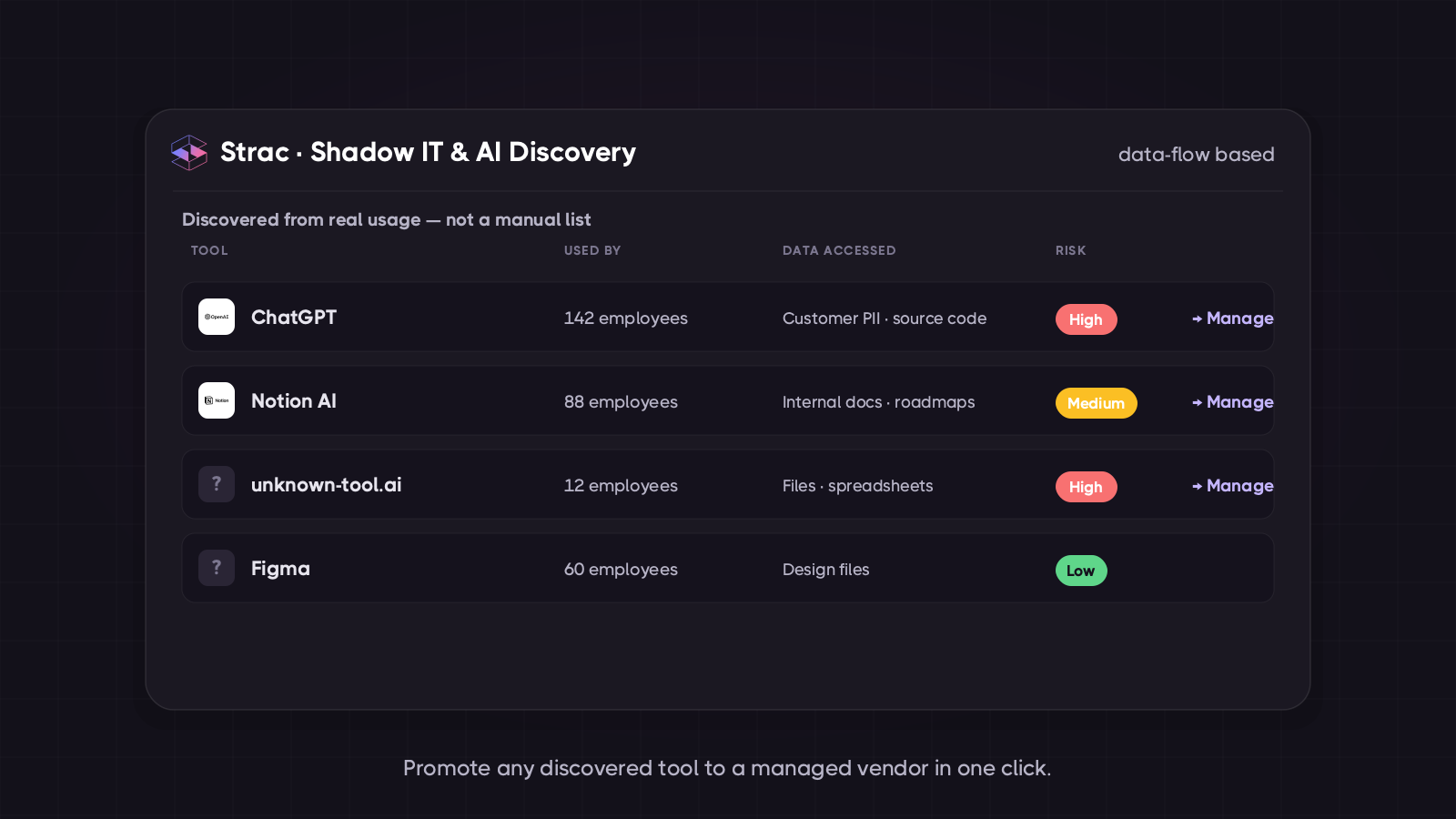
Strac flips it: discover the AI vendors and agents in use from real data flows, score the risk by the sensitive data exposed, and enforce offboarding — not just file a survey.
✨ Why AI Breaks Traditional TPRM
Classic TPRM assumes a vendor goes through procurement, fills a questionnaire, and gets approved. AI doesn't work that way:
Shadow adoption. Employees sign up for AI tools with a personal account in seconds — no procurement, no questionnaire. See shadow AI.
Agents pull data automatically. Via MCP, an AI agent reaches into Salesforce, Snowflake, or Google Drive and pulls sensitive data in — a data flow no questionnaire captures.
The risk is the data, not the contract. What matters is which sensitive data reaches which AI, not whether a SOC 2 report is on file.
Discovery-first AI TPRM: see the AI in use and the data it touches — see TPRM software.
1. Discover Every AI Vendor and Agent
Find every AI vendor, tool, and agent in use — from browser, endpoint, OAuth grants, and SaaS logs — including the shadow AI employees adopted without procurement. AI TPRM starts here because you cannot assess what you cannot see.
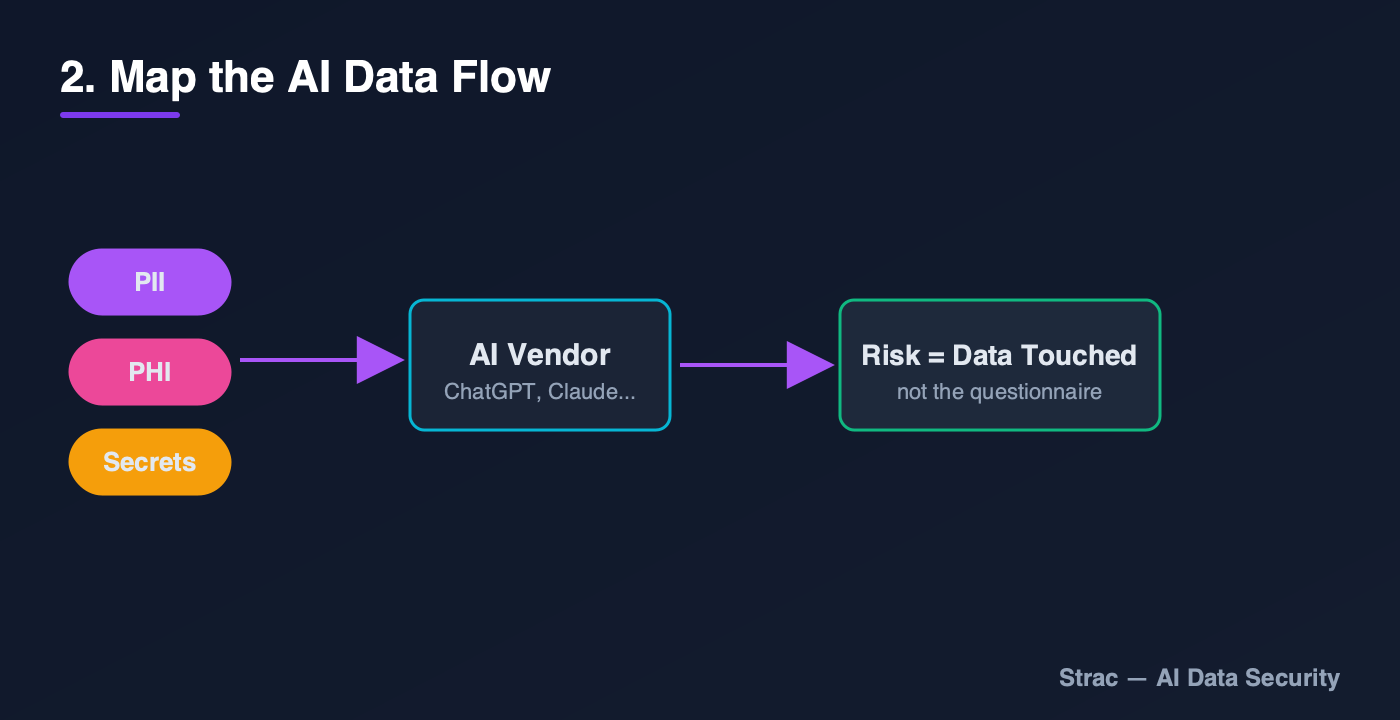
✨ 2. Map the AI Data Flow
For each AI vendor or agent, map which sensitive data — PII, PHI, PCI, secrets — actually reaches it. This data flow, not a SOC 2 PDF on file, is what AI TPRM scores risk on.
AI TPRM scores risk by the data a vendor actually touches — mapped from real data flows, not a questionnaire.
3. Score Risk by Data Sensitivity
Weigh each AI vendor by the sensitivity and volume of data it can reach, not by a self-reported questionnaire score. A free AI tool wired to your customer database outranks a SOC 2-certified vendor that touches nothing sensitive.
4. Control and Remediate AI Access
Block or scope access, and redact sensitive data before it reaches the vendor's model — at the browser, endpoint, and MCP layer. Remediation is what turns AI TPRM from a register into a control.
5. Monitor AI Vendors Continuously
Alert on new AI vendors and on changes in data exposure. AI adoption shifts weekly, so AI TPRM has to be continuous, not an annual review.
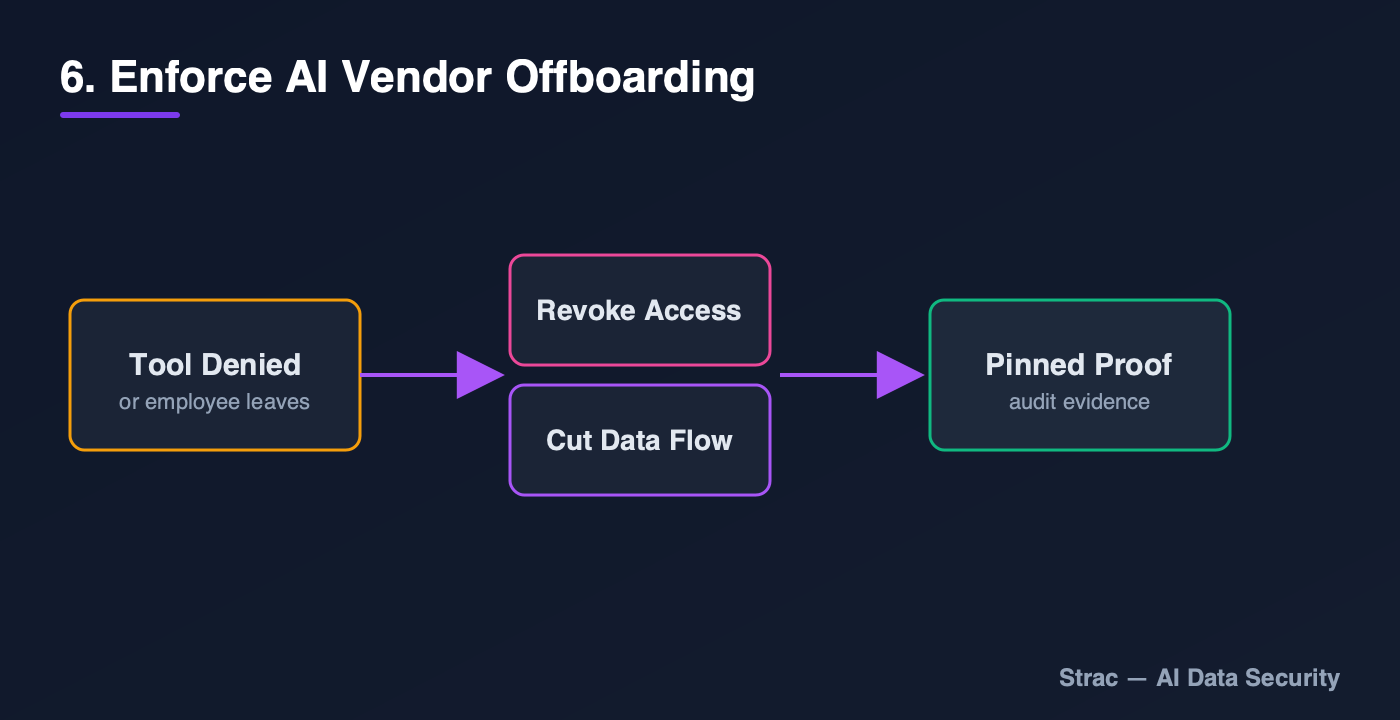
✨ 6. Enforce AI Vendor Offboarding
When a tool is denied or an employee leaves, actually cut the data access — and pin the proof — instead of marking a row "offboarded." Enforced offboarding is the step questionnaire-first AI TPRM tools leave open.
Real offboarding in AI TPRM: revoke access, cut the data flow, and pin auditor-ready proof.
✨ How Strac Does AI TPRM
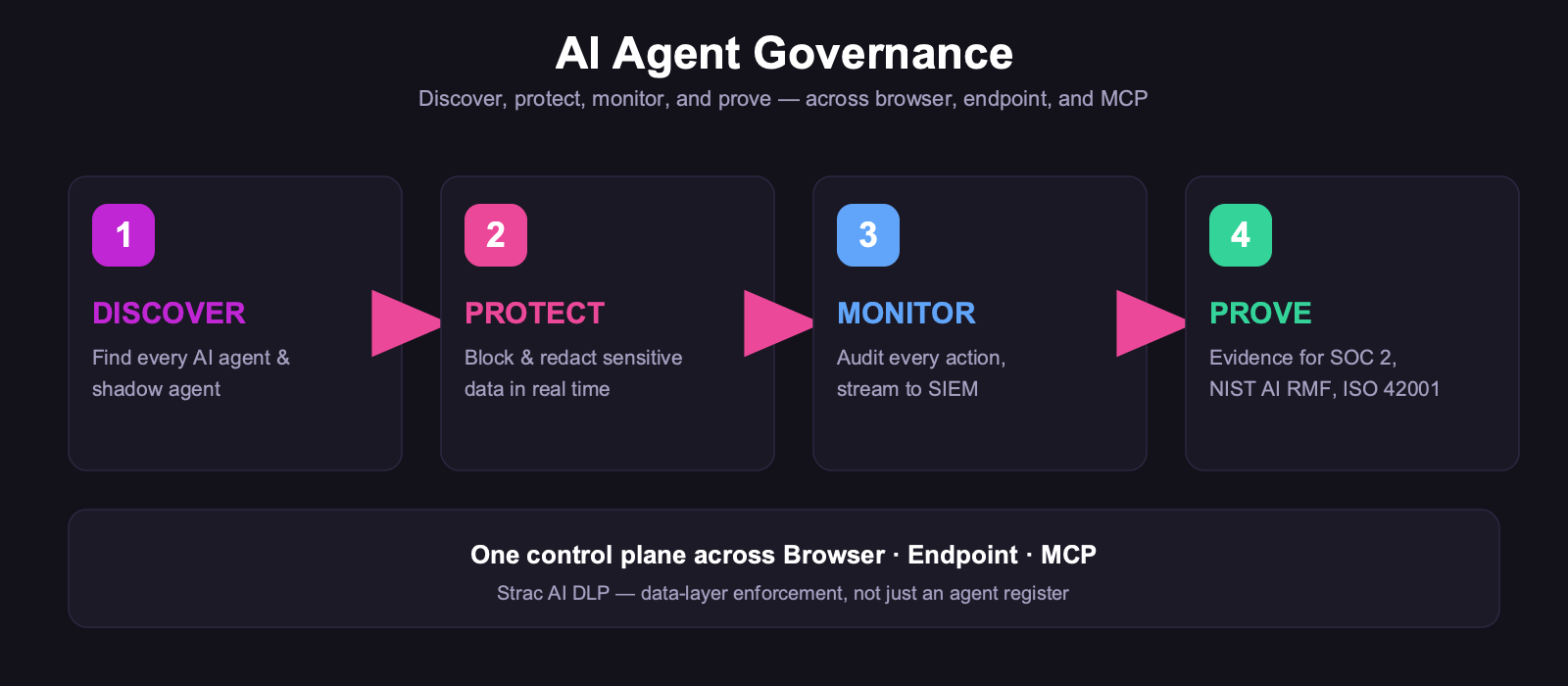
Strac's AI data governance platform is discovery-first and data-flow-based. It surfaces shadow AI and agents, quantifies the sensitive data each reaches, controls and remediates that access in real time, and enforces offboarding — the gap questionnaire-first tools leave open.
The same See → Control → Protect → Prove model applied to AI vendor risk — see AI agent governance.
How Strac Comply Runs TPRM in the AI Era
Questionnaire-first TPRM tools score vendors on what they claim. Strac Comply's TPRM scores them on what they can actually touch. Discovery starts from your real attack surface: an OAuth and integration scan surfaces every SaaS app, sub-processor, and — critically — every GenAI tool employees connected, because half your team has already pasted data into an AI you have not inventoried.
Each vendor then runs a four-stage lifecycle — discover, assess, monitor, offboard — through a deterministic risk engine: typed inputs (data sensitivity, access scope, integration depth, attestations) map to inherent and residual risk through fixed rules, not a black box. Because Comply is built on Strac's DSPM/DLP foundation, that risk reflects the data a vendor genuinely handles, and offboarding revokes access while pinning the proof. It is one platform for vendor risk, compliance automation, and the data security that backs both.
🌶️ Spicy FAQs for AI TPRM
What is AI TPRM?
AI TPRM is third-party risk management applied to AI vendors, tools, and agents — governing the AI your data flows to. It extends classic TPRM with discovery of shadow AI and data-flow-based risk scoring, because AI is adopted outside procurement.
How is AI TPRM different from traditional TPRM?
Traditional TPRM is questionnaire-first and assumes vendors go through procurement. AI is adopted ad hoc by employees and pulls data automatically via agents, so AI TPRM has to start with discovery of what's actually in use and what data it touches.
How do I assess AI vendor risk?
Score by the sensitive data exposed, not just a security questionnaire: discover the AI in use, map which PII/PHI/PCI/secrets reach each one, and weigh by sensitivity and volume. Strac does this from real data flows.
What is shadow AI in TPRM?
Shadow AI is AI tools employees adopt without approval — the biggest blind spot in AI vendor risk. See shadow AI.
Strac Comply's TPRM auto-discovers every vendor, sub-processor, and OAuth grant — plus the AI tools your team adopted without telling you — and produces a risk score backed by real evidence (including pentest results), across the full discover → assess → monitor → retire lifecycle. See Strac Comply.
The Bottom Line
AI is the fastest-growing source of third-party risk, and it doesn't fit the questionnaire model. AI TPRM starts with discovery and data flows: see the AI in use, score it by the data it exposes, remediate the access, and enforce offboarding. Strac is built for exactly that.
AI TPRM is third-party risk management applied to AI vendors, tools, and agents — governing the AI your data flows to. It extends classic TPRM with discovery of shadow AI and data-flow-based risk scoring, because AI is adopted outside procurement.
How is AI TPRM different from traditional TPRM?
Traditional TPRM is questionnaire-first and assumes vendors go through procurement. AI is adopted ad hoc by employees and pulls data automatically via agents, so AI TPRM has to start with discovery of what's actually in use and what data it touches.
How do I assess AI vendor risk?
Score by the sensitive data exposed, not just a security questionnaire: discover the AI in use, map which PII/PHI/PCI/secrets reach each one, and weigh by sensitivity and volume. Strac does this from real data flows.
What is shadow AI in TPRM?
Shadow AI is AI tools employees adopt without approval — the biggest blind spot in AI vendor risk. See shadow AI.
Discover & Protect Data on SaaS, AI, MCP, Endpoints & Cloud
Strac provides end-to-end data loss prevention for all SaaS and Cloud apps. Integrate in under 10 minutes and experience the benefits of live DLP scanning, live redaction, and a fortified SaaS environment.


.webp)




.avif)



.gif)
