What third-party risk management software does, the 6-stage TPRM lifecycle, the features to look for, and how Strac discovers the shadow vendors and AI tools other tools miss, from real data flows.
Third-party risk management (TPRM) software helps you find, assess, and monitor the vendors and tools that touch your data, so a breach at their company doesn't become an incident at yours.
The standard TPRM lifecycle has six stages: identify, assess inherent risk, perform due diligence, onboard, continuously monitor, and offboard.
Most TPRM tools only manage the vendors you manually add, using self-attested questionnaires. That leaves your biggest exposure, the shadow IT and shadow AI your employees adopt on their own, completely invisible.
Strac's TPRM, a module of Strac Comply, is different: it discovers vendors and AI tools from real data flows, scores each by the data it actually touches, and lets you promote any of them to a managed vendor with a security review, AI assessment, document collection, and continuous monitoring.
TPRM is also a compliance requirement, SOC 2, ISO 27001, GDPR, and the SEC's Reg S-P all demand vendor oversight.
What Is Third-Party Risk Management (TPRM)?
Third-party risk management (TPRM) is the practice of identifying, assessing, and controlling the risk that vendors, suppliers, contractors, and SaaS and AI tools introduce to your business. If a third party can access your customer data, your network, or your systems, their security posture becomes part of your attack surface, and regulators and customers will hold you accountable when it fails.
TPRM software (also called vendor risk management or VRM software) centralizes that work: a single place to inventory every third party, gauge how risky each one is, collect their security documentation, track findings, and watch for changes over time. The goal is simple, make sure the companies you trust with your data are actually trustworthy, and be able to prove you checked.
It's a fast-growing discipline for a reason. The average company now relies on hundreds of vendors and dozens of AI tools, and a single vendor breach can expose the data of everyone they serve.
1. Identify & inventory, catalog every third party, including the SaaS and AI tools employees adopt on their own.
2. Assess inherent risk & tier, rank each vendor (critical, high, medium, low) by how much sensitive data and access it has.
3. Due diligence, send security questionnaires, collect SOC 2 reports, DPAs, and certificates, and review them.
4. Onboard, set contract controls (including breach-notification clauses), provision access, and assign an owner.
5. Continuously monitor, watch for breaches, expiring certificates, and material changes after the contract is signed.
6. Reassess & offboard, re-review on a risk-based cadence, and when a relationship ends, revoke access and ensure your data is deleted.
Most programs are strong on stages 3 and 4, the questionnaire and the contract, and weak everywhere else. The hardest stages are the bookends: knowing every third party in the first place, and proving the relationship was actually closed out.
Why Traditional TPRM Falls Short
Here's the uncomfortable truth about most TPRM software: it can only manage the vendors you already know about. Someone has to manually add each one, send a questionnaire, and trust the answers that come back.
That model has two big holes:
It misses shadow IT and shadow AI. Employees sign up for SaaS apps and AI tools, ChatGPT, an AI note-taker, a niche analytics tool, without telling procurement. None of them appear in a manual vendor list, yet they're often the ones with the most direct access to your sensitive data.
It trusts self-attestation. A questionnaire tells you what a vendor says about its security. It doesn't tell you what data that vendor can actually reach inside your environment, which is the thing that actually determines your risk.
The result is a vendor inventory that looks complete but isn't, and risk scores based on paperwork instead of reality. To close those gaps, TPRM has to start from what's actually happening to your data.
✨ How Strac Does TPRM Differently: Shadow IT & AI Discovery
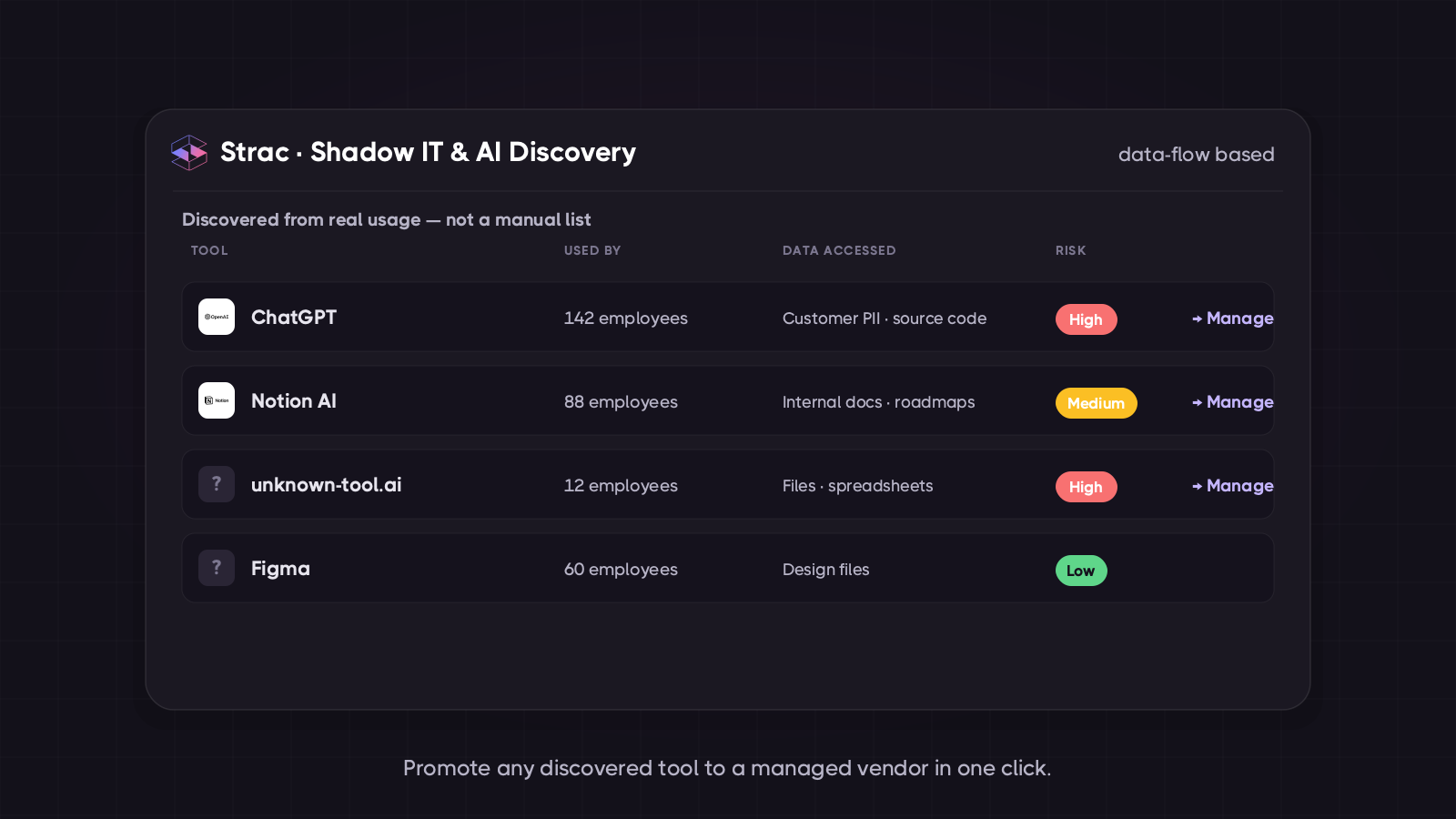
Strac's TPRM module sits on top of Strac's data-security layer, which means it doesn't wait for you to type in a vendor. It discovers the third parties and AI tools your employees actually use, from real data flows across your SaaS, cloud, browser, and endpoints, and shows you exactly what data each one touches.
Instead of a manual list, you get a live, evidence-based view: which tool, used by how many people, touching what kind of data (customer PII, source code, financial records), with a risk rating grounded in that exposure, not a self-reported guess. When something looks risky, you promote it to a managed vendor in one click and start the formal review. This is the same engine behind Strac's GenAI and MCP data security, applied to vendor risk.
That's the gap no questionnaire-first tool can close: you can't assess the vendors you never knew existed.
✨ Managed Vendors: Security Review, AI Assessment, and Documents
Once a third party is a managed vendor, Strac gives you everything the due-diligence and monitoring stages require, in one profile:
Security review, send and track questionnaires (SIG, CAIQ, or custom), with findings logged for remediation.
AI risk assessment, Strac's AI reads the vendor's SOC 2, DPA, and questionnaire responses, scores the risk, and flags gaps so your team isn't manually parsing 80-page reports.
Document collection, gather and store SOC 2 Type II reports, DPAs, BAAs, pen-test results, and insurance certificates, with alerts before anything expires.
Continuous monitoring, stay aware of breaches, material changes, and, because Strac watches the data layer, any change in the sensitive data that vendor is actually accessing.
Enforced offboarding, when the relationship ends, Strac doesn't just mark it closed; it can revoke the vendor's access and ensure shared data is deleted.
That last point matters: most TPRM tools track offboarding as a checkbox. Because Strac sits on the data-security layer, it can actually execute it.
What to Look for in TPRM Software
If you're evaluating third-party risk management software, platforms, or tools, here's the capability checklist that separates a real program from a spreadsheet with a login:
Capability
Why it matters
Vendor discovery
Finds shadow IT and AI you'd otherwise miss, ideally from real data flows, not just SSO logs
Inherent risk tiering
Auto-classifies vendors by the data and access they hold, so you focus on what's critical
Questionnaires & AI document review
Sends SIG/CAIQ/custom assessments and uses AI to read SOC 2 reports and DPAs fast
Document & certificate management
Stores evidence and warns you before SOC 2s, pen tests, and DPAs expire
Continuous monitoring
Surfaces breaches and material changes after onboarding, not just at signup
Risk register & remediation
Tracks findings to closure with owners and due dates
Reassessment cadence
Re-reviews vendors on a risk-based schedule automatically
Enforced offboarding
Revokes access and deletes data, not just a status change
Framework mapping & reporting
Maps vendor controls to SOC 2, ISO 27001, GDPR, and Reg S-P for audits and the board
The differentiator to weigh most heavily: does the tool discover your third parties and ground risk in the data they actually touch, or does it just organize the vendors you already knew about?
TPRM and Compliance: SOC 2, ISO 27001, PCI DSS, HIPAA, NIST CSF & More
Third-party risk management isn't optional, it's written into nearly every framework you'll be audited against:
SOC 2, the CC9 (risk mitigation) and CC3 criteria expect vendor risk assessment and ongoing oversight.
ISO 27001, Annex A requires supplier security controls and monitoring.
HIPAA, covered entities must sign a Business Associate Agreement (BAA) with every vendor that touches PHI, and take reasonable assurance those business associates safeguard it.
PCI DSS, Requirement 12.8 makes you inventory, contract with, and monitor any service provider that can affect cardholder data security.
NIST CSF, the 2.0 framework's Govern function (GV.SC, Cybersecurity Supply Chain Risk Management) expects you to identify, assess, and continuously manage the suppliers and third parties in your ecosystem.
GDPR, Article 28 makes you responsible for the processors who handle personal data.
SEC Reg S-P, the 2024 amendments require service-provider oversight and a 72-hour vendor breach-notification clause for financial firms.
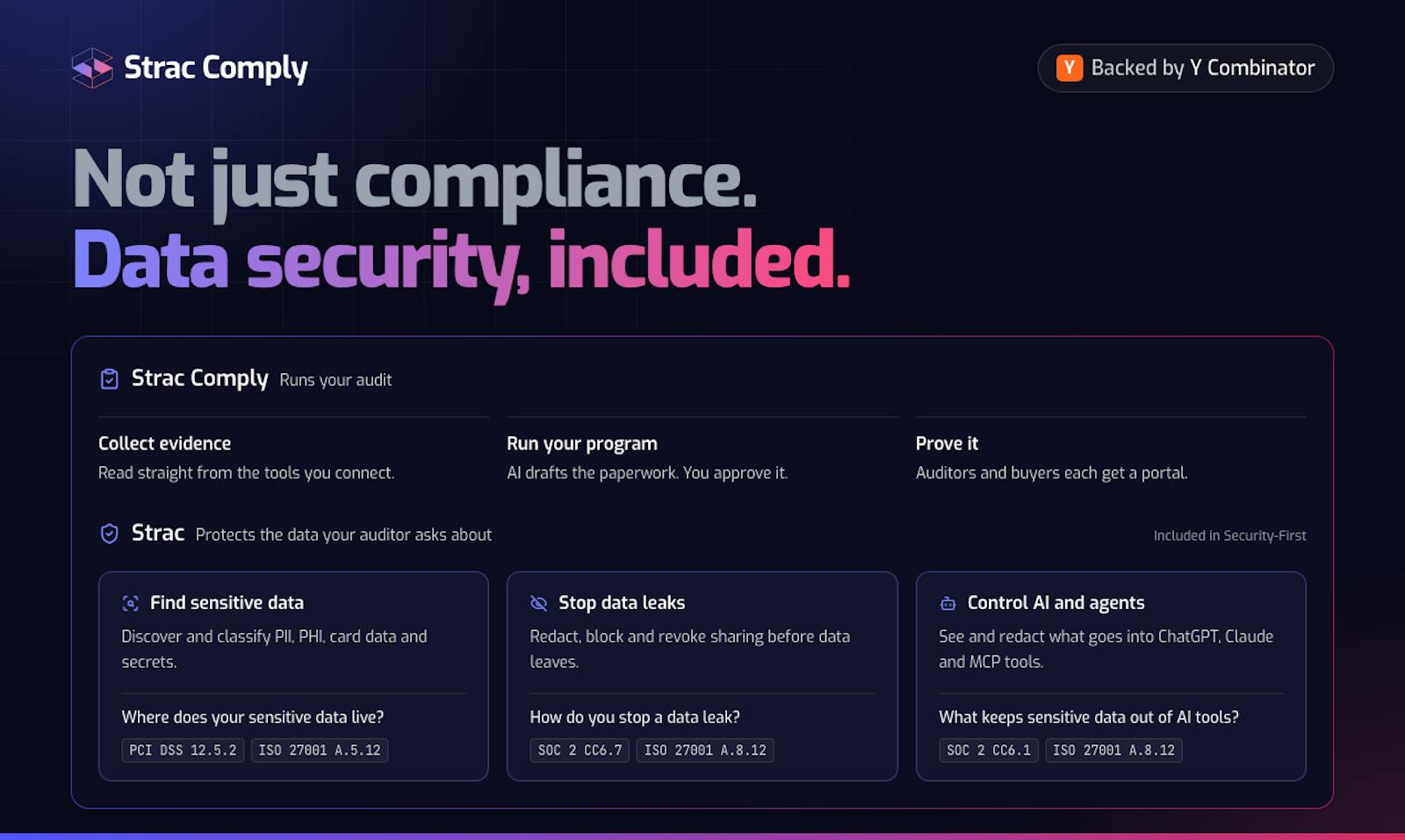
Because Strac's TPRM lives inside Strac Comply, every vendor review, document, and finding becomes evidence mapped to those frameworks automatically, so a vendor assessment isn't busywork, it's audit-ready proof.
Get vendor risk with Strac Comply
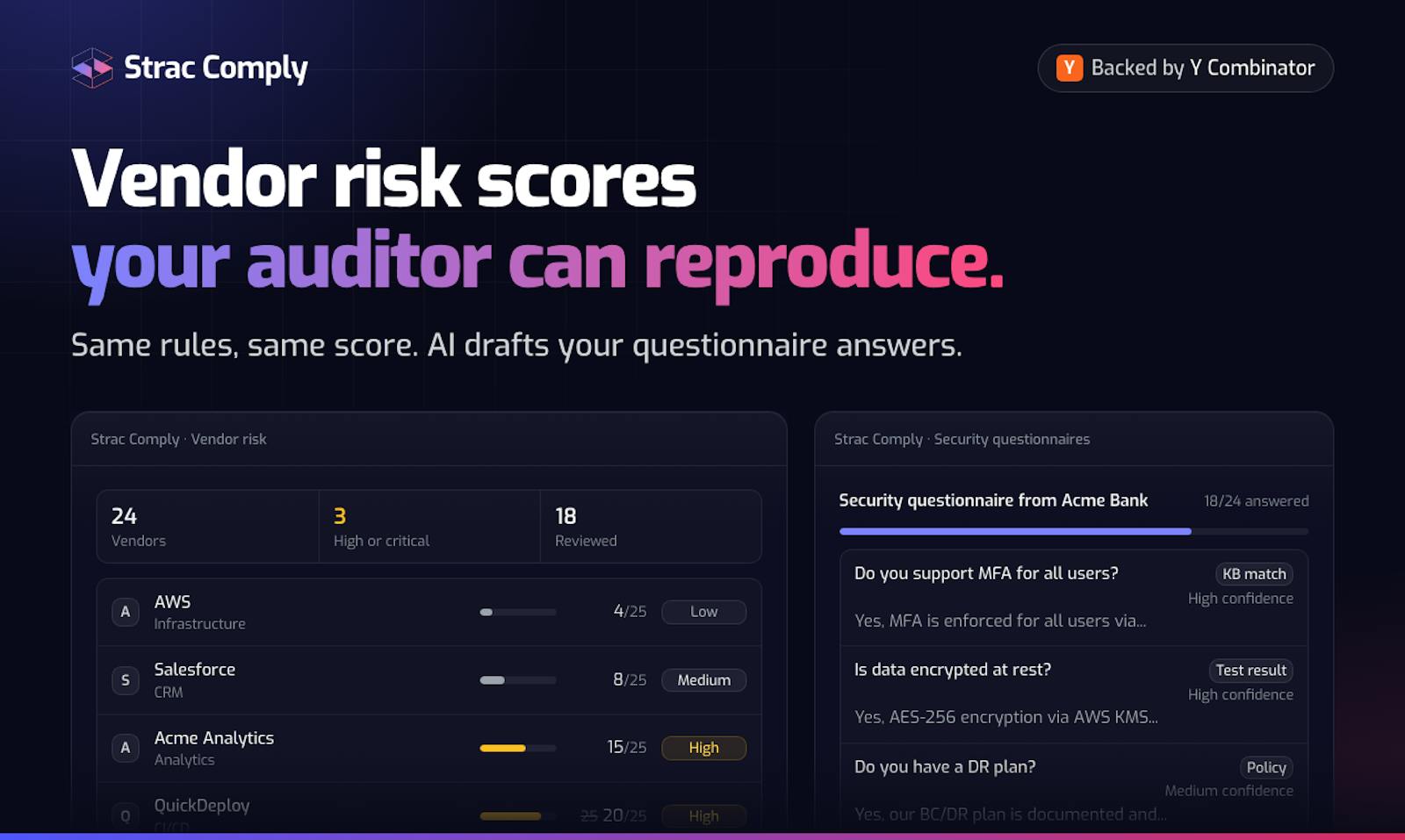
Vendor risk is only useful if an auditor can reproduce the score. Strac Comply's TPRM module produces vendor risk scores with a clear, repeatable basis, inside the same platform that runs your framework tests.
✨ Vendor risk your auditor can reproduce
Reproducible vendor risk scores, with AI-drafted security-questionnaire answers, in the same platform as your vendor risk evidence.
Same rules, same score, and AI drafts your questionnaire answers.
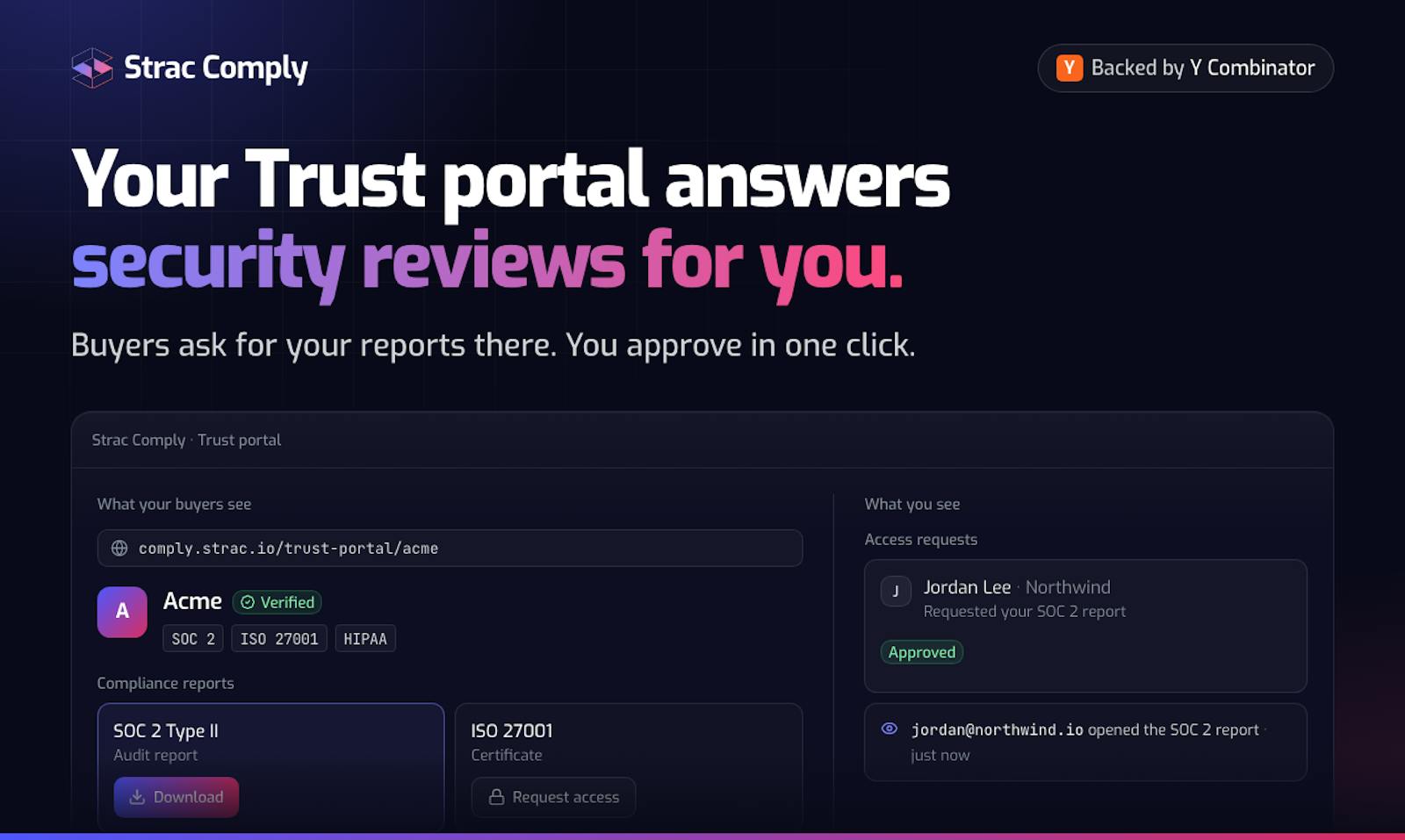
✨ A trust portal that answers security reviews for you
Buyers request your vendor risk report in your trust portal and you approve access in one click, instead of emailing PDFs around.
Buyers ask for your reports in the trust portal. You approve in one click.
✨ Strac Comply pricing: transparent, no sales call
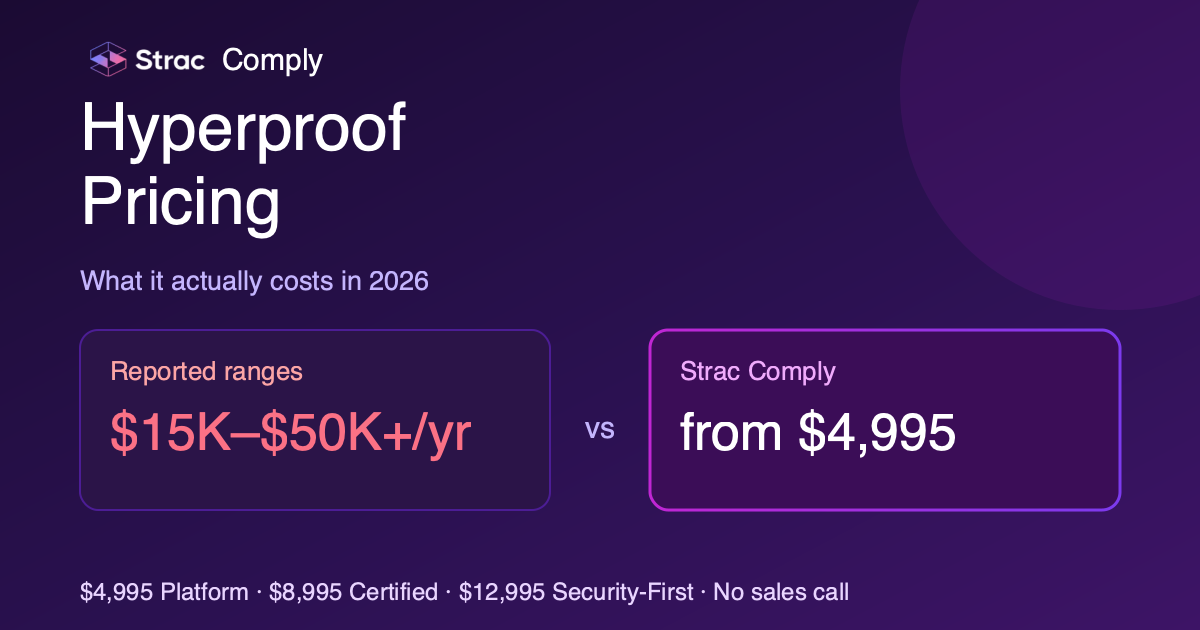
Strac Comply is transparent and self-serve: $4,995/yr for the Platform (bring your own auditor) or $8,995/yr for Certified (audit by an independent licensed CPA firm on one invoice), or $12,995/yr for Security-First (adds a human-led penetration test and Strac DLP for Slack, Google Workspace, and AI tools). All five frameworks (SOC 2, ISO 27001, PCI DSS, HIPAA, NIST CSF 2.0) are included at one price, no per-framework fees, on plans for up to 10 employees, with a free trial and no credit card. Note: the plan prices are for Strac Comply, which includes vendor risk. Strac’s DLP and DSPM data-security platform is purchased separately.
Published pricing, a free trial, and no sales call.
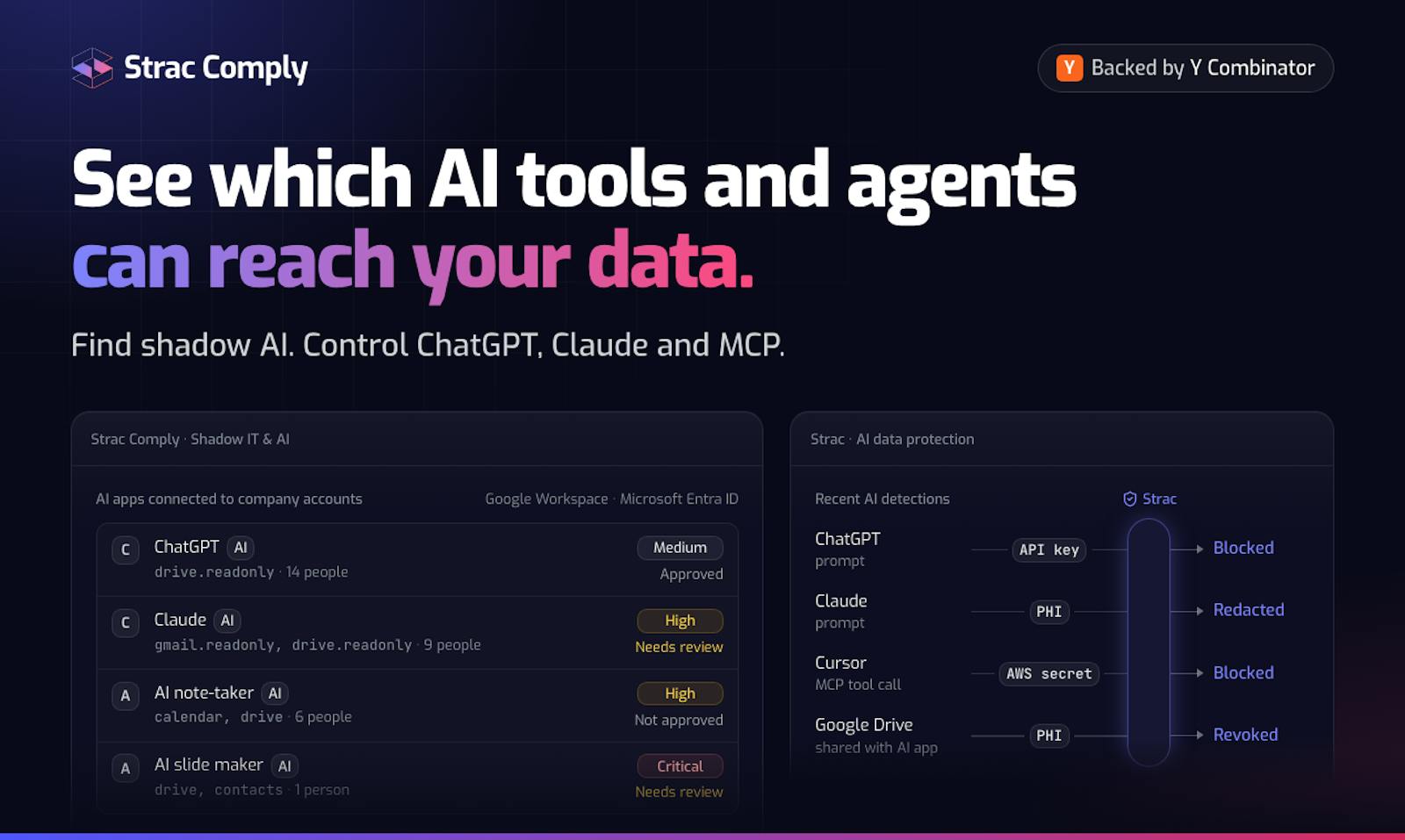
✨ Discover the vendors you did not onboard
Strac Comply surfaces shadow SaaS and AI tools from real data flows, so your vendor inventory includes the tools teams adopted without telling procurement.
Discover the vendors you did not onboard.
✨ Reproducible risk scores, AI-drafted reviews
Every vendor is scored by the same rules and the AI drafts the security-questionnaire answers, so reviews are consistent and defensible.
Reproducible risk scores, AI-drafted reviews.
✨ See what data each vendor can reach
Because Strac is a data-security platform, Comply shows which sensitive data a vendor or AI tool can touch, mapped to specific controls, not just a questionnaire score.
See what data each vendor can reach.
🎥 Watch Strac Comply get you to vendor risk without the sales call
🌶️ Spicy FAQs for Third-Party Risk Management
What is third-party risk management software?
TPRM software is a platform for finding, assessing, and monitoring the vendors and tools that have access to your data and systems. It centralizes vendor inventory, risk scoring, security questionnaires, document collection, and continuous monitoring so you can reduce, and prove you've managed, third-party risk.
What is the difference between TPRM and vendor risk management (VRM)?
They're used almost interchangeably. VRM usually refers specifically to vendors and suppliers; TPRM is the broader term that also covers contractors, partners, and the SaaS and AI tools employees adopt. Most software in this space handles both.
What are the stages of the TPRM lifecycle?
Six: identify and inventory third parties, assess inherent risk and tier them, perform due diligence, onboard, continuously monitor, and reassess or offboard. Strong programs support the whole lifecycle, not just the questionnaire.
How is Strac's TPRM different from Vanta, Drata, or OneTrust?
Those tools manage the vendors you manually add, using self-attested questionnaires. Strac discovers vendors and AI tools from real data flows, scores them by the data they actually touch, and can enforce offboarding by revoking access and deleting data, because it sits on a data-security layer, not just a questionnaire engine.
Does TPRM software help with shadow AI?
It should, and most don't. Shadow AI (employees using ChatGPT, Copilot, and niche AI tools without approval) is one of the fastest-growing sources of third-party data exposure. Strac discovers shadow AI from actual usage and lets you bring each tool under management.
How does TPRM relate to SOC 2 and Reg S-P?
Vendor oversight is required by SOC 2 (CC9), ISO 27001, GDPR Article 28, and the SEC's Reg S-P amendments. TPRM software gives you the assessments, documents, and monitoring records auditors and regulators expect to see.
Can TPRM software discover vendors automatically?
Some can do basic discovery from SSO or expense data. Strac goes further by discovering third parties from real data flows across SaaS, cloud, browser, and endpoints, so it catches the shadow IT and AI those methods miss.
Third-party risk management software has matured from a questionnaire spreadsheet into the system of record for everyone who touches your data. But most tools still share one blind spot: they can only manage the vendors you already know about, scored on what those vendors say about themselves.
Strac closes that gap. As the TPRM module of Strac Comply built on a data-security layer, it discovers your shadow IT and shadow AI from real data flows, scores each third party by the data it actually touches, runs the full security review and AI assessment, and can enforce offboarding when the relationship ends. Book a demo and we'll show you the vendors and AI tools already touching your data, the ones your current TPRM tool can't see.
What is third-party risk management software?
TPRM software is a platform for finding, assessing, and monitoring the vendors and tools that have access to your data and systems. It centralizes vendor inventory, risk scoring, security questionnaires, document collection, and continuous monitoring so you can reduce, and prove you've managed, third-party risk.
What is the difference between TPRM and vendor risk management (VRM)?
They're used almost interchangeably. VRM usually refers specifically to vendors and suppliers; TPRM is the broader term that also covers contractors, partners, and the SaaS and AI tools employees adopt. Most software in this space handles both.
What are the stages of the TPRM lifecycle?
Six: identify and inventory third parties, assess inherent risk and tier them, perform due diligence, onboard, continuously monitor, and reassess or offboard. Strong programs support the whole lifecycle, not just the questionnaire.
How is Strac's TPRM different from Vanta, Drata, or OneTrust?
Those tools manage the vendors you manually add, using self-attested questionnaires. Strac discovers vendors and AI tools from real data flows, scores them by the data they actually touch, and can enforce offboarding by revoking access and deleting data, because it sits on a data-security layer, not just a questionnaire engine.
Does TPRM software help with shadow AI?
It should, and most don't. Shadow AI (employees using ChatGPT, Copilot, and niche AI tools without approval) is one of the fastest-growing sources of third-party data exposure. Strac discovers shadow AI from actual usage and lets you bring each tool under management.
Discover & Protect Data on SaaS, AI, MCP, Endpoints & Cloud
Strac provides end-to-end data loss prevention for all SaaS and Cloud apps. Integrate in under 10 minutes and experience the benefits of live DLP scanning, live redaction, and a fortified SaaS environment.


.webp)






.avif)



.gif)
