What SEC Reg S-P requires after the 2024 amendments — written incident response, 30-day breach notice, the vendor 72-hour rule, and the data safeguards that satisfy it. Plus how Strac helps you discover, protect, detect, and prove it.
Reg S-P is the SEC's rule — built on the Gramm-Leach-Bliley Act — that requires financial firms to keep customers' nonpublic personal information (NPI) private and safeguarded.
The May 2024 amendments added real teeth: a written incident response program, 30-day customer breach notification, service-provider oversight with a 72-hour vendor-notice rule, and new recordkeeping.
Who's covered: broker-dealers, SEC-registered investment advisers (RIAs), investment companies, and transfer agents.
Deadlines: larger entities (≥ $1.5B AUM) had to comply by December 3, 2025; smaller entities by June 3, 2026 — that deadline has now passed, and incident response is the first real test.
Reg S-P is a data-security problem, not just paperwork. You have to find customer information, protect it, detect unauthorized access, dispose of it properly, and prove all of it. Strac does exactly that — data discovery and classification, real-time redaction, a who-accessed-what audit trail, and the evidence your incident response program needs.
What Is SEC Regulation S-P?
Regulation S-P (often written "Reg S-P") is the Securities and Exchange Commission's privacy and safeguarding rule for the firms it regulates. It implements the Gramm-Leach-Bliley Act (GLBA) for the securities industry and has two long-standing components:
The Privacy Rule — firms must tell customers how their nonpublic personal information is collected and shared, and give them a chance to opt out of certain sharing.
The Safeguards Rule — firms must adopt written policies and procedures with administrative, technical, and physical safeguards to protect customer records and information.
"Customer information" here means nonpublic personal information (NPI): names tied to account numbers, Social Security numbers, balances, transaction history, and anything else a firm collects to provide a financial product or service. If a broker-dealer or adviser holds it, Reg S-P expects it to be protected — and after 2024, expects the firm to prove it.
If you're comparing privacy regimes, Reg S-P sits alongside the same family of obligations Strac already helps customers meet — GDPR, SOC 2, and PCI DSS — with the SEC as the enforcer.
The headline change: covered firms must now detect, respond to, and recover from unauthorized access to customer information — and notify the people affected. "We have a policy" is no longer enough; the SEC made clear that reliance on a vendor without oversight does not transfer the obligation.
Reg S-P Compliance Deadlines: Who Must Comply by When
The SEC set a tiered timeline running from the June 3, 2024 Federal Register publication (Holland & Knight, Proskauer):
Firm size
Who
Reg S-P compliance date
Larger entities
Investment advisers with ≥ $1.5B AUM; larger broker-dealers, investment companies, transfer agents
December 3, 2025
Smaller entities
Everyone else covered by the rule
June 3, 2026
Both deadlines have now passed. For most firms the rule is live today, and examiners will expect to see a working incident response program — not a draft. If your program still lives in a Word document, the gap is operational: can you actually detect unauthorized access to customer information and show what was touched? That's where most firms fall short.
The Reg S-P Requirements, Explained
The amended rule adds four core obligations on top of the existing privacy and safeguards duties.
1. Written incident response program. You must maintain written policies and procedures to detect, respond to, and recover from unauthorized access to or use of customer information — and the program has to actually work, not just exist on paper.
2. Customer breach notification (the 30-day rule). Once you determine that unauthorized access to sensitive customer information has occurred or is reasonably likely, you must notify affected individuals as soon as practicable, and within 30 days.
3. Service-provider oversight (the 72-hour rule). You must take reasonable steps to ensure your vendors protect customer information — and contract for notification within 72 hours of a breach at the service provider (ncontracts).
4. Recordkeeping. You must document the program, the incidents, and the notifications, and retain those records for examination.
The amendments also extend the disposal rule (proper disposal of consumer report information) to more firms, and broaden the definition of the customer information you're on the hook to protect. Two clocks now define an incident: a 72-hour window for vendor notice and a 30-day window for customer notice once you make a determination.
✨ How Strac Helps You Meet Reg S-P
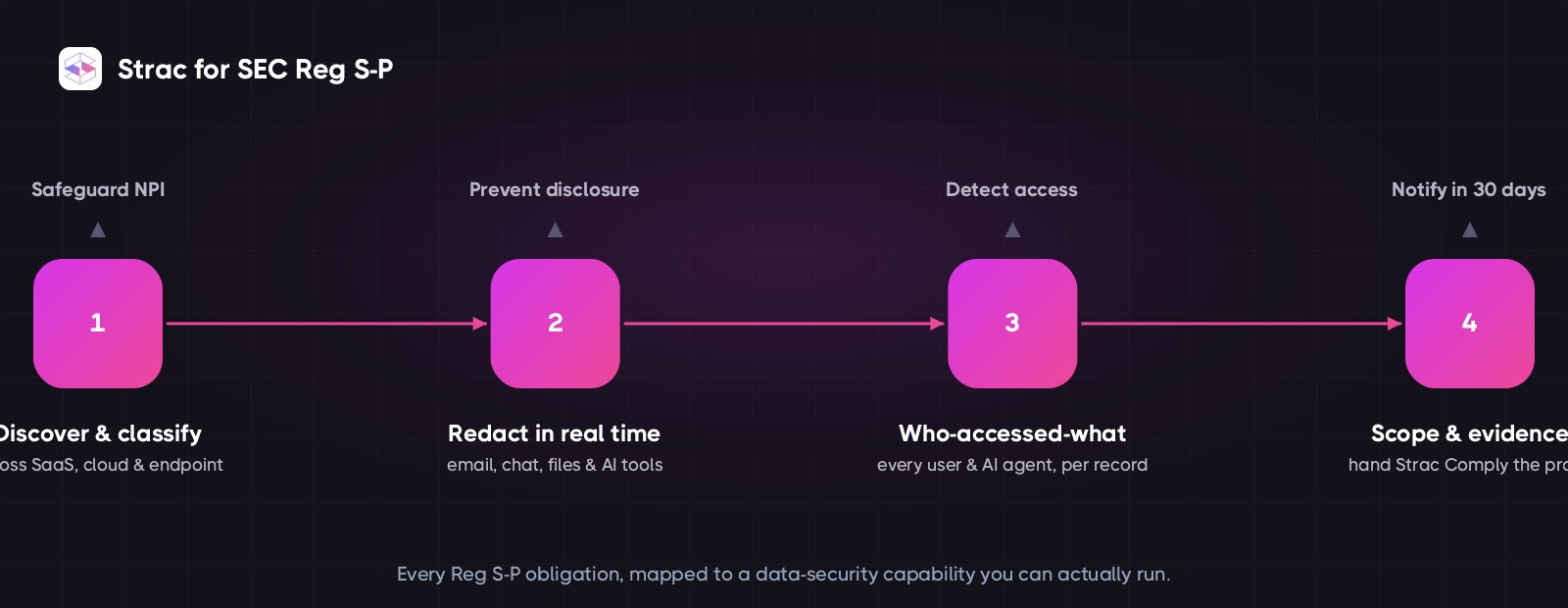
Here's the part the law-firm guides skip: every one of these requirements is, underneath, a data-security problem. You cannot protect, detect, dispose of, or report on customer information you can't see. Strac is built for exactly that — and it spans the full obligation, from finding the data to proving what happened to it.
Reg S-P obligation
What it really requires
How Strac delivers it
Safeguard customer records
Know where NPI lives and lock it down
Data discovery and classification across SaaS, cloud, and endpoints — you can't protect what you can't find
Detect unauthorized access/use
See when customer data is touched
A who-accessed-what audit trail — every access attributed to a user or AI agent, at the record level
Prevent disclosure
Stop NPI from leaving
Real-time redaction and masking of customer data in email, chat, files, and AI tools
Disposal rule
Get rid of NPI properly
Data-lifecycle controls — redact, tokenize, or delete, with proof
Service-provider / 72-hour oversight
Watch third-party and agent access
Monitor what vendors and AI agents reach for, in real time
Incident response + 30-day notice
Determine scope and notify fast
Scope an incident from the audit trail and hand your Strac Comply program the evidence to notify on time
In other words: Strac Comply runs the program and the evidence binder, while Strac's data securityis the technical safeguard the rule is asking for. That bundle — discover, protect, detect, prove — is what turns a Reg S-P policy into something you can actually defend in an SEC exam.
✨ Step 1: Discover and Classify Your Customer Information
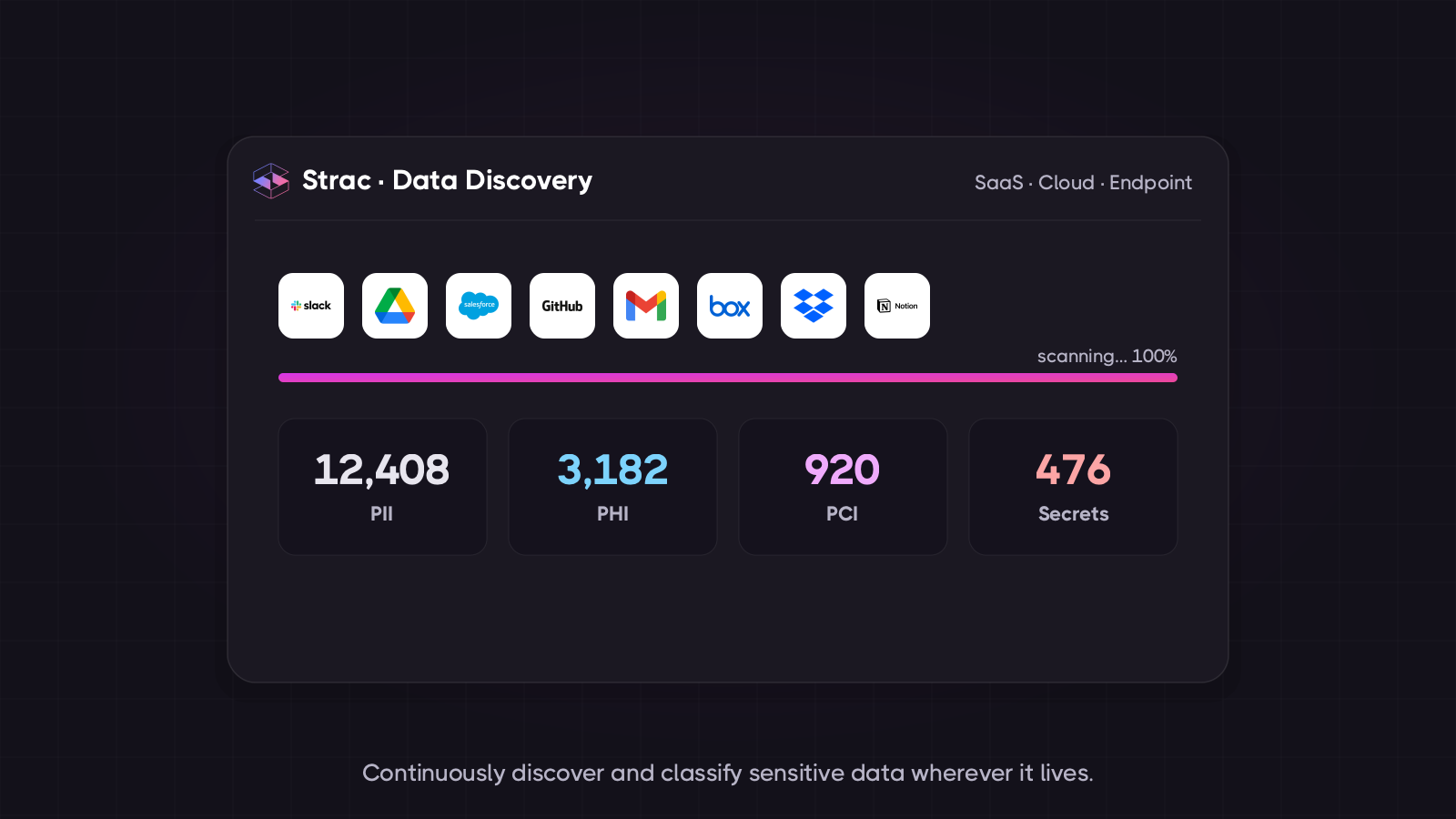
The safeguards rule starts with a question most firms can't answer: where is all our customer NPI? It's in CRMs, shared drives, email inboxes, support tickets, spreadsheets, and increasingly inside AI tools. Strac continuously scans those surfaces and classifies the regulated data — names tied to accounts, SSNs, financial details — so you have a live map of the NPI you're responsible for.
This is the foundation for everything else in Reg S-P: you can't safeguard, monitor, or properly dispose of data you didn't know you had. It's the same data discovery engine Strac customers already use to find and protect sensitive data across 50+ integrations.
✨ Step 2: Detect Unauthorized Access — and Prove It
The 2024 amendments hinge on a verb most policies can't back up: detect. To notify affected customers within 30 days, you first have to know their information was accessed — and to satisfy an examiner, you have to show it.
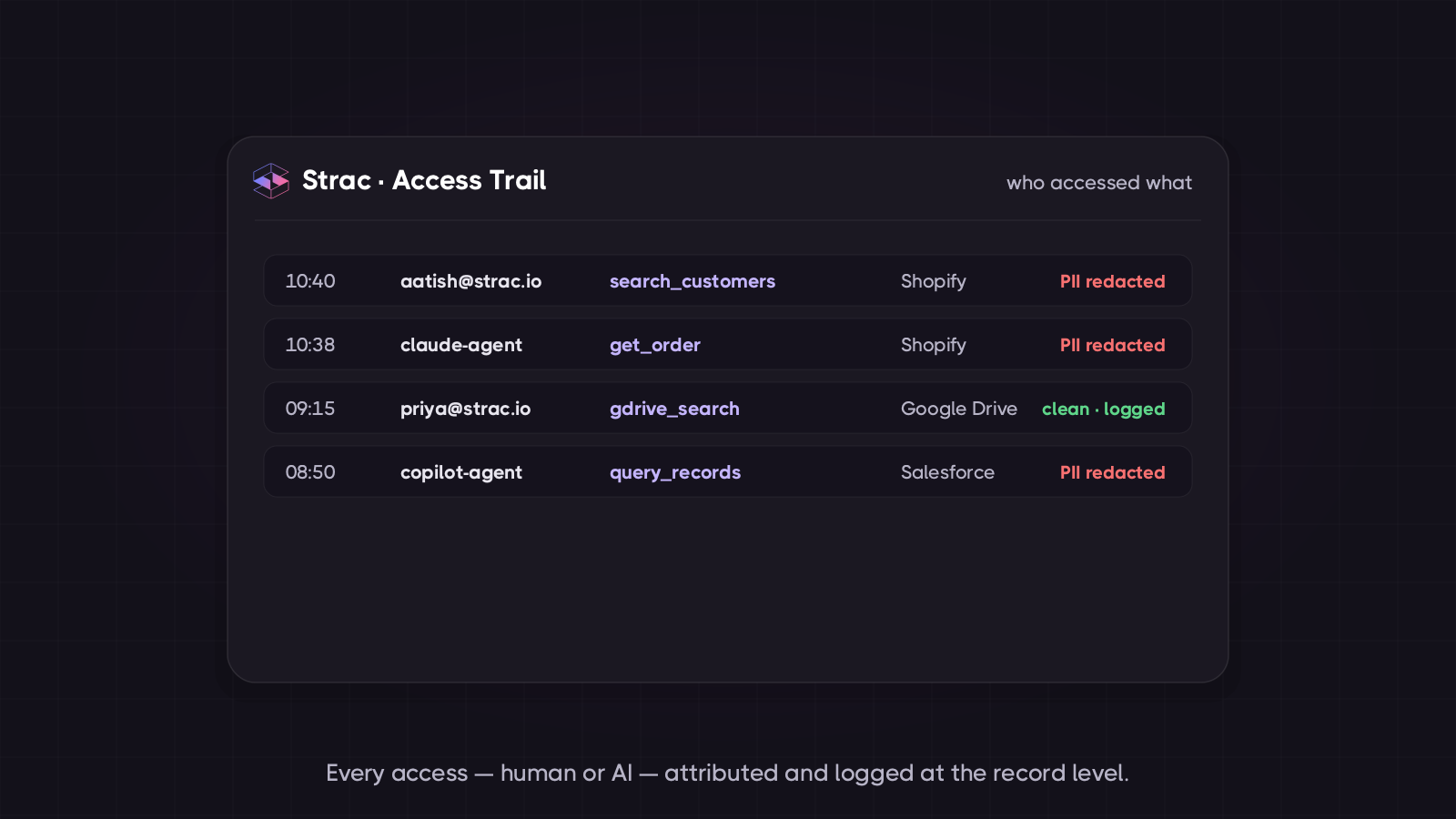
Strac writes every access to customer data to an append-only, who-accessed-what audit trail: which user or AI agent, which records, what sensitive data was present, and what action was taken. When something looks wrong, you can scope the incident in minutes instead of reconstructing it after the fact — and the same log is the evidence your Strac Comply incident response program produces for the SEC.
This is exactly the gap firms discover after the deadline: the policy says "detect and notify," but nothing in the stack actually detects. Strac closes it.
Reg S-P Incident Response Plan: From Policy to Practice
A compliant Reg S-P incident response program has to cover four things: detection, response, recovery, and notification (customers within 30 days, vendors held to 72 hours). Most firms have the words; few have the wiring.
Strac gives the program its missing operational half:
Detection — real-time monitoring of access to customer information across your stack.
Scoping — the who-accessed-what trail tells you exactly whose data was touched, so the 30-day clock starts with facts, not guesses.
Evidence — every finding and action is logged and retained for the recordkeeping requirement.
Vendor oversight — monitor what third parties and AI agents reach for, so the 72-hour rule isn't just a contract clause.
Want a head start on the written program? See how Strac Comply maps to Reg S-P and we'll walk through a Reg S-P incident response plan template mapped to your stack.
🌶️ Spicy FAQs for Reg S-P
What is Reg S-P in simple terms?
Reg S-P is the SEC's rule requiring broker-dealers, investment advisers, and other covered firms to keep customers' nonpublic personal information private and safeguarded. The 2024 amendments added a written incident response program, customer breach notification, and vendor oversight on top of the original privacy and safeguards rules.
Who has to comply with Reg S-P?
Broker-dealers, SEC-registered investment advisers (RIAs), investment companies, and transfer agents. The 2024 amendments extended several requirements — including the disposal rule — to transfer agents for the first time.
What is the Reg S-P compliance date?
Larger entities (investment advisers with ≥ $1.5B AUM and larger firms) had to comply by December 3, 2025; smaller entities by June 3, 2026. Both deadlines have passed, so the rule is in effect for essentially all covered firms.
What is the Reg S-P 72-hour rule?
It's the service-provider notification requirement: covered firms must contract for their vendors to report a breach of customer information within 72 hours. It pairs with the separate 30-day deadline to notify affected customers once the firm determines unauthorized access occurred.
What is the Reg S-P disposal rule?
The disposal rule requires proper disposal of consumer report information so it can't be reconstructed — for example, securely deleting or destroying records you no longer need. The 2024 amendments extended this obligation to more covered firms, including transfer agents.
How is Reg S-P different from GLBA?
Reg S-P is how the SEC implements GLBA for the securities industry. GLBA is the underlying federal law; Reg S-P is the SEC's specific rule (with its own 2024 amendments and deadlines) that broker-dealers and advisers are examined against.
Does Reg S-P require specific software?
No — the rule is technology-neutral. But it requires capabilities most firms don't have out of the box: discovering where customer information lives, detecting unauthorized access, and producing records of it. A data security platform like Strac provides those capabilities directly.
The 2024 Reg S-P amendments quietly turned a privacy-notice rule into a data breach and incident-response mandate — and the deadlines are now behind us. The firms that pass their next SEC exam won't be the ones with the best-worded policy; they'll be the ones who can actually find their customers' information, protect it, detect when it's touched, and prove every step.
That's the whole job, and it's what Strac is built for: data discovery and classification, real-time redaction, a who-accessed-what audit trail, and the evidence your incident response program needs. Book a demo and we'll map Strac to your Reg S-P obligations, line by line.
What is Reg S-P in simple terms?
Reg S-P is the SEC's rule requiring broker-dealers, investment advisers, and other covered firms to keep customers' nonpublic personal information private and safeguarded. The 2024 amendments added a written incident response program, customer breach notification, and vendor oversight on top of the original privacy and safeguards rules.
Who has to comply with Reg S-P?
Broker-dealers, SEC-registered investment advisers (RIAs), investment companies, and transfer agents. The 2024 amendments extended several requirements — including the disposal rule — to transfer agents for the first time.
What is the Reg S-P compliance date?
Larger entities (investment advisers with ≥ $1.5B AUM and larger firms) had to comply by December 3, 2025; smaller entities by June 3, 2026. Both deadlines have passed, so the rule is in effect for essentially all covered firms.
What is the Reg S-P 72-hour rule?
It's the service-provider notification requirement: covered firms must contract for their vendors to report a breach of customer information within 72 hours. It pairs with the separate 30-day deadline to notify affected customers once the firm determines unauthorized access occurred.
What is the Reg S-P disposal rule?
The disposal rule requires proper disposal of consumer report information so it can't be reconstructed — for example, securely deleting or destroying records you no longer need. The 2024 amendments extended this obligation to more covered firms, including transfer agents.
Discover & Protect Data on SaaS, AI, MCP, Endpoints & Cloud
Strac provides end-to-end data loss prevention for all SaaS and Cloud apps. Integrate in under 10 minutes and experience the benefits of live DLP scanning, live redaction, and a fortified SaaS environment.


.webp)






.avif)



.gif)
