Enterprise Data Protection in the AI Era: AI, SaaS, Cloud & Endpoint (2026)
This blog highlights the importance of enterprise data protection, strategies, solutions, and how Strac.io helps organizations secure sensitive information and ensure regulatory compliance.
Protecting confidential information is crucial for business success, and Strac.io offers a robust Data Security Posture Management (DSPM) solution to help organizations secure their data while ensuring compliance with regulations.
Enterprise data encompasses all structured and unstructured information used by organizations, including customer and financial data, which is essential for informed decision-making and operational efficiency.
A comprehensive Enterprise Data Protection (EDP) strategy is vital to safeguard data from breaches and unauthorized access, ensuring legal compliance, protecting intellectual property, and maintaining customer trust.
Key components of an effective enterprise data protection strategy include encryption, data masking, backup solutions, and access controls to mitigate risks associated with cyber threats.
Organizations must navigate various data protection laws like GDPR and CCPA while implementing best practices, such as multi-layered security and employee training, to enhance their data protection efforts.
In today’s data-driven world, protecting confidential information is not just a necessity but a important component of business success. As organizations increasingly rely on substantial amounts of enterprise data, the risk of breaches and data loss escalates.
✨ Enterprise Data Protection in the AI Era
For years, “enterprise data protection” meant backup, access control, and disaster recovery. That still matters — but it is no longer where the biggest exposure lives. Today, sensitive data leaks through the tools employees use every day: someone pastes a customer record into ChatGPT, Microsoft 365 Copilot surfaces files a user was never meant to see, and AI agents pull regulated data through the Model Context Protocol. Modern enterprise data protection has to follow the data across every surface — and do it by content, not by locking things down.
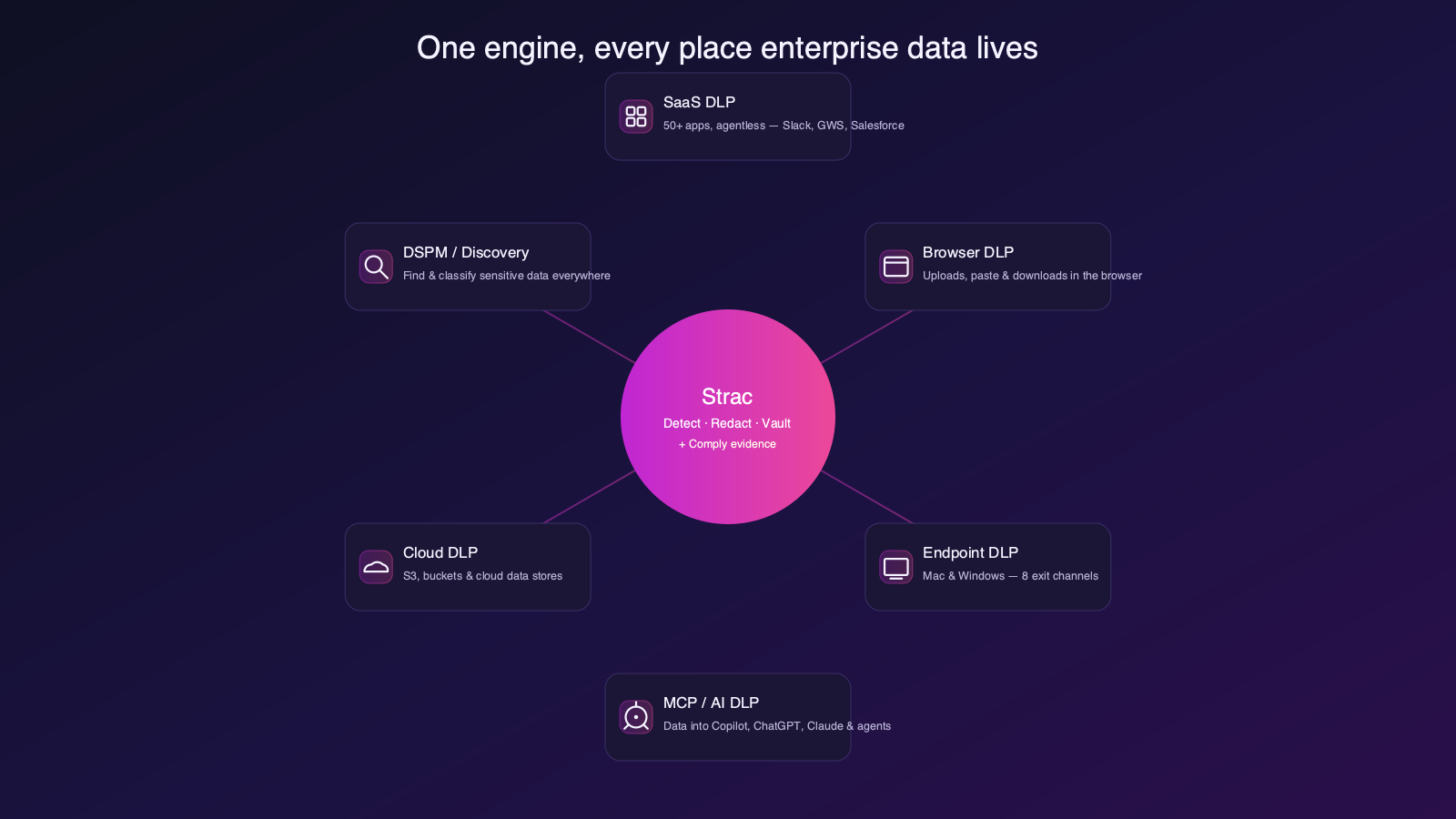
Modern enterprise data protection has to follow the data — into AI tools, across SaaS, off the endpoint, and through the cloud — on one content-aware engine.
Strac protects enterprise data wherever it moves, with a single content-aware engine — the same classifiers detecting PII, PHI, PCI, secrets, and source code whether the data is in a SaaS app, on a laptop, or flowing into an AI assistant. It doesn’t just detect: it redacts, masks, or vaults the sensitive value and writes every action to an audit trail for compliance.
Where Enterprise Data Is Exposed — and How Strac Protects It
Surface
The exposure
How Strac protects it
AI tools (Copilot, ChatGPT, Claude)
Employees paste PII and secrets into prompts; assistants index files people shouldn’t see
Browser, endpoint, and MCP DLP inspect content going into AI tools and block or redact by data type
MCP / AI agents
Agents pull sensitive data through the Model Context Protocol
MCP DLP redacts sensitive data on the agent path — redact-and-continue, not just block
SaaS apps
Regulated data spreads across Slack, Google Workspace, Salesforce and 50+ apps
Agentless SaaS DLP discovers and remediates sensitive data in-app
Endpoints (Mac / Windows)
Data leaves via USB, print, AirDrop, clipboard, and browser uploads
The endpoint agent governs eight exit channels in Block, Warn, or Audit
Cloud storage
Sensitive files sit exposed in S3 and cloud buckets
Cloud DLP scans and classifies data at rest
Data discovery (DSPM)
You can’t protect what you can’t see
DSPM finds and classifies sensitive data across your estate
Strac.io addresses these challenges head-on by offering a robust Data Security Posture Management (DSPM) solution that seamlessly integrates with SaaS, Cloud, and GenAI tools. With advanced features like accurate detection and remediation of sensitive data, Strac empowers businesses to safeguard their information while ensuring compliance with industry regulations. Take control of your data protection strategy and fortify your defenses with Strac.
What is Enterprise Data?
Enterprise data refers to the structured and unstructured information generated, collected, and utilized by an organization to support its core business activities. This contains a wide range of data types, including customer information, employee records, financial transactions, and product details.
Effective management of enterprise data is crucial for improving decision-making, enhancing operational efficiency, and driving business growth. By centralizing data from various sources, organizations can achieve better collaboration and innovation while ensuring data quality and security.
✨ What is Enterprise Data Protection?
Enterprise Data Protection (EDP) is a comprehensive strategy designed to safeguard an organization's data from unauthorized access, breaches, or loss. It includes various processes and technologies aimed at ensuring the confidentiality, integrity, & availability of important data. EDP is essential for maintaining business continuity, protecting intellectual property, and complying with legal regulations related to data privacy.
Key components include encryption, data masking, backup solutions, and access controls.
Enterprise Data Protection Strategy: Share Sensitive Data Securely Without Anyone Seeing It
Enterprise Data Protection Strategy and Its Importance
An effective enterprise data protection strategy is vital for several reasons:
Legal Compliance: Organizations must adhere to various laws and regulations governing data protection. Non-compliance can lead to critical fines and legal repercussions.
Protecting Intellectual Property: Safeguarding sensitive data is crucial for maintaining competitive advantage.
Maintaining Customer Trust: Customers expect companies to protect their personal information; any breach can severely damage a company's reputation.
Preventing Financial Loss: Data breaches can incur substantial costs related to remediation efforts, regulatory fines, and potential lawsuits.
Enabling Data-Driven Decisions: A robust data protection framework allows organizations to leverage their data effectively without compromising sensitive information.
Enterprise-Grade Security
Enterprise-grade security refers to the high-level security measures implemented within an organization to protect its critical assets. This includes advanced threat detection systems, encryption protocols, access controls, and comprehensive monitoring solutions.
Such security measures are essential in mitigating risks associated with cyber threats and ensuring compliance with industry regulations. A multi-layered security approach helps organizations defend against both internal and external threats.
🎥 Enterprise Data Protection Solutions
Strac protects enterprise data in real time across the browser, endpoint, SaaS, and AI tools.
Various solutions are available to enhance enterprise data protection:
Data Encryption: Converts plaintext into ciphertext to protect sensitive information.
Data Masking: Hides sensitive data during application testing or analytics.
Data Backup: Regularly saves copies of critical data for recovery in case of loss.
Data Loss Prevention (DLP): Monitors and protects sensitive information from unauthorized access.
Access Control Systems: Manage user permissions and authentication processes.
Essential Components and Considerations for a Successful Enterprise Data Protection Strategy
A successful enterprise data protection strategy typically includes:
Data Lifecycle Management: Standardizes processes from creation through deletion.
Data Risk Management: Identifies potential risks affecting data security.
Backup and Recovery Plans: Ensures that critical data can be restored after loss.
Compliance with Regulations: Adheres to laws governing data protection.
Monitoring and Reviewing Processes: Provides visibility into data activities and helps improve protection efforts.
✨ C-Suite Leadership on Enterprise Data Protection
C-suite executives play an important role in shaping an organization's approach to enterprise data protection. Their leadership is essential in establishing a culture of security awareness throughout the organization.
This involves:
Enterprise Data Protection Strategy: C-suite Leadership in Data Protection
Effective leadership from the C-suite ensures that data protection is prioritized at all levels of the organization.
Data Protection Laws and Compliance
Organizations must navigate various laws governing data protection, such as:
General Data Protection Regulation (GDPR): A complete EU regulation that mandates strict guidelines for handling personal information.
California Consumer Privacy Act (CCPA): Protects the privacy rights of California residents regarding their personal information.
Compliance with these regulations is critical not only for avoiding penalties but also for fostering trust with customers.
How to Build an Enterprise Data Protection Plan
Building an effective enterprise data protection plan involves several key steps:
Identify and Classify Sensitive Data: Determine which types of data require enhanced security measures.
Conduct Risk Assessments: Identify vulnerabilities within the organization’s systems.
Implement Security Controls: Deploy tools like encryption, DLP systems, and access management solutions.
Train Employees: Regularly educate staff about best practices in data protection.
What Are the Different Types of Enterprise Data Protection?
Different types of enterprise data protection methods include:
Data Encryption
Data Masking
Data Backup
Data Loss Prevention (DLP)
Access Control Systems
These methods work together to ensure that sensitive information remains secure across various environments.
Best Practices for Enterprise Data Protection
To enhance enterprise data protection efforts, organizations should consider these best practices:
Implement multi-layered security approaches.
Regularly update software and systems.
Conduct frequent audits of security measures.
Enhance a culture of security awareness among employees.
Ensure compliance with relevant laws and regulations.
What Are Common Shortcomings of Enterprise Data Management?
Common shortcomings in enterprise data management include:
Lack of proper governance leading to inconsistent data quality.
Insufficient integration between different systems causing silos.
Inadequate training on best practices among employees.
Failure to comply with evolving regulations impacting operational efficiency.
What Are Enterprise Data Protection Challenges & Threats?
Challenges in enterprise data protection include:
Increasing sophistication of cyber threats.
Difficulty in maintaining compliance with diverse regulations.
Balancing accessibility with security requirements.
Managing large volumes of diverse data types effectively.
✨ The New Enterprise Data Protection Frontier in 2026: AI, GenAI & MCP
In 2026, the biggest gap in most enterprise data protection strategies is AI. Employees paste regulated data into ChatGPT, Claude, and Copilot; AI agents pull data out of your SaaS and cloud over the Model Context Protocol (MCP); and none of it crosses the network perimeter your legacy tools watch. Three AI-era risks now belong in every enterprise plan:
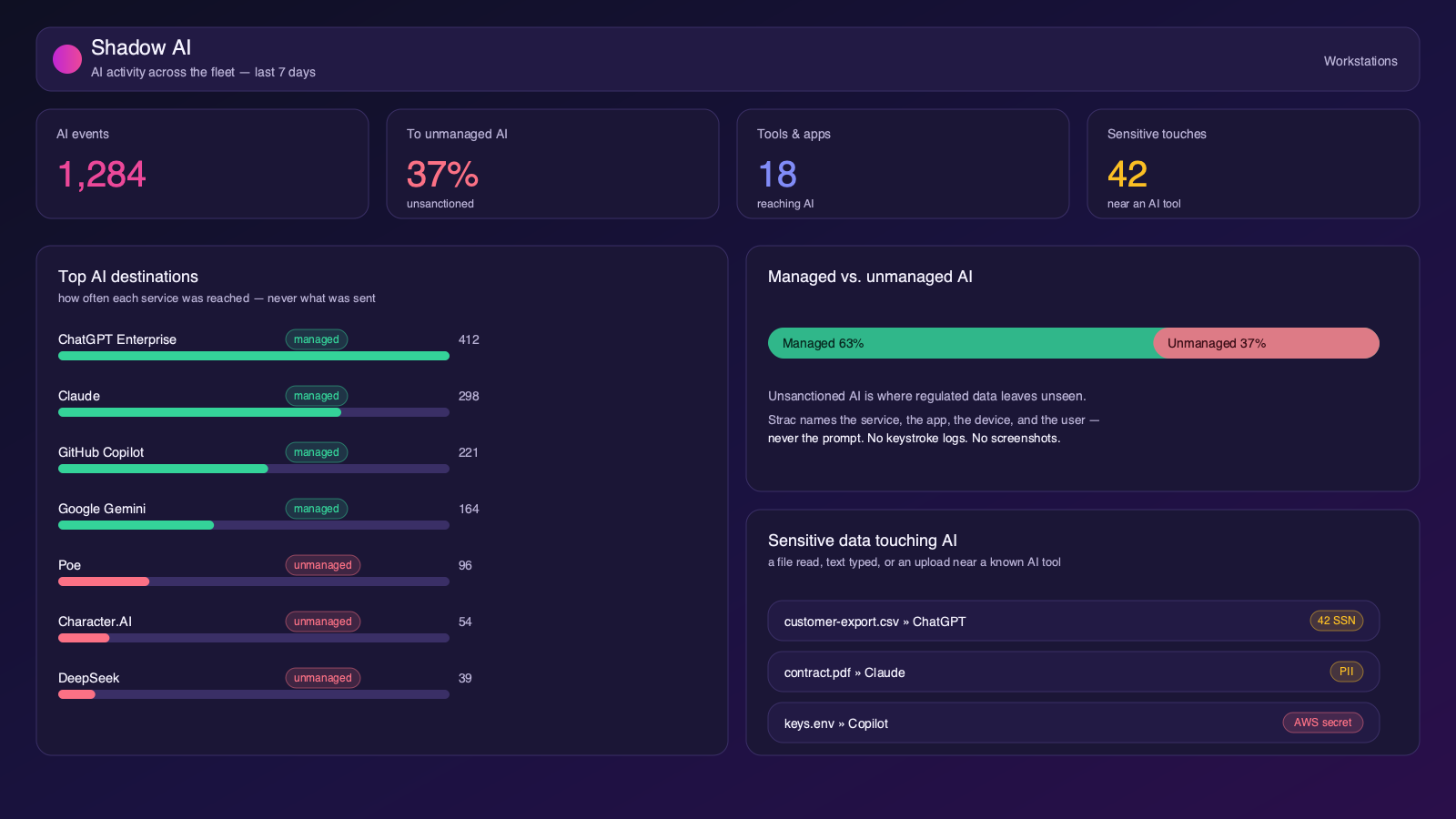
Shadow AI: unsanctioned AI tools employees adopt without IT’s sign-off — each one an ungoverned path for sensitive data to leave.
GenAI prompt leakage: PII, PHI, secrets, and source code typed or pasted into AI chat, where a model outside your compliance boundary may retain it. AI DLP inspects and redacts these in the browser in real time.
Agent-to-data access over MCP: an AI agent can retrieve a customer record on an authenticated tool call and feed it straight into a model. MCP DLP redacts sensitive data on that path before the agent ever sees it.
Enterprise data protection in 2026 is no longer just firewalls, DLP, and backups — it is governing the data flowing into and out of AI, across every surface, under one policy.
Modern enterprise data protection must see Shadow AI — which AI tools are in use and the data at risk in each.
✨ Master Enterprise Data Protection with strac.io
Strac.io offers tools designed to enhance enterprise data protection strategies by providing comprehensive solutions tailored to meet organizational needs. We focus on integrating advanced security measures while ensuring compliance with regulatory standards.
Enterprise Data Protection Strategy: Protect Sensitive Data Without Touching It
By leveraging such specialized tools, organizations can significantly bolster their defenses against potential threats while optimizing their overall data management processes.
Enterprise Data Protection Strategy: Our Data Discovery, DSPM & DLP Integrations
🌶️ Spicy FAQs for Enterprise Data Protection
What is enterprise data protection in the AI era?
It is the strategy and controls that keep an enterprise’s sensitive data safe across every surface it now moves through — SaaS, cloud, endpoints, the browser, GenAI tools, and AI agents over MCP — not just the network perimeter. In 2026 it must include Shadow AI discovery and data-layer DLP on AI access paths.
How is AI changing enterprise data protection?
AI moved the leak points inward. Data now leaves through prompts pasted into ChatGPT and through AI agents pulling records over MCP — paths legacy DLP and firewalls never watched. Protecting enterprise data now means redacting sensitive data at the point of AI use.
Does enterprise data protection replace DLP and backups?
No — it extends them. You still need endpoint DLP, encryption, access control, and backups; the AI era adds browser/GenAI DLP, MCP-layer redaction, and Shadow AI governance on top, ideally under one policy and classifier.
What is the fastest win for an enterprise data protection program in 2026?
Close the AI gap first: discover Shadow AI usage, then put data-layer DLP in front of GenAI prompts and MCP tool calls. That’s where regulated data is leaking today, and it’s the gap most existing programs miss.
How does Strac fit an enterprise data protection strategy?
Strac is one agentless-plus-endpoint platform covering SaaS, cloud, browser, GenAI, endpoint, and MCP — discovering sensitive data, redacting it in motion, and proving control for compliance, so enterprise data stays protected wherever it moves.
Related: Data Detection and Response (DDR) — real-time detect-and-respond across SaaS, cloud, endpoints, and GenAI, the reactive complement to DSPM.
Conclusion
An enterprise data protection strategy is very important today. With 89% of companies seeing data's value, strong cybersecurity is needed. Good data management is key, as 95% of successful companies show.
Data security is more than just tech. It needs a whole approach, including training, risk checks, and watching closely. Companies with good plans have 40% fewer data breaches.
Encryption and access control help a lot. They cut data risk by 50% and 70%, respectively. This makes data safer.
Take control of your sensitive data with Strac, your premier Data Security Posture Management (DSPM) solution for SaaS, Cloud, and GenAI tools. Strac is a leading DSPM vendor that offers continuous, automated monitoring of your entire ecosystem to detect sensitive data effortlessly.
Discover & Protect Data on SaaS, AI, MCP, Endpoints & Cloud
Strac provides end-to-end data loss prevention for all SaaS and Cloud apps. Integrate in under 10 minutes and experience the benefits of live DLP scanning, live redaction, and a fortified SaaS environment.


.webp)









.avif)



.gif)
