Enterprise AI Agent Governance: The Rollout Playbook (2026)
Enterprise AI agent governance at scale: discover every agent, protect the data on every action, prove it against your frameworks, and monitor continuously. A 90-day playbook.
Enterprise AI agent governance is how a large organization discovers, controls, monitors, and proves the safety of AI agents at scale — across many teams, tools, and MCP connections.
The core enterprise problem is agent sprawl: agents spin up faster than security can track them, each one an ungoverned path to sensitive data.
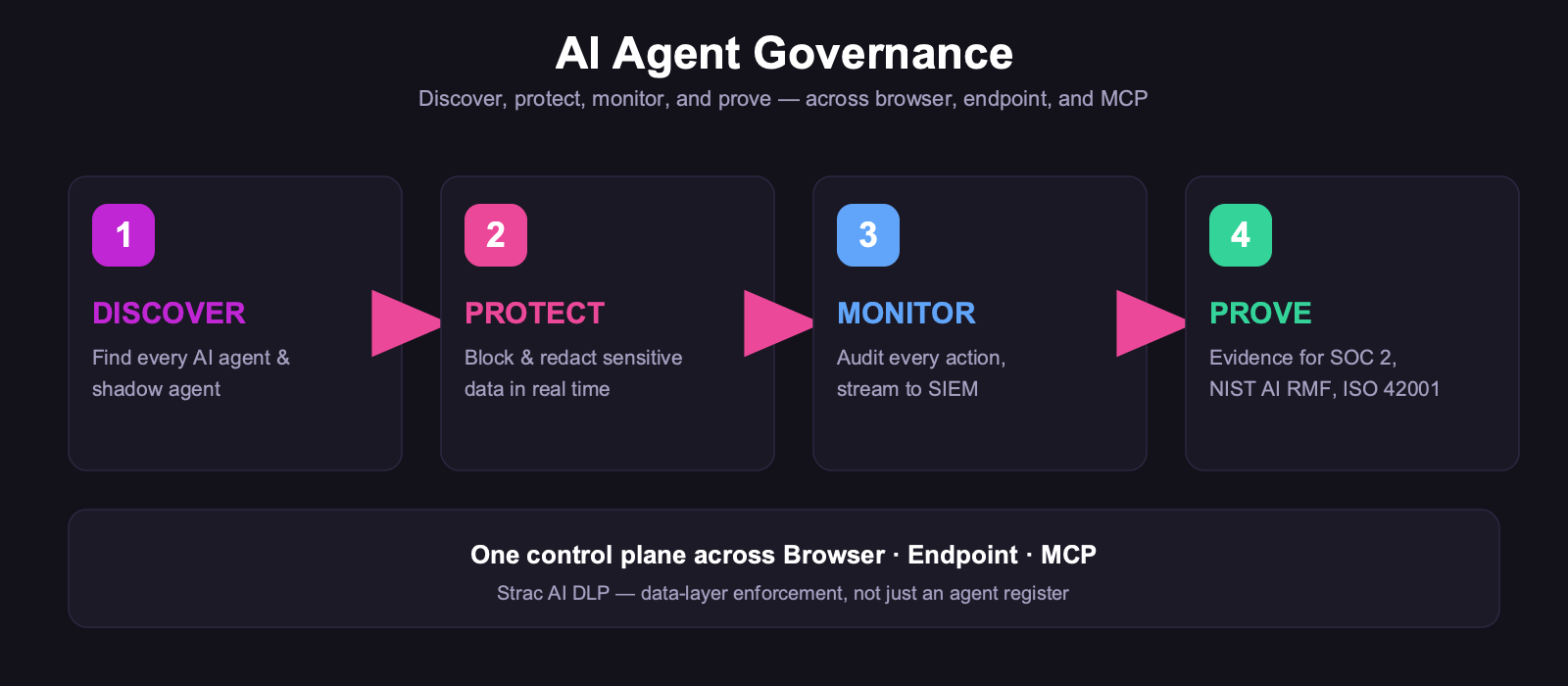
A working operating model runs on four verbs — Discover, Protect, Prove, Monitor — with clear owners across security, compliance, data, and engineering.
Strac supplies the Protect and Prove layers: redacting sensitive data on every MCP DLP call and generating the audit evidence auditors and frameworks require.
This page is the enterprise rollout playbook; start from the pillar on AI agent governance.
✨ What Enterprise AI Agent Governance Means
Enterprise AI agent governance is AI agent governance operationalized at scale. In a small team you can eyeball which agents exist; in an enterprise, agents are created by dozens of teams using ChatGPT, Claude, Cursor, internal copilots, and a growing web of MCP servers. Governance becomes an operating model — repeatable discovery, enforced controls, continuous monitoring, and audit-ready evidence — rather than a one-time review.
Enterprise agent governance runs as a repeatable loop across discovery, protection, proof, and monitoring.
✨ Why Enterprises Struggle: Agent Sprawl
The defining enterprise challenge is sprawl. Every team that connects an AI assistant to a SaaS app over MCP creates a new, often invisible, path to regulated data. Shadow agents proliferate the same way shadow SaaS did — faster, because spinning one up is a prompt away. Without a program, security cannot answer the basic questions: how many agents exist, what data each can reach, and who owns them. Discovery is step one — see discover AI agents.
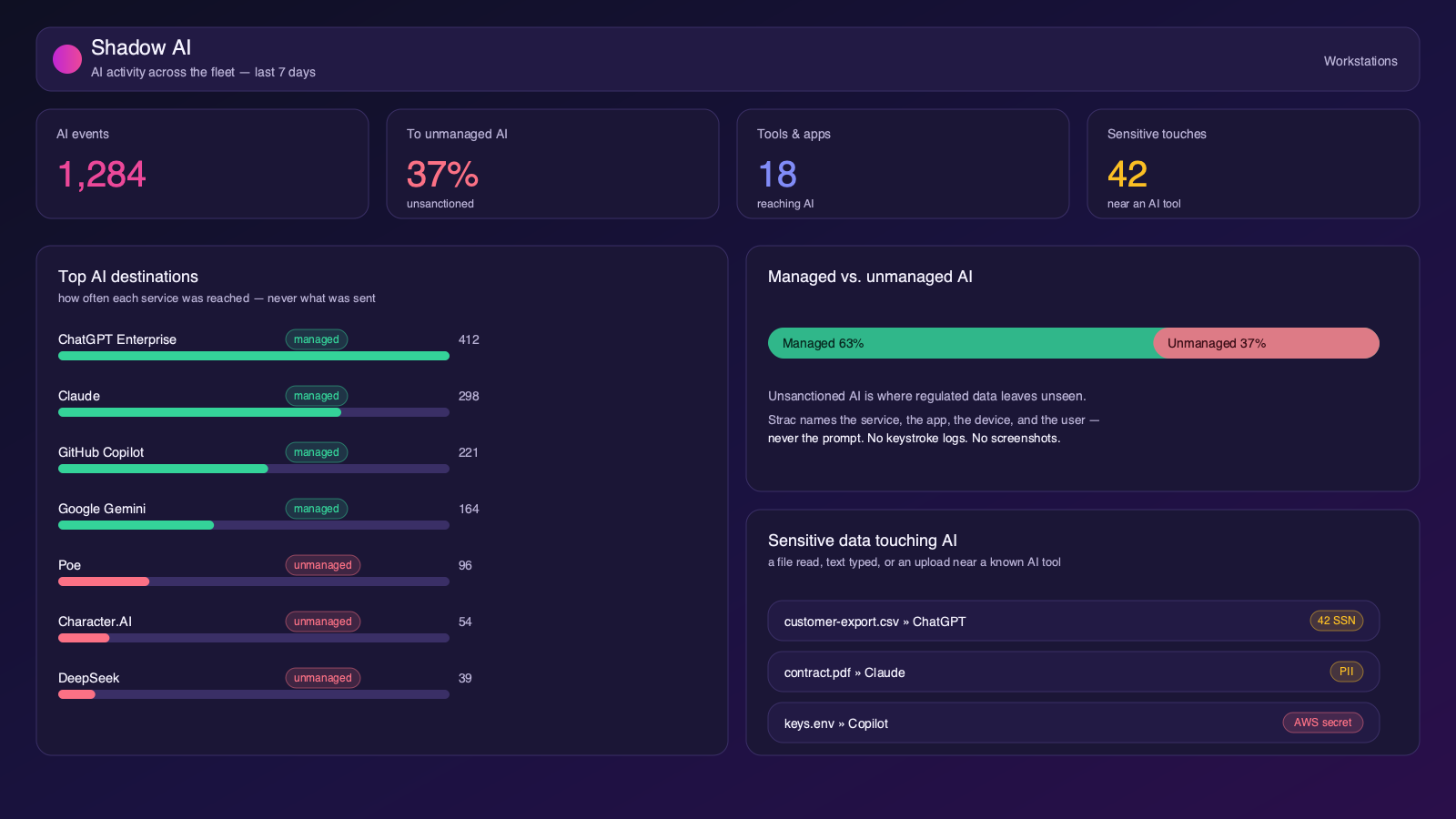
An enterprise view of AI usage: which agents and tools are in use, and the data at risk in each.
The Enterprise Operating Model: Discover, Protect, Prove, Monitor
Verb
What it delivers
Owner
Discover
A live inventory of every agent, tool, and MCP connection
Security / IT
Protect
Sensitive data redacted or blocked on every agent action
Security + Data
Prove
Audit evidence mapped to SOC 2, ISO 42001, EU AI Act
Compliance / GRC
Monitor
Continuous attribution, anomaly detection, and revocation
SecOps
Discover Agents at Scale
At enterprise scale, discovery has to be continuous and automated. You need to surface agents across every surface — browser-based GenAI, IDE assistants, internal copilots, and MCP servers — and map what data each can reach. Strac feeds this by watching where sensitive data actually flows, so your inventory reflects reality, not a spreadsheet. Read discover AI agents.
✨ Protect the Data on Every Agent Action
Enforcement is where governance becomes real. Strac redacts PII, PHI, PCI, and secrets on every MCP DLP tool call, blocks and redacts sensitive prompts in the browser, and enforces on the endpoint when agents drive local tools. One policy and one classifier apply across SaaS, cloud, browser, GenAI, endpoint, and MCP — so an agent in any team is covered by the same rules. See protect AI agents.
Strac redacts sensitive data automatically — the same engine enforces on every agent path enterprise-wide.
🎥 Prove It: Evidence for SOC 2, ISO 42001 & the EU AI Act
Enterprises must not only control agents but demonstrate it. Every Strac detection and remediation is logged, giving compliance teams the evidence to map against SOC 2, ISO 42001, NIST AI RMF, and the EU AI Act — without a manual evidence scramble. Ground your controls in the AI governance frameworks and connect the story to AI DLP and AI data governance.
Strac produces a real-time audit trail of every detection and remediation as compliance evidence.
✨ One Platform Across Every Surface
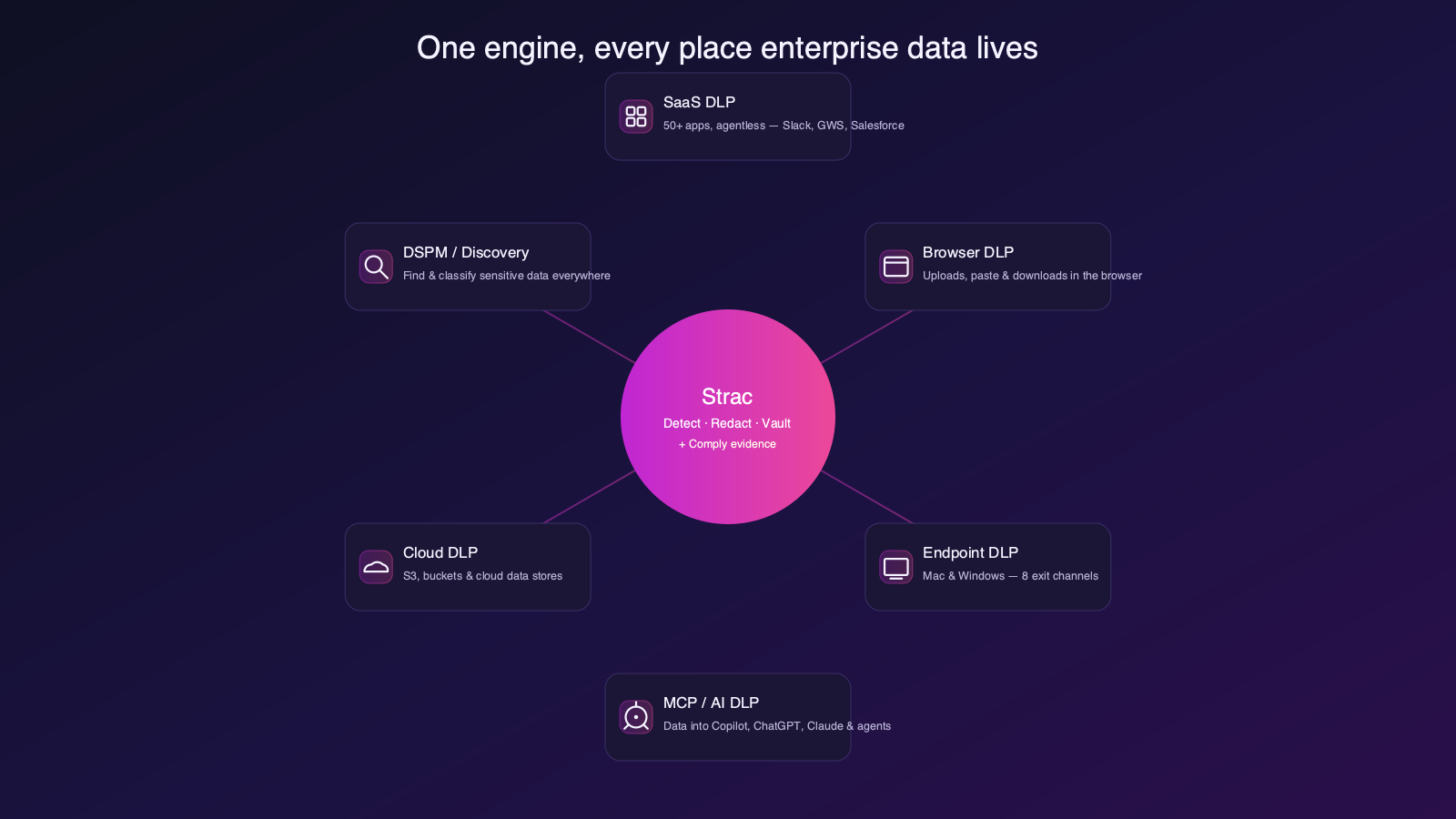
Point tools leave gaps between teams and surfaces. Strac is one agentless-plus-endpoint platform covering SaaS, cloud, browser, GenAI, endpoint, and MCP under a single policy — the coverage an enterprise agent program needs to avoid blind spots.
Strac covers every surface enterprise agents touch — one policy across SaaS, cloud, endpoint, browser, GenAI, and MCP.
Roles & Responsibilities (RACI)
Function
Responsibility
Security / IT
Own discovery and identity; run the agent inventory
Data / Privacy
Define what counts as sensitive; own classification policy
Compliance / GRC
Map controls to frameworks; own the evidence
Engineering
Build agents to policy; wire MCP calls through DLP
Executive sponsor
Fund the program; set risk appetite
A 90-Day Enterprise Rollout
Days 0–30 — Discover: stand up a live agent inventory; identify the highest-risk data paths.
Days 30–60 — Protect: deploy MCP + browser + endpoint DLP on the top agents and data sources; set block/warn/redact policies.
Days 60–90 — Prove & scale: wire evidence to your frameworks, extend coverage to all teams, and stand up monitoring and revocation.
Metrics That Matter
Metric
Why it matters
% of agents with a managed identity
Coverage of your identity program
% of agent data paths behind DLP
How much of the data layer is actually protected
Sensitive-data redactions per week
Real leaks prevented
Mean time to revoke an agent
How fast you can contain an incident
🌶️ Spicy FAQs for Enterprise AI Agent Governance
Where do enterprises usually start?
With discovery. You cannot govern agents you cannot see, and sprawl means most enterprises underestimate how many exist. Start at discover AI agents, then add protection.
Is this a security or a compliance project?
Both. Security owns discovery and enforcement; compliance owns the evidence. The operating model only works when the two share one system of record — which is why logged remediation matters.
How is enterprise agent governance different from AI model governance?
Model governance is about how models are built, tested, and approved. Agent governance is about what deployed agents do with your data and systems in production. Enterprises need both.
Can we govern agents without slowing teams down?
Yes — that is the point of data-layer enforcement. Redaction and vaulting let an agent keep working on non-sensitive content while sensitive values are protected, instead of blocking the whole workflow.
How does Strac fit an existing stack?
Strac is the Protect and Prove layer. It complements your identity provider and SIEM, adds MCP DLP plus browser and endpoint enforcement, and feeds evidence to your GRC tooling.
Enterprise AI agent governance is a program, not a policy doc: discover every agent, protect the data on every action, prove it against your frameworks, and monitor continuously. Strac supplies the Protect and Prove layers across every surface your agents touch. Book a demo to build your agent-governance program on Strac.
Where should an enterprise start with AI agent governance?
With discovery — a live inventory of every agent, tool, and MCP connection — because sprawl means most enterprises underestimate how many agents exist.
Is agent governance security or compliance?
Both. Security owns discovery and enforcement; compliance owns the evidence. They must share one system of record, which is why logged remediation matters.
How is agent governance different from model governance?
Model governance covers how models are built and approved. Agent governance covers what deployed agents do with your data in production. Enterprises need both.
Does governance slow teams down?
Not with data-layer enforcement. Redaction and vaulting let agents keep working on non-sensitive content while sensitive values are protected instead of blocking the whole task.
How does Strac fit?
Strac is the Protect and Prove layer — MCP, browser, and endpoint DLP plus audit evidence — complementing your identity provider, SIEM, and GRC tooling.
Discover & Protect Data on SaaS, AI, MCP, Endpoints & Cloud
Strac provides end-to-end data loss prevention for all SaaS and Cloud apps. Integrate in under 10 minutes and experience the benefits of live DLP scanning, live redaction, and a fortified SaaS environment.


.webp)




.avif)



.gif)
