September 3, 2026

6
min read
Data Loss Prevention Requirements: The Complete Guide
Data loss prevention requirements define what a DLP must discover, detect, and remediate across SaaS, cloud, browser, endpoint, GenAI, and MCP — the 2026 spec.
.webp)
Data loss prevention requirements define what a DLP must discover, detect, and remediate across SaaS, cloud, browser, endpoint, GenAI, and MCP — the 2026 spec.
· Data loss prevention requirements are thecapabilities a DLP program must cover: discovering sensitive data at rest,classifying it accurately, detecting it in motion, and remediating itautomatically on every surface it touches.
· The requirement set changed because the surfaceschanged — data now leaves through a browser tab, a chat prompt, and anautonomous agent's tool call, not only through email and a file share.
· Most requirements lists still describe email,endpoint, and network. They stop at the edge of the browser, and they saynothing about generative AI or MCP, so a program can satisfy every line andstill leak.
· Strac meets the full requirement set acrossSaaS, cloud, browser, endpoint, GenAI, and MCP — with detection and redactionthat run inline, not after the fact.
· Requirements are what a DLP must do; rollout ishow you get there. For the process side, start from the guide to DLPimplementation and requirements, and for the AI slice, from the pillar on AI data governance.
Data loss prevention requirements are the specification a DLP program is measured against. They answer four questions: what sensitive data exists, where it lives, when it moves somewhere it should not, and what happens automatically when it does.
Everything else in a DLP evaluation — the deployment model, the console, the pricing — is downstream of those four. A tool that cannot answer them is not a DLP requirement gap; it is a DLP that does not qualify.
Requirements are not the same as a rollout plan. The rollout is sequencing, ownership, and pilot scope. The requirements are the capability floor you refuse to go below — and the floor moved in 2026.
The canonical DLP requirements list was written for a world where data left the company as an attachment. Cover email, cover endpoints, cover the network egress point, and the exposure was mostly closed.
That world is gone. An employee opens a browser tab, pastes a customer export into a free summarizer, and a thousand records leave in one second — no attachment, no file write, no network signature that looks like exfiltration. An agent connected over MCP reads a ticketing system and returns raw PHI into a model context you do not control.
The gap is not that legacy tools are bad at their job. It is that their job was defined against surfaces that no longer carry the traffic. A requirements list that covers email and endpoint and stops there is a list that is fully satisfied by a program that leaks daily. This is the argument behind why legacy DLP fails for AI.
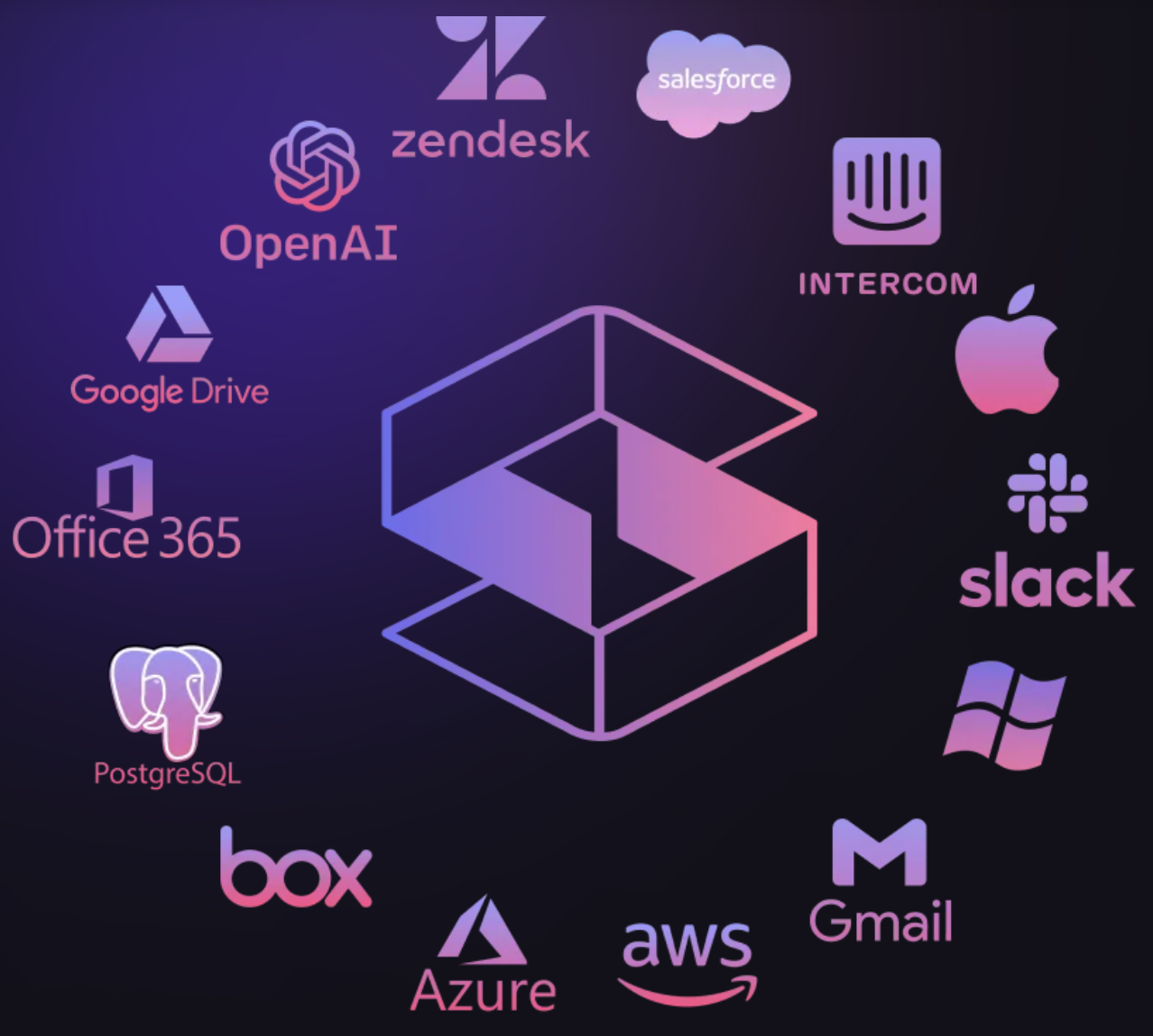
The first requirement is coverage. A DLP requirement set in 2026 names six surfaces, and a gap in any one of them is the surface an incident will use.
SaaS and endpoint DLP are table stakes. The browser, AI DLP, and MCP DLP requirements are the ones that separate a current program from a historical one.
Coverage without capability is a map with no controls on it. Three capability requirements sit underneath every surface.
Discovery and classification. The program must find sensitive data wherever it already sits — across SaaS, cloud stores, and endpoints — and classify it by element, not by folder. PII, PHI, PCI data, credentials, and source code are different risks and earn different policies. Discovery that runs once at onboarding is a snapshot; the requirement is continuous.

Detection accuracy. Detection must work on the shapes data actually takes: text in a message, a table in a spreadsheet, an account number inside a PDF, a driver's license photographed and pasted as an image. A detector set that handles clean text and fails on attachments and images produces the worst outcome in DLP — a stream of false positives that trains the security team to ignore it.
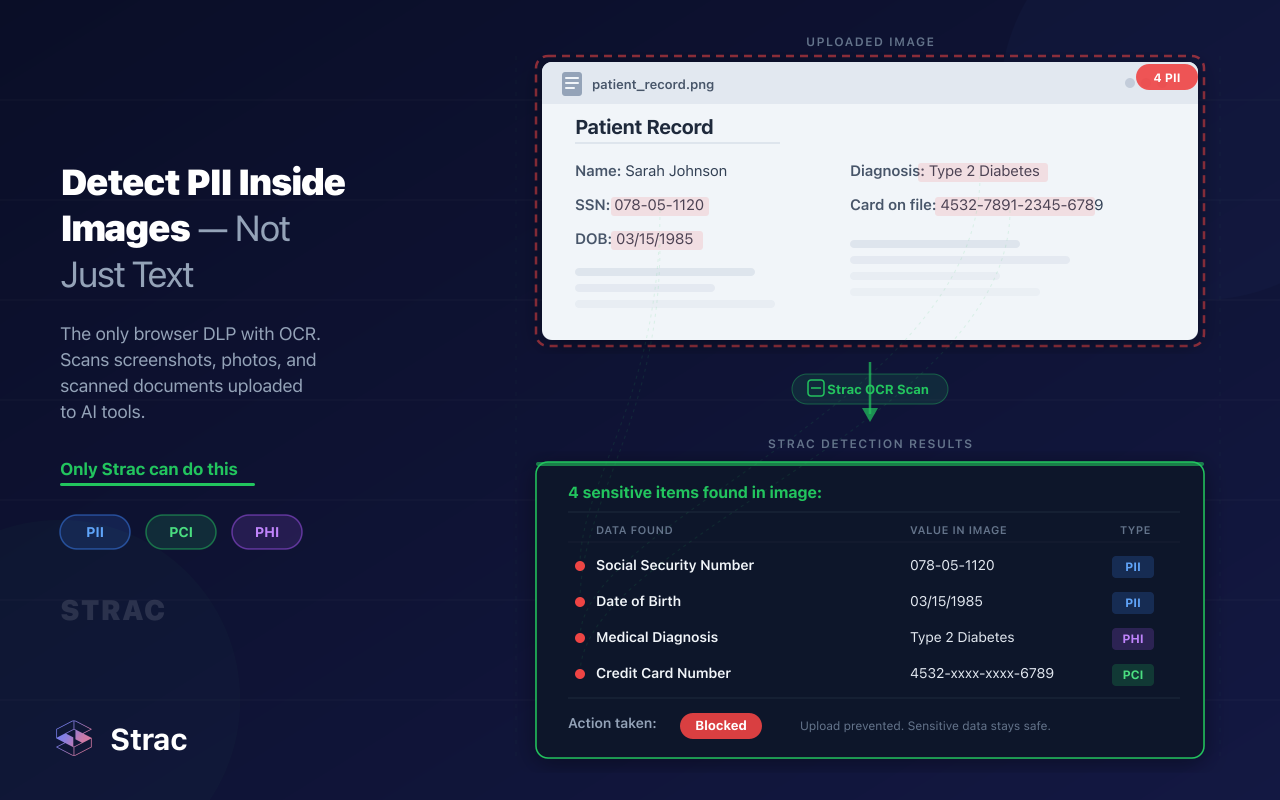
Automated remediation. Alerting is not remediation. If a human has to act before the data is safe, the data was already exposed for the length of the queue. The requirement is that the control fires inline, on the action, without a ticket.
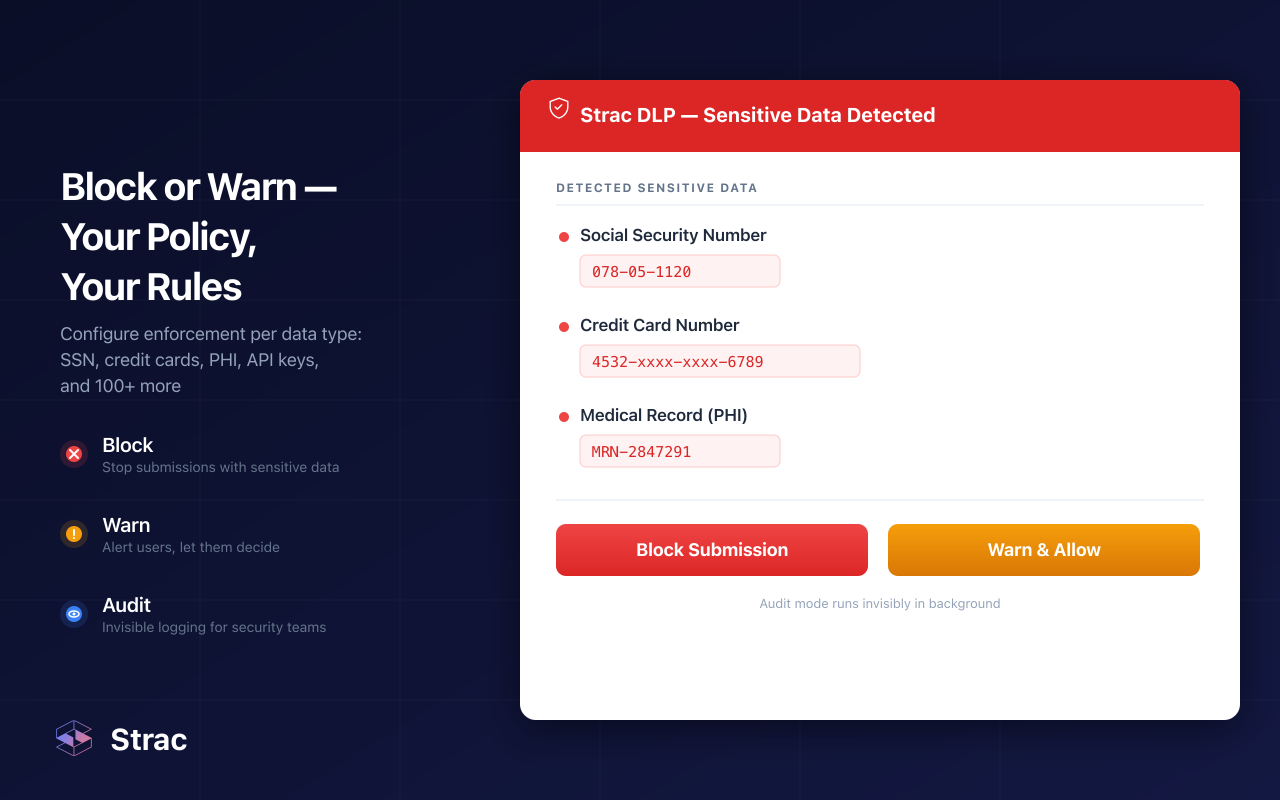
Discovery tells you what you have. Detection tells you when it moves. Remediation is the only one of the three that stops a loss.
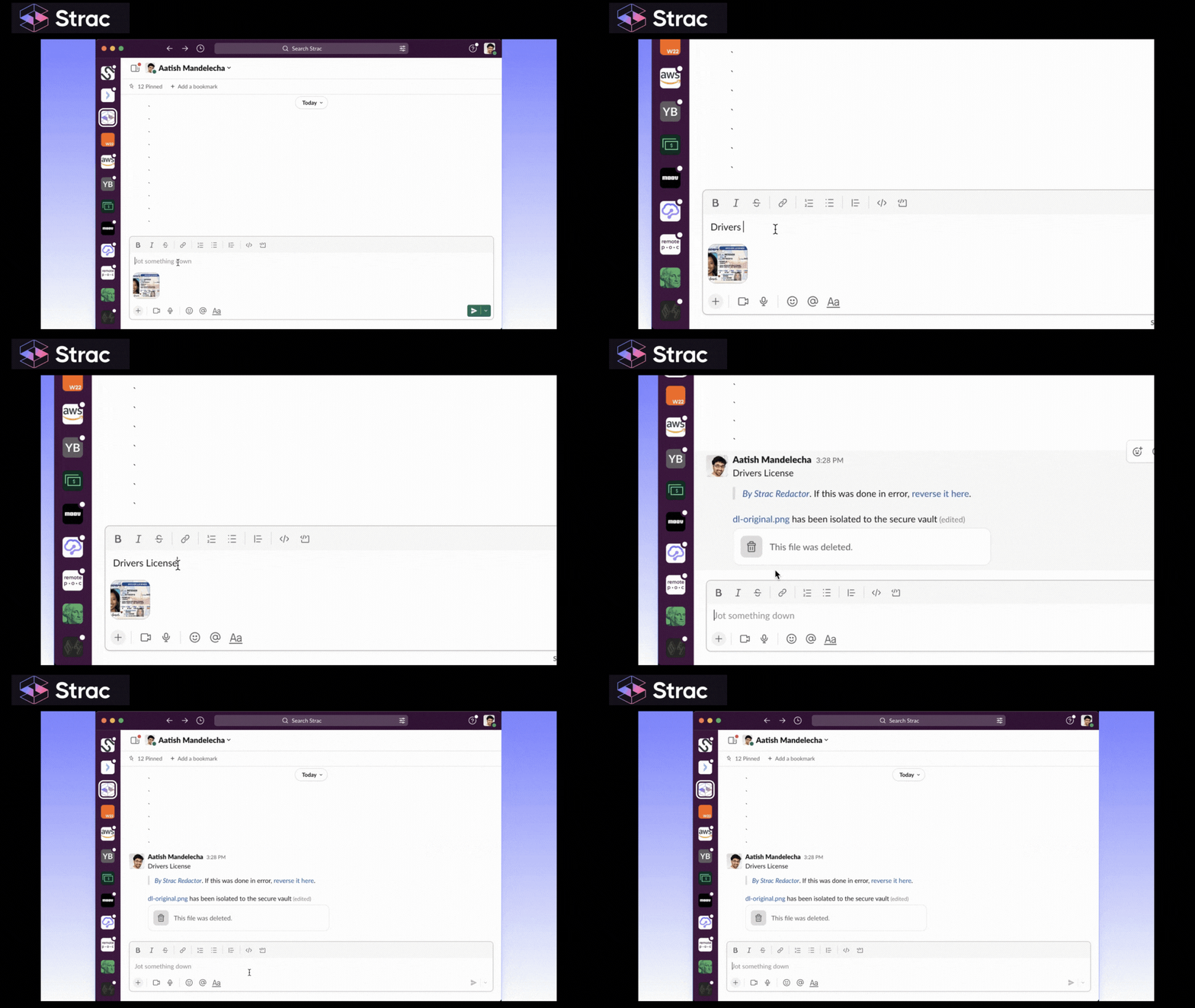
Most requirements lists specify "block sensitive data." Blocking alone is why DLP programs get switched to monitor-only in month three: it stops the leak and the work at the same time, and the business wins that argument every time.
The requirement is a graduated remediation ladder, in this order:
Strac redacts the sensitive element and lets the work continue — the requirement that keeps a DLP program switched on.
Redaction is what makes the other three politically survivable. A program that only blocks gets turned off; one that redacts by default stays on and keeps earning.
Regulatory requirements do not name products. They name outcomes, and each outcome resolves to a specific DLP capability.
Auditors do not accept a policy document as evidence that a control operates. They accept logs of the control firing. That makes automated remediation the compliance requirement as well as the security one.
Strac is a Data Loss Prevention (DLP), Data Discovery, and DSPM platform built against this requirement set rather than an older one.
Discovery and classification run continuously across SaaS, cloud stores, and endpoints, with built-in and custom detectors for PII, PHI, PCI data, credentials, and confidential elements — including deep inspection of attachments and detection inside images.
Remediation runs inline on every surface. Endpoint DLP covers files and local exfiltration paths. Browser coverage and AI DLP inspect prompts, pastes, and uploads to generative AI tools, sanctioned or shadow AI. MCP DLP inspects and redacts on every agent tool call, in both directions, which is the requirement that closes the newest surface. Policies are enforced as redact, block, warn and coach, or revoke access — the same ladder everywhere, so the requirement is met once rather than six times.
One platform, one policy set, six surfaces — the requirement most stacks meet with six tools and six sets of gaps.
Take this into a vendor conversation and mark it honestly.
Any unchecked row is a surface or a control an incident can route through. Related reading: DLP implementation and requirements, AI data governance, and how to detect shadow AI.
Data loss prevention requirements are not a procurement formality; they are the list of places your data can leave and the controls that meet it there. Identity, network, and model controls all fail eventually — the data layer is the backstop, and redacting sensitive data on every action is what keeps a compromise from becoming a breach. Judge any DLP against the six surfaces and the remediation ladder, not against a feature list written for attachments. Book a demo to see Strac meet the requirement set on every surface your data moves through
Requirements define what the tool must do; implementation defines how you deploy it. Requirements are the capability floor — surfaces, detectors, remediation. Implementation is sequencing, ownership, and pilot scope, covered in DLP implementation and requirements.
Because it was specified against email, endpoint, and network egress. Those surfaces still matter, but the browser, generative AI, and MCP now carry the traffic, and a tool built before those surfaces existed cannot inspect them.
No. The requirement is redaction, not prohibition. Strac removes the sensitive element from the prompt or paste and lets the work continue, which is why the control survives contact with the business.
No — no control set is complete, and insiders with legitimate access will always have some path. That is why the requirement is layered: redact at the data layer so that when identity, network, or model controls fail, what escapes carries no raw PII, PHI, or secrets.
Each framework names an outcome that resolves to a capability: GDPR to minimization, HIPAA to PHI detection, PCI DSS to masking, SOC 2 to continuous evidence. See AI data governance for how the same mapping extends to AI systems.
.avif)


.gif)