Cyberhaven vs Code42 Incydr: Insider-Risk DLP Compared (2026)
Cyberhaven vs Code42 Incydr (now Mimecast) — how the two insider-risk DLP tools compare on data lineage, exfiltration detection, remediation, and AI coverage, plus the remediation-first alternative most teams overlook.
Quick answer: Cyberhaven and Code42 Incydr are both insider-risk / data-detection tools built on an endpoint agent — they excel at watching how data moves and flagging risky user behavior. Neither is a content-remediation platform: their default response is detect-and-alert, not redact-or-block-inline. Choose Cyberhaven for data-lineage depth, Code42 Incydr (now part of Mimecast's Human Risk Management platform) for exfiltration-focused insider risk tied to a human-risk suite.
The catch both share: they are endpoint-and-insider-centric, so SaaS data at rest, GenAI prompts, and AI-agent (MCP) traffic — the fastest-growing leak paths of 2026 — sit largely outside their model.
If your real goal is to stop sensitive data leaving (not just build a case file after it does), Strac is the remediation-first option that pairs detection with inline redaction/masking/blocking across SaaS, cloud, endpoint, browser, and AI — reviewed in full below.
Cyberhaven vs Code42 Incydr: Who Each One Is
Cyberhaven pioneered data lineage — often called Data Detection and Response (DDR). Its endpoint agent traces a piece of data through its entire journey (where it originated, how it transformed, where it moved), so security teams can see, for example, that a file which started as source code ended up in a personal Dropbox. That lineage context is its signature strength for insider-risk investigations.
Code42 Incydr was built for insider risk management — detecting file exfiltration to USB, personal cloud, web uploads, and email, and scoring user risk so teams can prioritize response. In July 2024, Mimecast acquired Code42, folding Incydr into Mimecast's broader Human Risk Management platform; the product is now positioned inside that human-risk suite rather than as a standalone.
The honest framing: these two compete on visibility and insider-risk detection, not on data remediation. Both tell you a leak happened (or is about to) and give you the forensic trail. Neither is designed to redact the SSN out of a file, mask a card number in a SaaS message, or strip secrets from a GenAI prompt before it's sent.
Head-to-Head Comparison
Dimension
Cyberhaven
Code42 Incydr (Mimecast)
Core model
Data lineage / DDR
Insider-risk exfiltration detection
Deployment
Endpoint agent
Endpoint agent + SaaS connectors
Signature strength
Tracing data movement + transformation
File-exfiltration detection, risk scoring
Primary response
Detect, alert, investigate
Detect, alert, prioritize
Inline content remediation
Limited
Limited
SaaS data at rest
Partial
Partial
GenAI / browser prompts
Limited
Limited
AI agents (MCP)
No
No
Best for
Lineage-driven insider investigations
Insider-risk programs inside a human-risk suite
Verdicts by Use Case
Best for tracing exactly how data leaked → Cyberhaven. Its lineage graph is the differentiator when the investigation question is "where did this come from and everywhere it went."
Best for insider-risk programs already standardizing on Mimecast → Code42 Incydr. The Human Risk Management integration is the reason to pick it post-acquisition.
Best for actually preventing the leak, not just documenting it → Strac (below). If the outcome you're paying for is "sensitive data never leaves in the first place," a detect-and-alert tool leaves the last mile unsolved.
✨ The Third Option Most Teams Miss: Strac
Both Cyberhaven and Code42 answer "did data leak?" Strac answers "stop the data from leaking — across every surface, automatically." It's the remediation-first, AI-native data-security platform that does what insider-risk telemetry doesn't: acts on the data itself.
What Strac covers that endpoint-insider tools don't:
Every surface, one platform.Strac unifies DLP + DSPM across SaaS, Cloud, Endpoint, Browser/GenAI, and AI agents — not just the laptop. That means Slack, Gmail, Google Drive, O365, OneDrive, SharePoint, Salesforce, Zendesk, Notion, Intercom, Jira, Box and 60+ integrations; AWS (S3, RDS, CloudWatch, cloud databases), Azure, and GCP; and endpoint DLP for Mac, Windows, and Linux.
Detection and remediation. Where the others alert, Strac acts: redact, mask, tokenize, block, warn the user, delete, revoke access, quarantine, or label — inline, at the moment of exposure. Sensitive data is removed, not just recorded.
Accurate, low-false-positive detection. Custom ML models tuned on real PII, PHI, PCI, and secrets; Luhn-validated card numbers, 48+ secret patterns, OCR on images and PDFs, all file formats (pdf, docx, xlsx, jpeg, png, screenshots), plus fully custom detectors and regex.
The AI/MCP surface the insider tools ignore.Strac inspects GenAI prompts in the browser — redacting or blocking sensitive data before it reaches ChatGPT, Claude, Gemini, Copilot, or Perplexity (extensions for Chrome, Edge, Firefox, and Safari) — and redacts data inside AI-agent tool calls across 41 MCP connectors. See MCP DLP and AI DLP.
Historical + real-time scanning across new and archived data; built-in compliance evidence mapped to PCI, SOC 2, HIPAA, ISO 27001, CCPA, GDPR, and NIST.
Deploys in under 10 minutes (agentless for SaaS), and is proven in production at UiPath, Crypto.com, and Underdog Fantasy.
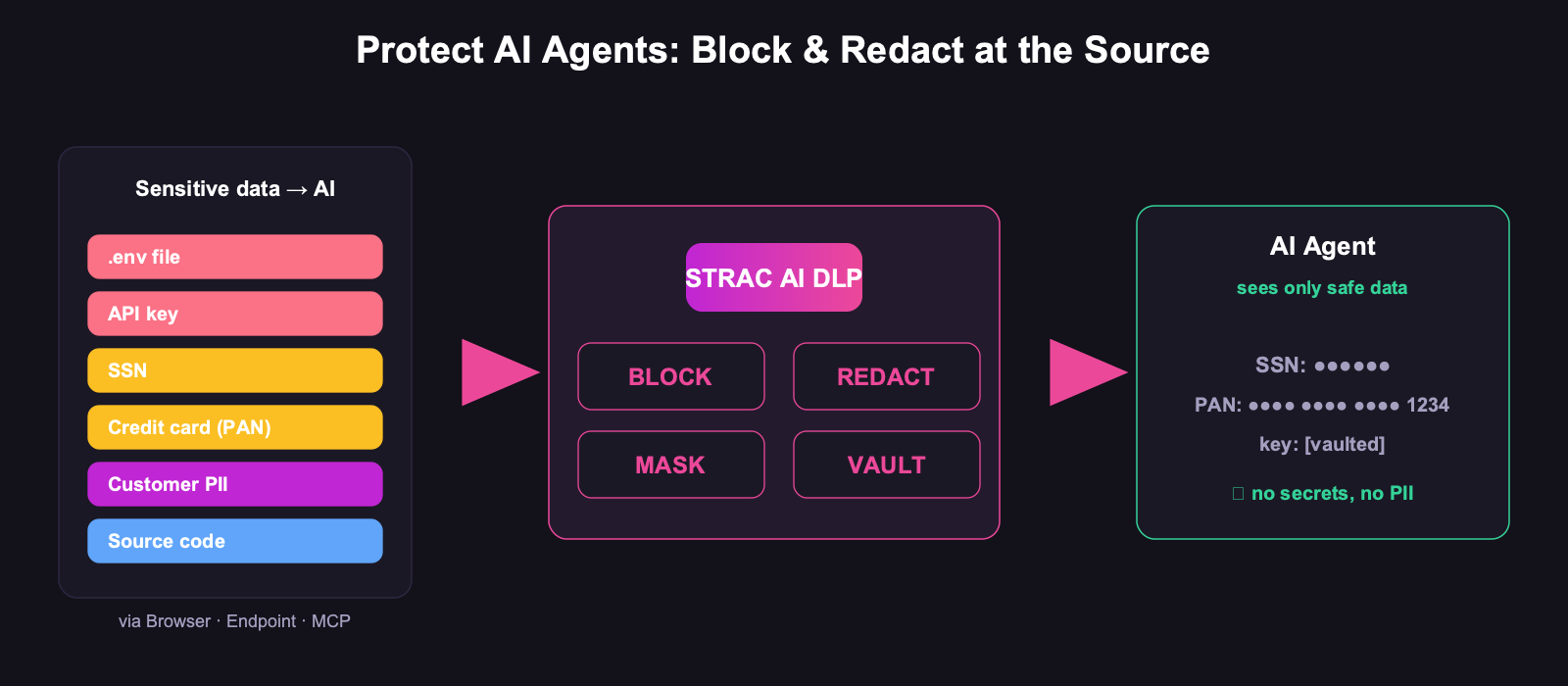
Where Cyberhaven and Code42 build a case file, Strac removes the sensitive data at the point of exposure — block, redact, mask, or vault.
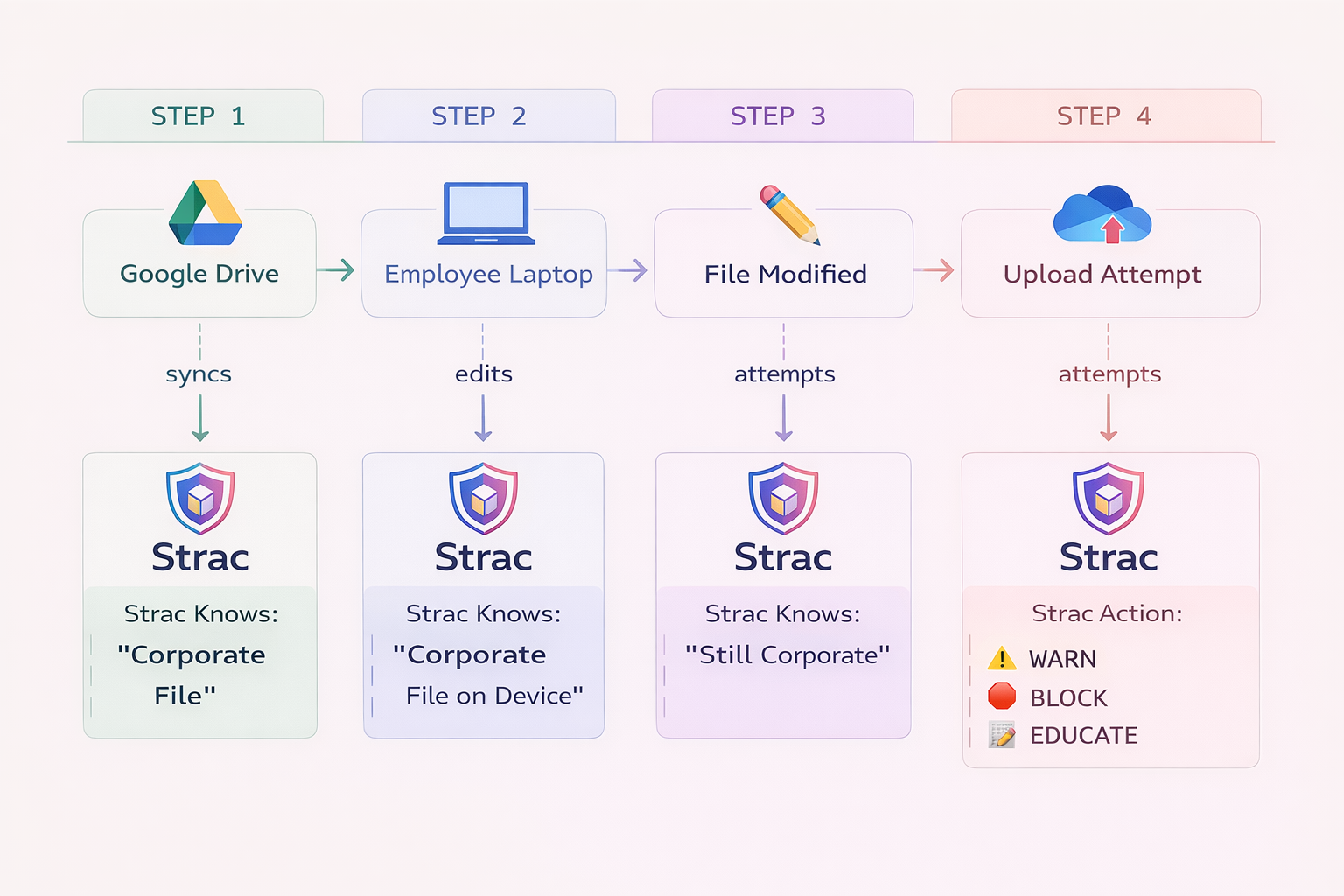
And because insider risk is often really an endpoint data-lineage question, Strac carries that too — mapping how sensitive files move on the endpoint — while adding the inline remediation the lineage-only tools lack.
Strac gives you the lineage view Cyberhaven is known for — and then acts on it.
On-device DLP for the channels a proxy never sees
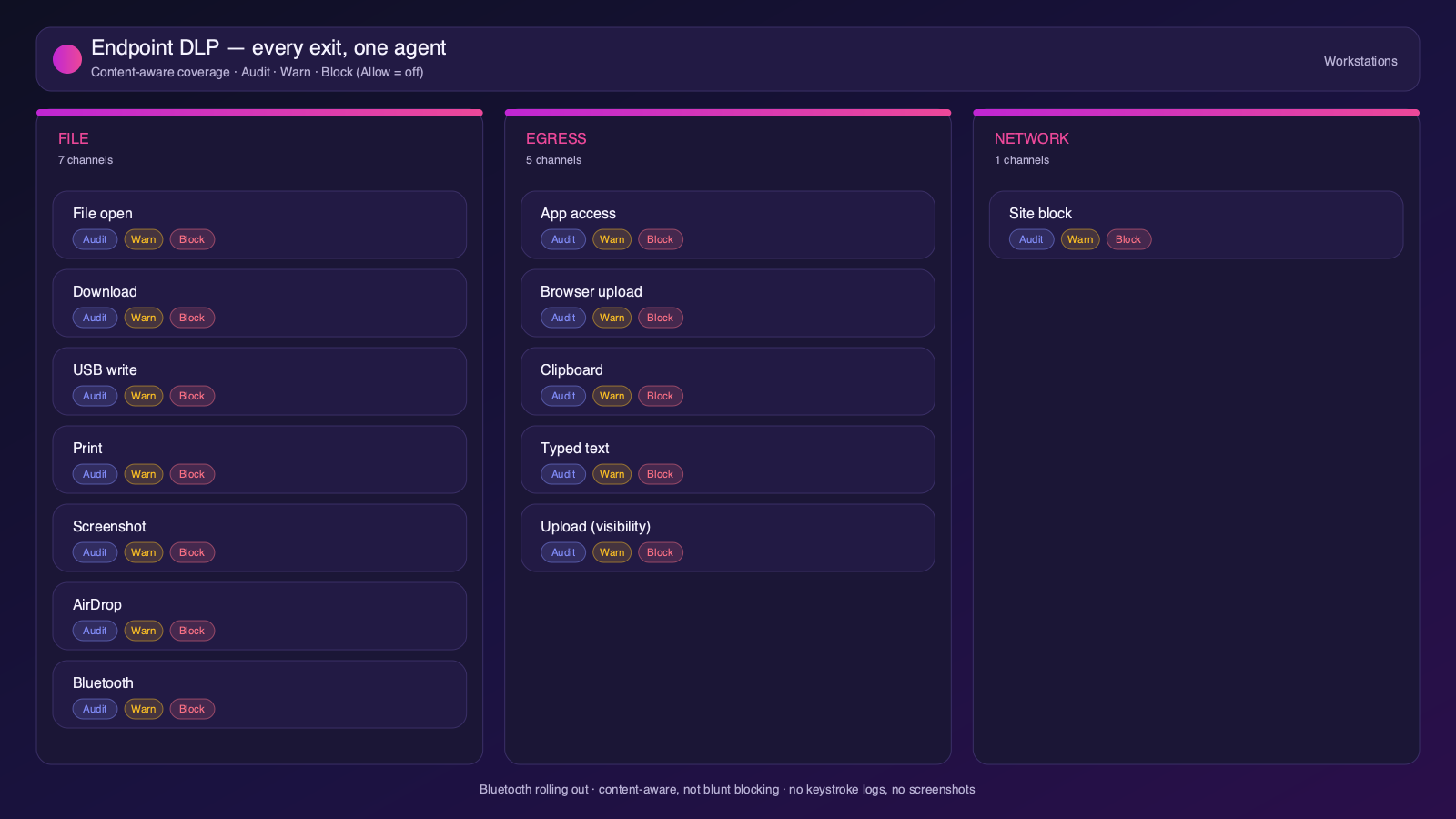
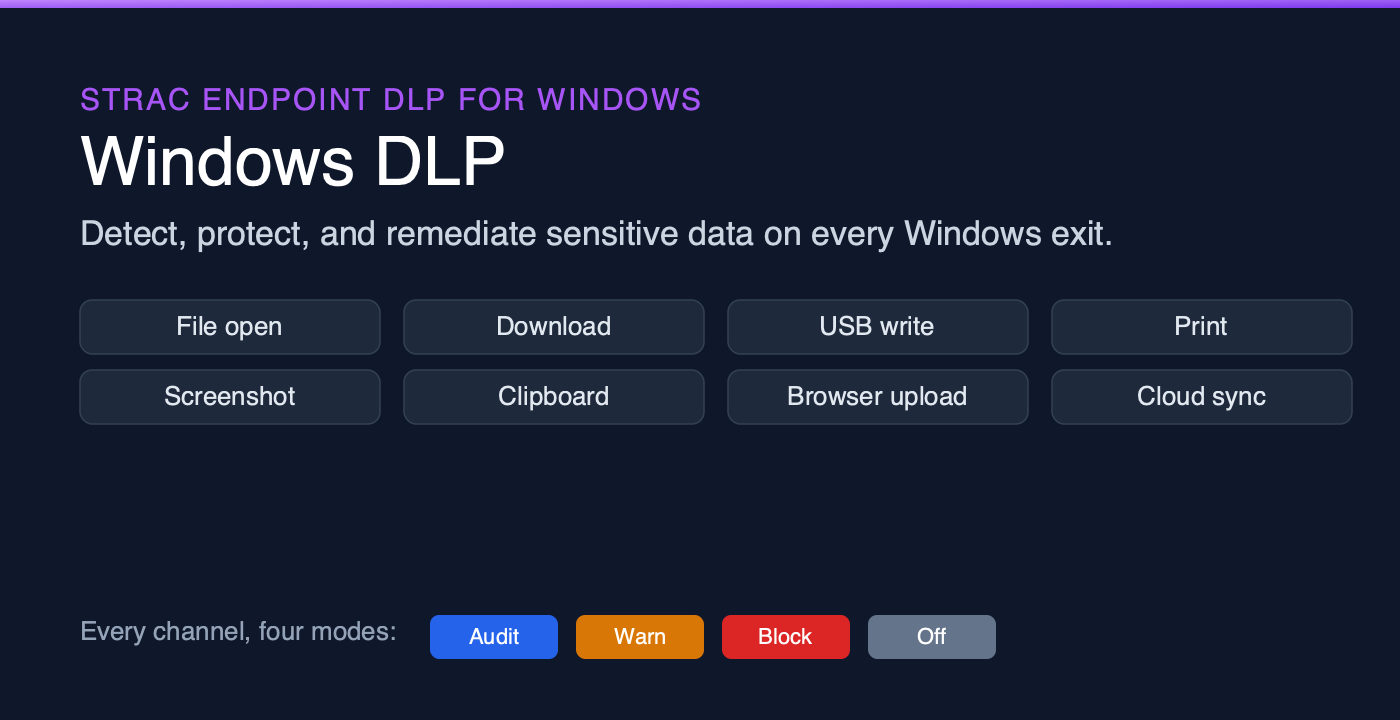
Strac’s endpoint agent enforces where network tools are blind — a file copied to USB, an AirDrop to a personal phone, a local print, a screenshot. It reads the content on the device and applies Block, Warn, or Audit per channel on Mac and Windows, coaching employees in the moment rather than only alerting after the fact.
Strac coaches and blocks at the endpoint — the local exits network DLP can’t observe.
Shadow AI, governed at the data layer
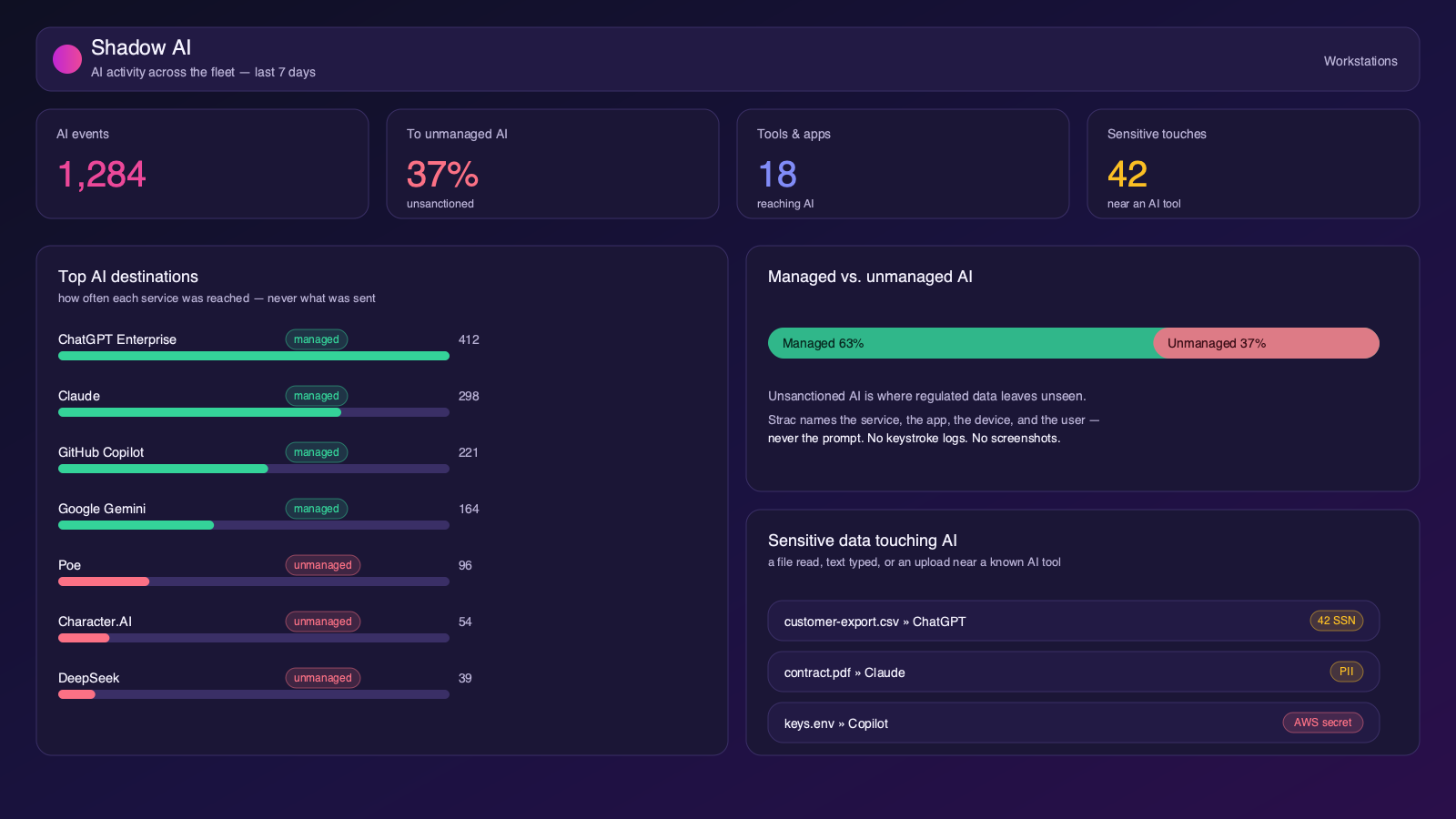
Strac turns Shadow AI from an unknown into a managed surface: it inventories the AI apps and agents in use, scores the data risk of each, and stops regulated content from reaching them — in the browser and at the MCP layer — while respecting employee privacy with no keystroke logs or screenshots.
Strac inventories Shadow AI usage and the data at risk — privacy-first, no keystroke logging.
✨ Strac's Endpoint Agent: Prevention and Lineage, Where Cyberhaven and Code42 Each Stop Short
Cyberhaven and Code42 both excel at watching data move — lineage and insider-risk telemetry — but both are lighter on real-time, content-aware prevention. They tell you a regulated file left after the fact more readily than they stop it in the moment, and neither was built for browser GenAI or MCP.
Where a legacy endpoint tool blocks bluntly or only alerts, Strac enforces content-aware policy across every exit on the machine — file opens and downloads, USB and removable-media writes, printing, screenshots, AirDrop, clipboard, browser uploads, and text typed directly into a GenAI prompt — each set independently to Block, Warn, or Audit on Mac and Windows.
One agent that tracks the file like Cyberhaven and stops the leak the way neither tool reliably does.
Strac's endpoint agent combines what each does separately. It builds per-file Data Lineage and inspects content, so it can Block a regulated file at USB, print, AirDrop, clipboard, browser upload, or a GenAI prompt in real time — Block, Warn, or Audit per channel, on Mac and Windows.
It adds Shadow AI detection in the same agent, without keystroke logging or screen capture, and unifies with Strac's SaaS, browser, and MCP coverage under one policy. You stop choosing between lineage and prevention and get both across every surface.
🌶️ Spicy FAQs for Cyberhaven vs Code42
Which is better, Cyberhaven or Code42 Incydr?
For pure data-lineage investigations, Cyberhaven; for insider-risk detection tied to Mimecast's human-risk platform, Code42 Incydr. But "better" depends on the job: both are detect-and-alert tools. If the goal is to prevent sensitive data from leaving — inline redaction, masking, blocking across SaaS, endpoint, browser, and AI — a remediation-first platform like Strac addresses a need neither is built for.
What is the difference between Cyberhaven and Code42?
Cyberhaven leads with data lineage (Data Detection and Response) — tracing a data element's full journey. Code42 Incydr leads with insider-risk exfiltration detection and user-risk scoring, now inside Mimecast's Human Risk Management suite. Both rely on an endpoint agent and focus on visibility; neither centers on inline content remediation or AI-surface coverage.
Do Cyberhaven or Code42 cover AI tools and GenAI prompts?
Only lightly. Both are endpoint-and-insider-centric, so prompts assembled in the browser and AI agents pulling data through MCP connectors fall largely outside their model. Covering those paths — redacting sensitive data before it reaches ChatGPT, Claude, or an agent — is where AI-native platforms like Strac differ.
Which has better insider-risk remediation, Cyberhaven or Code42?
Both emphasize response workflows (alert, investigate, prioritize) over content remediation. Neither redacts or masks the sensitive data in place by default. If remediation speed — actually stopping the exposure, not just triaging it — is the metric, evaluate a platform that redacts, blocks, or quarantines inline.
Is Code42 Incydr still standalone after the Mimecast acquisition?
Following Mimecast's July 2024 acquisition, Incydr is being integrated into Mimecast's Human Risk Management platform. It remains available, but roadmap and packaging now sit within Mimecast's suite — a factor worth weighing if you prefer a focused, independent data-security platform.
The Bottom Line
Cyberhaven vs Code42 Incydr is really a choice between two flavors of insider-risk visibility — lineage depth versus exfiltration detection inside a human-risk suite. Both are good at telling you a leak happened. Neither is built to stop it at the source, and both are thin on the SaaS-at-rest and AI surfaces where 2026's data exposure is growing. If the outcome you want is prevention plus proof — detection and inline remediation across every surface — Strac is the option to put on the shortlist.
Book a 30-minute demo to see detect-and-remediate across SaaS, endpoint, browser, and AI — the last mile insider-risk tools leave open.
For pure data-lineage investigations, Cyberhaven; for insider-risk detection tied to Mimecast's human-risk platform, Code42 Incydr. But "better" depends on the job: both are detect-and-alert tools. If the goal is to prevent sensitive data from leaving — inline redaction, masking, blocking across SaaS, endpoint, browser, and AI — a remediation-first platform like Strac addresses a need neither is built for.
What is the difference between Cyberhaven and Code42?
Cyberhaven leads with data lineage (Data Detection and Response) — tracing a data element's full journey. Code42 Incydr leads with insider-risk exfiltration detection and user-risk scoring, now inside Mimecast's Human Risk Management suite. Both rely on an endpoint agent and focus on visibility; neither centers on inline content remediation or AI-surface coverage.
Do Cyberhaven or Code42 cover AI tools and GenAI prompts?
Only lightly. Both are endpoint-and-insider-centric, so prompts assembled in the browser and AI agents pulling data through MCP connectors fall largely outside their model. Covering those paths — redacting sensitive data before it reaches ChatGPT, Claude, or an agent — is where AI-native platforms like Strac differ.
Which has better insider-risk remediation, Cyberhaven or Code42?
Both emphasize response workflows (alert, investigate, prioritize) over content remediation. Neither redacts or masks the sensitive data in place by default. If remediation speed — actually stopping the exposure, not just triaging it — is the metric, evaluate a platform that redacts, blocks, or quarantines inline.
Is Code42 Incydr still standalone after the Mimecast acquisition?
Following Mimecast's July 2024 acquisition, Incydr is being integrated into Mimecast's Human Risk Management platform. It remains available, but roadmap and packaging now sit within Mimecast's suite — a factor worth weighing if you prefer a focused, independent data-security platform.
Discover & Protect Data on SaaS, AI, MCP, Endpoints & Cloud
Strac provides end-to-end data loss prevention for all SaaS and Cloud apps. Integrate in under 10 minutes and experience the benefits of live DLP scanning, live redaction, and a fortified SaaS environment.


.webp)




.avif)




.gif)
