Best Third-Party Risk Management Software (2026) Compared
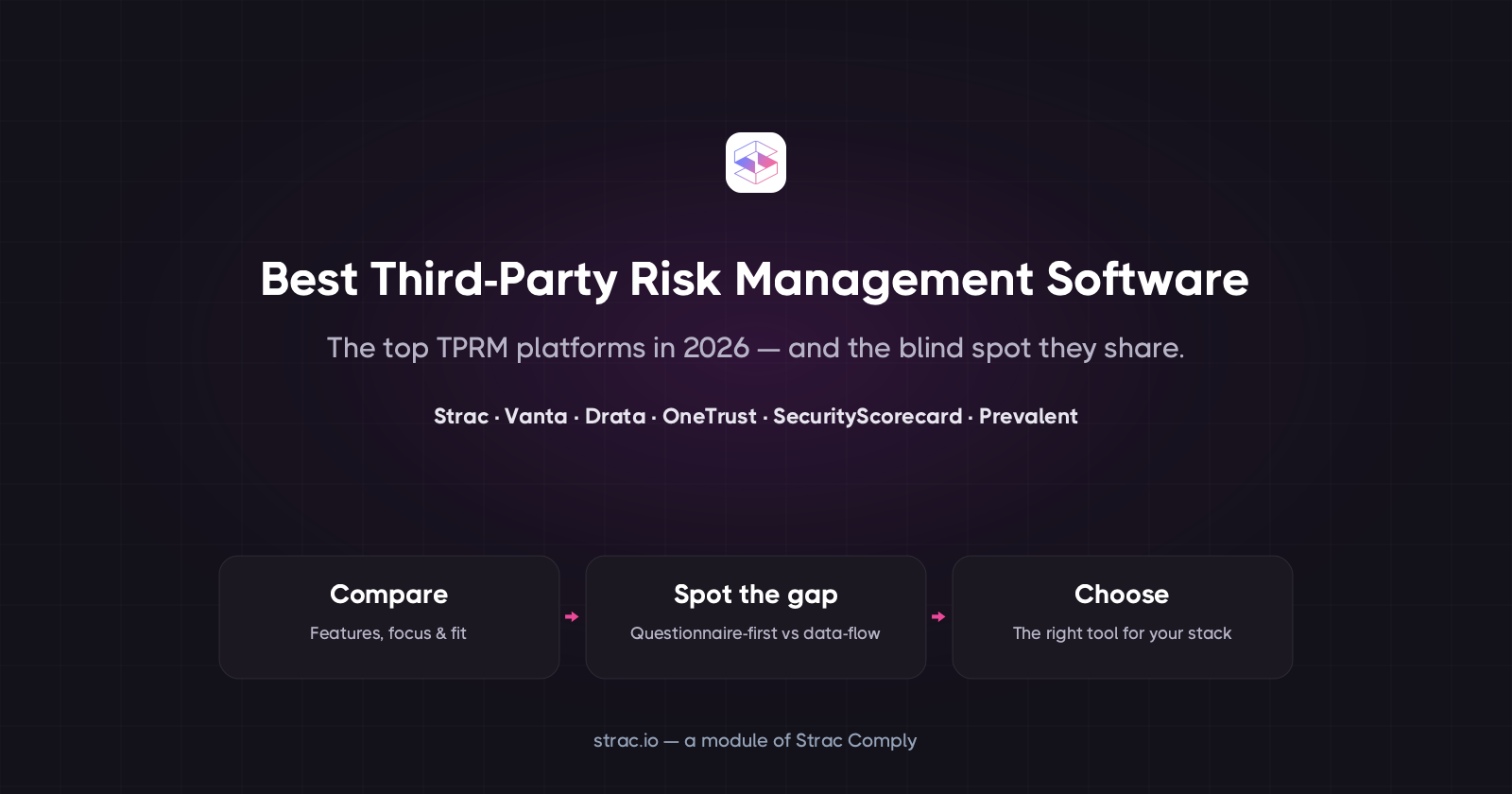
The best third-party risk management software and TPRM companies in 2026, Strac, Vanta, Drata, OneTrust, SecurityScorecard, and Prevalent, compared on features, focus, and the blind spot most of them share.
The leading third-party risk management (TPRM) companies in 2026 include Strac, Vanta, Drata, OneTrust, SecurityScorecard, and Prevalent (Vanta, Drata).
Most of them are excellent at organizing the vendors you already know about, questionnaires, document collection, scoring, and monitoring.
They share one blind spot: they don't discover the shadow IT and shadow AI your employees adopt on their own, and they score risk on what vendors say rather than the data they actually touch.
Strac is built differently, its TPRM module sits on a data-security layer, so it discovers third parties from real data flows and can enforce offboarding, not just track it.
The right pick depends on your stack: if you live in a compliance platform already, its TPRM module may be enough; if your biggest exposure is shadow AI and data you can't see, that's a different problem.
How to Choose Third-Party Risk Management Software
Before the list, the criteria that actually separate these tools:
Discovery, can it find shadow IT and AI, or only manage vendors you add manually?
Risk scoring, based on questionnaires, external security ratings, or the data a vendor actually touches?
Assessment speed, does AI read SOC 2s and DPAs for you, or does a human?
Monitoring, continuous, or point-in-time at onboarding?
Offboarding, does it just track closure, or actually revoke access and delete data?
Fit, standalone TPRM, or a module of a broader compliance/GRC platform you already use?
✨ The Blind Spot Most TPRM Tools Share
Almost every tool below starts the same way: someone adds a vendor, sends a questionnaire, and trusts the answers. That works for the vendors you know about, but it misses the ones you don't.
The fastest-growing third-party risk today is shadow AI, employees pasting customer data into ChatGPT, using an unsanctioned AI note-taker, or adopting a niche tool no one in security has heard of. None of those show up in a manual vendor list. As you read the comparison, weigh this: does the tool discover your third parties from real usage, or just organize the ones you remembered to add?
The Best Third-Party Risk Management Software in 2026
1. Strac
Best for: teams whose biggest exposure is data and AI, not paperwork.
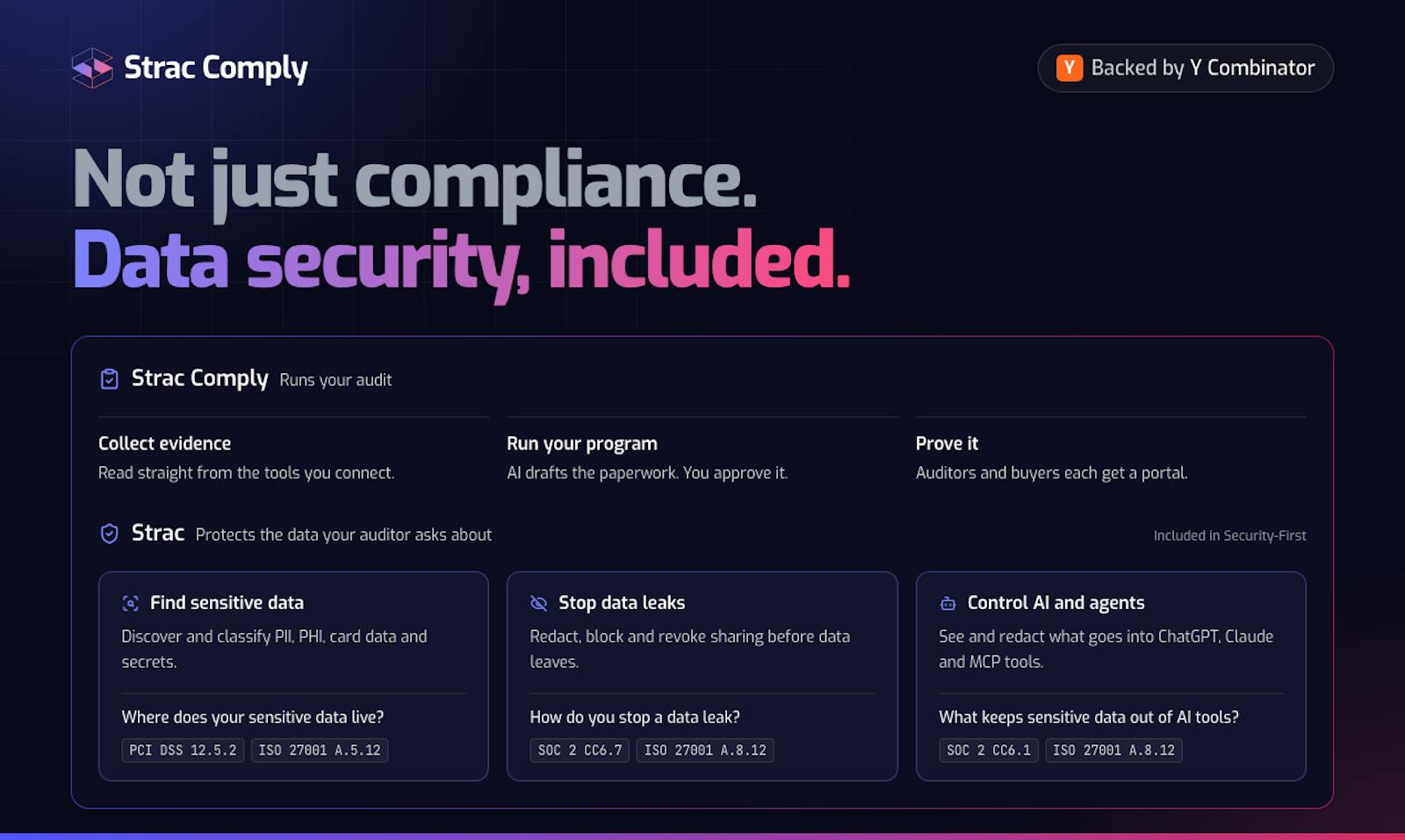
Strac's TPRM module is part of Strac Comply and sits on Strac's data-security layer. That foundation changes what's possible: Strac discovers vendors and AI tools from real data flows, scores each by the sensitive data it actually touches, runs AI-powered security reviews, and can enforce offboarding by revoking access and deleting shared data. It's the only option here that treats the data itself as the source of truth, which also makes it strong on shadow AI and GenAI risk.
2. Vanta
Best for: startups and SMBs already using Vanta for SOC 2.
Vanta's vendor risk management automates questionnaires and uses AI to analyze SOC 2 reports and DPAs, with a "TPRM Agent" that monitors vendors for breaches and material changes (Vanta). If you already run your compliance program in Vanta, its TPRM module is a natural extension, though discovery is limited to the vendors you connect or add.
3. Drata
Best for: compliance-led teams that want vendor risk inside their audit platform.
Drata's vendor risk module includes assessment workflows and basic vendor discovery, backed by 250+ integrations and continuous control testing (Drata). Like Vanta, it's strongest as part of a broader compliance program.
4. OneTrust
Best for: large enterprises with complex, multi-domain GRC needs.
OneTrust is a full governance, risk, and privacy suite with comprehensive TPRM, vendor onboarding workflows, scoring engines, and continuous monitoring. It's powerful and deep, with the budget and implementation effort to match.
5. SecurityScorecard
Best for: continuous external security ratings.
SecurityScorecard rates vendors' external security posture and pairs it with questionnaires, so you get an outside-in view that updates continuously. It's a strong monitoring signal, though it sees the vendor's external surface rather than the data they touch inside your environment.
6. Prevalent (Mitratech)
Best for: dedicated, assessment-heavy TPRM programs.
Prevalent is a long-standing standalone TPRM platform built around assessments, a questionnaire library, and continuous monitoring, a fit for mature programs that want a purpose-built tool rather than a module.
Comparison: TPRM Software at a Glance
Tool
Best for
Discovery
Risk grounded in
Strac
Data & AI exposure
Shadow IT & AI, from data flows
Data the vendor actually touches
Vanta
SOC 2-first SMBs
Connected/added vendors
Questionnaires + AI doc review
Drata
Compliance-led teams
Basic vendor discovery
Questionnaires
OneTrust
Large enterprises
Added vendors
Questionnaires + scoring engine
SecurityScorecard
External monitoring
Added vendors
External security ratings
Prevalent
Dedicated TPRM programs
Added vendors
Questionnaires + monitoring
Which TPRM Software Is Right for You?
If you already run SOC 2 in Vanta or Drata, start with their TPRM module, it's the least friction.
If you're a large enterprise with privacy, ESG, and procurement all in scope, OneTrust has the breadth.
If you want continuous external ratings, SecurityScorecard is a strong signal to layer in.
If your real worry is the data and AI tools you can't see, shadow AI, vendors with quiet access to customer PII, that's the gap Strac was built to close, because it starts from the data, not the questionnaire.
Get vendor risk with Strac Comply
The best third-party risk management software does not make you buy a separate compliance tool. Strac Comply bundles reproducible vendor risk with full framework automation at a published price.
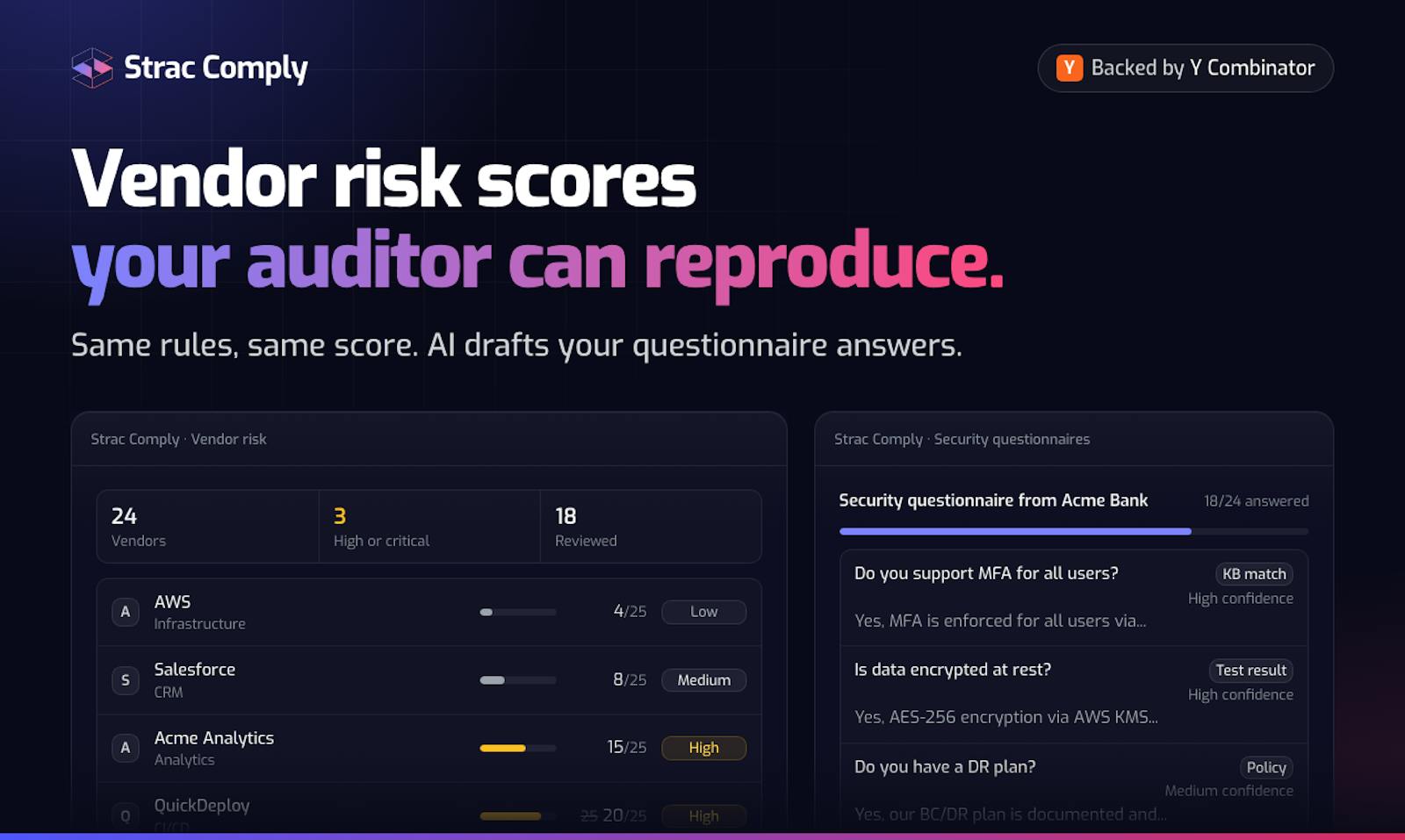
✨ Vendor risk your auditor can reproduce
Reproducible vendor risk scores, with AI-drafted security-questionnaire answers, in the same platform as your vendor risk evidence.
Same rules, same score, and AI drafts your questionnaire answers.
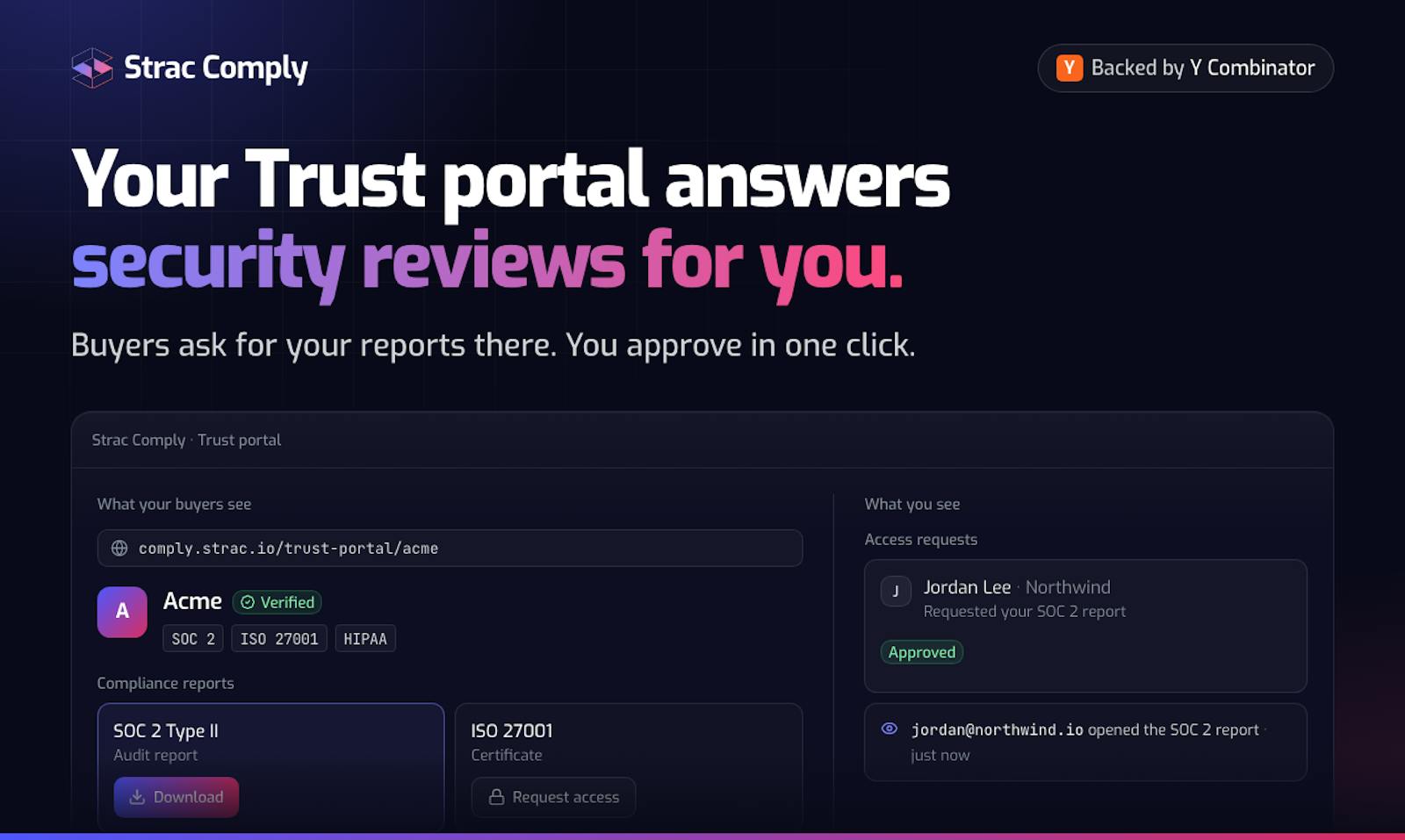
✨ A trust portal that answers security reviews for you
Buyers request your vendor risk report in your trust portal and you approve access in one click, instead of emailing PDFs around.
Buyers ask for your reports in the trust portal. You approve in one click.
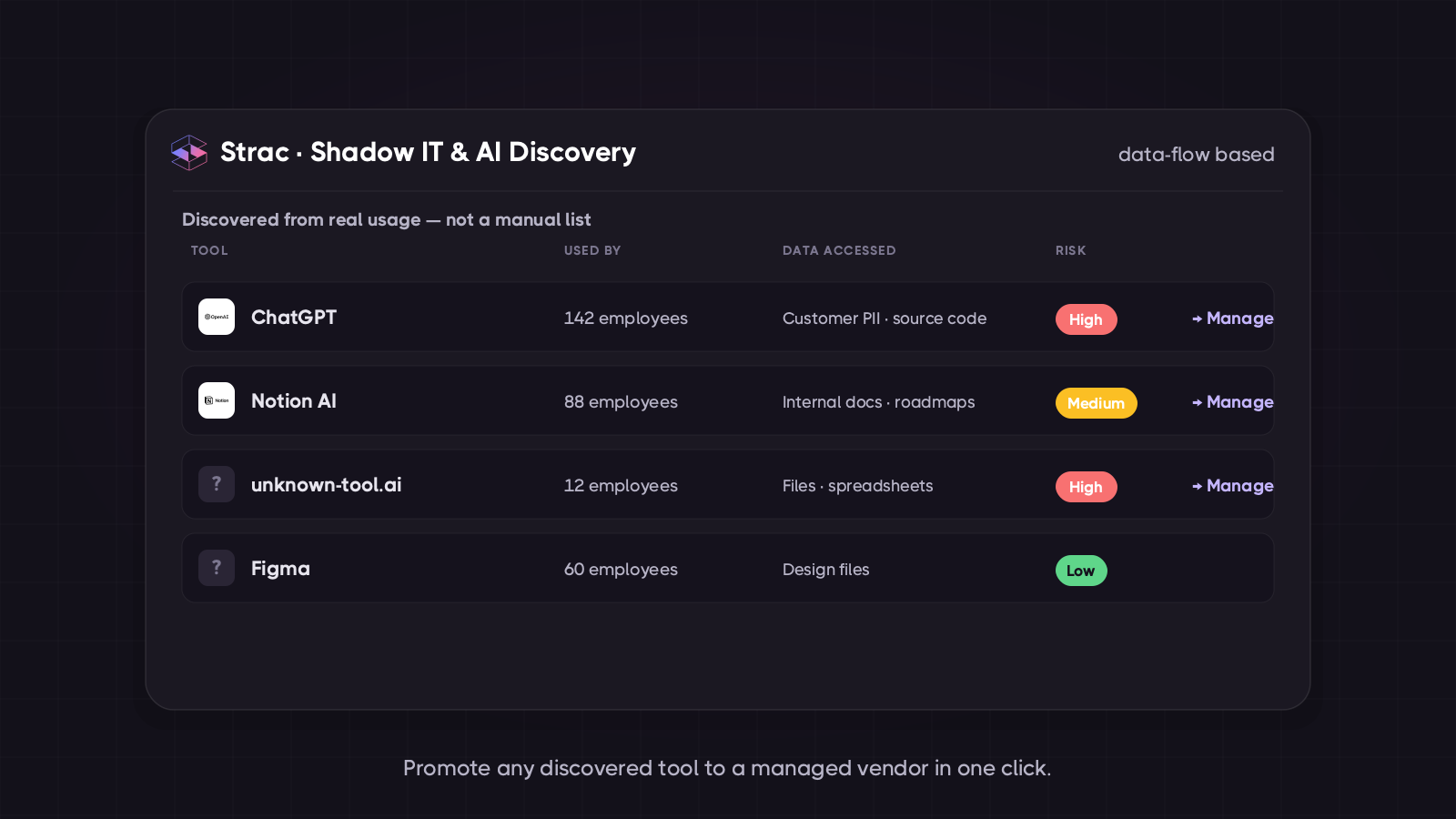
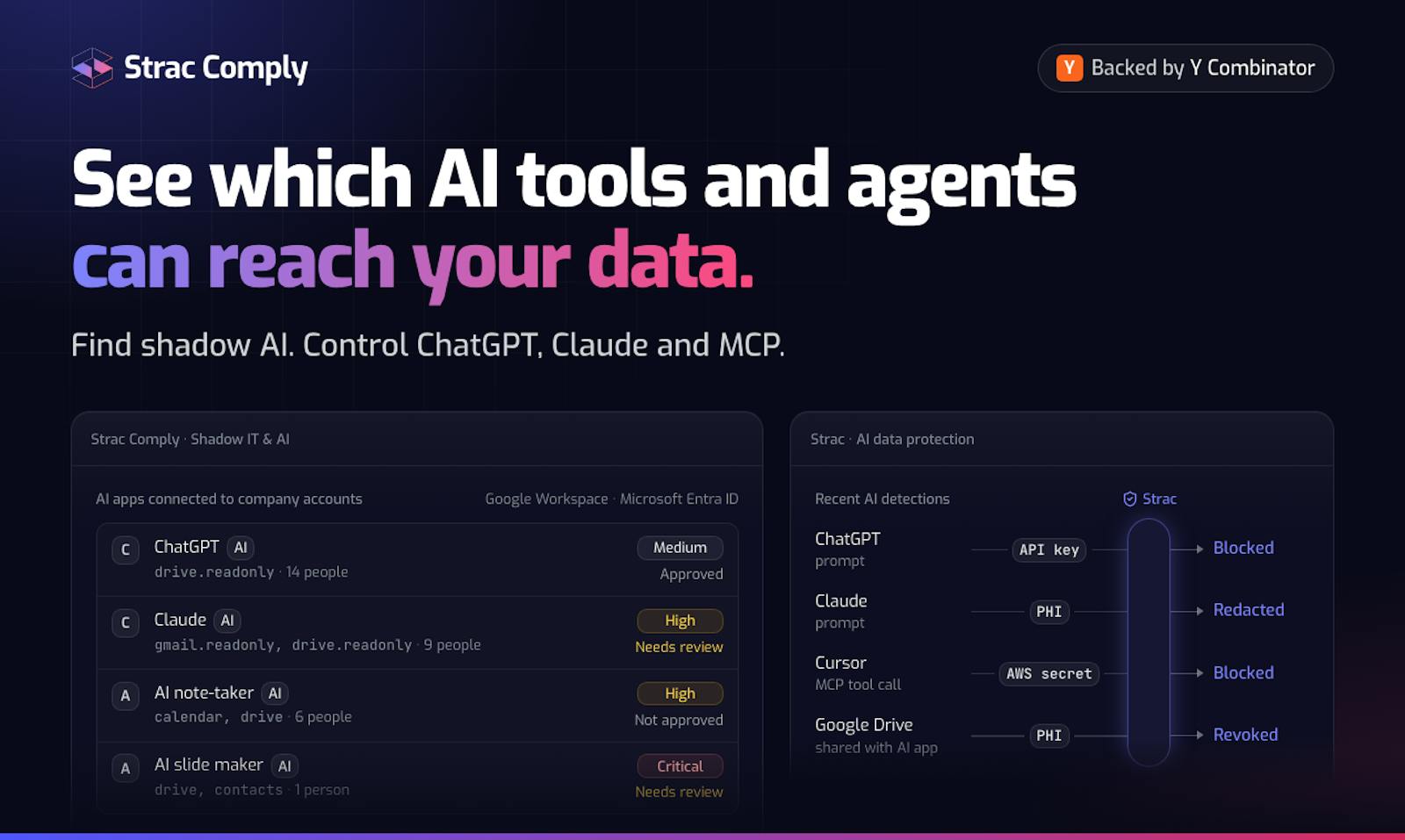
✨ Shadow-vendor discovery, built in
The best TPRM tools find vendors you never onboarded; Strac Comply detects shadow SaaS and AI from actual activity, not a manual intake form.
Shadow-vendor discovery, built in.
✨ Scores an auditor can reproduce
Vendor risk is scored by consistent rules with AI-drafted questionnaires, so your TPRM program holds up under scrutiny instead of relying on gut feel.
Scores an auditor can reproduce.
✨ Data-aware vendor risk
Comply ties each vendor to the sensitive data it can reach, mapped to controls, so your risk score reflects real data exposure, not just a checklist.
Data-aware vendor risk.
✨ Strac Comply pricing: transparent, no sales call
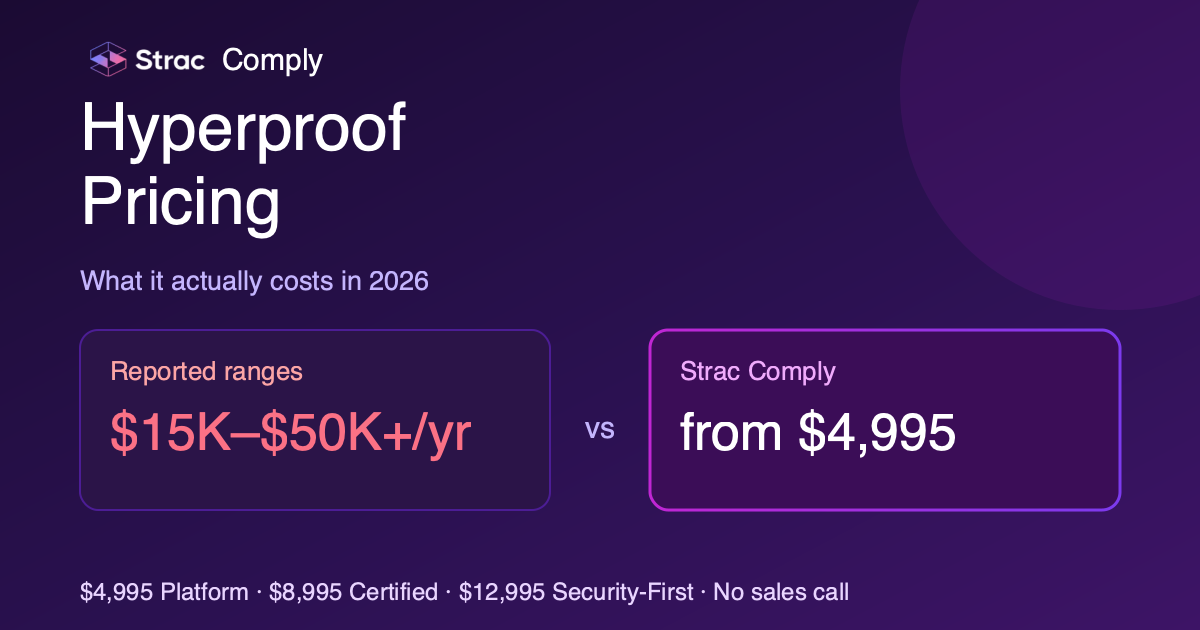
Strac Comply publishes its price: $4,995/yr for the Platform (bring your own auditor) or $8,995/yr for Certified (audit by an independent licensed CPA firm on one invoice), or $12,995/yr for Security-First (adds a human-led penetration test and Strac DLP for Slack, Google Workspace, and AI tools). All five frameworks (SOC 2, ISO 27001, PCI DSS, HIPAA, NIST CSF 2.0) are included at one price, no per-framework fees, on plans for up to 10 employees, with a free trial and no credit card. Note: $4,995 to $12,995 covers Strac Comply and its TPRM module. Strac’s full DLP and DSPM platform is a separate product with its own pricing.
Published pricing, a free trial, and no sales call.
🎥 Watch Strac Comply get you to vendor risk without the sales call
🌶️ Spicy FAQs for Best Third-Party Risk Management Software
What is the best third-party risk management software?
It depends on your stack. Vanta and Drata are great if you already use them for compliance; OneTrust suits large enterprises; SecurityScorecard excels at external ratings; and Strac is the strongest option when your biggest exposure is data and shadow AI, because it discovers vendors from real data flows.
Who are the top TPRM companies?
Commonly cited leaders include Strac, Vanta, Drata, OneTrust, SecurityScorecard, and Prevalent (Vanta).
What's the difference between a TPRM platform and a compliance platform's vendor module?
A standalone TPRM platform (like Prevalent) is purpose-built for vendor risk; a compliance platform's module (Vanta, Drata) adds TPRM to a broader SOC 2/ISO program. Strac is a module of Strac Comply but uniquely backed by a data-security layer.
Does any TPRM software discover shadow AI?
Most don't. Strac discovers shadow AI and shadow IT from actual data flows, so you can bring unsanctioned tools under management instead of finding out about them after an incident.
Do I need TPRM software for SOC 2?
Effectively yes, SOC 2's CC9 criteria require vendor risk assessment and oversight, and TPRM software gives you the assessments, documents, and monitoring records auditors expect. The same is true for ISO 27001 and Reg S-P.
The Bottom Line
The best third-party risk management software for you comes down to one question: do you mostly need to organize the vendors you already know about, or do you need to discover the ones you don't? Vanta, Drata, OneTrust, SecurityScorecard, and Prevalent are all strong at the former.
Strac is built for the latter, discovering shadow IT and shadow AI from real data flows, scoring vendors by the data they actually touch, and enforcing offboarding, all inside Strac Comply. Book a demo and we'll show you the vendors and AI tools already touching your data.
What is the best third-party risk management software?
It depends on your stack. Vanta and Drata are great if you already use them for compliance; OneTrust suits large enterprises; SecurityScorecard excels at external ratings; and Strac is the strongest option when your biggest exposure is data and shadow AI, because it discovers vendors from real data flows.
Who are the top TPRM companies?
Commonly cited leaders include Strac, Vanta, Drata, OneTrust, SecurityScorecard, and Prevalent (Vanta).
What's the difference between a TPRM platform and a compliance platform's vendor module?
A standalone TPRM platform (like Prevalent) is purpose-built for vendor risk; a compliance platform's module (Vanta, Drata) adds TPRM to a broader SOC 2/ISO program. Strac is a module of Strac Comply but uniquely backed by a data-security layer.
Does any TPRM software discover shadow AI?
Most don't. Strac discovers shadow AI and shadow IT from actual data flows, so you can bring unsanctioned tools under management instead of finding out about them after an incident.
Do I need TPRM software for SOC 2?
Effectively yes, SOC 2's CC9 criteria require vendor risk assessment and oversight, and TPRM software gives you the assessments, documents, and monitoring records auditors expect. The same is true for ISO 27001 and Reg S-P.
Discover & Protect Data on SaaS, AI, MCP, Endpoints & Cloud
Strac provides end-to-end data loss prevention for all SaaS and Cloud apps. Integrate in under 10 minutes and experience the benefits of live DLP scanning, live redaction, and a fortified SaaS environment.


.webp)




.avif)



.gif)
