November 3, 2026

10
min read
Best LLM Gateway in 2026: 6 Options Compared
Every LLM gateway routes and caches. We ranked six on content handling, cache-safe redaction and deployment. Strac, Cloudflare, Azure, AWS, Kong and Vercel compared.

Every LLM gateway routes and caches. We ranked six on content handling, cache-safe redaction and deployment. Strac, Cloudflare, Azure, AWS, Kong and Vercel compared.
TL;DR:
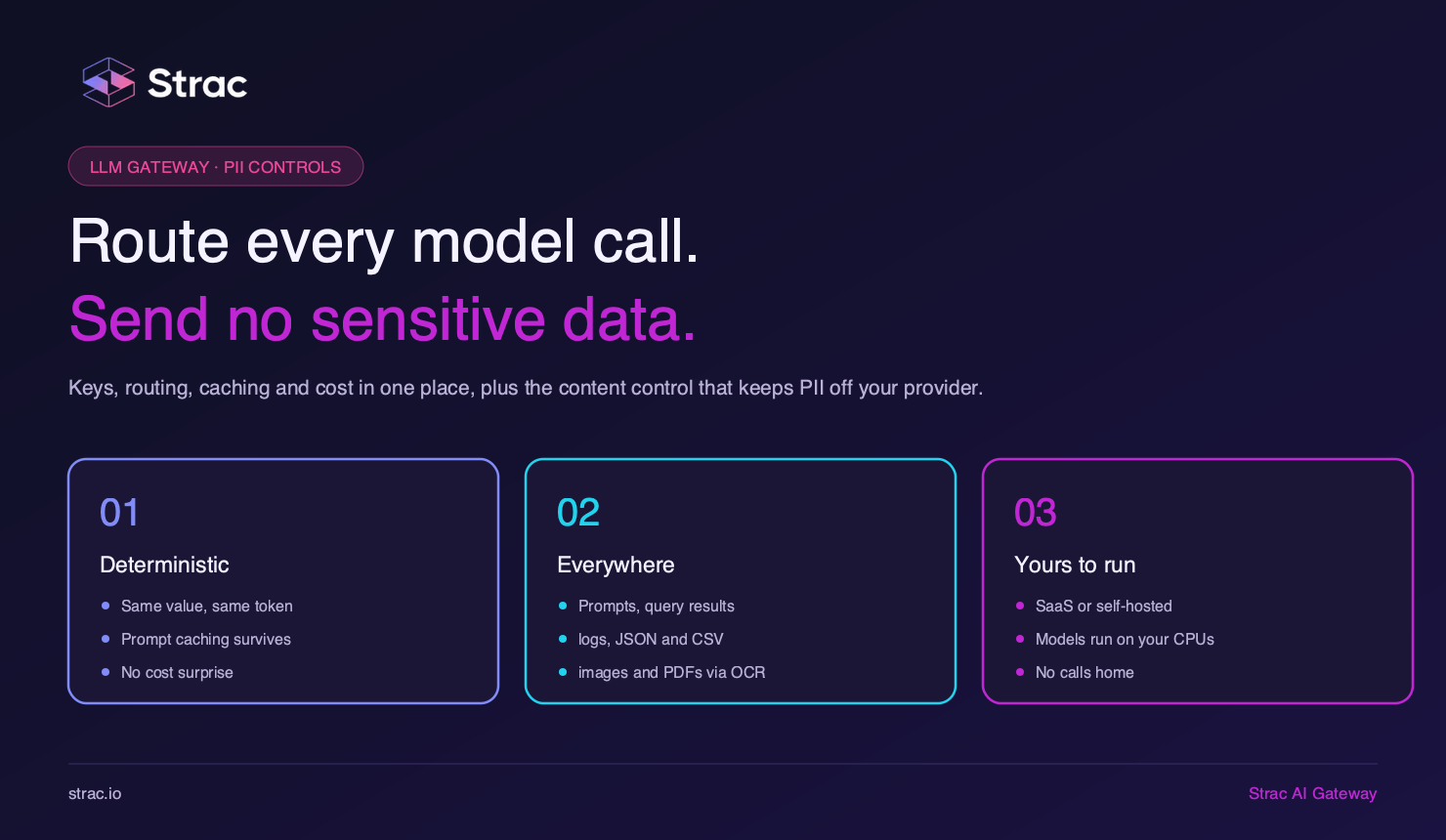
If you are shopping for an LLM gateway, the feature grids will look nearly identical. Multi-provider routing, retries, failover, semantic caching, a spend dashboard, key management. Pick any incumbent and you will get those, and the differences come down to which cloud you are already on.
So the useful way to choose is to ask what happens when the traffic stops being toy prompts and starts being real customer data. That is where the grids diverge sharply, and it is how this list is ordered. For the architecture behind the term, see what is an LLM gateway and the broader AI gateway framing.
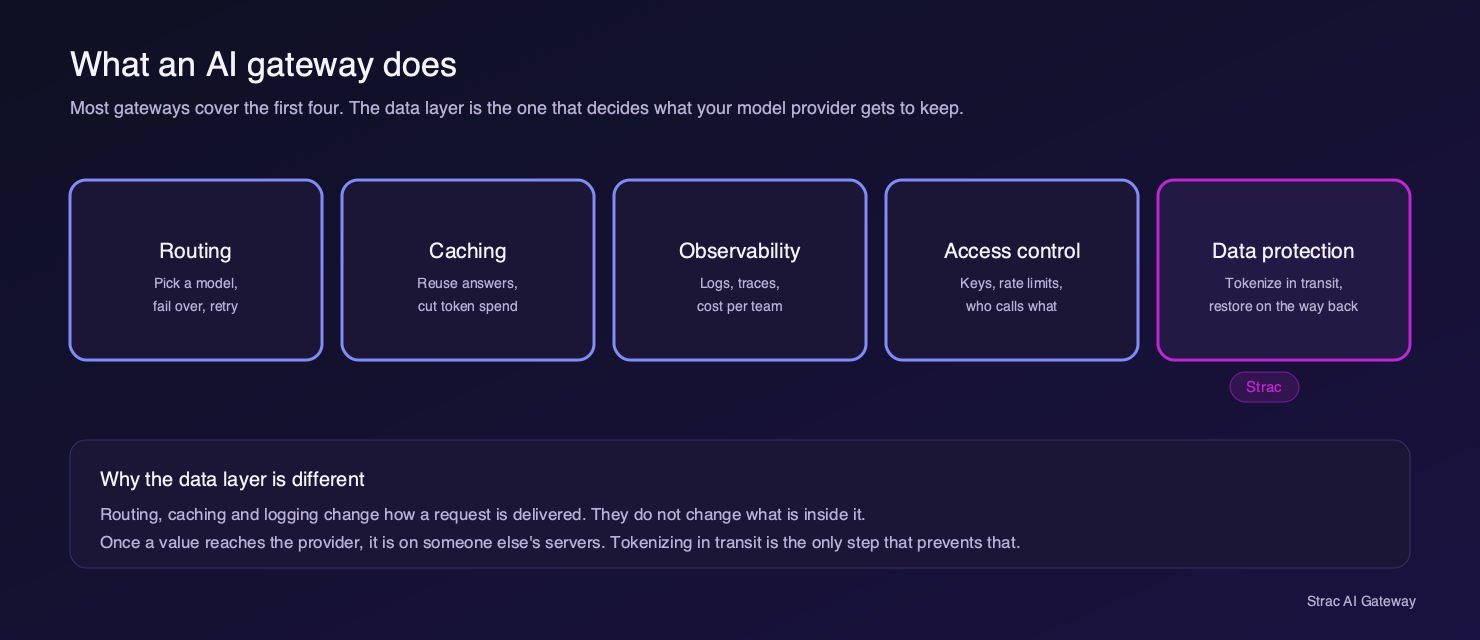
The substitution mechanic is the same reversible tokenization behind data masking, and the same classifier powers AI DLP and Endpoint DLP.
Here is the fork that decides everything downstream. Detection is no longer the scarce part: Kong has shipped PII sanitizing since early 2025 and Cloudflare followed later that year. The scarce part is what the gateway does once it finds something. Blocking returns an error, so whatever your application was doing stops. Deleting lets the call through but hands the model a hole where the customer used to be, so it cannot draft the reply or build the next query. Substituting is the only branch where the request succeeds, the model stays useful and the provider never holds the real value. Ask every vendor which branch they implement, and then ask how far the restore reaches.
Best for: regulated workloads where prompts and retrieved context carry real customer data.
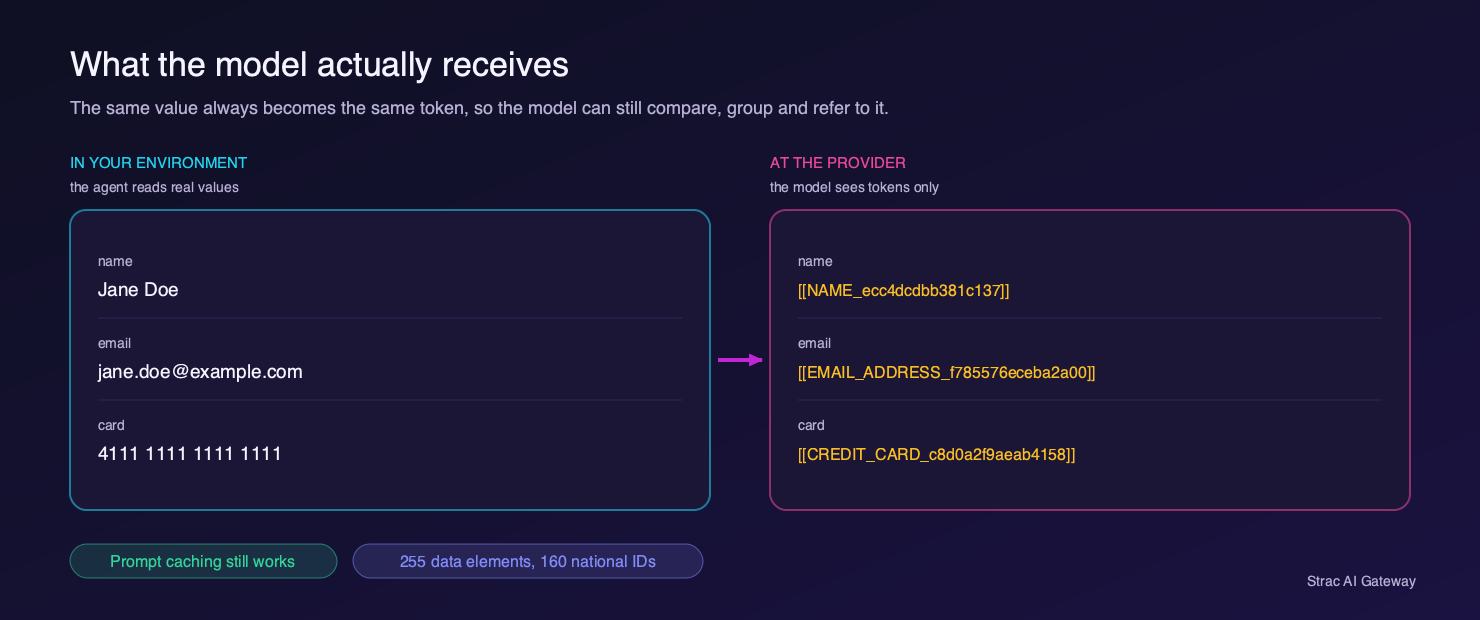
Strac is first here for one reason: it is the only option on this list where a prompt containing a Social Security number can be sent, processed and acted on without the provider ever receiving that number, and without the request failing.
The mechanics are simple from the outside. Point your application at Strac with one environment variable. Sensitive values are detected and replaced with deterministic tokens before the request leaves. The model reasons over tokens. Real values are restored in the response and inside tool calls so your application acts on genuine data.
Detection covers 255 data element types including 160 national ID formats, across prompts, query results, command output, logs, JSON, CSV, images via OCR and PDFs. Deployment is SaaS or self-hosted Docker with no calls home.
Where it is not the answer: if your only problem is spreading traffic across providers and tracking spend, Strac does not ship routing or cost dashboards today, and you would be buying a data security product to solve an infrastructure problem. Full detail in what is an LLM gateway.
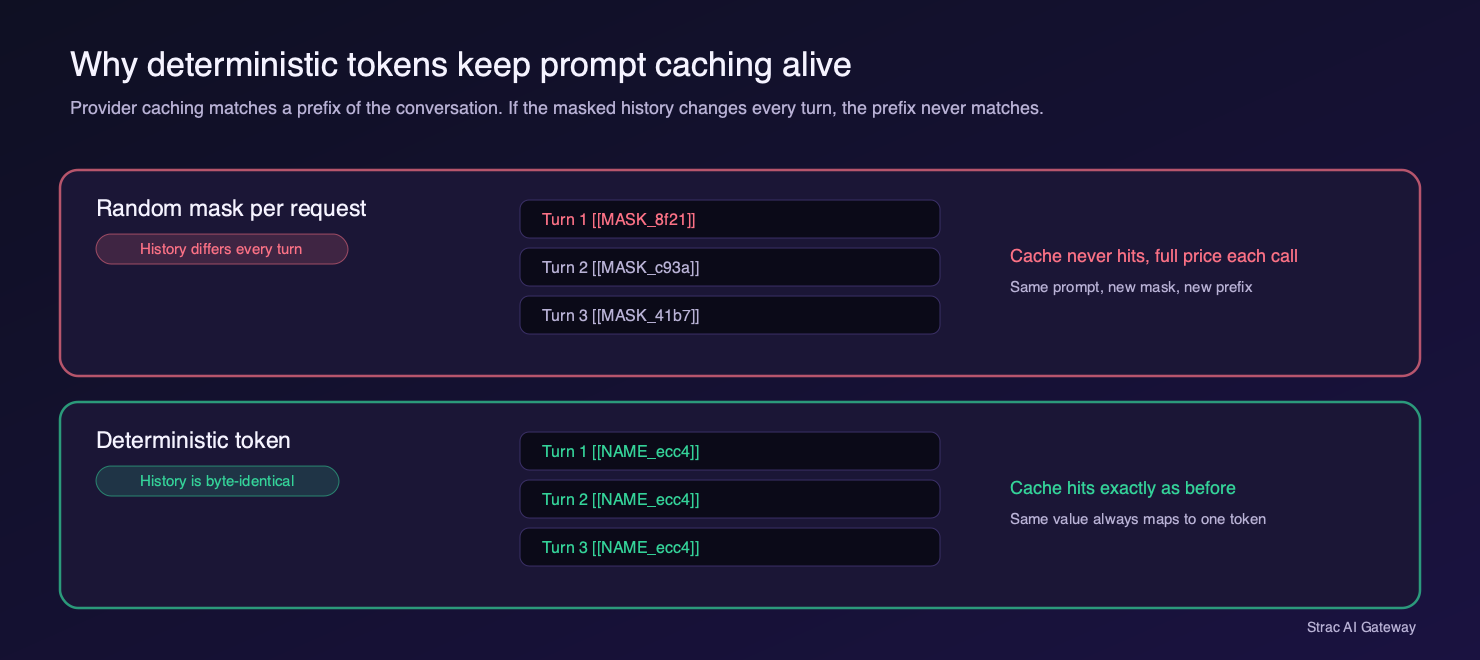
Provider prompt caching matches on a prefix of the conversation. Any filter that generates a fresh placeholder per request changes that prefix every turn, so the cache never hits and you pay full price on every call. Teams usually discover this weeks later as an unexplained cost increase, and it is the most common way a redaction layer gets ripped back out.
Best for: teams already on Cloudflare wanting fast routing plus basic data controls.
The most capable of the routing-first incumbents, and the only edge provider here with a shipped DLP feature. Analytics, caching, rate limiting and failover are mature and the edge footprint is unmatched.
Its data control detects and blocks. That is a legitimate design for a chat product and a poor one for agents, because a blocked call is an aborted workflow. There is no token vault, so there is no mechanism for giving the model a placeholder and recovering the real value afterwards. The same tradeoff on the tool-call path is covered in MCP DLP.
Best for: Microsoft-standardized enterprises.
Token limits, semantic caching and load balancing across model deployments, all governed by the same platform and identity model as the rest of your estate. For a Microsoft shop the integration and approval path is dramatically shorter than anything else on this list.
Data protection relies on platform policy and Purview rather than inline substitution, and Purview does not inspect the application-to-model path by default. The frequent mistake is assuming that existing Microsoft data governance already covers this traffic. See MCP data security for where that assumption breaks.
Best for: AWS-native teams keeping everything in one account boundary.
Content policy applied to prompts and completions, inside your own AWS account, inheriting IAM and CloudTrail. For AWS-committed teams the compliance story is easy to tell.
The native inline path skips toolResult and toolUse.input outright, per AWS documentation, which is precisely where retrieved records travel in an agent workflow. AWS added InvokeGuardrailChecks in June 2026 to cover agentic steps, but it is detect-only: you receive scores and write the enforcement yourself. AgentCore Policy suppresses the whole tool response instead. Neither substitutes, and ANONYMIZE masking is irreversible. The inbound equivalent is covered in MCP gateway.
Best for: enterprises already running Kong as their API layer.
Mature gateway engineering, a known operational model, strong traffic policy and authentication. Running model traffic through the control plane your platform team already operates has real organizational value.
Kong's AI PII Sanitizer is the real thing: NLP-based detection, placeholder or synthetic replacement, and an optional restore that puts the originals back in the response. Two gaps matter for agents. Restoration lands in the response body, not inside tool calls, and detection is text only, with no OCR path for the scanned document an agent just opened. For what unmanaged agent usage looks like before any gateway exists, see shadow AI.
Best for: product teams on Vercel who want routing to be invisible.
The best developer experience here by some distance, and effectively free if you already deploy on Vercel. One endpoint, many models, unified billing.
Built for shipping features, not for passing a security review. No classifier, no tokenization, no self-hosted option. Teams in this position usually arrive at AI agent security once the first security review lands.
| Gateway | Behaviour on a hit | Cache-safe replacements | PII beyond prompt text | Runs in your network |
|---|---|---|---|---|
| Strac | Substitutes and restores | Yes, deterministic | Yes, OCR and PDF | Yes, no calls home |
| Cloudflare AI Gateway | Flags or blocks; never restores | Not applicable | Limited | No |
| Azure API Management | Policy based | Not applicable | No | Your Azure tenant |
| AWS Bedrock Guardrails | Detects, blocks or suppresses; never restores | Not applicable | Images for harm categories only; no PDFs | Your AWS account |
| Kong | Substitutes and restores (response only) | Placeholders are per-request | No | Self-managed or Konnect |
| Vercel AI Gateway | Not a data control | Not applicable | No | No |
See it on your own data. Send a few examples of what your agents handle and Strac returns a tuned policy plus a report of exactly what the model would have seen. Book a demo or browse the integrations your agents already touch.
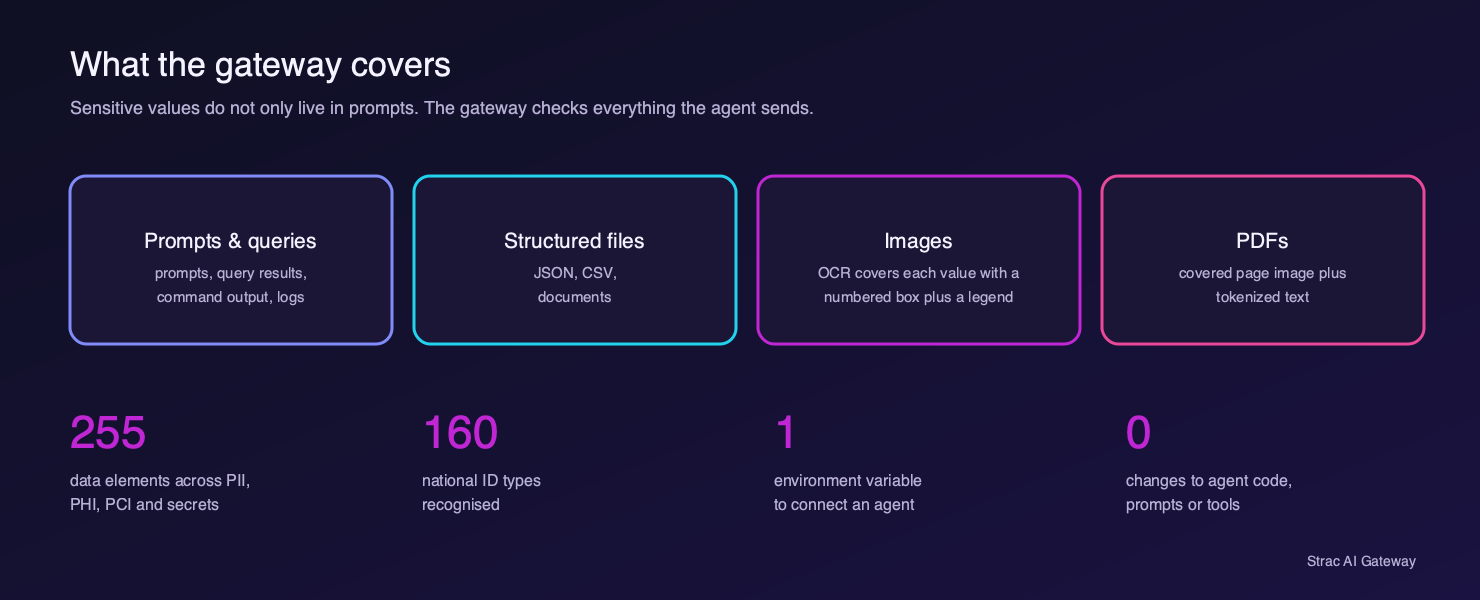
This is where feature grids mislead most. A gateway that filters the prompt string and nothing else will pass an evaluation and then miss the scanned invoice the agent just opened, or the 400-row query result it pasted into context.
Strac detecting and remediating sensitive data in Slack. The gateway applies the same detection engine to the model path.
Give every vendor the same test: a prompt containing a real-shaped customer record, with a follow-up turn that requires the model to act on it. Then check three things. Did the request succeed? Did the provider receive the actual values? Could the application still complete the action afterwards?
Most products fail the first or the third. Pair this with an MCP gateway for the inbound path, and see AI DLP for the same engine applied elsewhere in the stack.
For pure provider management, meaning one key store, traffic spread across models and a spend dashboard, the cloud incumbents all do this competently and the right pick is whichever sits closest to your stack. For any workload where prompts or retrieved context carry regulated data, Strac is first on this list because it is the only one that substitutes sensitive values rather than blocking the request or stripping the value out.
For routing, usually yes. Open-source proxies handle multi-provider routing, retries and key management perfectly well, and if that is your whole problem you do not need to buy anything. Where they run out is content: most rely on general-purpose entity recognition bolted on as a plugin, with no OCR for scanned documents, and restore paths that cover the response body but not values inside tool calls, so an agent that hits a real customer record either stops or loses the data it needed.
It can, mostly through caching and by letting you route cheap requests to cheaper models. The thing to watch is that a poorly designed PII filter destroys those savings: if the filter emits a different placeholder on every request, your resent conversation history changes each turn, provider prompt caching stops hitting and your bill goes up. Deterministic tokenization avoids that because the serialized history stays identical.
Some can, most cannot. The routing-first products are cloud services by design, and a few offer a customer-managed control plane. Strac ships a self-hosted Docker container for your VPC, on-prem or your customer's infrastructure, with detection models bundled in the image running on your CPUs, no calls home, and an AES-256-GCM token vault on storage you control.
Mostly scope. LLM gateway usually describes a proxy focused on model traffic: routing, caching, keys and cost. AI gateway is the broader term covering that plus the agentic surface, including tool calls and the data agents retrieve from your systems. If your workloads are agents rather than single prompts, the broader framing is the one that matters.
No rebuild is required. Connecting an application is one environment variable pointing at the gateway, with no changes to code, prompts or tools. Strac becomes the hop closest to your application, which is where it needs to be, because anything upstream writes raw values into its own logs before Strac ever sees them.
“Don’t just alert on problems, fix them.”
Scott Roberts, Chief Information Security Officer, UiPath









Customers include