August 10, 2026

min read
Best Data Masking Tools & Software: What to Look For (2026)
.webp)
Last updated: August 2026
Data masking tools replace sensitive data — PII, PHI, PCI, secrets — with realistic fake values so it stays usable for testing, analytics, and AI without exposing real people. The best ones preserve format and referential integrity across every data source, not just SQL.
Data masking software finds sensitive values in your data and replaces them with realistic substitutes, so a masked dataset behaves like production — same formats, same relationships — but exposes no real person. It is the safe way to give developers, analysts, and AI models the data they need.
| Capability | Why it matters |
|---|---|
| Format coverage | Real sensitive data lives in databases, PDFs, spreadsheets, JSON, code, and images — not just SQL |
| Referential integrity | The same value must map to the same fake across tables and files, or joins break (details) |
| Detection accuracy | You can only mask what you can find — ML detection beats brittle regex |
| Static and dynamic | Some use cases need a portable copy, others need live query-time masking (compare) |
| Scale | Large SAP / warehouse estates need incremental processing, not full re-scans |
| Deployment | Agentless and cloud-native (S3, Azure, GCP) beats heavy agents |
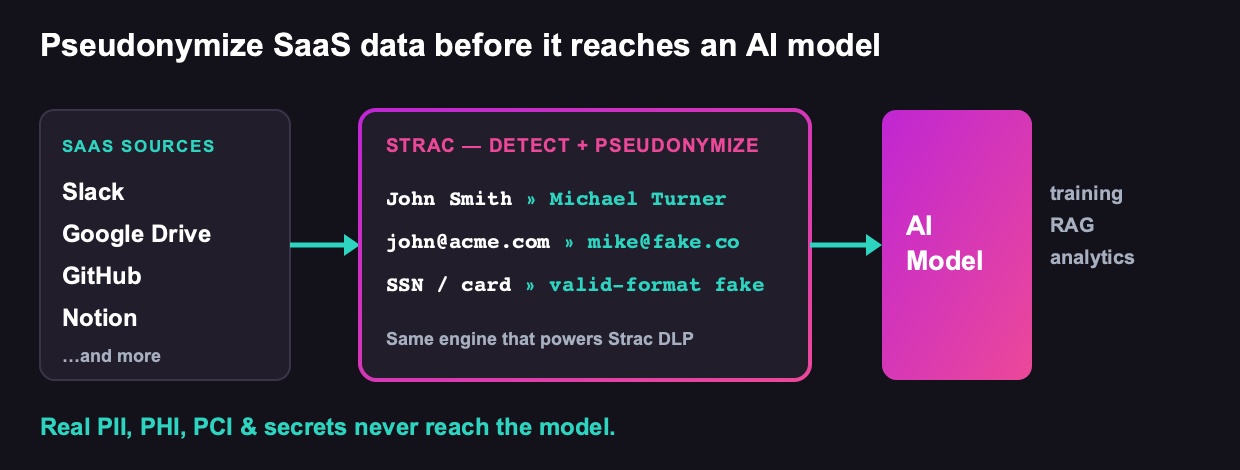
Strac approaches data masking as a security control, not a developer utility. It uses the same detection engine that powers Strac DLP to find PII, PHI, PCI, secrets, and IDs across SaaS apps, cloud storage, databases, documents, code, and images — then pseudonymizes them into a realistic, referentially-consistent safe copy, delivered to your destination store. It scales to SAP HANA incrementally and produces an audit log of every field transformed.
The market splits into a few types. Knowing which you need narrows the field fast.
| Category | What it does | Best for |
|---|---|---|
| Static maskers | Create a masked copy of data at rest | Test/dev/AI datasets you move and keep |
| Dynamic maskers | Mask on the fly at query time | Controlling live access to production |
| Synthetic data generators | Generate data from a model | Volume/edge cases where realism-from-scratch is fine |
| Enterprise TDM suites | Provision + mask + subset | Large orgs with heavy test-data pipelines |
Start from the use case. If you need a safe, portable dataset for testing or AI, choose a static masker with strong format coverage and referential integrity. If you need to gate live access, choose dynamic. If you are a security or privacy team trying to keep real data out of AI and lower environments, Strac is built for exactly that.
No. Encryption is reversible with a key and the data is unusable until decrypted. Masking replaces values with realistic fakes that stay usable but reveal nothing real.
Static if you need a copy you can move (testing, analytics, AI). Dynamic if you need to mask live query results without copying. Many teams use both — see static vs dynamic.
.avif)


.gif)