August 28, 2026

min read
SAP Data Masking: Pseudonymize SAP HANA at Scale (Incremental, 2026)
.webp)
Last updated: August 2026
SAP data masking creates a safe, pseudonymized copy of an SAP HANA database — replacing PII, PHI, PCI, and other sensitive fields with realistic, consistent fakes while preserving every table relationship — so teams can test, analyze, and feed AI on SAP data without exposing real records.
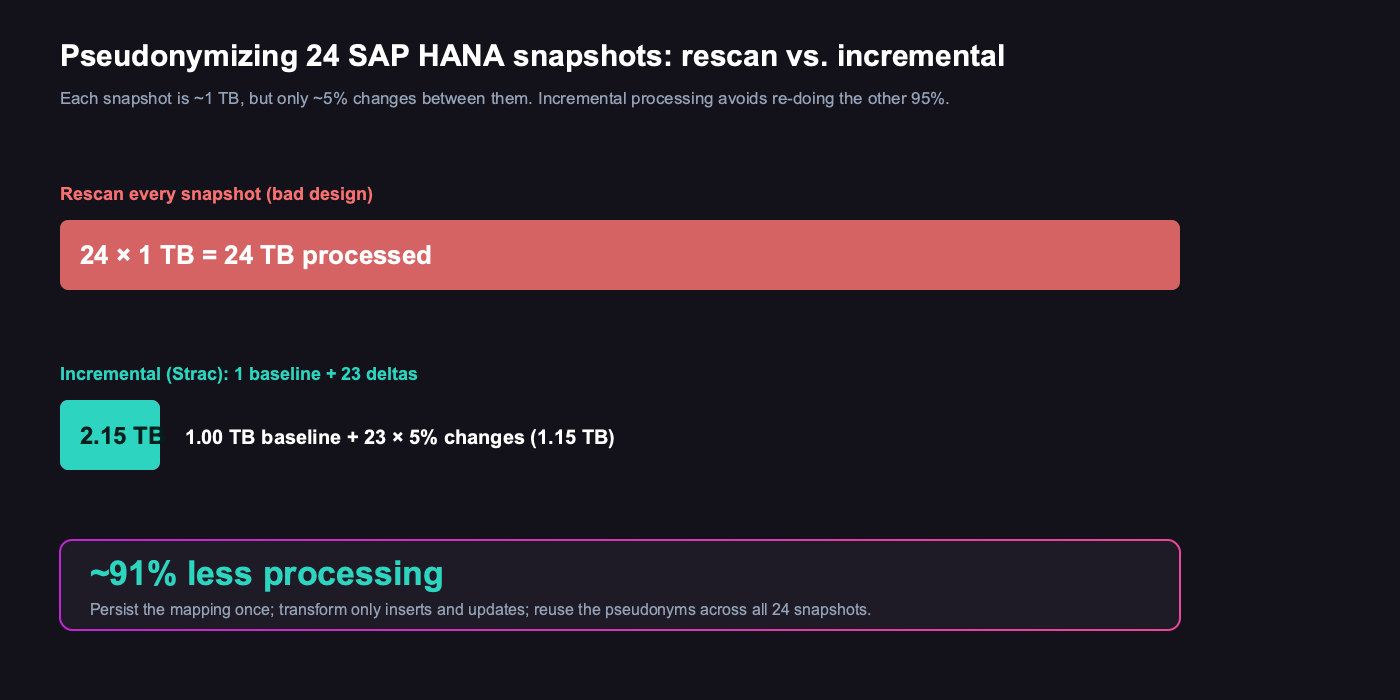
SAP HANA holds a company's most sensitive records — customers, employees, payments — spread across thousands of related tables. To use that data safely for testing, analytics, or AI, you need a pseudonymized copy that keeps the relationships intact. The catch is volume: a HANA estate often lands as 24 snapshots of ~1 TB each. Reprocessing all of them independently means scanning 24 TB.
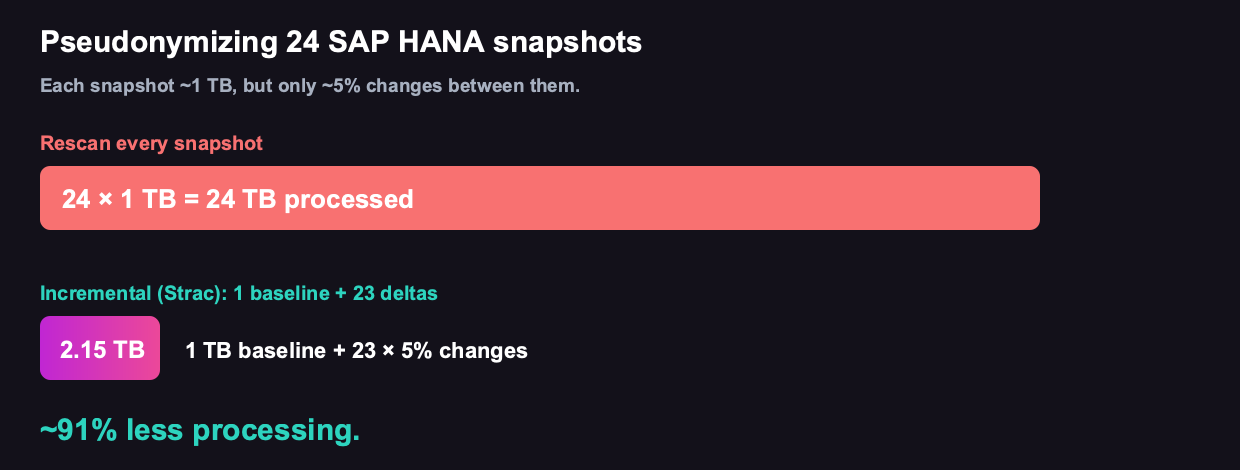
Only about 5% of data changes between snapshots, so re-doing the other 95% every time is pure waste. Strac builds one full pseudonymized baseline, persists the mapping, and then for each later snapshot transforms only the rows that were inserted or updated — reusing the original pseudonyms. Roughly 2.15 TB processed instead of 24 TB.
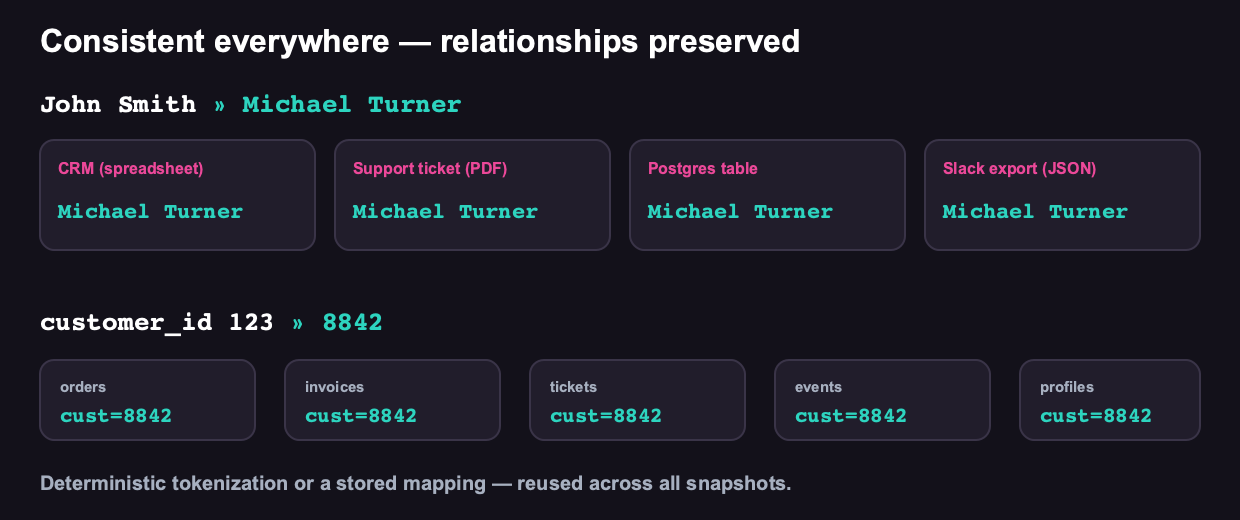
The same customer secret and mapping version are used for all 24 snapshots, so if John Smith became Michael Turner in snapshot 1, he is still Michael Turner in snapshot 8 even after his address changes. Strac uses deterministic tokenization — token = HMAC(customer_secret, data_type + normalized_value) — or a stored, versioned mapping, so referential integrity holds across time and tables.
The savings depend on how the snapshots arrive. Before pricing or processing, determine whether they are full logical SAP exports, HANA incremental/differential backups, storage-level copy-on-write snapshots, tables accessible directly through HANA, or CDC/transaction-log changes. If you receive 24 opaque, independent 1 TB exports with no change manifest, keys, or hashes, Strac falls back to table, partition, row, or file hashing to detect changes — still cheaper on the mapping step, but with more I/O.
| Snapshot type | Change info available? | Processing |
|---|---|---|
| HANA incremental / differential backup | Yes — native change data | Cheapest — transform only the delta |
| CDC / transaction log | Yes — change stream | Cheap — stream inserts/updates |
| Copy-on-write storage snapshot | Partial | Block-level diff, then transform |
| Opaque full exports (no manifest) | No | Fall back to row/partition/file hashing |
Related reading:
It depends on the format. HANA backup and recovery generally operate at the database level, so a logical change stream (CDC) is ideal; if only backups are available, we confirm whether they can be consumed directly or must be restored first — which is why we scope the snapshot type before pricing.
Not automatically — S3 does not dedupe identical content, so uploading 24 full 1 TB copies still stores ~24 TB. Use a baseline-plus-deltas or Iceberg/Delta-style representation and materialize a full snapshot only when the customer actually needs one.
SAP data masking is one surface of Strac data pseudonymization, which covers databases, documents, code, email, and images alike.
.avif)


.gif)