August 10, 2026

min read
Data Pseudonymization: Safe SaaS Data for Testing, Analytics & AI (2026)
.webp)

Last updated: August 2026
Data pseudonymization replaces sensitive values in a dataset — names, emails, phone numbers, SSNs, card numbers — with realistic, consistent fake values, so the data stays fully usable for testing, analytics, and AI, but no real person can be identified.
Data pseudonymization is the process of swapping real sensitive values for realistic fake ones while preserving the structure and relationships of the original data. A pseudonymized copy looks and behaves like production data — the same columns, formats, and joins — so teams can build, test, analyze, and train AI on it without ever touching real personal information. Because a secure mapping links each fake value back to its original, it is reversible by authorized systems, which is what separates pseudonymization from one-way anonymization.

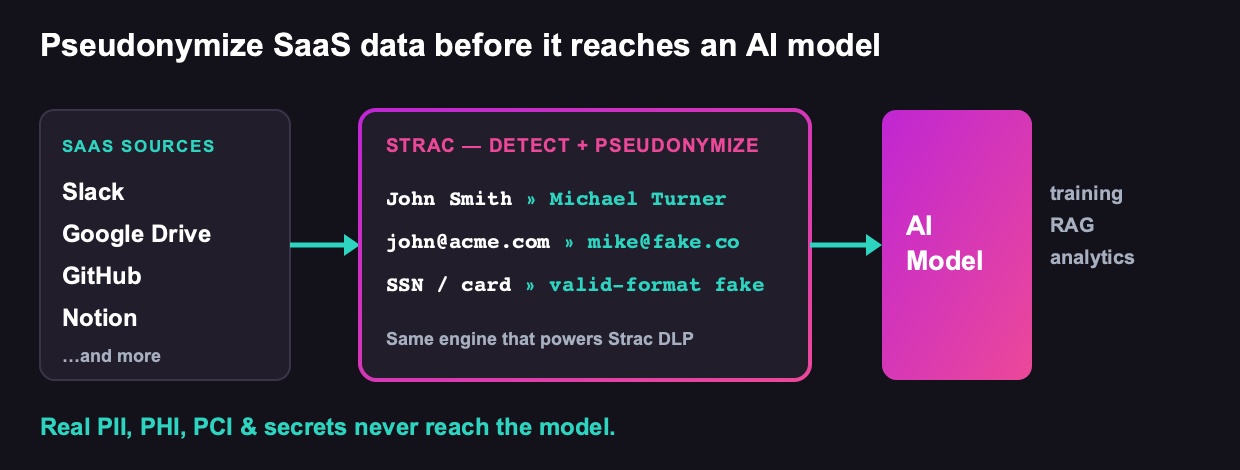
The reason this matters now: companies want to put their real business data — Slack conversations, Google Drive documents, GitHub repos, Notion pages — to work in AI models for training, RAG, analytics, and demos. But that data is saturated with PII, PHI, PCI, and secrets. Send it to a model as-is and you have handed an LLM your customers' personal data with no way to take it back.
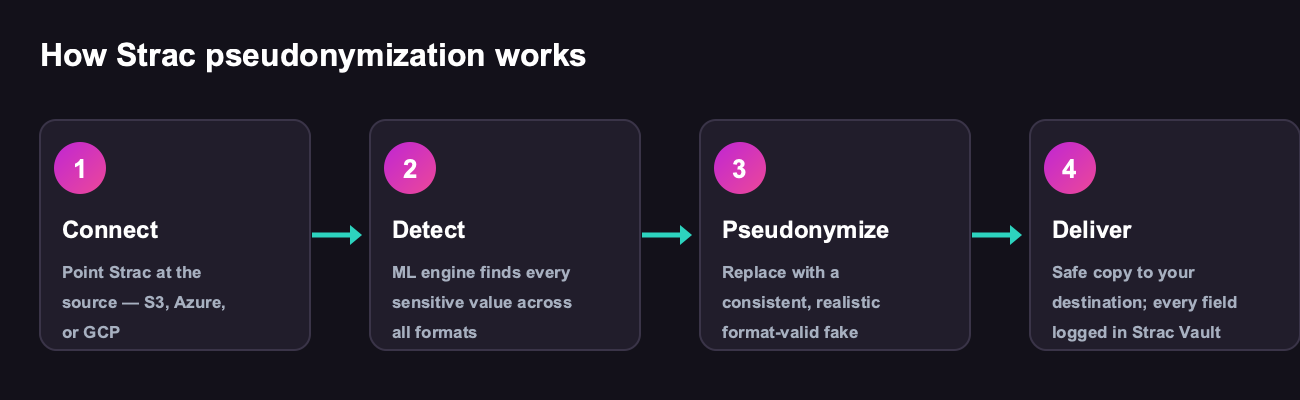
Strac sits in the middle of that pipeline. It reads the data from wherever it lands (an S3 bucket is a common intermediary, but it works the same on Azure Blob or Google Cloud Storage), detects every sensitive value with the same detection engine that powers Strac DLP, replaces it with a realistic, consistent fake, and writes a safe copy to a destination store. Only the safe copy goes to the model.
| Technique | What it does | Reversible? | Keeps data useful? |
|---|---|---|---|
| Pseudonymization | Swaps sensitive values for consistent, realistic fakes | Yes, via secure mapping | Yes — same shape and relationships |
| Anonymization | Irreversibly strips or generalizes identifiers | No | Often degraded (utility lost) |
| Masking | Hides characters (e.g., ****-1234) | No | Partial — breaks realism and joins |
| Redaction | Removes the value entirely | No | No — the field is gone |
Strac focuses on pseudonymization (a form of static data masking) because it is the only approach that keeps data realistic and relationally intact — exactly what testing and AI need.
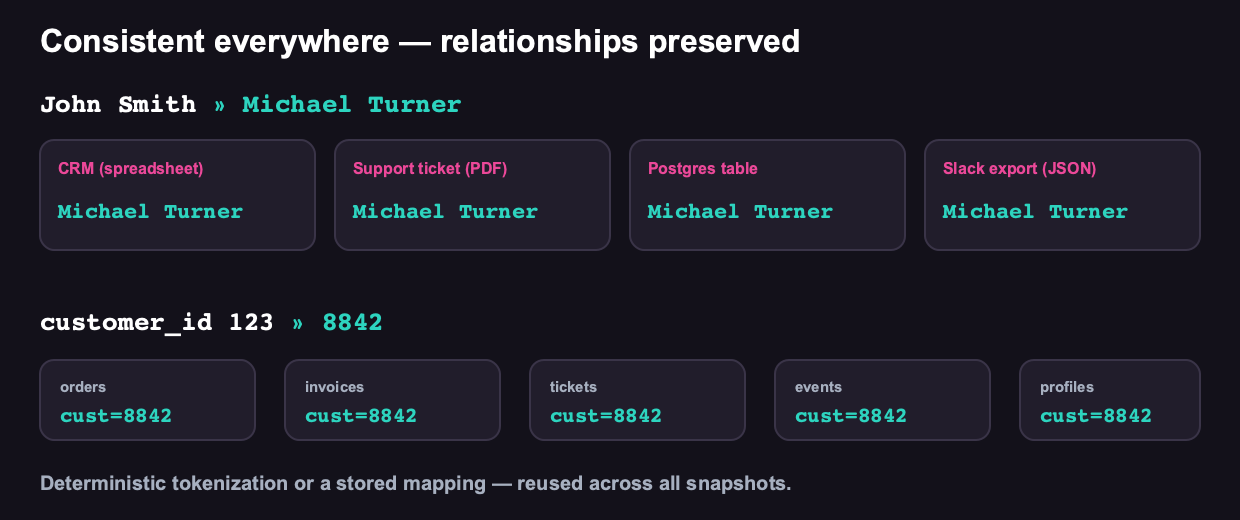
Anyone can replace "John Smith" with a random name once. The hard problem is making the same real value always become the same fake value — everywhere it appears, across every file and table and format. If customer_id 123 becomes 8842 in one table, it must be 8842 in all five tables, or every join breaks and the data becomes useless. Strac guarantees this with deterministic tokenization (or a stored, versioned mapping), so referential integrity holds across the entire dataset — and across every snapshot over time.
Sensitive data does not live in one neat place. Strac pseudonymizes it wherever it is, producing a new document in the same original format:
| Data / format | Examples | What Strac detects & replaces |
|---|---|---|
| Structured | SQL, Parquet, CSV, DuckDB, SAP HANA | Names, IDs, SSNs, cards, bank accounts — consistently across tables |
| Documents | PDF, Word, spreadsheets | PII/PHI in cells, paragraphs, and headers |
| Semi-structured | JSON, HTML, TXT, EML (email) | Sensitive values in fields, bodies, and metadata |
| Source code | .py and other code files | Hardcoded secrets, API keys, credentials, real data in fixtures |
| Images | Scans, screenshots | Sensitive text via OCR |
The detectors are the ones Strac already runs in production: names, email addresses, phone numbers, addresses, dates of birth, SSNs, credit cards, bank accounts, employee and customer IDs, API keys and credentials, and anything else in the Strac ML model.
Large SAP HANA estates arrive as a series of snapshots. Reprocessing every 1 TB snapshot from scratch would mean scanning 24 TB. Strac does it incrementally: build one full pseudonymized baseline, then for each later snapshot, transform only the rows that were inserted or updated and reuse the original mapping. With ~5% change between snapshots, that is roughly 2.15 TB processed instead of 24 TB — about 91% less. We cover the full approach in our SAP HANA data masking guide.
Yes — GDPR treats pseudonymized data as personal data because it can be re-linked via the mapping. But it is explicitly recommended as a safeguard (Article 32), and it dramatically reduces risk versus using raw production data. For fully non-personal data, pair it with anonymization.
No — that is the whole point of pseudonymization over redaction. The fake values are realistic and format-valid (a fake SSN still passes SSN validation; a fake card still passes Luhn), and relationships are preserved, so tests and models behave as they would on real data.
Yes — that is the core use case. Strac produces a safe copy of your SaaS data so the real PII, PHI, and secrets never reach the model. For live prompt protection, pair it with Strac AI DLP.
Those are developer test-data tools. Strac approaches pseudonymization as a data-security control owned by the security team — using the same engine that already governs your sensitive data, across SaaS, files, code, and SAP, with the goal of keeping real data out of AI and test environments.
Ready to see it on your own data? Explore the Strac Data Masking & Pseudonymization product, or book a demo.
.avif)


.gif)