August 10, 2026

min read
Referential Integrity in Data Masking: Keep Joins Valid (2026)
.webp)
Last updated: August 2026
Referential integrity is the guarantee that relationships between records stay valid — every foreign key still points to a real parent row. In data masking and pseudonymization, it means the same real value always becomes the same fake value, everywhere it appears, so joins never break.
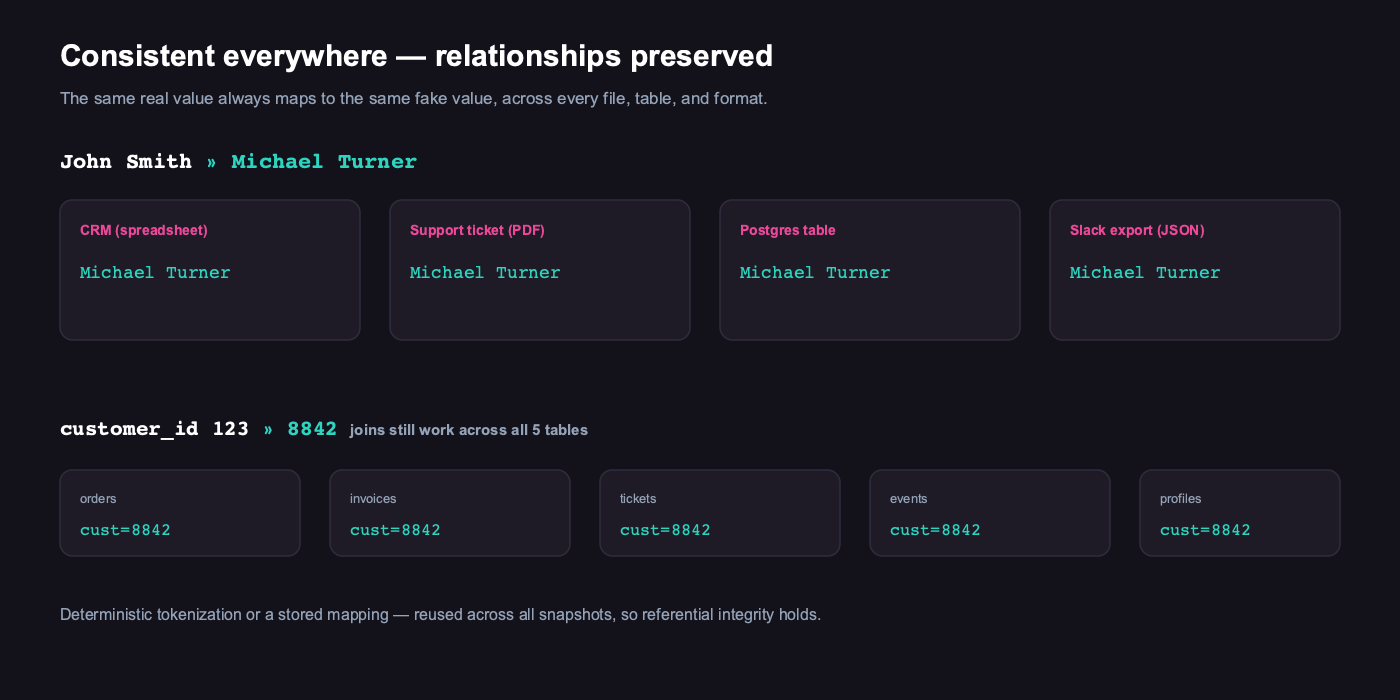
customer_id 123 must map to the same fake (e.g. 8842) in all five tables it appears in.In a relational database, referential integrity means a foreign key in one table always matches a primary key in another — orders point to real customers, invoices point to real orders. Naive data masking destroys this: if you replace customer_id 123 with a random value in the orders table but a different random value in invoices, the two no longer join. The masked data is now worthless for testing or analytics because the relationships are gone.
The only way to preserve referential integrity while masking is to make replacement deterministic: the same input always yields the same output. Strac does this with deterministic tokenization — token = HMAC(customer_secret, data_type + normalized_value) — or a stored mapping table, so a value maps to the same pseudonym in every table, file, and format, and across every snapshot over time.
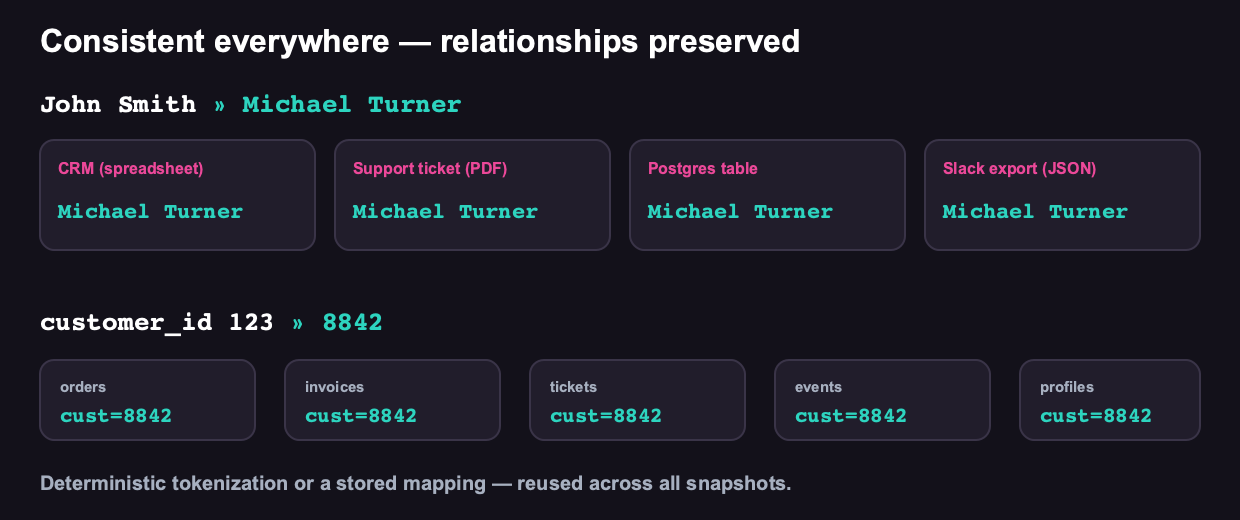
Real referential integrity is not just table-to-table. A customer named in a Postgres row, a support PDF, a Slack export, and a spreadsheet must become the same fake in all of them, or cross-source analysis breaks. Strac keeps the mapping consistent across every format it pseudonymizes, which is what makes the safe copy genuinely usable.
Only if the randomness is seeded deterministically from the original value. Pure per-occurrence randomness breaks joins. Deterministic tokenization gives you realistic-looking data that is still perfectly consistent.
Yes — the same customer secret and mapping version are reused, so pseudonyms stay stable over time. See SAP data masking.
.avif)


.gif)