August 28, 2026

min read
Static vs Dynamic Data Masking: The Difference (2026)
.webp)
Last updated: August 2026
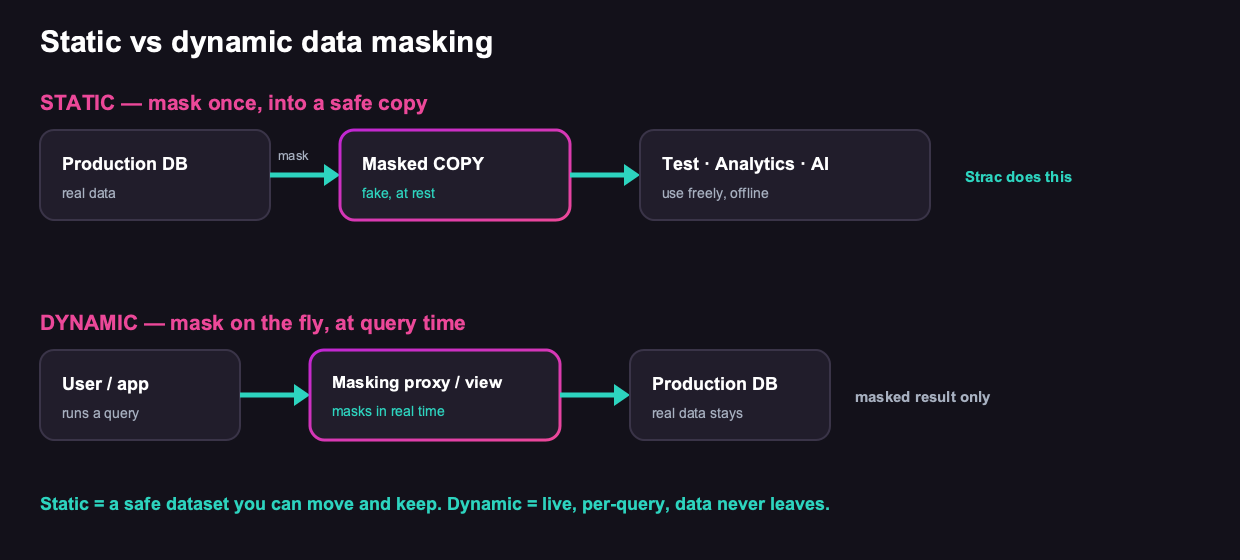
Static data masking (SDM) creates a permanently masked copy of your data for use offline — testing, analytics, AI. Dynamic data masking (DDM) masks data on the fly at query time, leaving the original untouched. Use static to move and keep a safe dataset; dynamic to control live access.
Both hide sensitive data, but they operate at different points. Static data masking transforms the data at rest, producing a new masked dataset. Dynamic data masking transforms data in flight, applying masking rules to query results while the underlying data is unchanged.
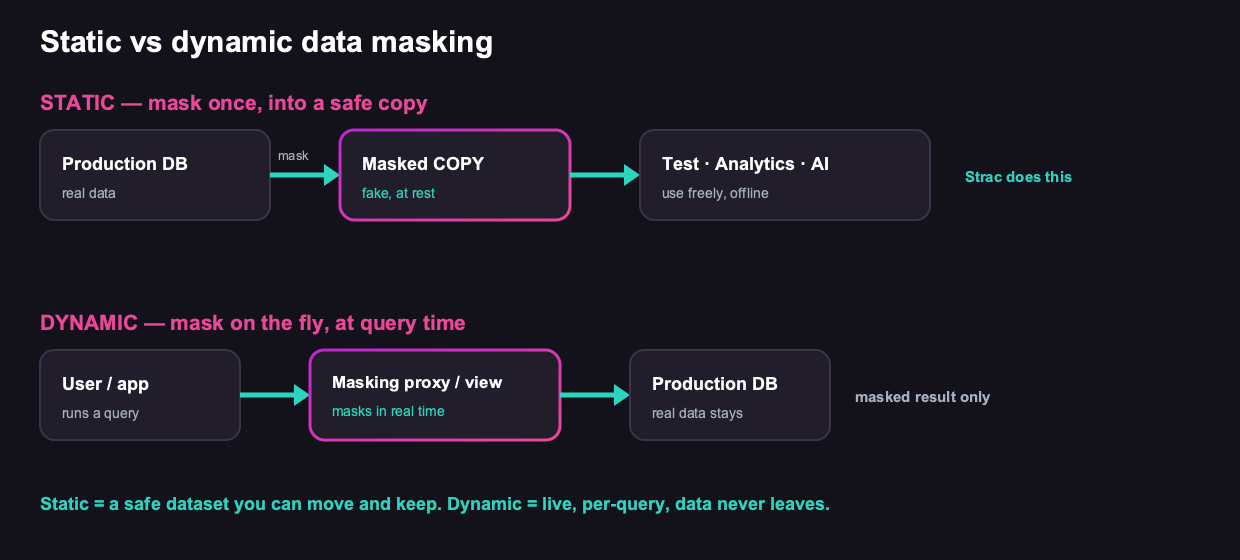
A static masker reads the source, detects sensitive fields, replaces them with consistent fakes, and writes a new dataset. Because the copy is fully masked, it is safe to move into dev, staging, analytics, or an AI pipeline — it can leave the secure boundary. This is a form of pseudonymization, and it must preserve referential integrity to stay useful.
A dynamic masker sits between the user and the database — as a proxy, a database view, or a native feature — and rewrites sensitive columns in the query result on the fly. The real data never changes; an unauthorized user simply sees masked values. It is ideal for controlling live access, but it does not give you a portable dataset, and it adds a dependency in the query path.
| Static (SDM) | Dynamic (DDM) | |
|---|---|---|
| When masking happens | Once, ahead of time | Live, at query time |
| Original data | Copied and masked | Untouched |
| Output | A portable safe dataset | Masked query results only |
| Best for | Testing, analytics, AI, demos | Production access control, support tooling |
| Can leave the boundary? | Yes | No |
Strac specializes in static masking / pseudonymization — creating the safe, realistic, referentially-consistent copy that testing and AI need, across every format and at SAP scale. For live, in-app protection, pair it with Strac DLP.
Related reading:
Yes, and many teams do: static to provision safe lower-environment datasets, dynamic to gate live production access. They solve different problems.
Static — you need a portable, realistic copy to train or RAG against. Dynamic only masks live query results and can’t feed a model a dataset.
.avif)


.gif)