How to run a third-party risk assessment — the process, the assessment types, inherent vs. residual risk, and how AI document review and data-flow scoring make it scale. Plus the software to use.
A third-party risk assessment evaluates how much risk a specific vendor or tool introduces — based on the data it accesses, its security posture, and its access to your systems.
Assessments come in several flavors: security, privacy, financial, operational, ESG, and now AI risk — and you tailor the depth to the vendor's risk tier.
The classic process is questionnaire → document review → scoring → remediation. The bottleneck is reading the evidence (an 80-page SOC 2, a dense DPA) fast enough to keep up.
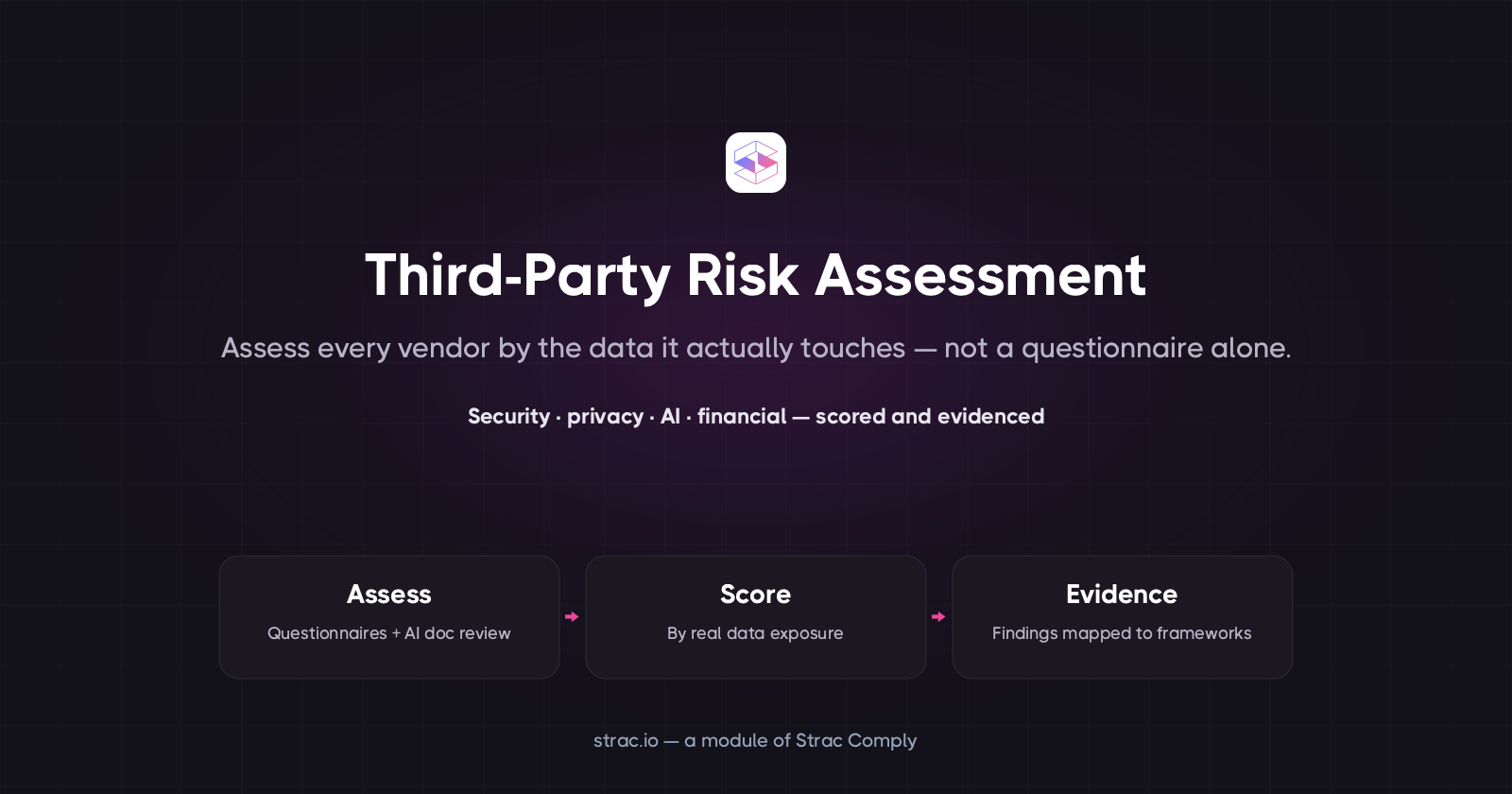
Two things modernize it: AI document review that reads SOC 2s and DPAs in seconds, and data-flow-based scoring that grounds risk in what a vendor actually touches — both built into Strac's TPRM module.
Assessments aren't one-and-done; critical vendors get reassessed on a cadence, and continuous monitoring fills the gaps in between.
What Is a Third-Party Risk Assessment?
A third-party risk assessment (often called a vendor risk assessment) is a structured evaluation of the risk a single vendor, supplier, or tool introduces to your organization. Where third-party risk management is the ongoing program, the assessment is the discrete event: you look at one vendor, decide how risky it is, and document why.
A good assessment answers three questions: What can this vendor access? (data and systems) How well do they protect it? (their controls and certifications) And what's our exposure if they fail? (impact). The output is a risk rating and a list of findings to remediate or accept.
Types of Third-Party Risk Assessment
Not every vendor needs the same scrutiny. The assessment type — and depth — should match what's at stake:
Security/cybersecurity — the vendor's controls, certifications (SOC 2, ISO 27001), and breach history. The most common type.
Privacy — how they handle personal data, their DPA, sub-processors, and data residency. Maps to GDPR Article 28 and similar.
Financial/operational — the vendor's stability and your dependency on them (concentration risk).
AI risk — increasingly its own category: what models a tool uses, how it trains on your data, and where that data goes.
Reputational/ESG — sanctions, adverse media, and ethics, weighted by industry.
Most programs lead with security and privacy and layer the others on for critical vendors.
The Third-Party Risk Assessment Process
A standard assessment follows five steps:
1. Scope & tier. Decide how deep to go based on the vendor's risk tier — driven by the sensitivity of the data and the access it has.
2. Send the questionnaire. SIG, SIG Lite, CAIQ, or a custom set, sized to the tier.
3. Collect & review evidence. Gather the SOC 2 report, DPA, pen-test results, and certificates — then actually read them against the questionnaire answers.
4. Score the risk. Combine the responses, the evidence, and the data exposure into a rating (and separate inherent risk from residual risk after controls).
5. Remediate or accept. Log findings, assign owners and due dates, and either fix the gaps or formally accept the risk.
Step 3 is where programs stall. Reviewers drown in lengthy reports, and the assessment becomes a paperwork exercise instead of a real evaluation.
✨ How to Scale Assessments: AI Review + Data-Flow Scoring
Two upgrades turn assessments from a bottleneck into something you can run across hundreds of vendors.
AI document review.Strac's TPRM module uses AI to read a vendor's SOC 2, DPA, and questionnaire responses, score the risk, and flag gaps — so your team isn't manually parsing 80-page reports. What took a reviewer hours takes minutes.
Data-flow-based scoring. Most tools score a vendor on what it says in a questionnaire. Strac sits on a data-security layer, so it also knows what data that vendor actually touches inside your environment — customer PII, source code, financial records. That turns an inherent-risk score from a guess into something grounded in reality.
The combination means a critical vendor and a low-risk tool both get the right depth of assessment, fast, with evidence attached.
Inherent vs. Residual Risk
A complete assessment separates two numbers:
Inherent risk — the risk before controls: how bad would it be if this vendor were breached, given what they access? Driven by data sensitivity and access.
Residual risk — the risk after you account for the vendor's controls and your own compensating controls.
The gap between them is the value of the vendor's security program. If a critical vendor has weak controls, residual risk stays high and you remediate or walk away. Grounding inherent risk in actual data exposure — rather than a self-reported tier — is what makes the whole calculation trustworthy.
Assessments Are Not One-and-Done
A vendor that passed last year may not pass today — certificates expire, breaches happen, and the data they access changes. That's why assessments pair with a reassessment cadence (critical vendors more often) and continuous monitoring in between. Strac watches for breaches, expiring documents, and shifts in the data a vendor is accessing, so the assessment stays current without a manual re-review every quarter. It's the same approach behind Strac's SOC 2 and Reg S-P evidence workflows.
🌶️ Spicy FAQs for Third-Party Risk Assessment
What is a third-party risk assessment?
A structured evaluation of the risk a specific vendor or tool introduces — based on the data it accesses, its security controls, and your exposure if it fails. The output is a risk rating and a list of findings.
What is the difference between a risk assessment and risk management?
The assessment is the discrete evaluation of one vendor; third-party risk management is the ongoing program that includes discovery, assessment, monitoring, and offboarding across all vendors.
What are the types of third-party risk assessment?
Security/cybersecurity, privacy, financial/operational, AI risk, and reputational/ESG. Most programs lead with security and privacy and add the others for critical vendors.
What is inherent vs. residual risk?
Inherent risk is the risk before controls (how bad a breach would be given what the vendor accesses); residual risk is what remains after the vendor's and your controls are applied.
How do you make vendor risk assessments scale?
Use AI to review SOC 2 reports and DPAs quickly, and ground risk scores in the data a vendor actually touches rather than self-reported answers. Strac's TPRM module does both.
How often should you reassess a vendor?
On a risk-based cadence — critical vendors quarterly to semi-annually, lower-risk vendors annually — supplemented by continuous monitoring for breaches and expiring documents in between.
The Bottom Line
A third-party risk assessment is only useful if it reflects reality and you can keep it current. The old model — long questionnaires, manual report review, self-reported tiers — is too slow and too easy to game. The modern one uses AI to read the evidence in minutes and grounds risk in the data a vendor actually touches.
That's how Strac's TPRM module, part of Strac Comply, runs assessments — fast, evidence-backed, and continuously monitored. Book a demo to see your vendors scored by the data they actually touch.
What is a third-party risk assessment?
A structured evaluation of the risk a specific vendor or tool introduces — based on the data it accesses, its security controls, and your exposure if it fails. The output is a risk rating and a list of findings.
What is the difference between a risk assessment and risk management?
The assessment is the discrete evaluation of one vendor; third-party risk management is the ongoing program that includes discovery, assessment, monitoring, and offboarding across all vendors.
What are the types of third-party risk assessment?
Security/cybersecurity, privacy, financial/operational, AI risk, and reputational/ESG. Most programs lead with security and privacy and add the others for critical vendors.
What is inherent vs. residual risk?
Inherent risk is the risk before controls (how bad a breach would be given what the vendor accesses); residual risk is what remains after the vendor's and your controls are applied.
How do you make vendor risk assessments scale?
Use AI to review SOC 2 reports and DPAs quickly, and ground risk scores in the data a vendor actually touches rather than self-reported answers. Strac's TPRM module does both.
Discover & Protect Data on SaaS, AI, MCP, Endpoints & Cloud
Strac provides end-to-end data loss prevention for all SaaS and Cloud apps. Integrate in under 10 minutes and experience the benefits of live DLP scanning, live redaction, and a fortified SaaS environment.


.webp)







.avif)



.gif)
