Stripe MCP Server: Secure Setup for Claude & AI Agents (2026)
The Stripe MCP server lets Claude, Cursor, ChatGPT, and AI agents read payments and issue refunds inside Stripe. Here's the official setup, the PCI and financial-data risks, and how to govern it with approval gates and redaction at the MCP layer.
The Stripe MCP server is the path for AI agents (Claude, Cursor, ChatGPT, Perplexity, custom agents) to read and act inside your Stripe account via the Model Context Protocol — spanning customers, charges, PaymentIntents, invoices, subscriptions, payouts, balance, and disputes, plus write actions like creating customers and invoices and issuing refunds.
Setup is documented in the official Stripe MCP documentation; the remote server lives at mcp.stripe.com and authorizes over OAuth (or a restricted API key), then serves tool calls to any MCP-aware client.
The risk is specific to payments: every read tool returns cardholder-adjacent data, customer PII, and full transaction history straight into the model's context, and write tools like create_refund move real money. None of it is inspected, and no action is gated, before it reaches the agent — putting PCI DSS scope and GDPR squarely on the line.
Strac Stripe MCP DLP is the governance layer for AI-agent access to Stripe. Strac governs every tool call between the agent and Stripe: it controls what each agent can read and what it can do — including approval or hard block on refunds and other high-risk writes — protects cardholder-adjacent data and customer PII with redaction, masking, tokenization, and vaulting, and logs every call as audit evidence mapped to PCI DSS v4.0.1 / SOC 2 / GDPR / HIPAA / EU AI Act / ISO 42001. One control plane across every charge, customer, invoice, payout, and dispute.
Setup is agentless and under 10 minutes per workspace. No application code changes, no agent SDK changes, no Stripe re-permissioning.
What Is the Stripe MCP Server?
The Stripe MCP server is a Model Context Protocol implementation that exposes the Stripe API as a standardized set of tools to AI agents. Once connected, an agent like Claude can list and search customers, pull PaymentIntents and invoices, read balances and disputes, and — when permitted — create customers, finalize invoices, and issue refunds on the authenticated account's behalf. Stripe's API surface becomes AI-actionable in a single connector.
Stripe runs the remote server at mcp.stripe.com and authorizes it over OAuth, with a restricted API key as an alternative for bearer-token access. Refer to the official Stripe MCP documentation for the current tool catalog, OAuth scopes, and the exact bearer-token configuration. The pattern matches other MCP integrations: authorize the server, add it as a connector in Claude (or another MCP-aware client), and tool calls start flowing.
From the operator's perspective, the AI agent suddenly understands the business's revenue — who's paying, what bounced, which disputes are open. From the security perspective, that same agent now has read access — and, depending on scopes, write access that moves money — across the account's payment records.
That's the value. It's also where a finance or security team needs a control layer.
What AI Agents Can Actually Do With Stripe MCP
Plug in the Stripe MCP server and an agent handles your billing data conversationally, reconciling and investigating against live objects instead of a dashboard. Concretely, it can:
Look up a customer's full payment history — "What has this account paid us in the last 12 months, and which charges failed?" resolves to live list_customers, list_payment_intents, and fetch_stripe_resources calls against real records, not a stale CSV export.
Summarize and triage open disputes — pull list_disputes, group by reason code, surface the chargebacks closest to their evidence deadline, and draft the response narrative for a human to submit.
Reconcile invoices and subscriptions — cross-check list_invoices against list_subscriptions to flag unbilled usage, dunning failures, or subscriptions that should have churned, across hundreds of records in one prompt.
Read balances and payouts — answer "what's our available balance by currency and when's the next payout?" from retrieve_balance and the payout records directly.
Draft and issue a refund — and here the agent crosses from reading to acting: create_refund moves real money out of your account. An agent that can summarize a dispute can also, with the wrong prompt or a bad tool plan, push a refund through.
Every one of those actions runs through Stripe's own API and permission model — which is what makes it genuinely useful, and exactly why the financial data it returns needs an inspection layer and the write actions it can take need an approval gate in the tool-call path.
The Real Security Risks of the Stripe MCP Server
The risks fall into four categories that every fintech, SaaS, and e-commerce security and finance team should price into the deployment.
1. Every read pulls financial and cardholder-adjacent data. Stripe is your payments system of record. list_customers, list_payment_intents, and fetch_stripe_resources return customer names, emails, billing addresses, partial card data (BINs, last-four, card brand, expiry), bank-account fingerprints, and the full transaction ledger. That data lands in the model's context window verbatim — which means it lands inside PCI DSS scope. The moment cardholder-adjacent data flows to an external AI model with no inspection, your assessment surface grows and so does your breach blast radius.
2. Refunds and writes have a money-moving blast radius. This is the difference that makes Stripe MCP riskier than a read-only CRM connector. create_refund, create_invoice, cancel_subscription, and update_dispute change state and move funds. A prompt-injection payload buried in a customer's metadata or a dispute note, a hallucinated tool plan, or an over-broad agent instruction can issue a refund that never should have gone out. There is no native "are you sure?" — the tool fires and the money is gone.
3. Transaction history is a GDPR and privacy exposure. Beyond cards, the payment record is a behavioral profile: what someone bought, how often, from where, on what device. Piping list_invoices and customer histories into an AI model is processing personal data under GDPR — purpose limitation, data minimization, and records of processing all apply, and none of it is enforced by the MCP server itself.
4. The data leaves your guardrails the moment the tool returns. The DLP a company already runs — at the network edge, in its payments vault, inside Stripe's own dashboard controls — does not sit in the MCP path. The tool response goes straight from Stripe into the AI agent's context window, and the write request goes straight back out, un-gated. That reach is exactly why each agent's access and actions in Stripe must be governed: controlled (what it can read and which writes it can fire), the financial data it touches protected, and every call audited. That is where Strac Stripe MCP DLP lives.
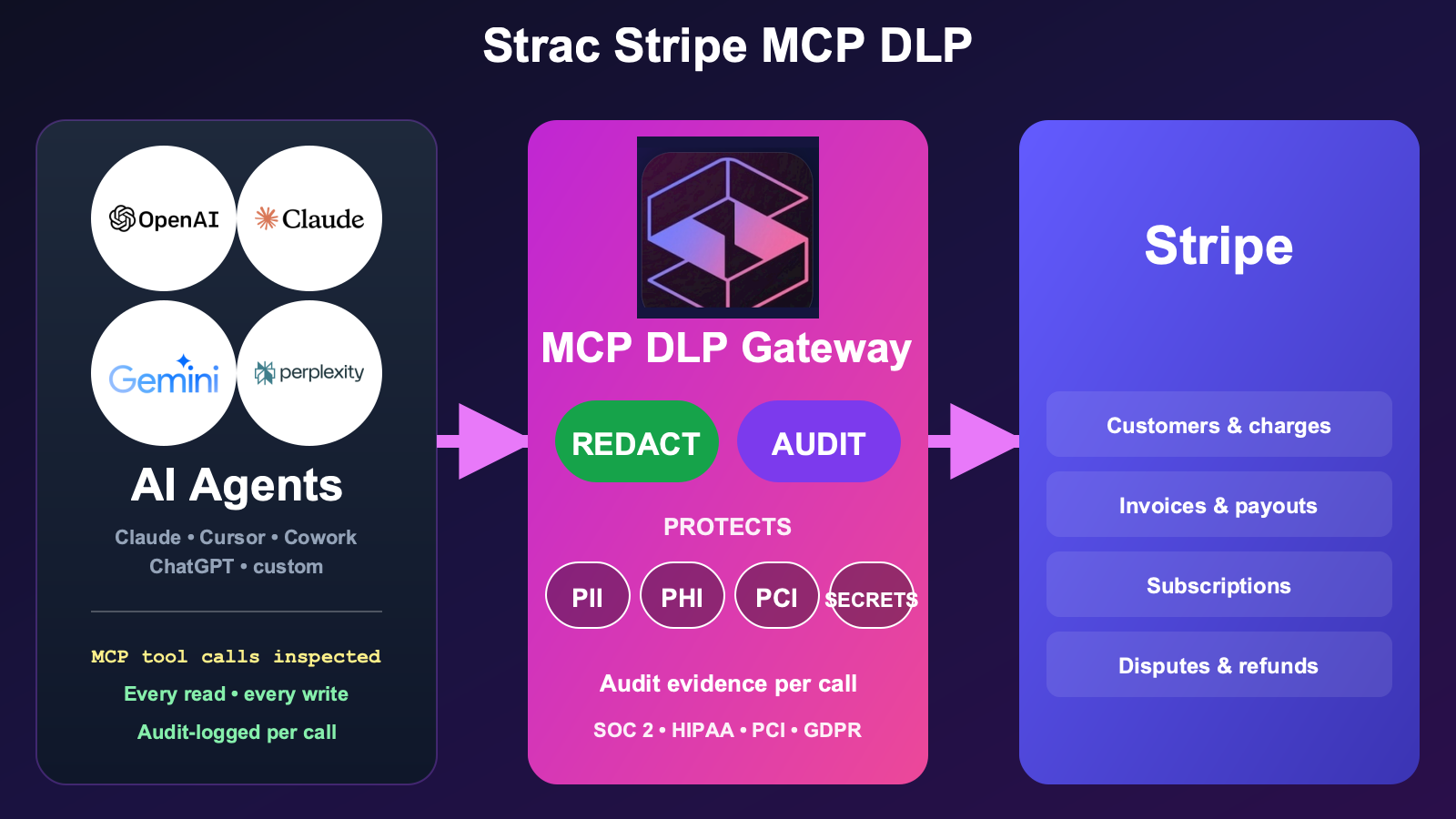
Strac's Stripe MCP DLP is the governance layer that sits between AI agents and the Stripe MCP server. Strac governs every tool call: it sees exactly what each agent reaches in Stripe, controls its actions — allow, block, or require human approval on high-risk writes like refunds and dispute updates — protects the cardholder-adjacent and customer data it touches by redacting, masking, tokenizing, or vaulting it, and proves the whole thing by logging every call as audit evidence. Non-sensitive, in-policy calls flow through untouched.
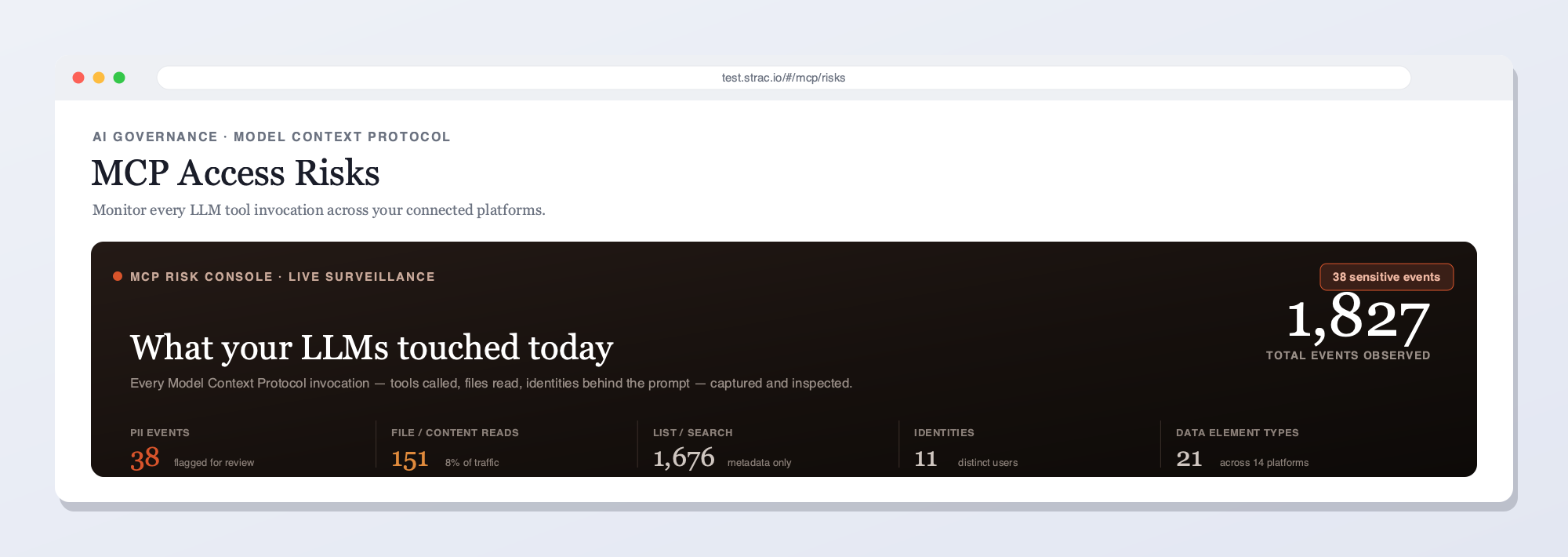
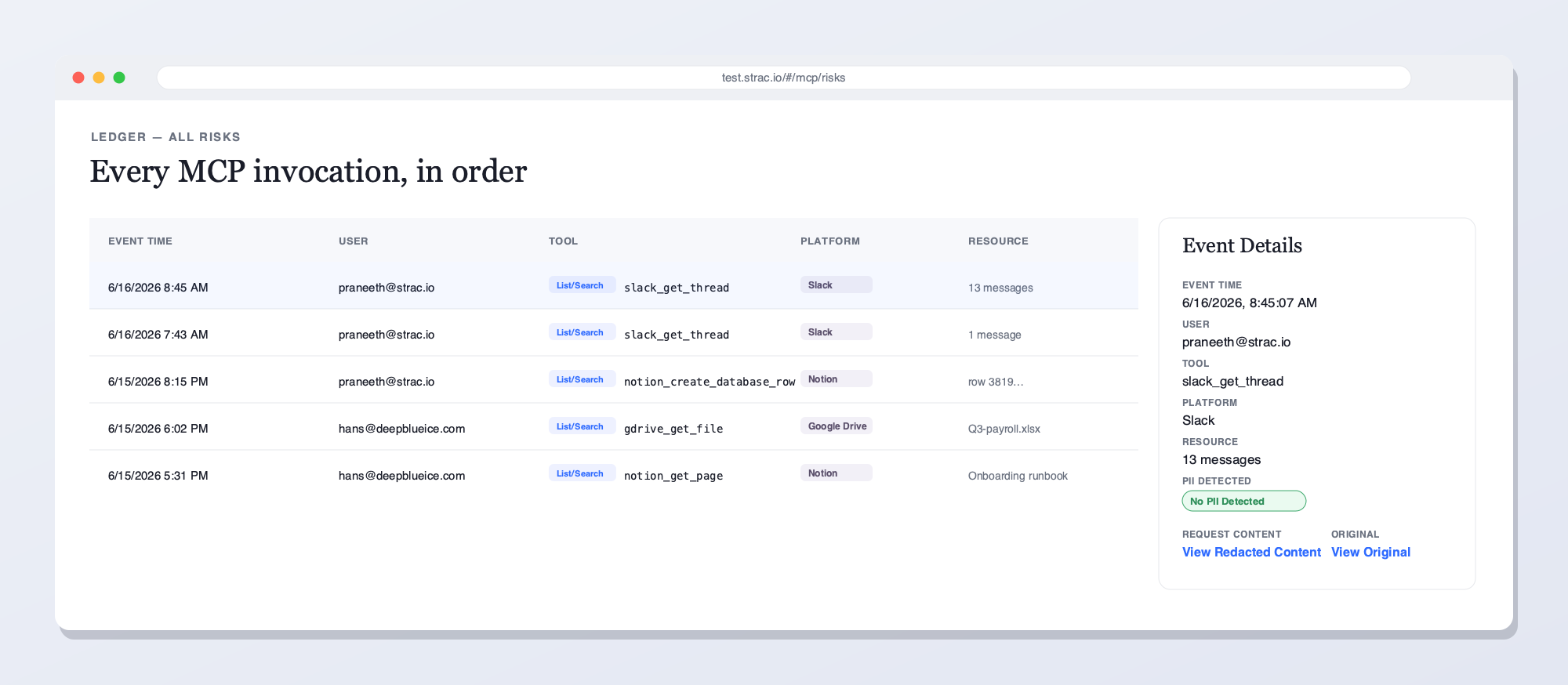
The Strac Stripe MCP DLP gateway intercepts every tool call between any AI agent (Claude, Cursor, ChatGPT, custom) and the Stripe MCP server. Card data, customer PII, and transaction history are redacted on the way in, and refunds and other money-moving writes are held for approval or blocked on the way out.Strac's live MCP Access console — every AI agent tool call touching Stripe and your other connected platforms, captured and inspected for sensitive data in real time. See what your LLMs reached for, who prompted, and what was flagged.Every MCP invocation in order — user, tool, platform, and the sensitive data found — with redacted vs. original content and a full audit trail. This is what Strac shows on Stripe that access-only gateways can't: the data in each call, not just the call.
Strac vs. access-only MCP gateways
A gateway that only governs access can tell you an agent called a Stripe tool — but not that the card numbers in a charge or invoice came back in the response. Strac inspects the content of every call, remediates the sensitive data — redact, mask, block, or delete — before the model sees it, and still logs the full access trail. You get access control and the data layer, in one place.
What Strac does on every Stripe tool call
One inline pass over each MCP response — five actions, enforced by your policy:
Detect — finds card numbers in a charge and any PII, PHI, PCI, secrets, or source code in the payload, including text inside images via OCR.
Redact or mask — replaces the sensitive elements inline, so the agent still gets its answer and the model never sees the raw data.
Block or require approval — stops a high-risk action like a refund or customer export, or routes it for sign-off before it runs.
Alert — notifies your team and streams the event to your SIEM (Datadog, Splunk, Chronicle) in real time.
Audit — logs who, which agent, which tool, what data, and the action taken — evidence mapped to SOC 2, HIPAA, GDPR, and ISO 42001.
Beyond redacting or blocking, Strac can also pseudonymize or de-identify the data on a Stripe MCP tool call — swapping PII, PHI, and PCI for realistic, format-preserving fakes — so a team can keep using the data in an AI model, analytics, or a test environment while the real records never leave your control. See Data Pseudonymization.
What this looks like in practice:
Read tools are filtered. When the agent calls list_customers, list_payment_intents, list_invoices, or fetch_stripe_resources, Strac inspects the returned payload, masks partial card data, redacts customer PII and bank identifiers, and tokenizes high-sensitivity fields inline before the agent reads them. The agent still reconciles and summarizes; the cardholder-adjacent data never enters the model context, and PCI scope stays contained.
Refunds and high-risk writes are gated. When the agent invokes create_refund, update_dispute, cancel_subscription, or create_invoice, Strac holds the call. Depending on policy, it requires a human approval (with the refund amount, customer, and reason surfaced for the approver), or it hard-blocks the action outright. A prompt-injected or hallucinated refund never reaches Stripe.
Files and structured data are inspected at depth. Invoice line items, customer metadata, and any attached documents are parsed with the same detection and OCR pipeline Strac runs across its DLP product line, so card numbers and identifiers hiding in free-text fields are found and handled.
Every invocation is logged. AI client, user, tool name, customer or charge accessed, data classes detected, redactions applied, vault references, approval decisions, and disposition. The log is the PCI DSS / SOC 2 / GDPR audit evidence — produced automatically.
Policy is contextual. Read tools, write tools, refund thresholds, and per-customer sensitivity each get their own rule. Strac maps to your existing data classification and your finance team's approval matrix, not an MCP-specific silo.
Two things matter past access when Stripe meets an agent. You control the enforcement — mask a card to its last four, tokenize a customer ID, apply a custom regex — driven by Strac's managed classifier rather than a self-hosted Presidio or Bedrock pipeline. And the same scrubbing protects the bespoke MCP tools your team builds on payment data for employees and customers, beyond the Stripe connector.
The same Strac MCP DLP layer covers Salesforce MCP, Slack MCP, and other surfaces — one control plane across every place AI agents touch your regulated and financial data. For the full pattern, see the MCP DLP pillar.
✨ Strac Native Stripe DLP — The Companion to MCP DLP
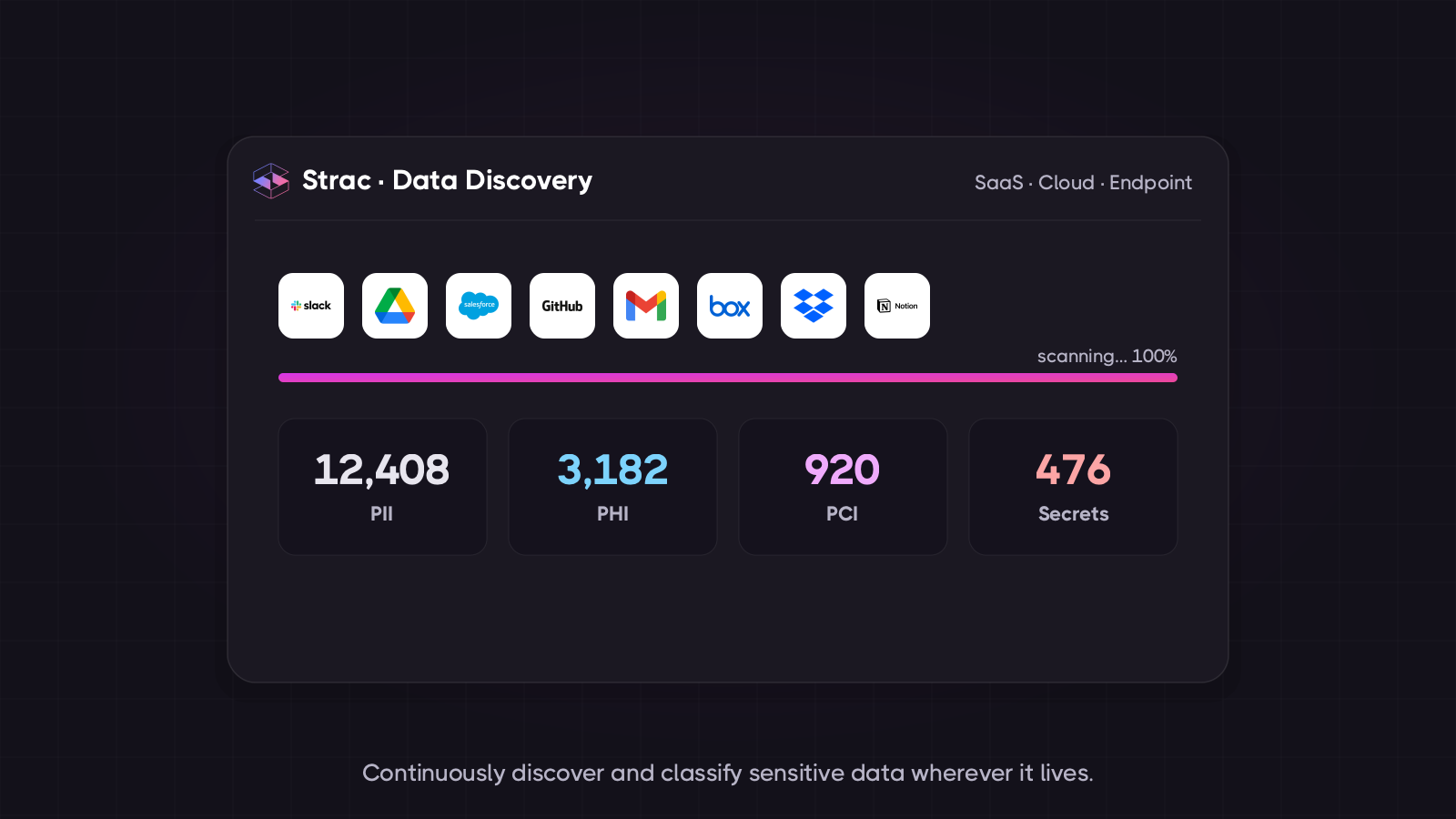
Strac natively discovers and classifies the regulated columns inside your Stripe billing data before any agent queries them — the companion to Stripe MCP DLP that maps where sensitive data lives.
MCP DLP protects the AI-agent surface. Strac's native Stripe and payments DLP protects the direct surface — the card and financial data scattered across the rest of your stack, inspected at the point where humans and systems store, share, and move it. Most fintechs and SaaS companies run both: native DLP for the data at rest and the user-driven actions, MCP DLP for the agent-driven actions. Together they cover every path cardholder-adjacent data can take.
What Strac's native financial-data DLP includes:
Continuous discovery and classification of full and partial card numbers (Luhn-validated), bank-account and routing data, and customer PII across your SaaS, cloud, email, and endpoints — not just Stripe
Vault-tokenization so a card number or bank identifier is replaced with a token while the workflow stays functional — the same vaulting that keeps systems out of PCI scope
Real-time monitoring of where payment data flows, with block/warn/redact policy enforcement at the egress points your team actually uses
Deep file inspection — PDFs, spreadsheets, and images, with OCR for scanned receipts, statements, and signed forms
Audit logs mapped per finding to PCI DSS v4.0.1, SOC 2 CC6, and GDPR
For the PCI program this sits inside, see PCI DSS compliance software. For the broader integration catalog — every SaaS, cloud, browser, and endpoint surface Strac covers — see strac.io/integrations.
✨ See Strac MCP DLP in Action
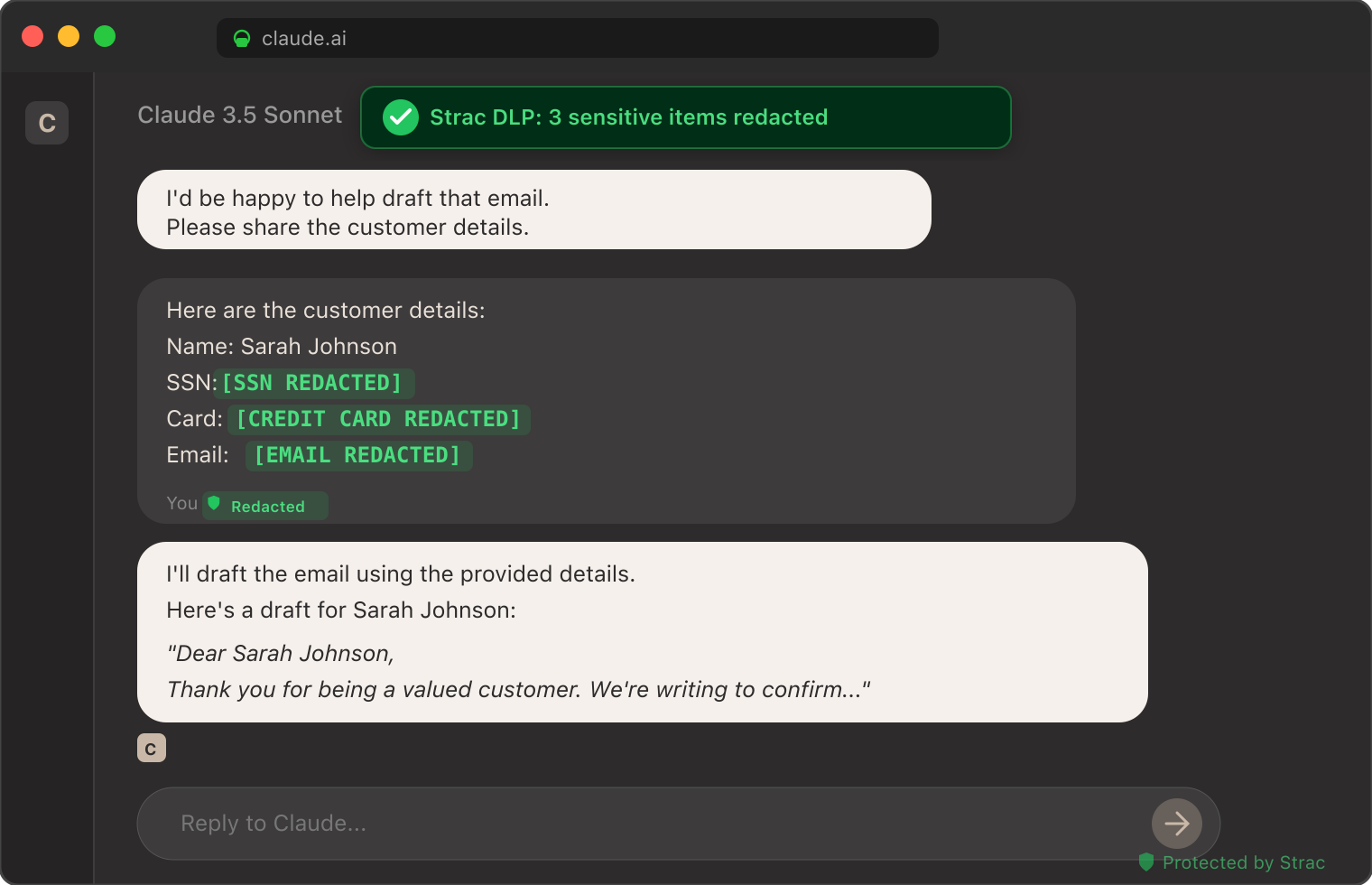
The screenshot below shows Strac's MCP DLP redacting sensitive data from a real Claude session — customer identifiers, emails, and card numbers tokenized inline before the model received the prompt. The same inspection pattern runs on every Stripe MCP tool call routed through Strac, with refunds and other money-moving writes held for approval on top of it.
Strac DLP at work inside a Claude conversation: sensitive elements tokenized inline before the model sees them. The same pattern runs at the MCP layer for every Stripe tool call.
How to Set Up Strac Stripe MCP DLP
Setup is agentless and takes under 10 minutes.
Authorize Strac with your Stripe account via OAuth (or a restricted API key). Strac requests only the scopes for the data and actions you want covered, and honors Stripe's permission model — it only sees what the authorizing account can see.
Configure the MCP gateway endpoint. Strac issues an MCP server endpoint that drops into your AI client's MCP configuration in place of the raw Stripe endpoint. For Claude Desktop:
json
   "mcpServers": {
     "stripe": {
       "url": "https://mcp.strac.io/stripe",
       "auth": { "type": "bearer", "token": "<your-strac-token>" }
     }
   }
For Cursor, OpenAI Agents, and custom agents — same endpoint, same auth.
Pick your policy. Out-of-the-box templates for PCI DSS, SOC 2, and GDPR. Set refund and write approval thresholds, choose which read fields are masked versus tokenized, and define per-customer sensitivity in minutes.
Done. Every MCP tool call between your agent and Stripe now flows through the Strac gateway — reads filtered, refunds and high-risk writes gated, every call logged. No application code changes. No agent code changes. The audit log starts populating immediately.
Compliance Coverage Out of the Box
The same Strac Stripe MCP DLP control produces evidence mapped to every major compliance framework — with PCI DSS and GDPR as the spine for a payments surface.
Framework
What Strac Stripe MCP DLP Satisfies
PCI DSS v4.0.1
Req. 3.3 / 3.4 (PAN masking and rendering unreadable), Req. 4.x (encryption in transit to the AI client), Req. 7 (least privilege over read and refund actions), Req. 10 (log every access and every money-moving write)
GDPR
Art. 5 (purpose limitation and data minimization over customer payment data), Art. 25 (privacy by design), Art. 30 (records of processing), Art. 32 (security of processing)
SOC 2
CC6.6 (unauthorized data exposure), CC6.7 (restricted transmission of data to external systems), CC7.2 (monitoring for anomalies including AI usage)
HIPAA
§164.312(b) (audit controls), §164.502(b) (minimum necessary) — where payment records intersect with health billing
EU AI Act
Art. 10 (data governance for high-risk AI systems)
ISO/IEC 42001
Clause 6.1.4 (risk treatment), Clause 8.4 (operational controls), Annex A.7 (data for AI systems)
For the broader AI-data-governance program this sits inside, see DSPM for AI and AI DLP.
🌶️ Spicy FAQs for Stripe MCP Server
What is the Stripe MCP server?
The Stripe MCP server is a Model Context Protocol implementation, hosted by Stripe at mcp.stripe.com, that lets AI agents (Claude, Cursor, ChatGPT, Perplexity, custom agents) read and act inside your Stripe account via standardized tool calls. It covers customers, charges, PaymentIntents, invoices, subscriptions, payouts, balance, and disputes — and write tools including creating customers and invoices and issuing refunds.
Is the Stripe MCP connector the same as the Stripe MCP server?
Two names for one component. The MCP spec says server; Claude and Cursor list it as the Stripe connector. It reaches the same customers, charges, and payouts under either name, and Strac's Stripe MCP connector masks cardholder-adjacent and customer data on every call.
Stripe MCP vs Stripe's built-in AI — what's the difference?
Stripe's built-in AI features run inside Stripe's own boundary — workflows and assistance that operate on your data within Stripe's native controls and stay under its guardrails. The Stripe MCP server points the other direction: it exposes Stripe to external agents (Claude, Cursor, ChatGPT, custom) over the open Model Context Protocol, so the AI client your team already uses can read payments and issue refunds in Stripe. The built-in features keep the data inside Stripe; MCP lets any agent reach in, and both the financial data and the money-moving actions leave Stripe's guardrails the moment the tool call crosses to the client. That hand-off is exactly where Strac Stripe MCP DLP inspects, redacts, and gates.
Does the Stripe MCP server put me in PCI DSS scope?
It can expand it. The read tools return cardholder-adjacent data — partial card numbers, BINs, brand, expiry, bank identifiers — and the moment that flows to an external AI model without masking, the AI client and its context become part of your assessment surface. Strac keeps that contained: card and bank data is masked or tokenized before it reaches the model, so the agent works the records without pulling cardholder data into PCI scope, and every access is logged for Req. 10.
Can an AI agent actually issue a refund through Stripe MCP?
Yes — create_refund is a write tool in the Stripe MCP catalog, and an agent with the right scope can fire it. That's the single highest-risk action on the surface: a prompt-injection payload in a dispute note, a hallucinated tool plan, or an over-broad instruction can push a refund that should never have gone out. Strac holds create_refund (and update_dispute, cancel_subscription, and other money-moving writes) for human approval or hard-blocks it by policy, so no automated or injected refund reaches Stripe unreviewed.
Is the Stripe MCP server safe to use with financial data?
By itself, not for production payments without an added control layer. The server honors the authorizing account's permissions but returns whatever that account can see — full transaction history, customer PII, partial card data — and lets agents move money. For regulated payment use you need an MCP-layer governance control like Strac Stripe MCP DLP that redacts financial data on reads and gates refunds and writes before they execute.
How is Strac Stripe MCP DLP different from Stripe's built-in protections?
Stripe's built-in protections — Radar, dashboard permissions, API-key restrictions — operate inside Stripe and on inbound payments. None of them sit in the MCP tool-call path or inspect what flows out to an AI model. Strac is purpose-built for the MCP layer: it inspects every tool response before content reaches the agent's context window, with detection breadth (card data, PII, bank identifiers, OCR-in-documents) beyond a native rule engine, and it adds an approval gate on refunds and high-risk writes that Stripe's API does not provide.
Does Strac Stripe MCP DLP work with Claude, Cursor, ChatGPT, and custom agents?
Yes. Strac exposes a standard MCP endpoint, so any MCP-aware AI client routes tool calls through it with one configuration change. No SDK changes, no application code changes.
What sensitive data types does Strac detect in Stripe MCP tool responses?
Full and partial card numbers (Luhn-validated), card brand / BIN / expiry, bank account and routing identifiers, customer PII (name, email, billing address, phone), and credentials or secrets hiding in metadata and free-text fields — across text, structured fields, and attached documents (with OCR). Custom detectors can be trained on your internal data classifications.
Where does masked data go — is it stored?
Masked content is replaced inline in the tool response. Optionally, sensitive values are vaulted — replaced with a short-lived retrieval link only authorized users can resolve — so a card number or bank identifier is retrievable for legitimate use without ever entering the AI context. Vaulted data is stored encrypted at rest in your Strac tenant; you control retention. This is the same vault-tokenization pattern that keeps systems out of PCI scope.
Can I see what an AI agent did in my Stripe account?
Yes. Strac produces a per-call audit log: timestamp, AI client identity, user, tool invoked, customer or charge accessed, data classes detected, redactions applied, vault references, approval decisions on refunds and writes, and disposition. The log is queryable in the Strac console and exportable to your SIEM — the evidence trail PCI DSS, SOC 2, and GDPR auditors will ask about for AI-agent activity in Stripe.
Strac ties every Stripe tool call to the individual user, so Stripe enforces its API-key and role scopes exactly as it would in the UI — and Strac inspects the tool results for injected instructions before the model ever acts on them. Strac protects the cardholder data and PII on the way through and proves per-user access in the audit log — identity to prevent retrieval, DLP to protect what's allowed.
The Bottom Line
The Stripe MCP server is rapidly becoming the way AI agents read into — and act inside — your payments stack. That surface holds cardholder-adjacent data, customer PII, and full transaction history, and it hands agents the ability to move real money through refunds and dispute updates. Running Stripe MCP in 2026 without an MCP-layer governance control is not a question of if the first un-reviewed refund or PCI exposure reaches your team; it's when.
Strac Stripe MCP DLP gives you the inspection layer on reads, the approval gate on refunds and high-risk writes, the audit evidence, and the PCI- and GDPR-anchored compliance coverage — so you can let your team use Stripe with Claude, Cursor, ChatGPT, and any future AI client without making each one a separate security exception.
If you are running — or about to run — Stripe MCP in production, book a 30-minute demo. We'll walk through the architecture, the refund-approval policy templates, and a deployment plan for your specific Stripe account and AI clients.
The Stripe MCP server is a Model Context Protocol implementation, hosted by Stripe at mcp.stripe.com, that lets AI agents (Claude, Cursor, ChatGPT, Perplexity, custom agents) read and act inside your Stripe account via standardized tool calls. It covers customers, charges, PaymentIntents, invoices, subscriptions, payouts, balance, and disputes — and write tools including creating customers and invoices and issuing refunds.
Is the Stripe MCP connector the same as the Stripe MCP server?
Two names for one component. The MCP spec says server; Claude and Cursor list it as the Stripe connector. It reaches the same customers, charges, and payouts under either name, and Strac's Stripe MCP connector masks cardholder-adjacent and customer data on every call.
Stripe MCP vs Stripe's built-in AI — what's the difference?
Stripe's built-in AI features run inside Stripe's own boundary — workflows and assistance that operate on your data within Stripe's native controls and stay under its guardrails. The Stripe MCP server points the other direction: it exposes Stripe to external agents (Claude, Cursor, ChatGPT, custom) over the open Model Context Protocol, so the AI client your team already uses can read payments and issue refunds in Stripe. The built-in features keep the data inside Stripe; MCP lets any agent reach in, and both the financial data and the money-moving actions leave Stripe's guardrails the moment the tool call crosses to the client. That hand-off is exactly where Strac Stripe MCP DLP inspects, redacts, and gates.
Does the Stripe MCP server put me in PCI DSS scope?
It can expand it. The read tools return cardholder-adjacent data — partial card numbers, BINs, brand, expiry, bank identifiers — and the moment that flows to an external AI model without masking, the AI client and its context become part of your assessment surface. Strac keeps that contained: card and bank data is masked or tokenized before it reaches the model, so the agent works the records without pulling cardholder data into PCI scope, and every access is logged for Req. 10.
Can an AI agent actually issue a refund through Stripe MCP?
Yes — create_refund is a write tool in the Stripe MCP catalog, and an agent with the right scope can fire it. That's the single highest-risk action on the surface: a prompt-injection payload in a dispute note, a hallucinated tool plan, or an over-broad instruction can push a refund that should never have gone out. Strac holds create_refund (and update_dispute, cancel_subscription, and other money-moving writes) for human approval or hard-blocks it by policy, so no automated or injected refund reaches Stripe unreviewed.
Discover & Protect Data on SaaS, AI, MCP, Endpoints & Cloud
Strac provides end-to-end data loss prevention for all SaaS and Cloud apps. Integrate in under 10 minutes and experience the benefits of live DLP scanning, live redaction, and a fortified SaaS environment.


.webp)






.avif)



.gif)
