Shadow IT & Shadow AI: The Third-Party Risk You Can't See
Shadow IT and shadow AI are the fastest-growing third-party risk — unsanctioned tools with quiet access to your data. Here's why traditional TPRM misses them and how to discover and govern them.
Shadow IT (unsanctioned SaaS) and shadow AI (unsanctioned AI tools) are third parties — they just never went through procurement, so traditional TPRM never sees them.
They're often your highest-access, lowest-oversight vendors: an AI note-taker in every meeting, ChatGPT with pasted customer data, a niche tool with an API key into your CRM.
You can't questionnaire your way out of this — you can't assess a vendor you don't know exists. The fix has to start from what's actually happening to your data.
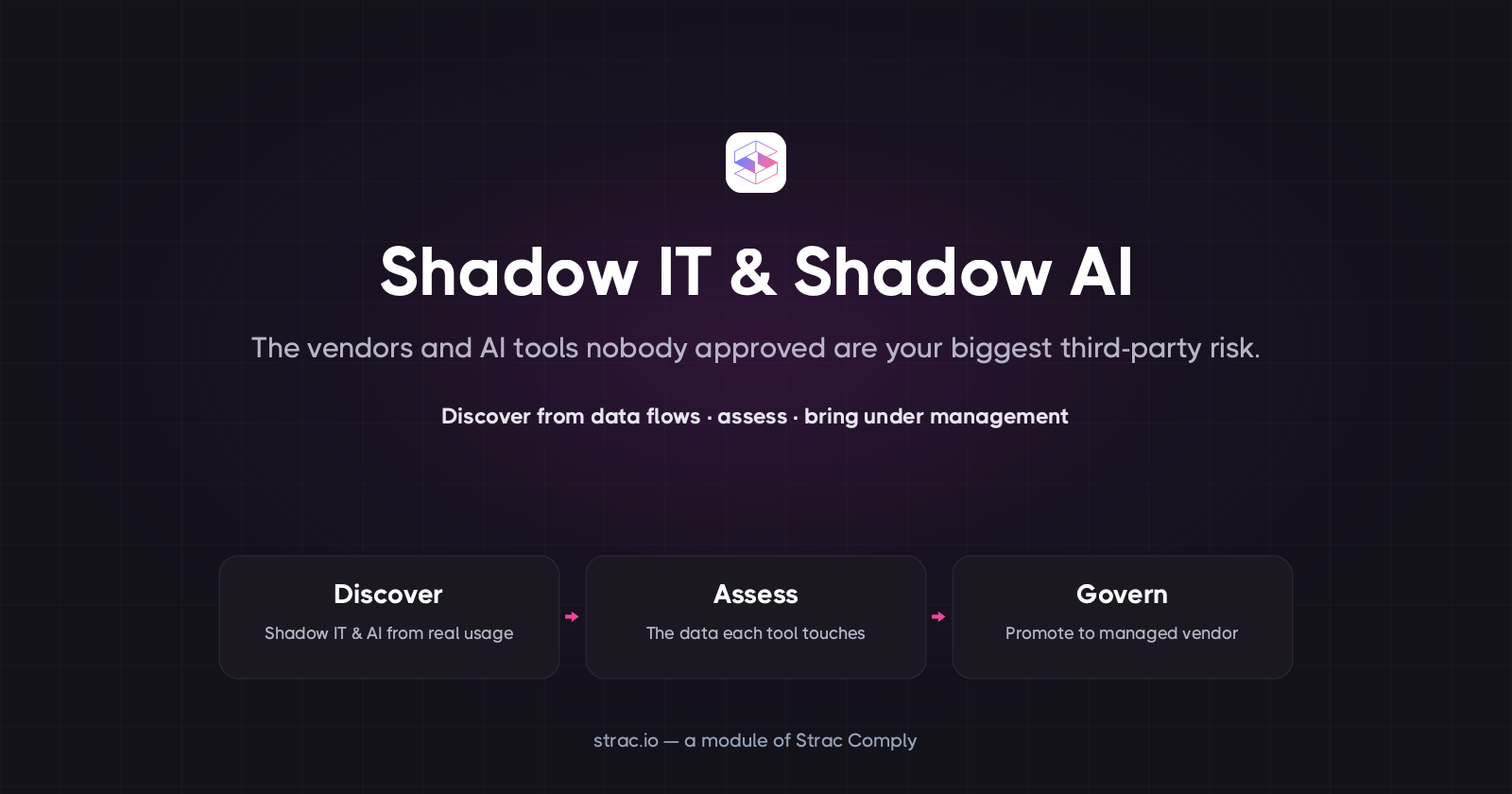
Strac discovers shadow IT and shadow AI from real data flows, shows what each tool touches, and lets you promote any of them to a managed vendor with a full review.
Getting this right is where third-party risk management and AI governance meet.
Shadow IT and Shadow AI Are Third-Party Risk
When security teams think about third-party risk, they picture the vendors on the procurement list — the ones with contracts, questionnaires, and a SOC 2 on file. But every unsanctioned tool an employee signs up for is also a third party. It has access to your data, it runs on someone else's infrastructure, and it can be breached. The only difference is that no one reviewed it.
That's shadow IT (SaaS apps adopted without IT's knowledge) and increasingly shadow AI (AI tools adopted without anyone's approval). They're not a separate problem from third-party risk management — they're the part of it that's invisible.
Why Shadow AI Is the Sharpest Edge
Shadow IT has been around for a decade. Shadow AI is newer, faster-spreading, and riskier, for three reasons:
It's trivially easy. Any employee can paste a customer list, a contract, or source code into a chatbot in seconds — no install, no approval, no trace.
The data leaves. Unlike a SaaS app that stores your data, a GenAI tool may use it in ways you can't see — and once sensitive data is in a third-party model's context, you've lost control of it.
It's everywhere. AI note-takers join meetings, AI coding assistants read repositories, AI browser extensions watch every page. Each is a third party with quiet, broad access — and almost none are on a vendor list. The data-leak risk from shadow AI is now one of the top concerns for security teams.
A vendor questionnaire can't help here, because there's no vendor in your system to send it to.
Why Traditional TPRM Misses Them
Most TPRM tools are questionnaire-first: someone manually adds a vendor, sends an assessment, and files the response. That model assumes you already know every third party. Shadow IT and shadow AI break that assumption by definition — they're the ones not on the list.
Some tools attempt basic discovery from SSO logs or expense reports. That helps with sanctioned-but-unmanaged apps, but it misses the tools employees use with a personal login or a free tier, and it tells you nothing about what data those tools actually touch. To catch shadow IT and AI, discovery has to start from the data itself.
✨ How to Discover and Govern Shadow IT & AI
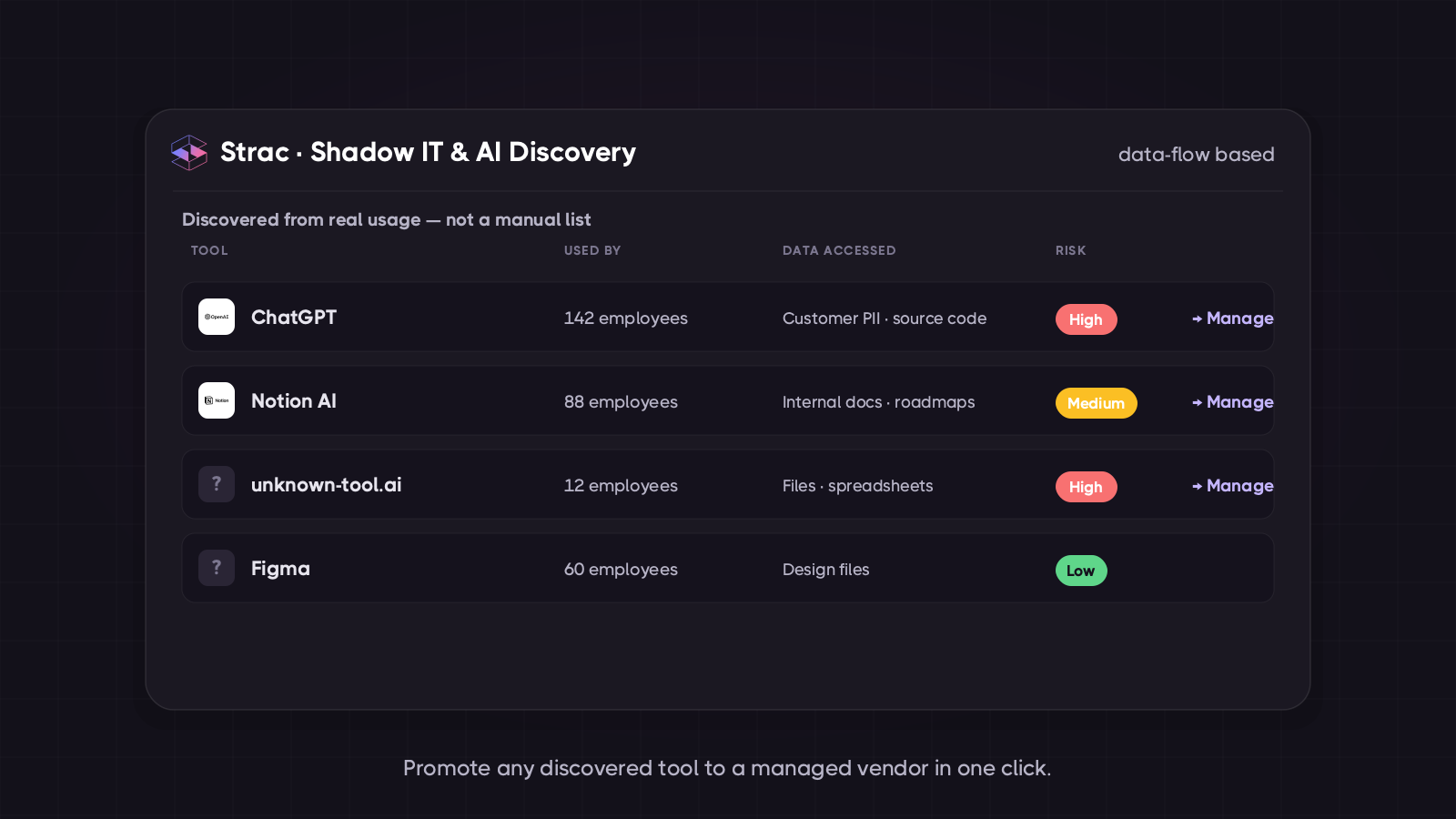
Strac approaches the problem from the data layer up. Because Strac's TPRM module sits on a data-security platform, it sees the real flows — which tools and AI services your data is actually moving to, who's using them, and what kind of data is involved.
That produces a live inventory you couldn't get any other way: ChatGPT used by 142 people touching customer PII and source code; an unknown AI tool used by a dozen, accessing files no one reviewed. Each one gets a risk rating grounded in the data it touches — not a guess. When something is risky, you promote it to a managed vendor in one click and run the full security review, AI assessment, and document collection.
This is the same detection engine behind Strac's GenAI and MCP data security, applied to the vendor problem — which is why discovering shadow AI and governing it land in the same place.
A Playbook for Bringing Shadow Tools Under Control
You don't have to block everything — most shadow tools are adopted because they're useful. The goal is visibility and governance, not prohibition:
Discover continuously. Find shadow IT and AI from real usage, not a one-time survey.
Triage by data exposure. A tool touching customer PII is a very different risk than one touching public marketing copy. Prioritize accordingly.
Sanction or manage. Approve the useful tools and bring them under management; block or replace the risky ones.
Guardrail the rest. For AI tools, redact sensitive data before it reaches the model so employees can keep working safely — the core of AI data security.
Re-scan. Shadow tools reappear; discovery has to be ongoing.
Shadow AI is shadow IT’s faster, riskier cousin — and the same blind spot hides both. Strac’s endpoint agent surfaces the unsanctioned AI tools and apps reaching your data, so the third-party risk you couldn’t see becomes a list you can act on.
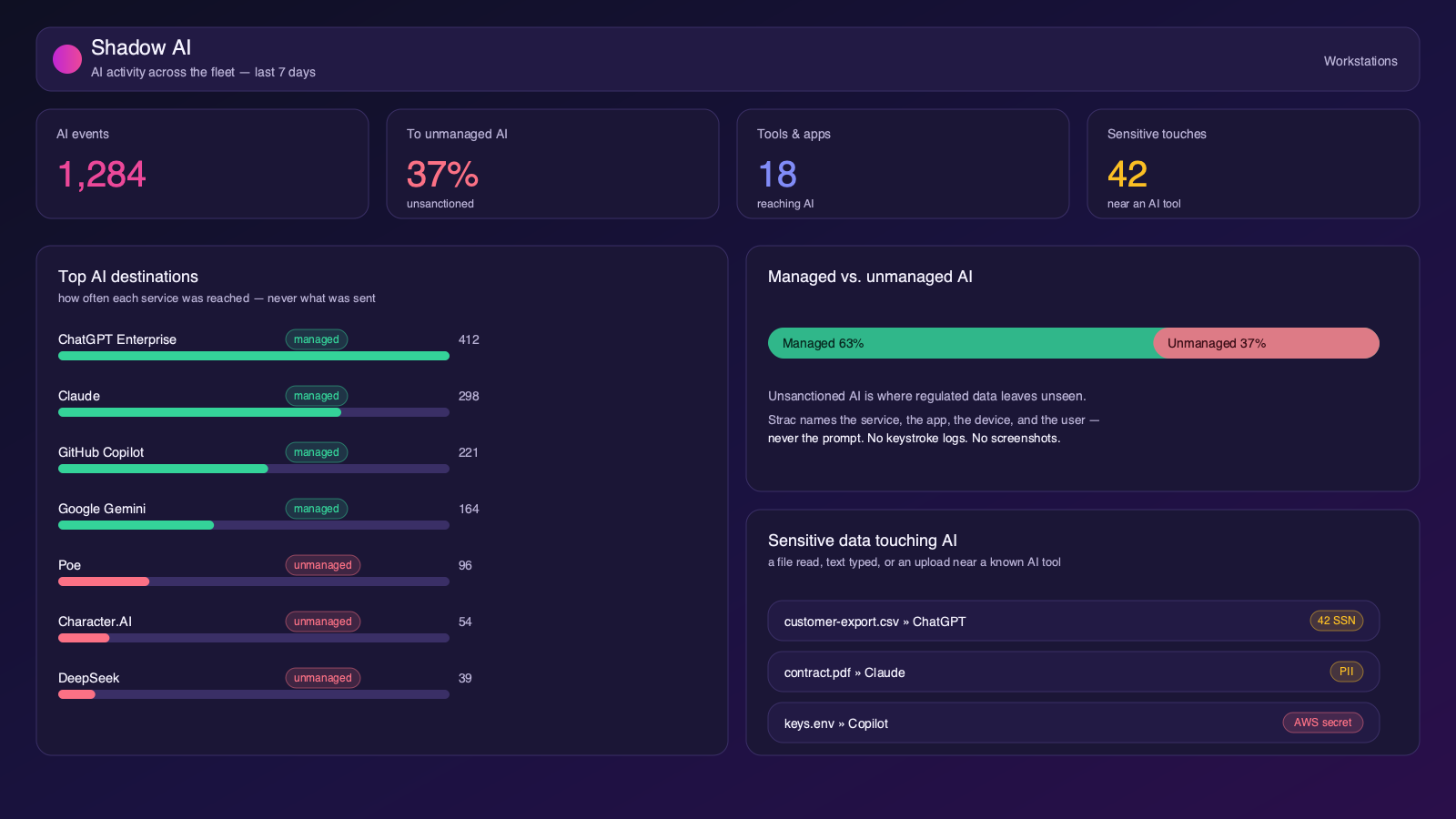
Strac Shadow AI: which services the fleet reaches, managed vs. unmanaged, and sensitive data touching AI — never the prompt.
Discover, govern, and control shadow AI from one agent. More on the Shadow AI hub.
🌶️ Spicy FAQs for Shadow IT & Shadow AI Third-Party Risk
How do you detect shadow AI? On the endpoint. Strac watches which AI services each device reaches — browser and desktop — names managed vs. unmanaged tools, and flags when sensitive data comes near them, without reading prompts or logging keystrokes.
Is shadow IT a third-party risk?
Yes. Any unsanctioned SaaS app is a third party with access to your data and systems — it just never went through review. That makes shadow IT a core part of third-party risk management.
What is shadow AI?
Shadow AI is AI tools used without approval — ChatGPT, AI note-takers, coding assistants, browser extensions. Because they can ingest sensitive data and send it to third-party models, they're often the highest-risk, least-governed third parties in a company.
Why does traditional TPRM miss shadow IT and AI?
Most TPRM tools are questionnaire-first and only manage vendors someone manually adds. You can't assess a tool you don't know exists, and SSO/expense-based discovery misses free-tier and personal-login usage.
How do you discover shadow AI?
By monitoring real data flows across SaaS, cloud, browser, and endpoints. Strac discovers shadow AI from actual usage and shows what data each tool touches, so you can govern it.
How do you reduce shadow AI risk without blocking AI?
Redact sensitive data before it reaches the AI tool, so employees keep the productivity without the exposure — then bring the useful tools under management. See Strac's GenAI data security.
Where do TPRM and AI governance overlap?
Exactly here. Shadow AI is both a third-party risk and an AI-governance problem, and discovering it from the data layer solves both at once.
The vendors most likely to cause your next data incident aren't on your vendor list — they're the shadow IT and shadow AI tools your team adopted without anyone reviewing them. Traditional TPRM can't see them, because it starts from a list instead of from your data.
Strac starts from the data: it discovers shadow IT and AI from real flows, scores each by what it touches, and lets you bring any of them under management — all inside Strac Comply. Book a demo and we'll show you the shadow tools already touching your sensitive data.
Is shadow IT a third-party risk?
Yes. Any unsanctioned SaaS app is a third party with access to your data and systems — it just never went through review. That makes shadow IT a core part of third-party risk management.
What is shadow AI?
Shadow AI is AI tools used without approval — ChatGPT, AI note-takers, coding assistants, browser extensions. Because they can ingest sensitive data and send it to third-party models, they're often the highest-risk, least-governed third parties in a company.
Why does traditional TPRM miss shadow IT and AI?
Most TPRM tools are questionnaire-first and only manage vendors someone manually adds. You can't assess a tool you don't know exists, and SSO/expense-based discovery misses free-tier and personal-login usage.
How do you discover shadow AI?
By monitoring real data flows across SaaS, cloud, browser, and endpoints. Strac discovers shadow AI from actual usage and shows what data each tool touches, so you can govern it.
How do you reduce shadow AI risk without blocking AI?
Redact sensitive data before it reaches the AI tool, so employees keep the productivity without the exposure — then bring the useful tools under management. See Strac's GenAI data security.
Discover & Protect Data on SaaS, AI, MCP, Endpoints & Cloud
Strac provides end-to-end data loss prevention for all SaaS and Cloud apps. Integrate in under 10 minutes and experience the benefits of live DLP scanning, live redaction, and a fortified SaaS environment.


.webp)



.avif)



.gif)
