October 29, 2026

5
min read
Data Loss Prevention (DLP) for ChatGPT, Gemini and LLM (Generative AI)
Learn why you need a Data Loss Prevention (DLP) solution for ChatGPT, Gemini/Google Bard, LLM Models, Generative AI
In the rapidly evolving digital age, generative AI technologies like ChatGPT and Google's Bard (or Gemini) are reshaping the boundaries of creativity, efficiency, and interaction. As these advanced tools become integral to businesses, the imperative to safeguard sensitive information against potential security threats has never been more critical. Strac, standing at the forefront of AI Data Loss Prevention (DLP), offers innovative solutions to navigate these challenges. This blog post delves into the security risks associated with generative AI, highlighting Strac's pivotal role in ensuring data integrity and compliance across various platforms.
✓ Strac is a listed Anthropic Claude Compliance API partner
Generative AI, through its expansive learning capabilities, has the potential to streamline operations, foster innovation, and enhance customer engagement. However, this technological marvel comes with its share of data security risks, including data leaks, breaches, and non-compliance with stringent data privacy laws. The very nature of Large Language Models (LLMs) like ChatGPT and Gemini, which learn from user inputs, presents a latent risk of inadvertently exposing sensitive information. Whether it's confidential details of a pending merger, proprietary software code, or personally identifiable information (PII), the misuse or unauthorized disclosure of such data could have far-reaching implications for businesses, including legal penalties and reputational damage.
Strac offers a comprehensive suite of DLP solutions tailored for ChatGPT, mitigating risks and enhancing data security. Key features include:


While Strac extends its DLP solutions to ChatGPT, it also encompasses services for Google's Bard or Gemini, ensuring a robust data protection framework irrespective of the platform. By implementing similar DLP strategies, Strac guarantees that businesses using Bard or Gemini can also benefit from real-time data security monitoring, automated sensitivity analysis, and configurable remediation actions, ensuring that their interactions with these LLMs are secure, compliant, and efficient.
The core of Strac's DLP strategy lies in its ability to seamlessly integrate with LLMs, offering a protective layer that shields sensitive data from exposure.
Strac's cutting edge APIs integrate with any third party partner or LLM model and can detect/block sensitive data present in LLM model. It does via its innovative proxy pattern.
Check out the API Docs: https://docs.strac.io/#operation/outboundProxyRedact

Generative AI poses risks such as data leaks, breaches, and non-compliance with privacy laws due to its learning capabilities from user inputs, making it crucial to safeguard sensitive information.
Real-time access control and robust data policies, along with Strac's comprehensive AI DLP solutions for ChatGPT/Google Gemini or LLM Models, are pivotal in protecting sensitive data within generative AI platforms.
It's prudent to assume so and take necessary precautions, including using DLP solutions like Strac to limit what data can be shared with these platforms. Read our blog post on Does ChatGPT Save Data?
Related reading:
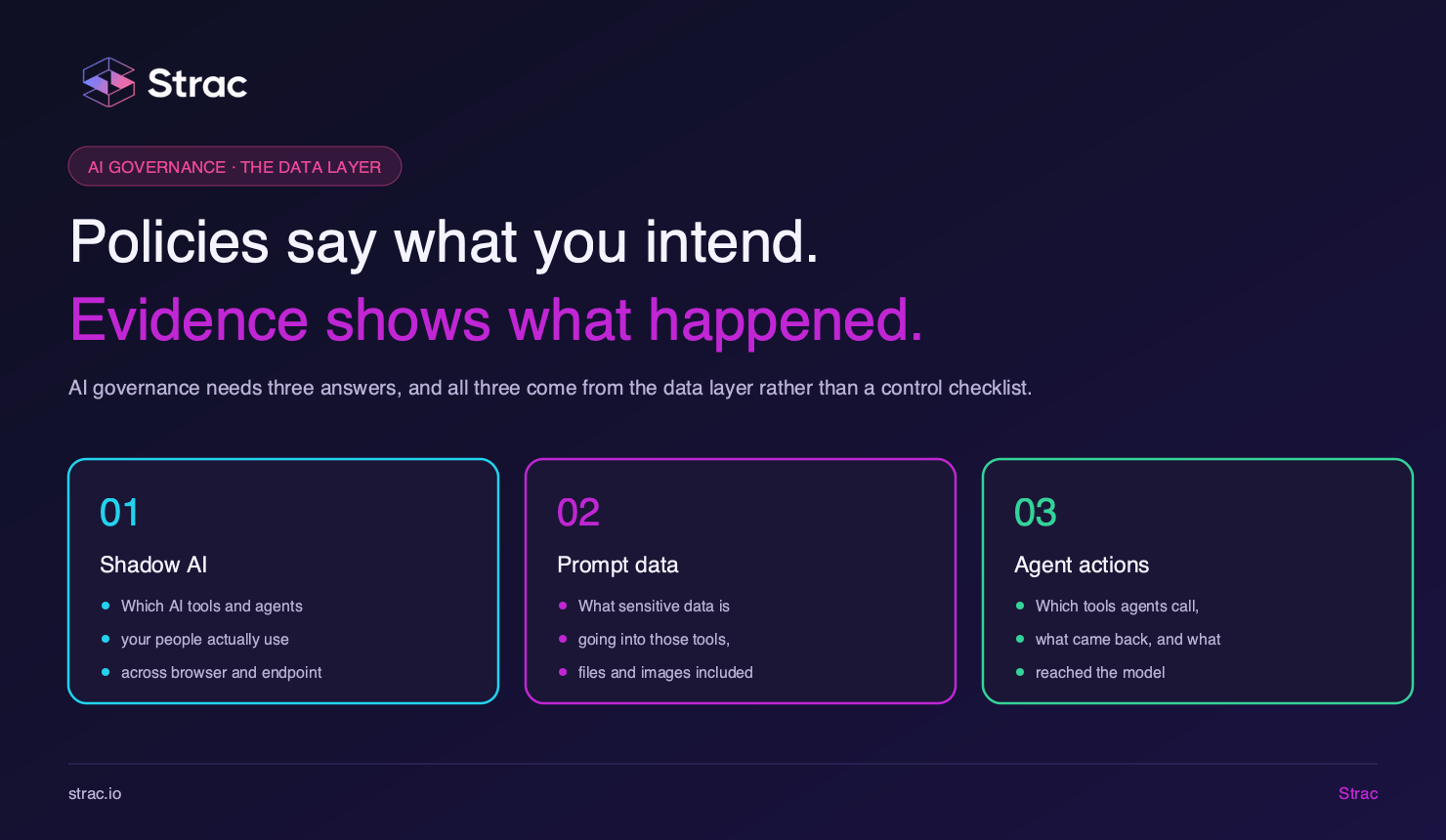
Strac does not depend on any single AI vendor’s API. It governs the data layer in three places, the browser extension, the Mac and Windows endpoint agent, and MCP DLP, so it inspects, redacts, blocks, warns, or audits sensitive data going into any AI tool, whether someone uses it on the web, in a desktop app, or through an AI agent. Here is how that maps to the tools teams actually use.

| AI tool | Where people use it | How Strac covers it |
| Anthropic Claude | Claude.ai, Claude Desktop, Claude Code, Claude Cowork | Native Claude DLP, browser, endpoint, and MCP. Strac is a listed Anthropic Claude Compliance API partner. |
| OpenAI ChatGPT and Codex | Web, desktop, mobile, and the Codex CLI and agents | Native ChatGPT DLP, plus browser, endpoint, and MCP DLP. |
| Microsoft Copilot | Microsoft 365 Copilot, GitHub Copilot, Copilot in Edge | Microsoft Copilot DLP across browser and endpoint. |
| Google Gemini | Gemini on the web and in Google Workspace | Browser extension and endpoint agent. |
| Perplexity | Perplexity on the web and desktop | Browser extension and endpoint agent. |
| Coding agents | Cursor, Claude Code, Codex and other MCP clients | MCP DLP controls what each agent can pull. |
| Any other AI tool | Grok, DeepSeek, Mistral Le Chat, Meta AI, Notion AI, Glean, and new tools | The browser extension and endpoint agent are tool-agnostic, so new tools are covered on day one. |
Whether an employee pastes into a chat box, uploads a file, or an AI agent pulls data over MCP, Strac applies the same block, warn, allow, or audit controls. No per-vendor rollout, and no waiting for an integration before a new AI tool is covered.
Yes, reviewing and updating data security policies to address the unique challenges posed by generative AI is essential for maintaining data integrity and compliance.
Please checkout Strac DLP for ChatGPT/Google Gemini or Strac DLP for LLM Models,
In conclusion, as businesses navigate the complexities of integrating generative AI into their operations, partnering with a seasoned DLP provider like Strac becomes indispensable. By leveraging Strac's comprehensive suite of data protection solutions, businesses can confidently harness the power of generative AI while ensuring their data security posture remains robust and compliant.

“Don’t just alert on problems, fix them.”
Scott Roberts, Chief Information Security Officer, UiPath









Customers include