How to manage the cybersecurity risk your vendors bring — supply-chain attacks, vendor breaches, the security assessment, and continuous monitoring grounded in the data each vendor can actually reach.
Cybersecurity third-party risk management is the security-team's slice of TPRM: managing the cyber risk that vendors, suppliers, and SaaS/AI tools introduce to your environment.
It matters because most breaches now have a third party in the blast radius — a vendor's compromise becomes your incident, and the data they can reach defines how bad it gets.
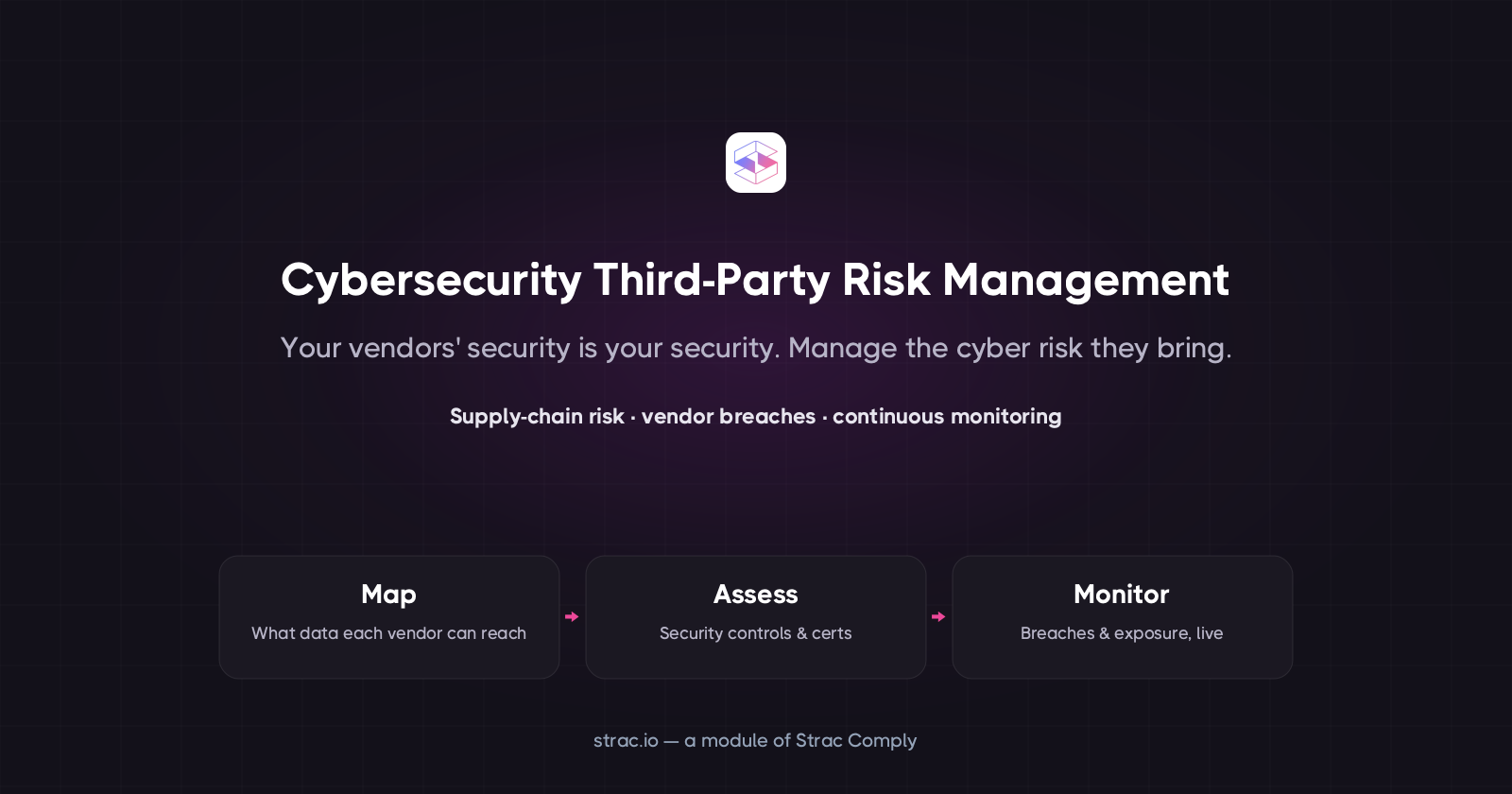
The core work: map what each vendor can access, assess their security controls and certifications, and continuously monitor for breaches and changes.
The weakness in most programs is that risk is scored on questionnaires, not on the data a vendor can actually reach. Strac grounds cyber risk in real data exposure — and discovers the shadow tools attackers love.
Cybersecurity TPRM is also required by SOC 2, ISO 27001, and the SEC's Reg S-P.
What Is Cybersecurity Third-Party Risk Management?
Cybersecurity third-party risk management is the practice of identifying and controlling the security risk that external parties bring to your organization. It's the security-focused subset of broader third-party risk management: where TPRM also covers financial, operational, and ESG risk, the cybersecurity lens zeroes in on one question — if this vendor is compromised, what happens to our data and systems?
Every vendor with an API key, a login, a network connection, or access to your customer data extends your attack surface. Cybersecurity TPRM is how you keep that surface from quietly growing beyond what you can defend.
Why Vendor Cyber Risk Is Rising
Three trends have pushed third-party cyber risk to the top of the security agenda:
Supply-chain attacks. Attackers increasingly target a single vendor to reach all of its customers at once — one compromise, hundreds of victims. Your security is now only as strong as your weakest vendor's.
SaaS sprawl. The average company runs hundreds of SaaS apps, each with some access to data. Every new integration is a new door.
Shadow AI. Employees feed sensitive data into AI tools that were never reviewed — often the highest-access, lowest-oversight third parties in the company. This is the fastest-growing blind spot in AI data security.
The common thread: the risk isn't just that you use a vendor — it's what data that vendor can reach. That's the number most programs never actually measure.
The Three Jobs of Cybersecurity TPRM
A strong program does three things well:
1. Map the blast radius. For every third party, know exactly what data and systems it can access. This defines your worst case if the vendor is breached.
2. Assess the controls. Evaluate the vendor's security posture — SOC 2 or ISO 27001 certification, pen-test results, encryption, access controls, and incident response — sized to the vendor's risk tier.
3. Monitor continuously. Watch for the vendor's own breaches, expiring certifications, and changes in the access they hold — because a point-in-time review goes stale fast.
Most teams do step 2 (the questionnaire) and skip the bookends. But step 1 is what tells you which vendors actually matter, and step 3 is what catches the breach before it becomes your problem.
✨ Grounding Cyber Risk in Real Data Exposure
Here's the gap: a security questionnaire tells you what a vendor claims about its controls. It doesn't tell you what data that vendor can actually reach inside your environment — which is the thing that determines your real exposure.
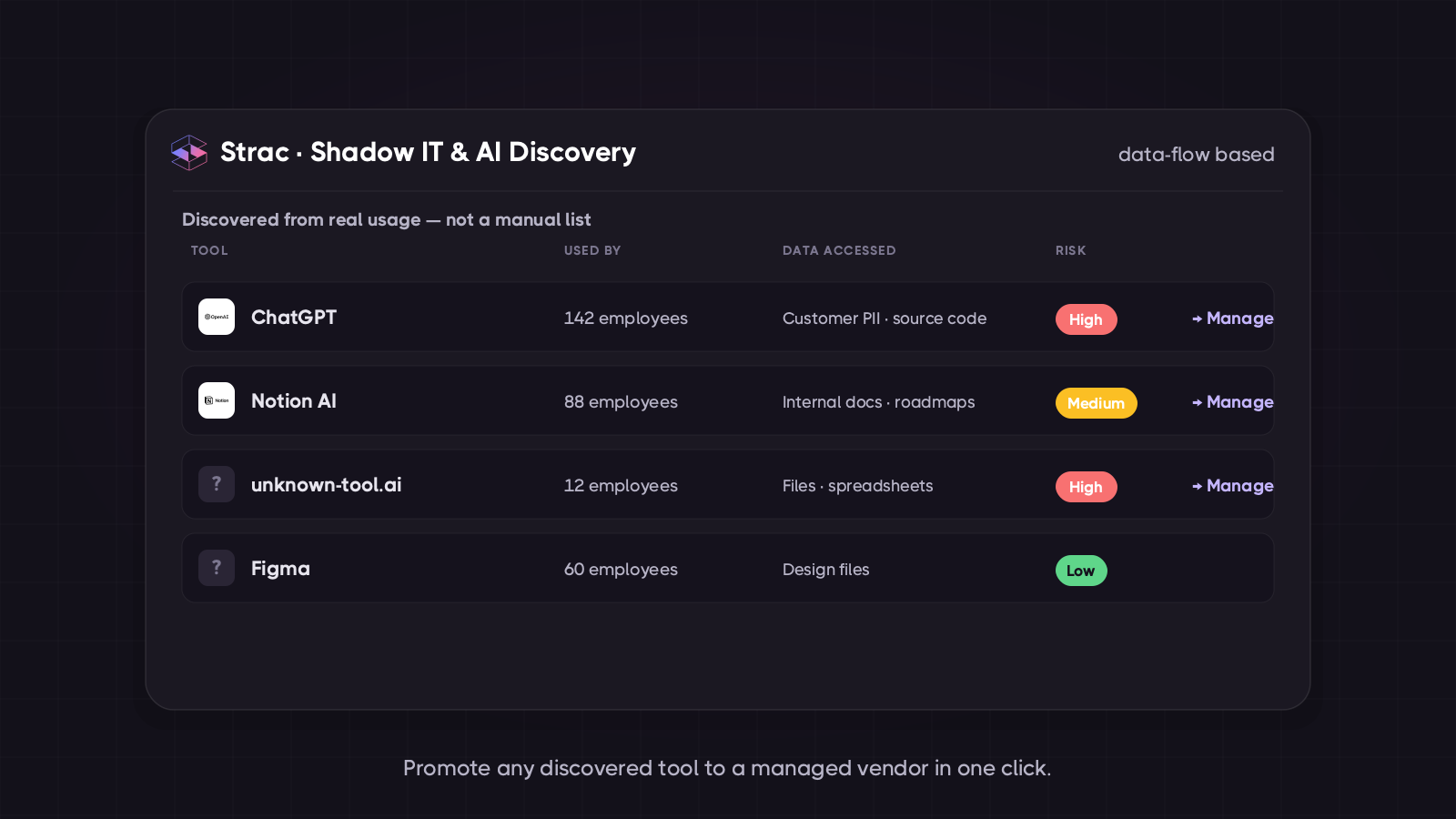
Because Strac's TPRM module sits on a data-security layer, it sees the actual flows: which vendors and AI tools touch customer PII, source code, or financial records — and which ones nobody reviewed. That turns cyber risk scoring from a self-reported guess into a measurement, and surfaces the shadow tools that attackers and auditors both look for first. When a tool looks risky, you bring it under management and apply the full security review.
It's the same engine behind Strac's GenAI and MCP security, pointed at your vendor landscape.
What to Require From High-Risk Vendors
For vendors that touch sensitive data, your security baseline should include:
A current SOC 2 Type II or ISO 27001 certification.
A recent penetration test summary and remediation status.
Encryption in transit and at rest, and documented access controls (MFA, least privilege).
A defined incident response process and a contractual breach-notification window — for financial firms under Reg S-P, that window is 72 hours.
A DPA (and BAA where PHI is involved) covering how they handle your data.
Tier these requirements: a vendor with deep access to customer data warrants all of them; a low-risk tool may not.
🌶️ Spicy FAQs for Cybersecurity Third-Party Risk Management
What is cybersecurity third-party risk management?
It's the security-focused part of third-party risk management — identifying and controlling the cyber risk that vendors, suppliers, and SaaS/AI tools introduce, with a focus on what they can access and how well they protect it.
How is it different from general TPRM?
General TPRM covers financial, operational, ESG, and security risk; cybersecurity TPRM focuses specifically on the security dimension — controls, certifications, breaches, and the data a vendor can reach.
What is a supply-chain attack?
An attack that compromises one vendor to reach its customers. Because a single vendor can serve hundreds of companies, supply-chain attacks are an efficient way for attackers to scale — and a key reason vendor cyber risk matters.
How do you assess a vendor's cybersecurity?
Review their security controls and certifications (SOC 2, ISO 27001), pen-test results, encryption and access controls, and incident response — sized to how much sensitive data they can access. AI document review speeds this up dramatically.
How do you monitor vendor cyber risk continuously?
Track the vendor's breaches, expiring certifications, and changes in access. Strac adds a data-layer signal: alerts when a vendor starts accessing more sensitive data than before.
Does shadow AI count as third-party cyber risk?
Absolutely — unsanctioned AI tools are often the highest-access, least-reviewed third parties in a company. Discovering and governing them is one of the most important parts of modern cybersecurity TPRM.
The Bottom Line
Your attack surface no longer stops at your own perimeter — it extends into every vendor and AI tool that touches your data. Cybersecurity third-party risk management keeps that surface defensible: map what each vendor can reach, assess their controls, and monitor continuously.
The programs that work ground cyber risk in real data exposure, not questionnaires — and catch the shadow tools no one reviewed. That's how Strac's TPRM module, part of Strac Comply, approaches vendor cyber risk. Book a demo to see which vendors and AI tools can reach your most sensitive data today.
What is cybersecurity third-party risk management?
It's the security-focused part of third-party risk management — identifying and controlling the cyber risk that vendors, suppliers, and SaaS/AI tools introduce, with a focus on what they can access and how well they protect it.
How is it different from general TPRM?
General TPRM covers financial, operational, ESG, and security risk; cybersecurity TPRM focuses specifically on the security dimension — controls, certifications, breaches, and the data a vendor can reach.
What is a supply-chain attack?
An attack that compromises one vendor to reach its customers. Because a single vendor can serve hundreds of companies, supply-chain attacks are an efficient way for attackers to scale — and a key reason vendor cyber risk matters.
How do you assess a vendor's cybersecurity?
Review their security controls and certifications (SOC 2, ISO 27001), pen-test results, encryption and access controls, and incident response — sized to how much sensitive data they can access. AI document review speeds this up dramatically.
How do you monitor vendor cyber risk continuously?
Track the vendor's breaches, expiring certifications, and changes in access. Strac adds a data-layer signal: alerts when a vendor starts accessing more sensitive data than before.
Discover & Protect Data on SaaS, AI, MCP, Endpoints & Cloud
Strac provides end-to-end data loss prevention for all SaaS and Cloud apps. Integrate in under 10 minutes and experience the benefits of live DLP scanning, live redaction, and a fortified SaaS environment.


.webp)



.avif)



.gif)
