September 7, 2026

9
min read
Understanding Data Loss Prevention License
Explore the importance of a Data Loss Prevention license, the risks it mitigates, and how Strac's comprehensive DLP solution can protect your sensitive data
In the era of digital transformation, protecting sensitive information has become paramount. One of the critical aspects of safeguarding data is understanding and implementing Data Loss Prevention (DLP) strategies. While traditional DLP focused on email, endpoints, and network traffic, today's organizations must also protect sensitive data across SaaS applications, cloud environments, AI tools, browsers, endpoints, and AI agent workflows.
As data increasingly moves between platforms such as ChatGPT, Claude, Salesforce, Slack, Google Workspace, and MCP-connected systems, organizations need modern DLP solutions that can discover, classify, monitor, and protect sensitive information wherever it exists. This comprehensive guide explores the evolution of Data Loss Prevention, the risks modern organizations face, the capabilities to look for in a DLP platform, and how Strac helps secure data across SaaS, Cloud, GenAI, MCP, Browser, and Endpoint environments.
A Data Loss Prevention license is a certification or permission granted by a DLP solution provider that allows an organization to use their DLP software. This license is crucial for enabling the deployment and operational capabilities of DLP systems within an enterprise.
A financial institution handling credit card transactions must comply with the Payment Card Industry Data Security Standard (PCI DSS). To achieve this, the institution needs a DLP solution that can detect and prevent unauthorized access to credit card information. By obtaining a DLP license, the institution can ensure its DLP software is fully operational and compliant with PCI DSS requirements.
A hospital managing patient records must adhere to the Health Insurance Portability and Accountability Act (HIPAA) regulations. This involves protecting sensitive patient health information (PHI) from breaches. With a DLP license, the hospital can deploy a DLP solution that monitors and secures PHI across all systems, ensuring compliance with HIPAA standards.
A tech company developing proprietary software needs to safeguard its intellectual property from potential leaks. A DLP license allows the company to implement a DLP solution that monitors internal communications, file transfers, and access controls, preventing unauthorized sharing of confidential data.
Implementing a DLP solution with the appropriate license addresses several key risks and problems associated with data security.
Data breaches are a significant threat to organizations, leading to financial losses, reputational damage, and regulatory penalties. A DLP license ensures that the DLP software is fully functional, providing comprehensive protection against data breaches by monitoring and controlling data transfers.
An e-commerce company experiences a data breach that exposes customer payment information. With a DLP license, the company can activate DLP features that detect and block unauthorized access to customer data, preventing such breaches.

Non-compliance with data protection regulations can result in severe fines and legal consequences. A DLP license enables organizations to configure their DLP solutions to meet specific regulatory requirements, ensuring compliance with standards such as GDPR, HIPAA, and PCI DSS.
A multinational corporation operates in the EU and must comply with the General Data Protection Regulation (GDPR). By obtaining a DLP license, the company can utilize DLP tools to monitor and protect personal data, ensuring compliance with GDPR mandates.
Insider threats, whether intentional or accidental, pose a significant risk to data security. A DLP license empowers organizations to implement DLP solutions that monitor employee activities and prevent unauthorized data access or sharing.
An employee attempts to transfer sensitive company files to a personal email account. With a DLP license, the organization's DLP system can detect and block this action, preventing potential data theft.
To effectively protect sensitive data, an ideal data loss prevention license solution should encompass several key features.
An ideal DLP solution must provide robust detection and prevention capabilities, identifying and blocking unauthorized data transfers across all channels, including email, cloud storage, and USB drives.
A manufacturing company uses a DLP solution to monitor data transfers across its email system, cloud storage platforms, and external devices. This comprehensive approach ensures that sensitive data is protected on all fronts.
Organizations have unique data protection needs. An ideal DLP solution should offer customizable policies that allow businesses to define specific rules and conditions for data monitoring and protection.
A legal firm creates customized DLP policies to monitor and protect client information. These policies include specific rules for handling case files and ensuring that sensitive data remains secure according to the firm's unique requirements.
Seamless integration with existing IT infrastructure is crucial for effective data protection. An ideal DLP solution should easily integrate with various platforms, including SaaS applications, cloud services, and endpoint devices.
A marketing agency integrates its DLP solution with popular SaaS applications like Google Drive and Slack. This integration allows the agency to monitor and secure data across its communication and collaboration platforms without disrupting workflows.
Real-time monitoring and alerting capabilities are essential for prompt response to potential data breaches. An ideal DLP solution should provide continuous monitoring and instant alerts for suspicious activities.
A financial services company uses a DLP solution with real-time monitoring. When an unauthorized data transfer is detected, the system immediately alerts the security team, allowing them to take swift action and mitigate the breach.
Strac is the unified DLP + DSPM solution built for SaaS, Cloud, Browser / GenAI, and Endpoints.
Strac supports a wide range of sensitive data element detectors, including those for PCI, HIPAA, GDPR, and more. Customers can also configure their own data elements, ensuring tailored data protection.
Strac is unique in its ability to detect and redact sensitive information in images (jpeg, png) and perform deep content inspection on documents like PDFs and Word files. This feature ensures comprehensive protection for various data formats.
Strac helps organizations achieve compliance with key standards such as PCI, SOC 2, HIPAA, ISO-27001, CCPA, GDPR, and NIST. This comprehensive compliance support ensures that businesses meet regulatory requirements effortlessly.
A tech startup uses Strac to achieve SOC 2 compliance. Strac's comprehensive compliance support helps the startup implement necessary data protection measures, ensuring secure handling of customer information.

Strac's DLP solution integrates seamlessly with various platforms, allowing organizations to implement DLP features without disrupting existing workflows. Integration can be completed in under 10 minutes, providing instant DLP capabilities.
A consulting firm integrates Strac with its SaaS applications, including Office 365 and Salesforce. This quick and easy integration enables the firm to monitor and protect data across its cloud services efficiently.

Strac employs custom machine learning models trained on sensitive data types such as PII, PHI, and PCI, ensuring high accuracy in detection and redaction with minimal false positives and negatives.
A retail company uses Strac's DLP solution to protect customer data. The custom machine learning models accurately detect and redact sensitive information, reducing the occurrence of false positives and ensuring efficient data protection.

Strac offers the widest and deepest number of SaaS and Cloud integrations, enabling organizations to protect data across various platforms effortlessly.
A multinational corporation integrates Strac with its extensive range of SaaS applications, ensuring comprehensive data protection across its global operations.
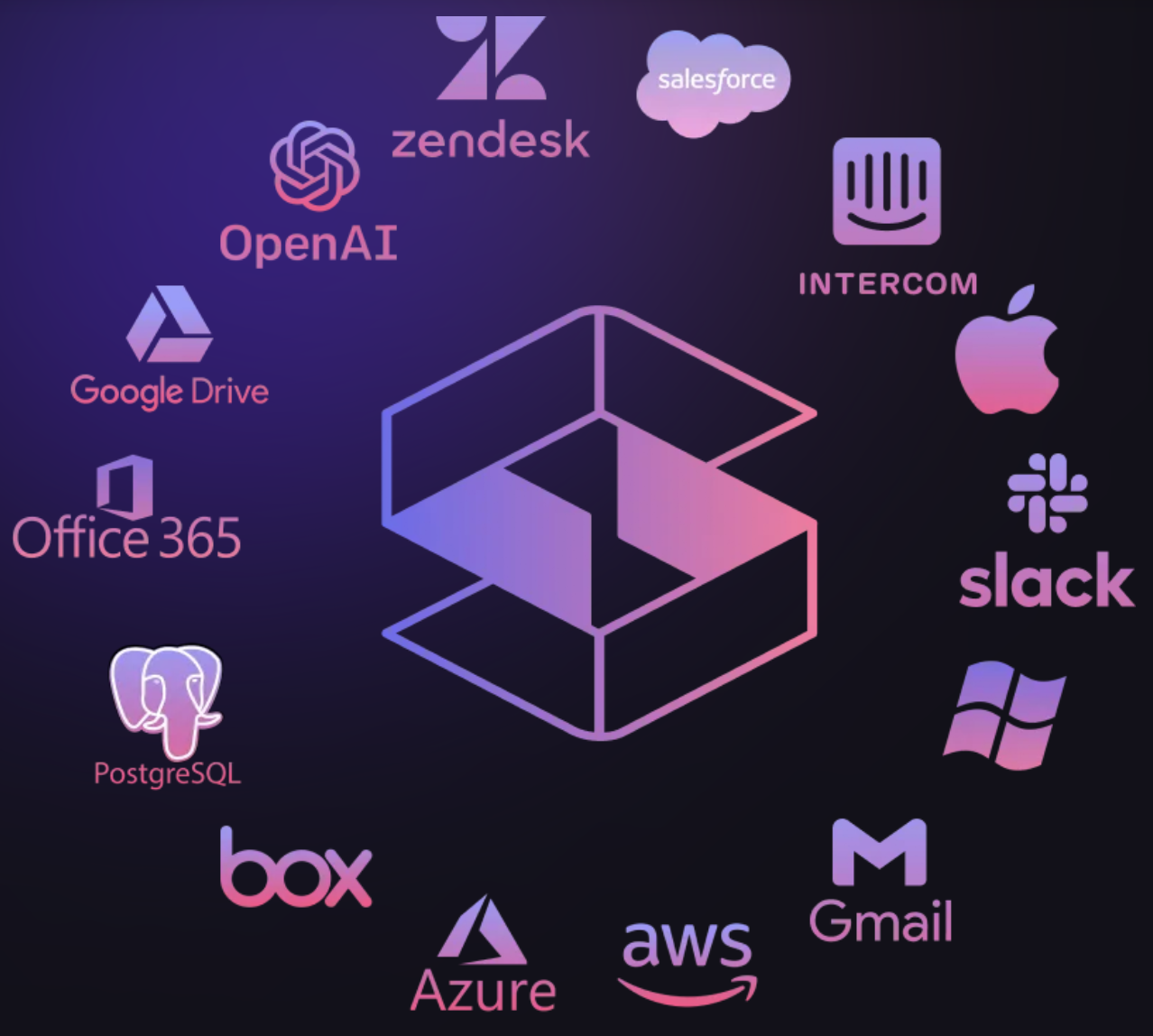
Strac integrates with AI platforms such as ChatGPT, Clude, Gemini, and Microsoft Copilot, protecting sensitive data within AI applications and safeguarding against potential breaches.
A research institution uses Strac's AI integration to protect sensitive data during interactions with AI platforms. This ensures that confidential information remains secure while leveraging AI capabilities.
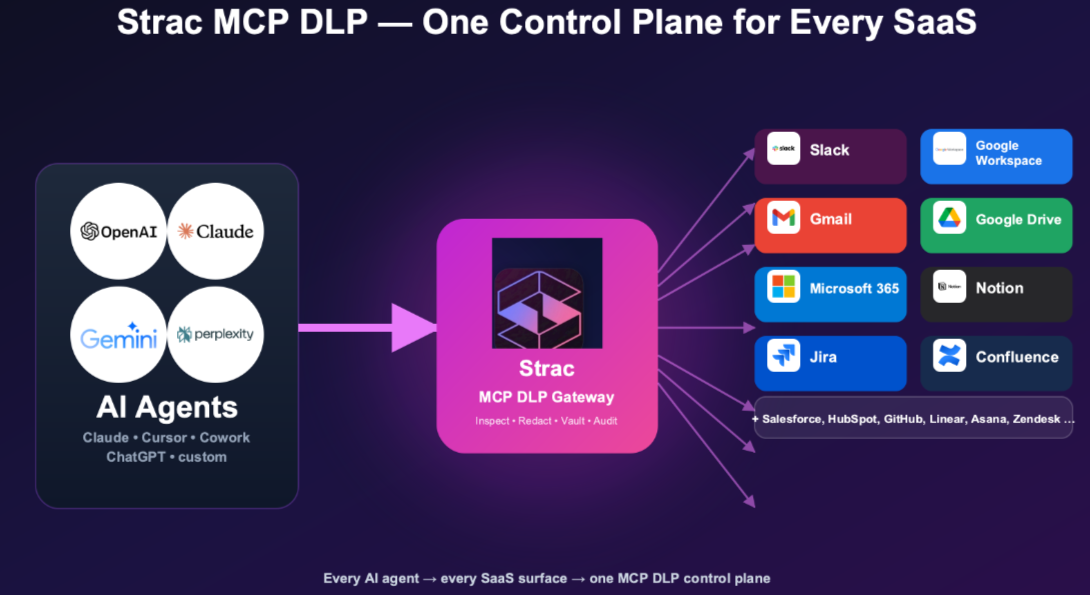
Detects, redacts, or blocks sensitive data flowing between AI agents (ChatGPT, Claude, Copilot, Cursor) and connected SaaS applications through MCP conector before data reaches the AI model.
Example: An employee asks an AI agent to generate a customer report. The agent retrieves data from Salesforce and Google Drive through MCP. Strac automatically identifies and redacts sensitive customer information before it reaches the AI model, ensuring secure AI-powered productivity.
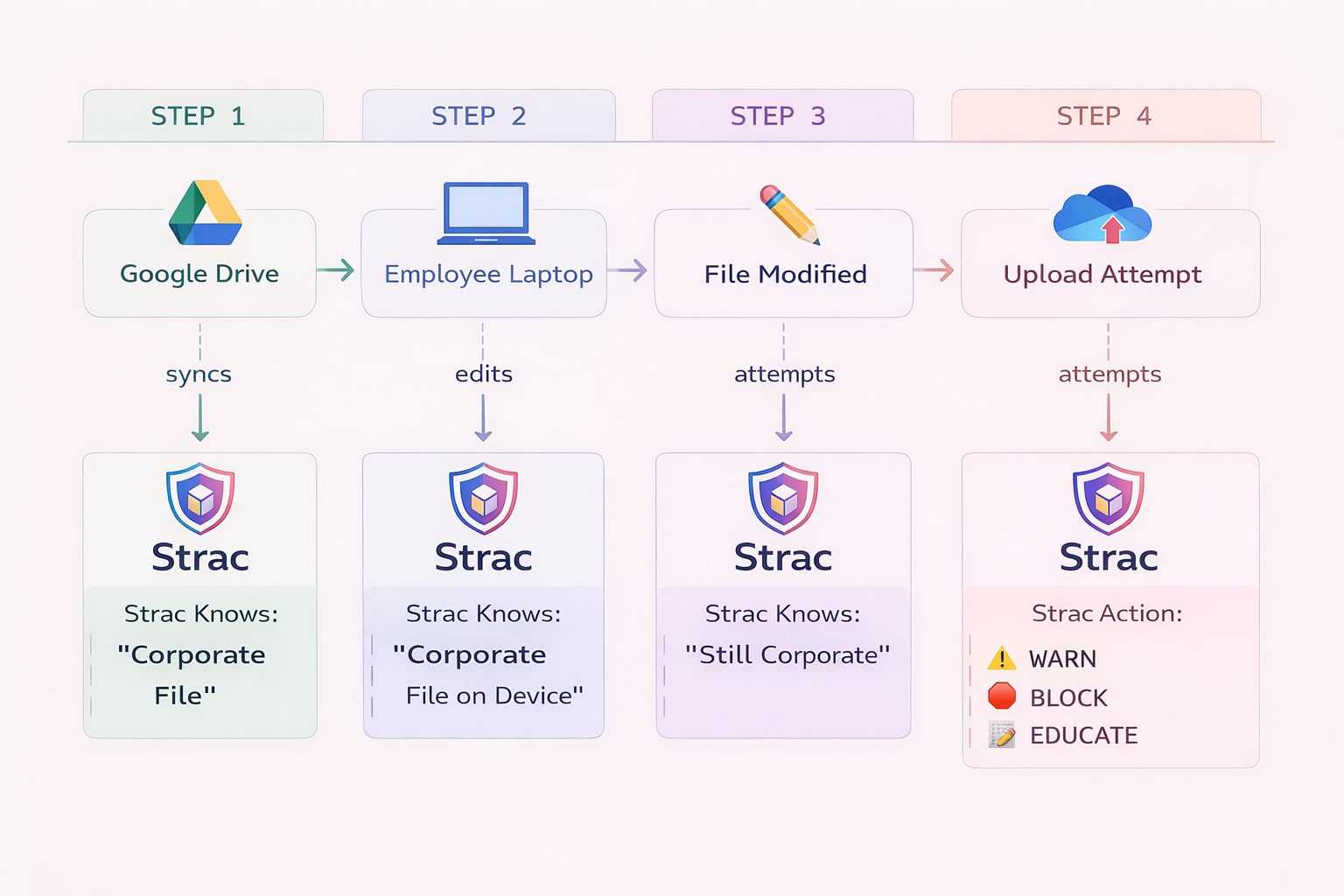
Strac's Endpoint DLP solution provides accurate and comprehensive data protection for SaaS, Cloud, and Endpoint devices, ensuring holistic security across all data access points.
A manufacturing company implements Strac's Endpoint DLP to monitor and secure data transfers on its employees' devices. This comprehensive approach ensures data protection beyond cloud and SaaS environments.
Strac offers APIs for developers to detect or redact sensitive data, enabling custom integrations and tailored data protection solutions.
A software development company uses Strac's APIs to integrate DLP features into its custom applications. This tailored approach ensures that sensitive data is protected within the company's unique software environment.
Strac's inline redaction feature masks or blurs sensitive text within any attachment, providing an additional layer of data protection.
A financial services firm uses Strac's inline redaction to protect sensitive information within email attachments. This ensures that confidential data remains secure, even when shared via email.
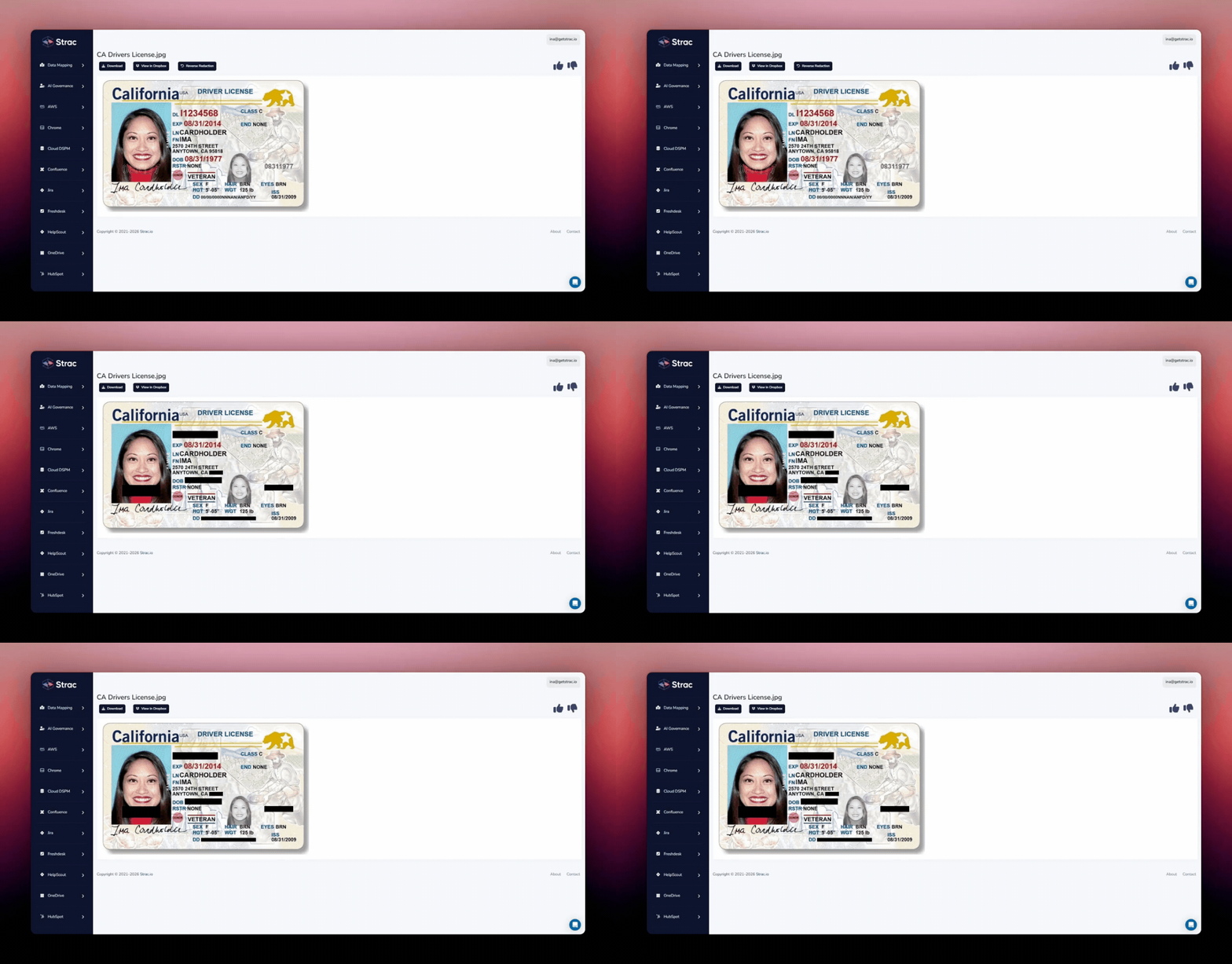
Strac provides out-of-the-box compliance templates with all sensitive data elements, along with flexible configurations to cater to specific business needs.
A healthcare organization uses Strac's customizable configurations to tailor its DLP policies according to HIPAA requirements. This ensures that the organization's data protection measures align with industry standards.

Strac has a strong reputation for customer satisfaction, as evidenced by positive G2 reviews. Customers appreciate Strac's comprehensive features and ease of use.
Numerous businesses praise Strac for its robust DLP capabilities and user-friendly interface. These testimonials highlight Strac's effectiveness in protecting sensitive data and ensuring regulatory compliance.

The definition of Data Loss Prevention has fundamentally changed.
Protecting sensitive information today requires far more than monitoring email or blocking file transfers. Organizations must secure data across SaaS applications, cloud environments, AI platforms, AI agents, MCP-connected systems, browsers, and endpoints.
As data continues to move across increasingly complex environments, organizations need solutions that combine discovery, classification, governance, monitoring, and remediation into a unified platform.
Strac helps organizations discover, classify, govern, and protect sensitive information wherever it lives, enabling secure adoption of AI and modern SaaS technologies while reducing security risk and simplifying compliance.

DSPM (Data Security Posture Management) helps organizations discover, classify, and understand where sensitive data exists across SaaS applications, cloud environments, databases, AI tools, and endpoints. DLP (Data Loss Prevention) focuses on preventing that sensitive data from being exposed, shared, or leaked. Modern platforms like Strac combine DSPM and DLP into a single solution, allowing organizations to both identify risk and automatically remediate it before a data breach occurs.
The most effective approach is implementing AI DLP. AI DLP solutions inspect prompts, responses, file uploads, and AI interactions in real time to detect sensitive information such as PII, PHI, PCI, source code, financial records, and confidential business data. Organizations can automatically redact, mask, block, or quarantine sensitive content before it reaches external AI models.
MCP (Model Context Protocol) allows AI assistants and agents to connect directly to business applications such as Salesforce, Jira, Slack, Zendesk, Google Drive, Notion, Confluence, GitHub, and internal databases. While MCP enables powerful automation, it also creates new data exposure risks. MCP Security helps organizations monitor AI agent activity, inspect data flowing between connected systems, and prevent sensitive information from being exposed through AI workflows.
Modern DLP solutions can. Advanced platforms use OCR, machine learning, and content-aware detection to inspect documents, images, spreadsheets, presentations, PDFs, and other file types. This enables organizations to identify and remediate sensitive information even when it is embedded in attachments, screenshots, scanned documents, or unstructured content.
The best DLP platforms go beyond traditional email and endpoint protection. Organizations should look for solutions that combine DSPM, DLP, AI DLP, AI Governance, Browser DLP, Endpoint DLP, Cloud DLP, SaaS DLP, and MCP Security in a single platform. Key capabilities should include content-aware detection, real-time remediation, agentless deployment, AI workflow protection, compliance support, and visibility across SaaS, cloud, AI, browser, and endpoint environments.
.avif)


.gif)


.webp)