Stripe DLP: Detect & Redact Sensitive Data in Stripe (2026)
Data Loss Prevention for Stripe. Detect and redact PII, bank details, and KYC data hiding in customer records, notes, metadata, and Connect onboarding, and block the human path.
Stripe keeps card numbers in a PCI-compliant vault, but the sensitive data that actually leaks lives everywhere else: SSNs and EINs in Connect KYC documents, bank details in customer notes, personal data in metadata and dispute evidence, and exports pulled into spreadsheets. Strac detects PII and financial data across Stripe customer records, notes, and metadata, redacts or masks it, and blocks the human path where employees paste or export it. It is agentless and covers both the API and the browser/endpoint.
Stripe DLP: Detect & Redact Sensitive Data in Stripe (2026)
Stripe is one of the most trusted places to store payment data, precisely because it handles the riskiest field, the card number, inside a PCI-DSS vault you never touch. That is exactly why teams get a false sense of security. The card PAN is safe. The SSN a support agent pasted into a customer note, the W-9 uploaded during Connect onboarding, and the bank details in a dispute evidence file are not.
This guide covers Data Loss Prevention for Stripe: where regulated data actually accumulates, and how Strac detects and redacts it.
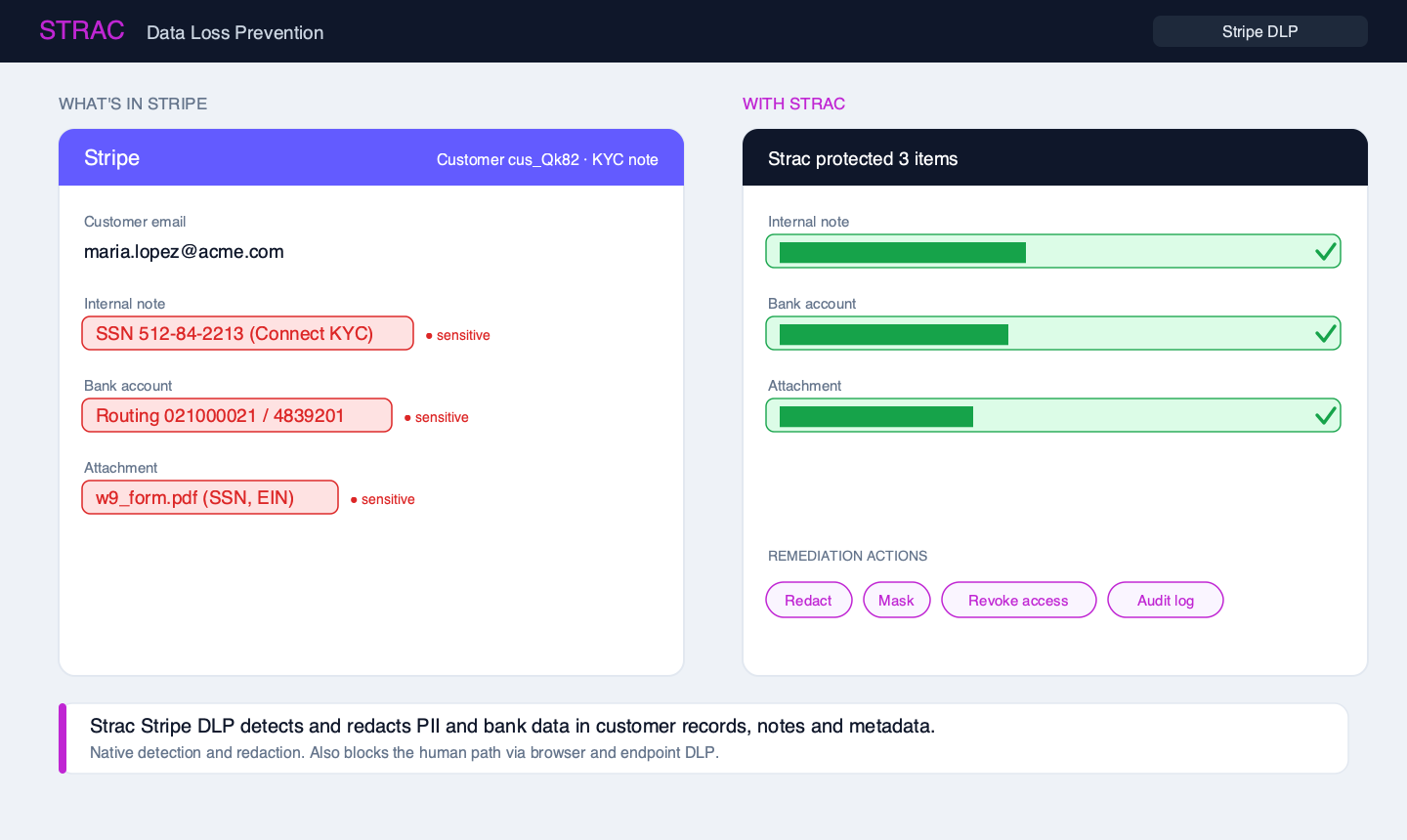
✨ Strac Stripe DLP in action
Strac scans customer records, internal notes, metadata, and attachments, then redacts the sensitive values in place while leaving the record usable.
💳 Where sensitive data hides in Stripe
Connect / KYC data — SSNs, EINs, and photo IDs collected during platform onboarding, often stored as file attachments.
Customer notes and metadata — free-text fields where agents paste SSNs, bank routing/account numbers, and full addresses "to remember them."
Dispute and refund evidence — uploaded PDFs and images containing statements, IDs, and account numbers.
Exports — CSV exports of customers and charges pulled into laptops and spreadsheets, well outside Stripe's vault.
The pattern is consistent: Stripe protects the PAN, humans leak everything around it.
🛡️ How Strac protects Stripe: detect, redact, revoke, prove
Strac connects to Stripe and runs four jobs:
Detect PII, bank details, and government IDs across customer objects, notes, metadata, and attachments (including images via OCR).
Redact or mask the sensitive value in place, keeping the original in an encrypted vault for authorized retrieval.
Revoke access so that a record still containing regulated data is restricted to the right roles.
Prove it with a complete audit log for your PCI and SOC 2 assessors.
🚧 The human path: browser and endpoint DLP
The Stripe Dashboard is a web app, and most leaks happen where a human touches it. Strac's browser DLP and endpoint DLP detect and block sensitive data at the point of paste, upload, and export, so a support agent cannot paste a customer's SSN into a note, and a finance analyst cannot download a full customer export to a personal device unnoticed. This closes the exfiltration path that an API-only integration never sees.
🤖 Stripe, AI agents, and MCP
Teams increasingly wire Stripe into AI assistants and MCP servers so agents can answer billing questions. Any assistant that can read a customer object can read the SSN sitting in its notes. Strac redacts sensitive data at the source, so what an AI agent retrieves is already clean.
📋 Stripe and compliance
PCI DSS 4.0 — Stripe covers the card number, but SSNs, bank details, and IDs in metadata can still pull processes into scope. Redaction is scope reduction.
GDPR / CCPA — customer personal data in Stripe is regulated; redaction and access controls reduce breach exposure.
Isn't Stripe already PCI compliant, so I don't need DLP?
Stripe is PCI compliant for the card data it vaults, but that does not cover the SSNs, bank details, and IDs your team puts into customer notes, metadata, and KYC attachments. Those fields are where most Stripe data-leak incidents actually happen, and they are exactly what Strac detects and redacts.
Can Strac redact sensitive data inside a Stripe customer record?
Yes. Strac detects PII and financial data in customer objects, notes, metadata, and attachments, then redacts or masks the value in place while preserving the record. The original is stored encrypted for authorized retrieval.
How does Strac stop employees exporting Stripe data?
Strac's browser and endpoint DLP detect sensitive data at the point of export and download and can block or warn, so a full customer export cannot quietly leave to a personal device.
Does this work with Stripe Connect KYC documents?
Yes. Strac scans uploaded documents, including images and PDFs via OCR, so SSNs and EINs inside W-9s and ID scans are detected and protected.
What about Stripe connected to an AI agent?
An assistant with Stripe access inherits access to any sensitive data in your records. Strac redacts that data at the source so the assistant only ever sees clean values. See our Stripe MCP and AI DLP guides, and compare tools in our best DLP solutions roundup.
Isn't Stripe already PCI compliant, so I don't need DLP?
Stripe is PCI compliant for the card data it vaults, but that does not cover the SSNs, bank details, and IDs your team puts into customer notes, metadata, and KYC attachments. Those fields are where most Stripe data-leak incidents actually happen, and they are exactly what Strac detects and redacts.
Can Strac redact sensitive data inside a Stripe customer record?
Yes. Strac detects PII and financial data in customer objects, notes, metadata, and attachments, then redacts or masks the value in place while preserving the record. The original is stored encrypted for authorized retrieval.
How does Strac stop employees exporting Stripe data?
Strac's browser and endpoint DLP detect sensitive data at the point of export and download and can block or warn, so a full customer export cannot quietly leave to a personal device.
Does this work with Stripe Connect KYC documents?
Yes. Strac scans uploaded documents, including images and PDFs via OCR, so SSNs and EINs inside W-9s and ID scans are detected and protected.
What about Stripe connected to an AI agent?
An assistant with Stripe access inherits access to any sensitive data in your records. Strac redacts that data at the source so the assistant only ever sees clean values. See our Stripe MCP and AI DLP guides, and compare tools in our best DLP solutions roundup.
Discover & Protect Data on SaaS, AI, MCP, Endpoints & Cloud
Strac provides end-to-end data loss prevention for all SaaS and Cloud apps. Integrate in under 10 minutes and experience the benefits of live DLP scanning, live redaction, and a fortified SaaS environment.


.webp)






.avif)



.gif)
