Shopify MCP Server: Secure Customer Data & Audit AI Access (2026)
The Shopify MCP server lets Claude, Cursor, and AI agents read your customers, orders, and PII. Here's the official setup, the real risks, and how Strac's Shopify MCP connector scans, redacts, and logs who-accessed-what.
The Shopify MCP server is how AI agents (Claude, Cursor, ChatGPT, custom agents) read and act inside a Shopify store via the Model Context Protocol — reaching customers, orders, addresses, and fulfillment data the authorizing token can see.
Shopify ships several official MCP servers — Storefront MCP, Customer Accounts MCP, and the Dev MCP — plus a wave of community servers. Adoption is real and growing.
The risk for any store handling real customers: an MCP tool call returns customer PII — names, emails, phone numbers, shipping addresses, order history — straight into the model's context window, with no record of what the agent actually read.
That second part is what legal and compliance teams ask about first: "If an AI agent can query every customer, how do we prove what it accessed?" Under GDPR and CCPA, "we don't know" is not an answer.
Strac Shopify MCP DLP is the governance layer for AI-agent access: it governs every tool call — controlling which access and actions each agent gets (including bulk-export limits and approval on high-risk actions), protecting buyer PII and payment data via redaction, masking, and vaulting before anything reaches the model, and logging every call as audit evidence — the who-accessed-what record your legal team is asking for.
What Is the Shopify MCP Server?
The Shopify MCP server is a Model Context Protocol implementation that exposes Shopify's commerce data and APIs as a standardized set of tools an AI agent can call. Once connected, an agent like Claude or Cursor can search products, look up customers, pull order details, and act on the merchant's behalf — turning the Shopify API surface into AI-actionable capabilities.
Shopify provides several first-party options, documented in its AI toolkit:
Storefront MCP — connects to a store's catalog, cart, and policies so AI shopping assistants can search products and help customers check out.
Customer Accounts MCP — lets customers track orders, manage returns, and access their account through an AI client.
Dev MCP — a local server for developers building against Shopify's APIs.
On top of these, the ecosystem has produced a long list of community and third-party Shopify MCP servers that wrap the Admin API and expose products, customers, orders, and more to any MCP-aware client.
From the merchant's side, the value is obvious: the AI agent suddenly knows the store. From the security side, that same agent now has read access — and often write access — to every customer record the connected token can reach.
What AI Agents Can Actually Do With Shopify MCP
What sells this internally is the work it removes. Once an agent is connected over MCP, it stops being a chatbot and starts operating your store. The concrete, day-one workflows look like this:
Query orders, customers, and products in plain language — "show me unfulfilled orders from this week" or "which products are low on stock" — without anyone opening the Shopify admin.
Summarize sales and inventory on demand — roll up revenue, units sold, and what's running low into a one-paragraph briefing instead of a report build.
Look up a specific order — pull the line items, fulfillment status, and shipping details for a single order number when a buyer writes in.
Surface a customer's purchase history — what they've bought, how often, and when, so support and CX agents have full context before they reply.
Draft responses to buyer inquiries — generate a reply to a "where's my order" or returns question grounded in that buyer's actual order data.
That reach is exactly the point — and exactly why it can't run ungoverned. The same connection that lets an agent draft a reply from one buyer's history can pull thousands of buyers' records in a single call. So each agent's access and actions have to be controlled, the buyer data it touches has to be protected, and every call it makes has to be audited.
What the Shopify MCP Server Actually Exposes
A Shopify store is one of the most concentrated stores of consumer PII a small company holds. An MCP server over the Admin API can surface, in a single tool call:
Customer records — full names, email addresses, phone numbers, and account history.
Shipping and billing addresses — physical location data for every order ever placed.
Order history — what each customer bought, when, for how much, and where it shipped.
Draft orders, notes, and tags — including free-text fields where staff routinely paste sensitive context.
Discount, customer-segment, and marketing data — the raw material for profiling.
Note one thing it does not hand over: raw card numbers. Shopify tokenizes payment data through its PCI-compliant vault, so primary account numbers don't flow through the Admin API. But everything around the payment — identity, contact, address, and purchase history — is exactly the regulated personal data that GDPR, CCPA, and breach-notification laws are written to protect. An AI agent pulling "all customers in California who ordered in the last 30 days" is pulling a regulated dataset.
The Real Security Risks of the Shopify MCP Server
The risks fall into four categories every e-commerce and DTC security team should price into the deployment.
Customer PII flows to the model uninspected.get_customer and customer-search tools return names, emails, phones, and addresses directly into the agent's context window. Nothing inspects or masks that data before the model — and a third-party model provider — receives it.
One query can pull the whole customer base. A single broad tool call ("list customers who bought X") can exfiltrate thousands of personal records at once — the digital equivalent of exporting the customer table, but initiated by an AI agent that may be following an ambiguous or injected instruction.
Write tools create exfiltration and tampering paths. Tools that create draft orders, update customer tags, or post notes let a compromised or manipulated agent move data out of Shopify or alter records — in one call, from somewhere else.
There is no native record of what the agent read. This is the one that stops deals. The Shopify MCP server honors the token's permissions, but it does not produce a per-record, attributable log of which customer data an AI agent accessed. When legal asks "prove what the AI touched," the answer out of the box is silence.
✨ The Question Your Legal Team Will Ask: "Who Accessed What?"
Setup guides answer "how do I connect it." Legal and compliance ask a different question, and it's the one that decides whether the integration ships: if an AI agent can read every customer's personal data, how do we know — and prove — what it actually accessed?
Strac's MCP ledger answers "who accessed what" directly: every tool call is attributed to a user or agent, tied to the exact records and the specific data elements detected — with redacted and original views one click away.
That isn't a nice-to-have. It's the spine of modern privacy law:
GDPR Article 30 expects records of processing activities, and Article 5(2) demands you can demonstrate accountability for how personal data is handled.
CCPA/CPRA gives California consumers the right to know what's collected and how it's used — which you can't answer if AI access is a black box.
Breach notification rules turn on knowing whose data was exposed. After an incident involving an over-broad or compromised agent, "we can't tell what it read" is the difference between a contained event and a mandatory mass disclosure.
An AI agent querying your store is a new actor touching regulated data. It needs the same thing every other actor needs: an attributable, reviewable audit trail. That's the gap a plain MCP connection leaves wide open — and the one Strac is built to close.
Strac Shopify MCP DLP is the governance layer for AI-agent access to your store. It sits inline as a gateway and intercepts every tool call between the agent and Shopify so you can See every call an agent makes, Control the access and actions each agent gets (allow, block, or require approval on high-risk actions like bulk customer exports), Protect the buyer data it touches (redact, mask, or vault PII and payment data before it reaches the model), and Prove what happened by auditing every call. Instead of bolting a control onto a generic connection, the governance is the connector: every record an agent requests passes through Strac's DLP engine on the way to the model.
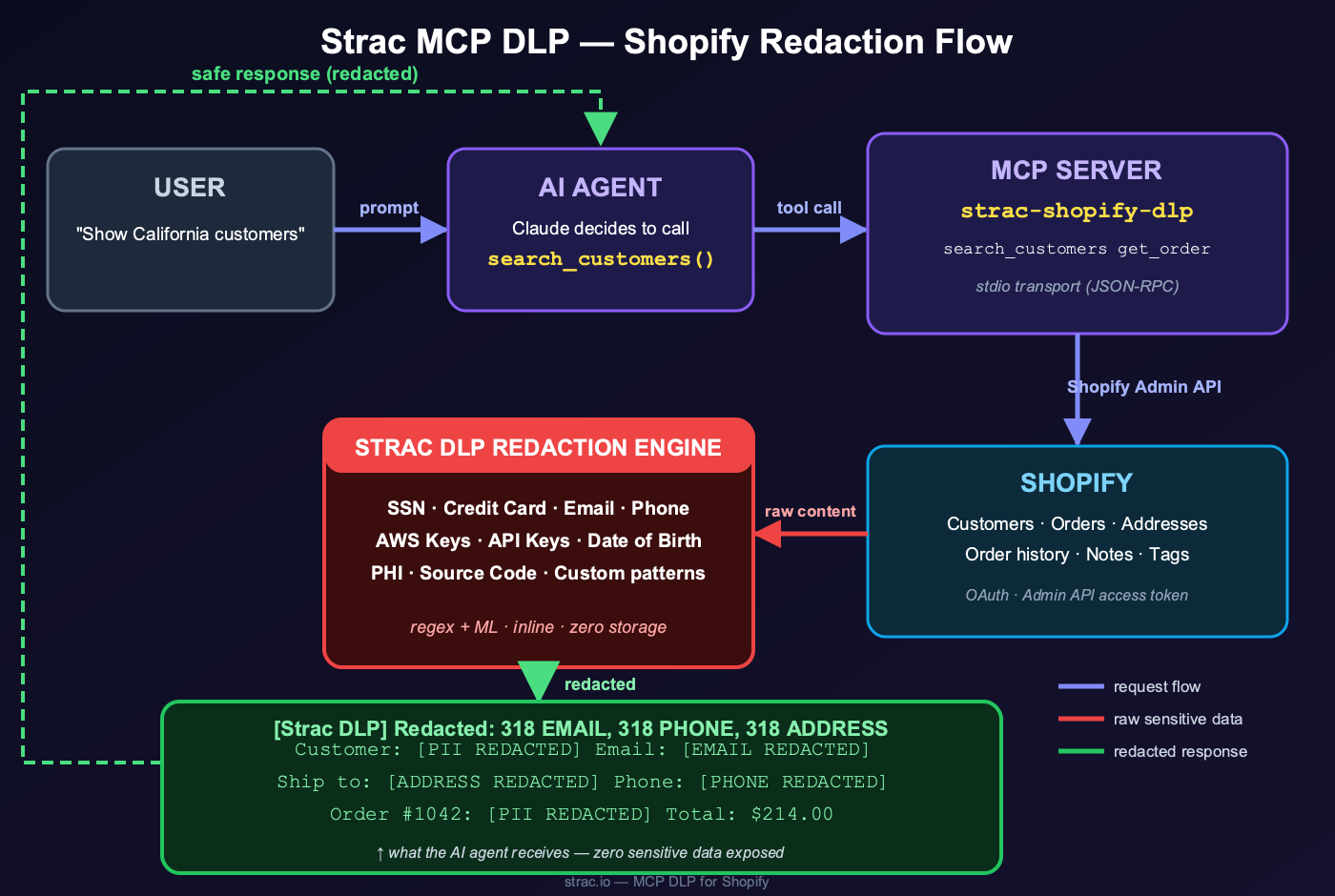
The full data flow: an agent asks for "customers in California who ordered in the last 30 days," the Shopify MCP connector fetches the records, and Strac's DLP engine applies your policy — here, masking every email, phone, and address — and logs the access before anything reaches the model. Depending on policy, the same call could instead be blocked, alerted on, or passed through and logged.
You set the policy — per data type, per agent, per platform — and Strac enforces it on every call. Detection and the audit log are always on; what happens to a flagged record is your choice:
Scan and classify (always on) — Strac's detection engine classifies PII (names, emails, phones, addresses), plus any PCI, PHI, or secrets that have leaked into notes and free-text fields, across every record the agent requests.
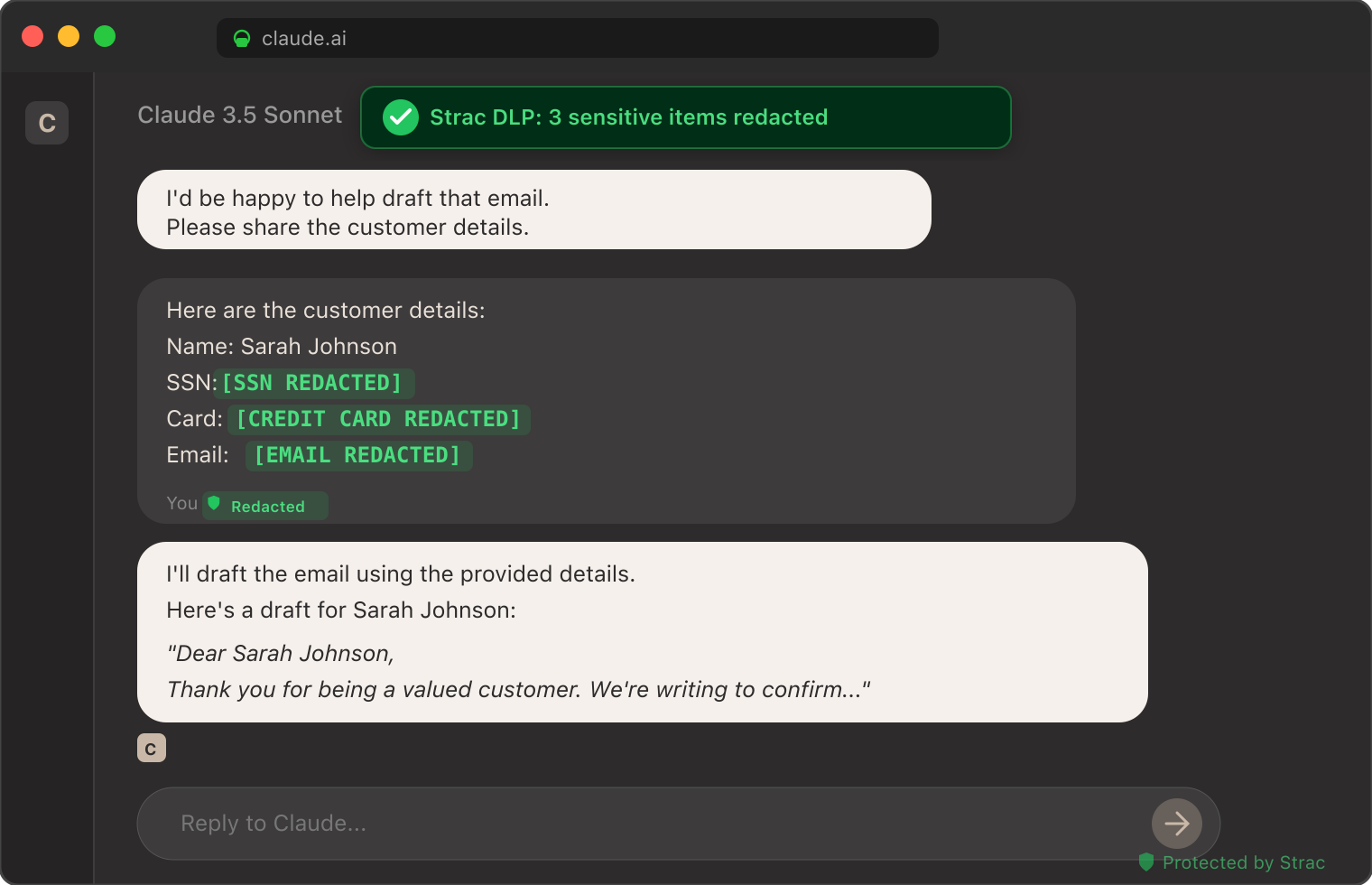
Redact, mask, or tokenize — if your policy calls for it, sensitive values are masked (e.g. j••••@gmail.com, XXX-XX-1234) so the agent gets the context it needs without raw PII flowing to a third-party model.
Block — stop an over-broad or out-of-scope request (a bulk customer export) before it ever returns data.
Alert — let the call proceed but notify security in real time when an agent reaches for regulated data.
Allow and log — pass low-risk requests through untouched.
Log who-accessed-what (always on) — regardless of the action taken, every call is written to an append-only audit log: which agent, which user, which records, what sensitive data was present, and what was done. This is the evidence your legal team asked for — and what maps Shopify AI access to SOC 2, GDPR, and PCI requirements.
Beyond redacting or blocking, Strac can also pseudonymize or de-identify the data on a Shopify MCP tool call — swapping PII, PHI, and PCI for realistic, format-preserving fakes — so a team can keep using the data in an AI model, analytics, or a test environment while the real records never leave your control. See Data Pseudonymization.
This is the same detection and remediation engine behind Strac's AI DLP and MCP security work — applied natively inside the Shopify connector instead of as an afterthought.
Compliance Coverage Out of the Box
The same connector that secures AI access to Shopify data produces the evidence your auditors and regulators expect.
Framework
What Strac's Shopify MCP connector satisfies
GDPR
Art. 5/30/32 — demonstrable accountability, records of AI processing of personal data, and security-of-processing controls over what reaches the model
CCPA / CPRA
Visibility into what personal data AI agents access and the controls limiting it
SOC 2
CC6 logical-access and monitoring evidence for a new class of automated actor
PCI DSS
Detection and masking of any cardholder data that leaks into notes or order fields
Every finding is logged and attributable, so "what did the AI access?" has a one-click answer.
Which AI Tools Work With Strac's Shopify MCP Connector?
Because Strac's Shopify MCP connector speaks the open Model Context Protocol, it works in every AI client that speaks MCP — and your configured policy (redact, mask, block, alert, or allow-and-log) plus the who-accessed-what audit trail travel with the data no matter which one is asking. As of 2026, every major AI lab is an MCP client, so the same policy applies whether your team queries Shopify from Claude, ChatGPT, Gemini, Copilot, or Perplexity. Here's how Strac's connector plugs into each.
Does Strac's Shopify MCP Connector Work With Claude (Claude.ai, Claude Code & Cowork)?
Yes. Strac's Shopify MCP connector works everywhere Claude reads connectors — Claude.ai on the web, Claude Desktop, Claude Code, and Cowork, on every plan. Add the Strac Shopify connector under Settings → Connectors and Claude can call search_customers or get_order against your store, while Strac applies your configured policy — redact, mask, block, or alert — to those records before they reach the model and writes each call to the who-accessed-what ledger. Claude runs remote MCP from Anthropic's cloud, so there's nothing to install locally.
Does Strac's Shopify MCP Connector Work With OpenAI ChatGPT & Codex?
Yes. Strac's Shopify MCP connector registers as a custom MCP app in ChatGPT Developer Mode (Plus, Pro, Business, Enterprise), so ChatGPT can pull orders and customer records the same way — except every record is scanned and handled by your policy first (redact, mask, block, or allow-and-log). For engineers, the connector also works with Codex over stdio or streaming HTTP in the CLI and IDE, so a "summarize last week's California orders" query from the terminal still flows through Strac's policy enforcement and audit trail.
Does Strac's Shopify MCP Connector Work With Google Gemini?
Yes. Following Google's official MCP support, Gemini CLI and the Gemini agent/enterprise platform act as MCP clients — point them at Strac's Shopify MCP connector and Gemini works with store data under the same configurable policy and audit logging that protects every other agent.
Does Strac's Shopify MCP Connector Work With Microsoft Copilot?
Yes. Strac's Shopify MCP connector plugs into both Copilot Studio and GitHub Copilot, so any Copilot agent you build inherits Strac's configured policy controls and per-record audit log the moment you add it. Copilot's enterprise MCP allowlists pair naturally with Strac's policy controls for governing exactly which agents touch customer data.
Does Strac's Shopify MCP Connector Work With Perplexity & Other MCP Clients?
Yes. Perplexity added custom MCP connectors for Pro, Max, and Enterprise in 2026, and Strac's Shopify MCP connector works there and in any other MCP-aware client — Cursor, Windsurf, Cline, Grok — the same way. Because Strac lives inside the connector and not the client, your policy enforcement and who-accessed-what logging are identical no matter which AI tool reaches for your Shopify customers. This is the same engine behind Strac's AI DLP and MCP DLP.
🌶️ Spicy FAQs for Shopify MCP Server
What is the Shopify MCP server?
It's a Model Context Protocol server that exposes Shopify's commerce data and APIs as tools an AI agent (Claude, Cursor, ChatGPT, custom agents) can call. Shopify ships official Storefront, Customer Accounts, and Dev MCP servers; community servers wrap the Admin API for products, customers, and orders. See the official Shopify AI toolkit.
Is the Shopify MCP connector the same as the Shopify MCP server?
Yes — one and the same. The protocol calls it a server; Claude and Cursor surface the Shopify connector in their directory. Orders, customers, and products are reachable either way, and Strac's Shopify MCP connector masks buyer PII and payment data on each tool call.
Shopify MCP vs Shopify Sidekick — what's the difference?
They're aimed at opposite directions. Shopify MCP is how external agents — Claude, Cursor, ChatGPT, your own custom agents — reach into Shopify over the Model Context Protocol to query orders, customers, and products. Shopify Sidekick (part of Shopify Magic) is the opposite: it's Shopify's native, in-admin AI assistant that lives inside the merchant dashboard and acts on the store from within. The security difference is the hand-off: with MCP, the tool-call result travels back out to the external client and its model provider, and that hand-off is exactly where Strac Shopify MCP DLP governs — controlling which access and actions each agent gets, protecting buyer data with redaction, masking, and vaulting before it leaves Shopify, and auditing every call. Sidekick stays inside Shopify's own boundary; MCP crosses it, which is why it needs a governance layer.
Is the Shopify MCP server safe to use with customer data?
By itself, it's only as safe as the token's permissions — which usually means the agent can read every customer's PII. The server returns names, emails, phones, addresses, and order history straight to the model with no inspection and no record of what was accessed. For any store with real customers, you need a control layer like Strac's Shopify MCP connector that scans every call, applies the policy you configure (redact, mask, block, alert, or allow-and-log), and logs who-accessed-what.
Can an AI agent read all my Shopify customers' personal data?
Yes — if the connected token can see it, the agent can pull it, often thousands of records in a single tool call. That's why bulk-pull blocking and per-record audit logging matter.
Does the Shopify MCP server expose credit card numbers?
No. Shopify tokenizes payment data in its PCI-compliant vault, so raw card numbers don't flow through the Admin API. But all the surrounding personal data — identity, contact, address, purchase history — does, and that's regulated under GDPR and CCPA.
How do I log what an AI agent accessed in Shopify?
A plain MCP connection doesn't produce an attributable record of which customer data an agent read. Strac's Shopify MCP connector writes an append-only audit log of who-accessed-what on every call — the agent, the user, the records, the sensitive data present, and the action taken.
How is this different from Shopify's built-in protections?
Shopify protects payment data and enforces token permissions, but it does not inspect, mask, or log the personal data an AI agent reads through MCP. Strac is purpose-built for that layer: detection breadth across PII/PCI/secrets, policy-driven redaction, masking, or blocking before the model, and a who-did-what audit trail.
Does it work with Claude, Cursor, ChatGPT, and custom agents?
Yes — it's MCP-standard, so any MCP-aware AI client connects the same way.
With Strac, an agent querying Shopify inherits the user's permissions — not a service account's — so staff permissions govern the answer, and any customer PII and order data inside it is redacted, masked, or blocked per policy. Strac protects the customer PII and order data on the way through and proves per-user access in the audit log — identity to prevent retrieval, DLP to protect what's allowed.
The Bottom Line
The Shopify MCP server is genuinely useful — and it hands AI agents the keys to your most regulated dataset: your customers. The setup question ("how do I connect it") is the easy one. The question that decides whether it ships is the one legal asks: can you prove what the AI accessed, and stop it from over-reaching?
Strac's Shopify MCP connector answers both — scanning every record and applying the policy you set (redact, mask, block, or alert) before it reaches the model, and logging who-accessed-what on every call. Talk to Strac about securing AI access to your Shopify data.
What is the Shopify MCP server?
It's a Model Context Protocol server that exposes Shopify's commerce data and APIs as tools an AI agent (Claude, Cursor, ChatGPT, custom agents) can call. Shopify ships official Storefront, Customer Accounts, and Dev MCP servers; community servers wrap the Admin API for products, customers, and orders. See the official Shopify AI toolkit.
Is the Shopify MCP connector the same as the Shopify MCP server?
Yes — one and the same. The protocol calls it a server; Claude and Cursor surface the Shopify connector in their directory. Orders, customers, and products are reachable either way, and Strac's Shopify MCP connector masks buyer PII and payment data on each tool call.
Shopify MCP vs Shopify Sidekick — what's the difference?
They're aimed at opposite directions. Shopify MCP is how external agents — Claude, Cursor, ChatGPT, your own custom agents — reach into Shopify over the Model Context Protocol to query orders, customers, and products. Shopify Sidekick (part of Shopify Magic) is the opposite: it's Shopify's native, in-admin AI assistant that lives inside the merchant dashboard and acts on the store from within. The security difference is the hand-off: with MCP, the tool-call result travels back out to the external client and its model provider, and that hand-off is exactly where Strac Shopify MCP DLP governs — controlling which access and actions each agent gets, protecting buyer data with redaction, masking, and vaulting before it leaves Shopify, and auditing every call. Sidekick stays inside Shopify's own boundary; MCP crosses it, which is why it needs a governance layer.
Is the Shopify MCP server safe to use with customer data?
By itself, it's only as safe as the token's permissions — which usually means the agent can read every customer's PII. The server returns names, emails, phones, addresses, and order history straight to the model with no inspection and no record of what was accessed. For any store with real customers, you need a control layer like Strac's Shopify MCP connector that scans every call, applies the policy you configure (redact, mask, block, alert, or allow-and-log), and logs who-accessed-what.
Can an AI agent read all my Shopify customers' personal data?
Yes — if the connected token can see it, the agent can pull it, often thousands of records in a single tool call. That's why bulk-pull blocking and per-record audit logging matter.
Discover & Protect Data on SaaS, AI, MCP, Endpoints & Cloud
Strac provides end-to-end data loss prevention for all SaaS and Cloud apps. Integrate in under 10 minutes and experience the benefits of live DLP scanning, live redaction, and a fortified SaaS environment.


.webp)







.avif)


.gif)
