MSP DLP: How to Deliver Data Loss Prevention as a Managed Service
MSP DLP means delivering data loss prevention as a managed service. Why it's a great recurring-revenue line, why legacy DLP breaks the MSP model, and how Strac's agentless platform makes it profitable.
MSP DLP is data loss prevention delivered by a managed service provider as a service — you deploy, tune, and monitor DLP across your clients’ data instead of each client buying and running it alone.
It’s one of the best new service lines an MSP or MSSP can add: recurring revenue, stickier clients, and a compliance story your customers are already being asked for.
The blocker with legacy DLP is operational: heavy agents, network changes, and weeks of tuning per client don’t scale across a book of business.
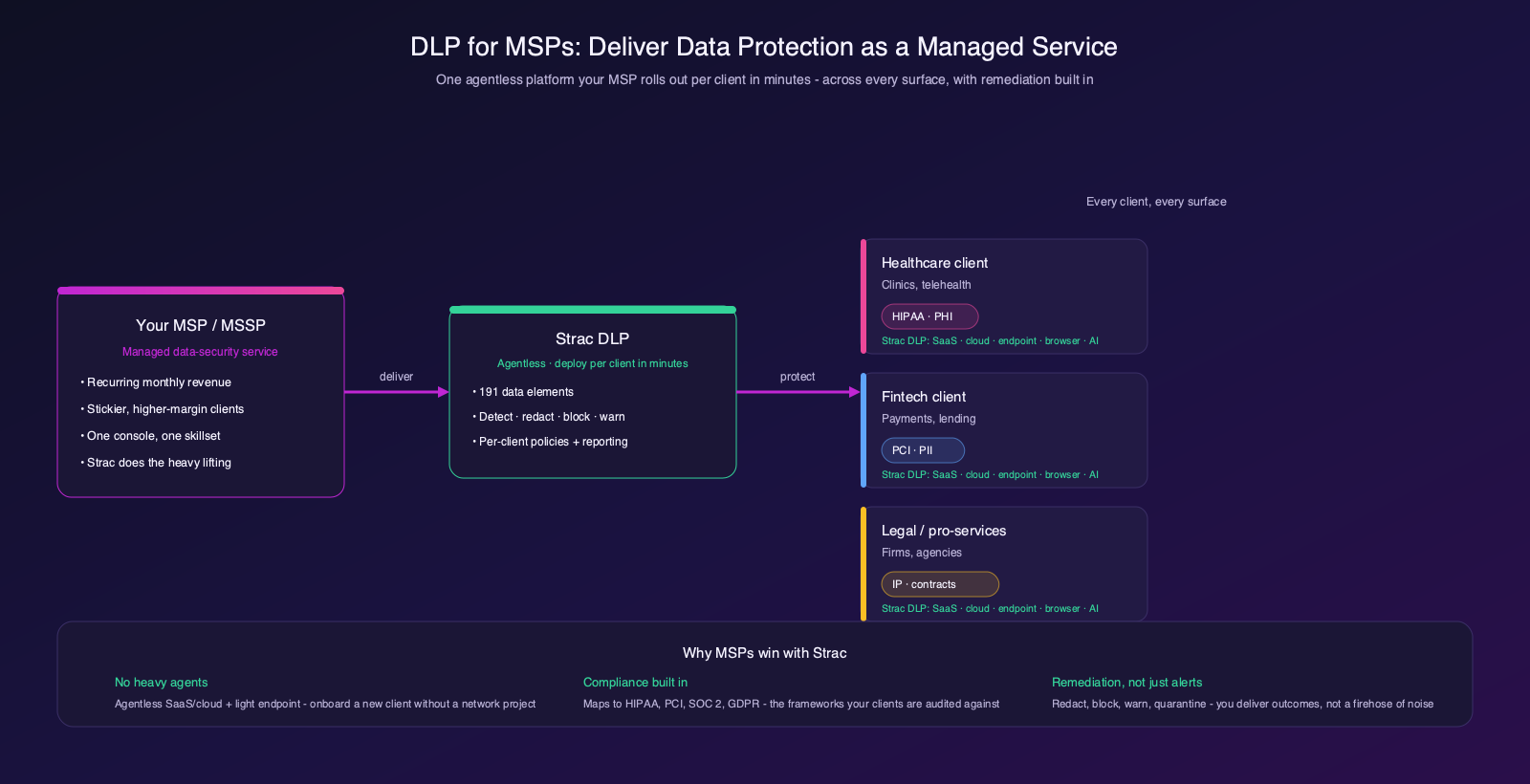
Strac is built for the MSP model — agentless, deploys per client in minutes, covers every surface, and remediates (redact, block, warn) instead of just alerting. You deliver outcomes; Strac does the heavy lifting.
✨ What Is MSP DLP?
MSP DLP is a managed data loss prevention service: instead of every client sourcing, deploying, and babysitting their own DLP tool, a managed service provider (MSP) or managed security service provider (MSSP) runs DLP on their behalf — discovering sensitive data, applying policies, and remediating leaks across each client’s SaaS, cloud, endpoints, email, browsers, and AI tools. The MSP owns the platform, the policies, and the reporting; the client gets protected data and an audit-ready compliance posture without hiring a security team.
MSP DLP: your MSP delivers Strac’s agentless DLP across every client — one platform, per-client policies, remediation built in.
Why DLP Is a Great Service Line for MSPs
Data protection has quietly become one of the highest-demand, highest-retention services an MSP can offer. Three forces are driving it:
Driver
What it means for your MSP
Compliance pressure
Clients are being asked for HIPAA, PCI DSS, SOC 2, and GDPR evidence — DLP is a control in every one of them.
GenAI data leakage
Employees paste PII, PHI, and secrets into ChatGPT, Claude, and Copilot. Clients feel the risk and want a managed answer.
Thin client security teams
SMBs and mid-market firms have no DLP expertise in-house — that gap is your recurring-revenue opportunity.
The business case is strong: DLP is recurring (monthly managed service, not a one-time project), it compounds retention (once you hold a client’s data-protection policies, switching costs are high), and it raises your margin and your ceiling — a data-security line item lets you move up-market into regulated verticals like healthcare, finance, and legal.
Why Legacy DLP Breaks the MSP Model
Most traditional DLP was built for a single large enterprise with a dedicated security team — the opposite of an MSP serving dozens of small clients. It breaks down fast:
Legacy DLP problem
Why it kills MSP economics
Heavy endpoint agents + network appliances
Every new client is an infrastructure project, not a fast onboarding.
Proxies and TLS interception
Network re-architecture per client; fragile, and a support burden you own.
Weeks of policy tuning
Labor cost per client destroys the margin the managed service is supposed to create.
Alert-only output
You inherit a firehose of false positives to triage — that’s cost, not a deliverable.
Per-surface point tools
Separate products for email, SaaS, endpoint, and AI multiplies what you have to learn and run.
If onboarding a client takes weeks and generates noise you have to staff against, DLP stops being profitable. The fix is a platform designed for fast, repeatable, low-touch delivery.
✨ What to Look for in DLP for MSPs
Agentless and fast to deploy. You should onboard a new client’s SaaS and cloud in minutes via API — no network project, no month-long rollout.
Every surface, one platform. Email, SaaS, cloud, endpoint, browser, and AI/GenAI in a single product, so you learn and operate one thing across your whole book.
Remediation, not just alerts. Redact, block, warn, and quarantine — deliver outcomes, not a queue of alerts you have to triage for free.
Per-client policies and clear reporting. Each client gets policies tuned to their frameworks, plus reporting you can hand them as compliance evidence.
Compliance mapping built in. HIPAA, PCI DSS, SOC 2, and GDPR templates so you are selling an outcome your clients are already audited against.
Accurate detection. Contextual ML and OCR over regex, so false positives don’t become your support cost.
Remediation, not just alerts — Strac redacts sensitive data in real time, so your MSP delivers outcomes instead of a queue of noise.
✨ How Strac Fits the MSP Model
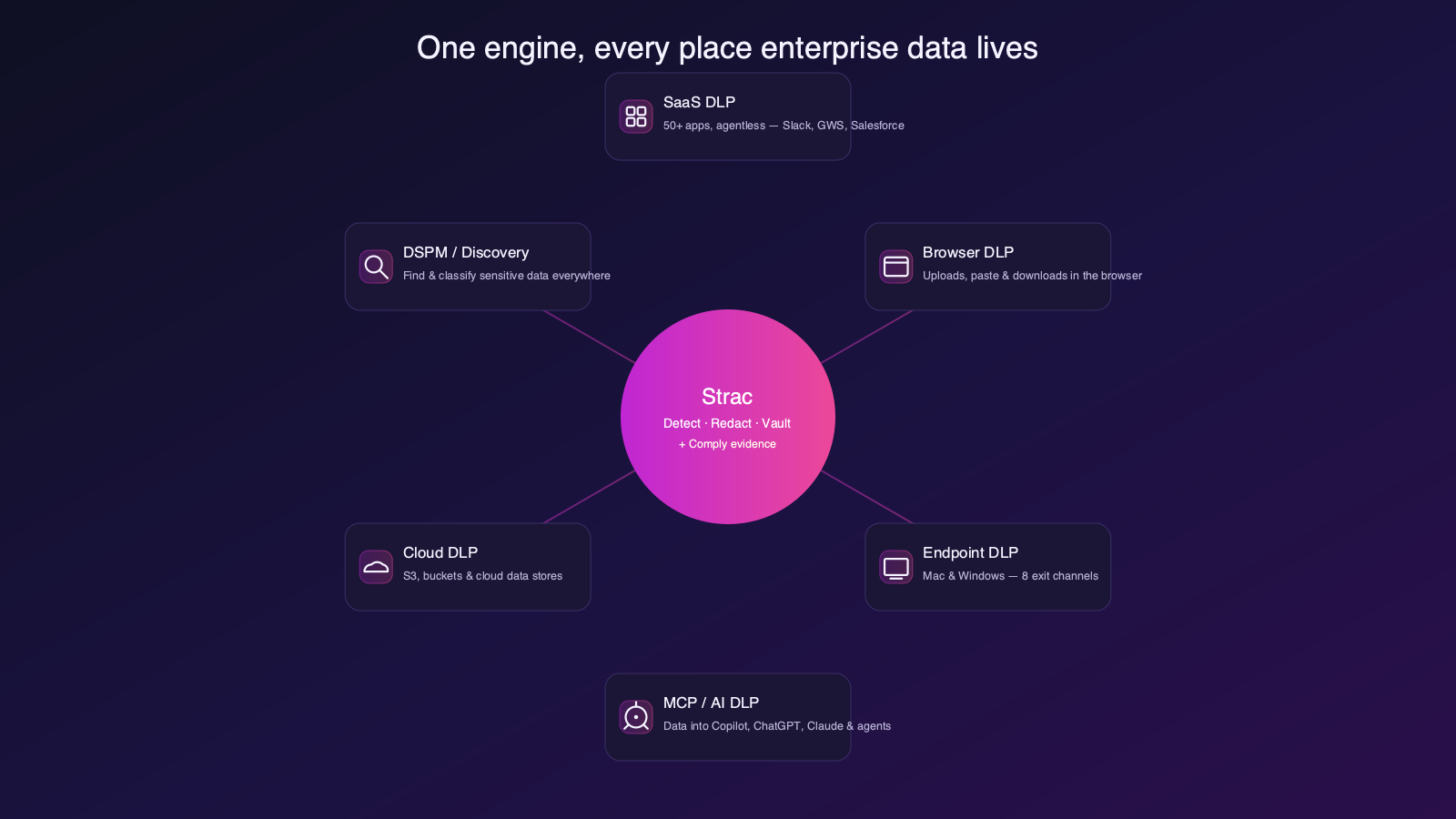
Strac was built agentless-first, which is exactly what makes it deliverable at MSP scale. You connect a client’s SaaS and cloud over API and start detecting and remediating in minutes — no proxy, no TLS interception, no per-client network project. For endpoints, a lightweight endpoint DLP agent (Apple system extension on macOS, a file-system minifilter driver on Windows) adds content-aware coach/warn/block at the point of use. One platform spans SaaS DLP, cloud, email DLP, browser/GenAI DLP, and MCP for AI agents — so your team learns one product and runs it across every client.
One Strac platform covers every client’s email, SaaS, cloud, endpoint, browser, and AI — the breadth an MSP needs to standardize on one tool.
And because Strac remediates — redacting, masking, tokenizing, blocking, or warning — you deliver a protected outcome, not a stream of alerts. Detection maps to HIPAA, PCI DSS, SOC 2, and GDPR, so each client engagement comes with the evidence they need. That combination — fast onboarding, full coverage, real remediation, compliance mapping — is what turns DLP into a profitable managed service instead of a per-client infrastructure grind.
How MSPs Roll Out Strac DLP: A Playbook
Scope by framework. Start with the client’s obligation — HIPAA for a clinic, PCI for a payments client, SOC 2 for a SaaS — and pick the matching policy templates.
Connect SaaS + cloud over API. Onboard the client’s core apps in minutes; discovery starts immediately.
Roll out endpoint + browser coverage. Deploy the lightweight endpoint agent and browser extension for data in use and GenAI activity.
Stage enforcement: audit → warn → block. Start in audit to baseline, coach users with warnings, then block the highest-risk flows — per data type, per channel.
Deliver reporting. Hand the client periodic reports as compliance evidence and as proof of the value you provide.
🌶️ Spicy FAQs on MSP DLP
What is MSP DLP?
MSP DLP is data loss prevention delivered as a managed service. Instead of each client buying and running DLP themselves, an MSP or MSSP deploys, tunes, and monitors it across the client’s SaaS, cloud, endpoints, email, browsers, and AI tools - and hands them the compliance reporting.
Why should an MSP offer DLP as a service?
Because it is recurring, sticky, and in demand. Clients need HIPAA/PCI/SOC 2/GDPR evidence and are worried about GenAI leaks but have no in-house expertise. A managed DLP line adds monthly revenue, raises retention, and lets you move up-market into regulated verticals.
Why doesn’t legacy DLP work for MSPs?
Legacy DLP assumes one big enterprise with a security team - heavy agents, network appliances, TLS interception, and weeks of tuning per client. That destroys the margin of a managed service. MSPs need agentless, fast-to-deploy DLP that covers every surface from one platform.
How fast can an MSP onboard a client with Strac?
SaaS and cloud connect over API in minutes - no network project. Endpoint and browser coverage add a lightweight agent and extension. You can baseline a client in audit mode the same day and stage enforcement from there.
Does Strac have a partner program for MSPs?
Strac already works with MSPs delivering managed data security to their clients. If you run an MSP or MSSP and want to add a DLP line, reach out through the demo link below to talk partnership.
The Bottom Line
DLP has become a service your clients need and will pay for monthly — but only if you can deliver it without a per-client infrastructure project. Strac makes MSP DLP profitable: agentless onboarding in minutes, coverage across every surface, real remediation instead of alert noise, and compliance mapping your clients are already audited against. Serving regulated SMBs and mid-market firms — including small businesses — is exactly where this model shines. Book a demo to see how Strac fits your MSP stack.
What is MSP DLP?
MSP DLP is data loss prevention delivered as a managed service. Instead of each client buying and running DLP themselves, an MSP or MSSP deploys, tunes, and monitors it across the client’s SaaS, cloud, endpoints, email, browsers, and AI tools - and hands them the compliance reporting.
Why should an MSP offer DLP as a service?
Because it is recurring, sticky, and in demand. Clients need HIPAA/PCI/SOC 2/GDPR evidence and are worried about GenAI leaks but have no in-house expertise. A managed DLP line adds monthly revenue, raises retention, and lets you move up-market into regulated verticals.
Why doesn’t legacy DLP work for MSPs?
Legacy DLP assumes one big enterprise with a security team - heavy agents, network appliances, TLS interception, and weeks of tuning per client. That destroys the margin of a managed service. MSPs need agentless, fast-to-deploy DLP that covers every surface from one platform.
How fast can an MSP onboard a client with Strac?
SaaS and cloud connect over API in minutes - no network project. Endpoint and browser coverage add a lightweight agent and extension. You can baseline a client in audit mode the same day and stage enforcement from there.
Does Strac have a partner program for MSPs?
Strac already works with MSPs delivering managed data security to their clients. If you run an MSP or MSSP and want to add a DLP line, reach out through the demo link below to talk partnership.
Discover & Protect Data on SaaS, AI, MCP, Endpoints & Cloud
Strac provides end-to-end data loss prevention for all SaaS and Cloud apps. Integrate in under 10 minutes and experience the benefits of live DLP scanning, live redaction, and a fortified SaaS environment.


.webp)
.webp)







.avif)


.gif)
