HIPAA DLP: How Data Loss Prevention Protects PHI (2026 Guide)
HIPAA never says 'DLP,' but DLP is how you enforce its Security Rule safeguards for ePHI. What HIPAA requires, where PHI leaks, and how Strac protects it across email, SaaS, cloud, endpoints, and GenAI.
HIPAA DLP is using data loss prevention to protect electronic protected health information (ePHI) — discovering it, controlling where it goes, and stopping it from leaking out of your systems.
HIPAA never uses the word “DLP,” but DLP is how you actually enforce the Security Rule’s technical safeguards: access control, audit controls, integrity, and transmission security.
ePHI leaks the same way all sensitive data does today — email, SaaS, cloud, endpoints, and AI tools — so HIPAA DLP has to cover every one of those surfaces.
Strac discovers PHI across all of them and remediates in real time (redact, mask, tokenize, block, warn), with an audit trail you can hand to an assessor.
What Is HIPAA DLP?
HIPAA DLP is the practice of applying data loss prevention specifically to protected health information. Its job is to find ePHI wherever it lives or moves, apply policies about who can access it and where it can go, and automatically stop or remediate any movement that would violate HIPAA — a patient record emailed to a personal address, an MRN pasted into ChatGPT, an unredacted insurance card uploaded to a public share. It is the operational control that turns HIPAA’s legal requirements into enforcement that actually happens on your systems.
✨ Does HIPAA Require DLP?
Not by name — and this trips people up. HIPAA’s Security Rule is deliberately technology-neutral, so it never mandates a “DLP tool.” What it does require are technical safeguards for ePHI: access control, audit controls, integrity, and transmission security. In a modern environment — cloud apps, SaaS, endpoints, and AI — DLP is the practical way to satisfy those safeguards. So while HIPAA doesn’t say “buy DLP,” DLP is how most covered entities and business associates actually meet the requirements for data in use and in motion.
HIPAA never says “DLP” — but DLP is how you enforce its Security Rule technical safeguards for ePHI.
How DLP Satisfies the HIPAA Security Rule
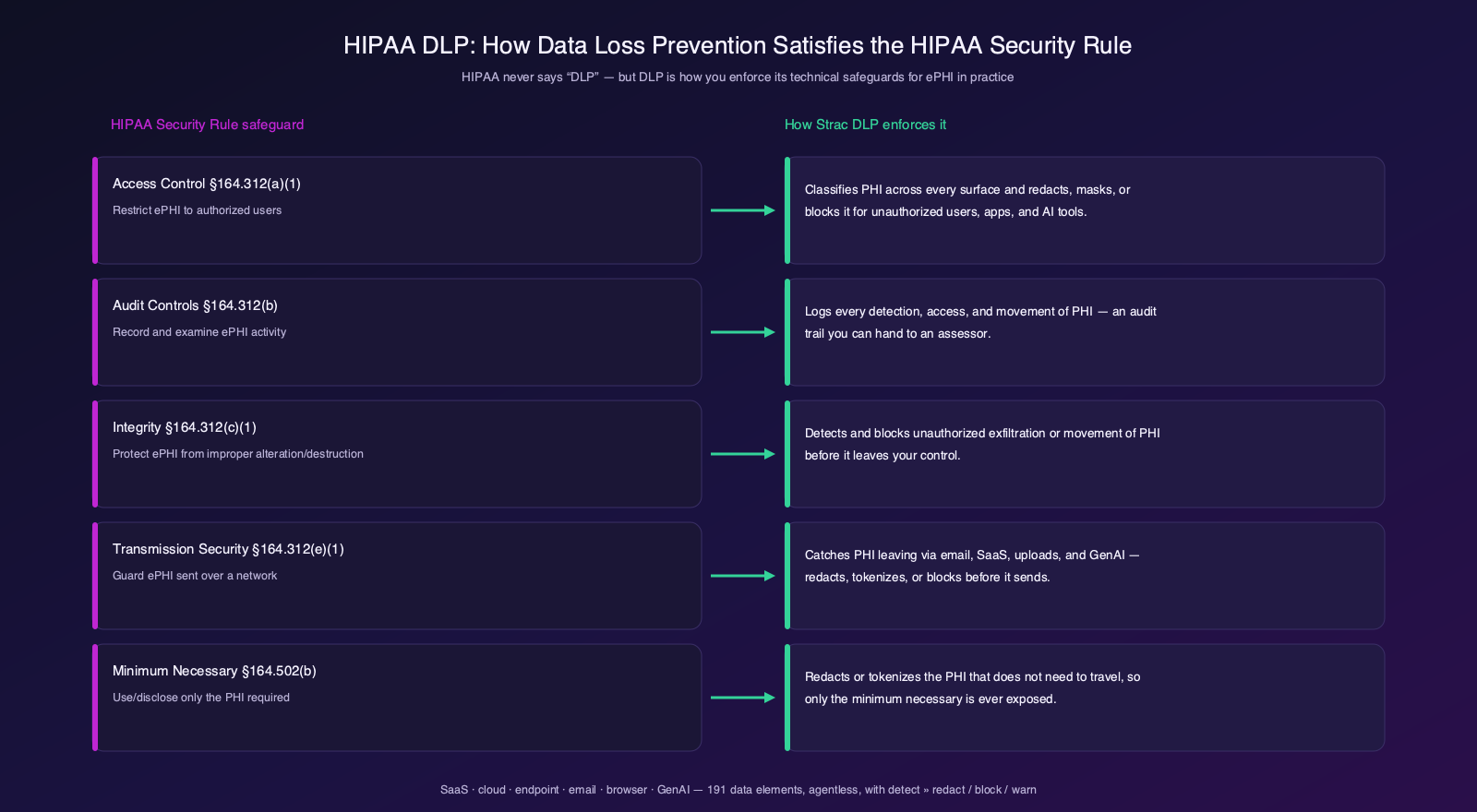
Here is the mapping between the Security Rule’s technical safeguards and what DLP does in practice:
HIPAA safeguard
How DLP enforces it
Access Control §164.312(a)
Classify PHI and restrict, redact, or mask it for users, apps, and AI tools that aren’t authorized to see it.
Audit Controls §164.312(b)
Log every detection, access, and movement of PHI — the activity record an assessor asks for.
Integrity §164.312(c)
Detect and block unauthorized exfiltration or movement of ePHI before it leaves your control.
Transmission Security §164.312(e)
Catch PHI leaving via email, SaaS, uploads, or GenAI and redact, tokenize, or block it before it sends.
Minimum Necessary §164.502(b)
Redact or tokenize the PHI that doesn’t need to travel, so only the minimum necessary is ever exposed.
Note that this covers PHI beyond the obvious database fields. The 18 HIPAA PHI identifiers include names, dates, device identifiers, and even full-face photos — which is why detection has to work on unstructured text, documents, and images, not just structured records.
Where ePHI Actually Leaks
PHI rarely leaks from the EHR itself — it leaks from everywhere around it. Common exposure points:
Surface
How ePHI escapes
Email
A record or attachment sent to the wrong address, or to a service with no BAA
SaaS & collaboration
PHI in Slack messages, Google Drive/SharePoint files, Jira tickets, Zendesk replies
Endpoints
Files copied to USB, printed, or moved to personal cloud from a laptop
Browser & GenAI
MRNs, diagnoses, and notes pasted into ChatGPT, Claude, or Copilot
Cloud storage
Unredacted scans, IDs, and lab results sitting in S3 buckets or Drive folders
Effective HIPAA DLP has to see all of these, because ePHI moves across all of them. Point tools that only watch email or only watch endpoints leave the majority of the exposure uncovered.
✨ How Strac Does HIPAA DLP
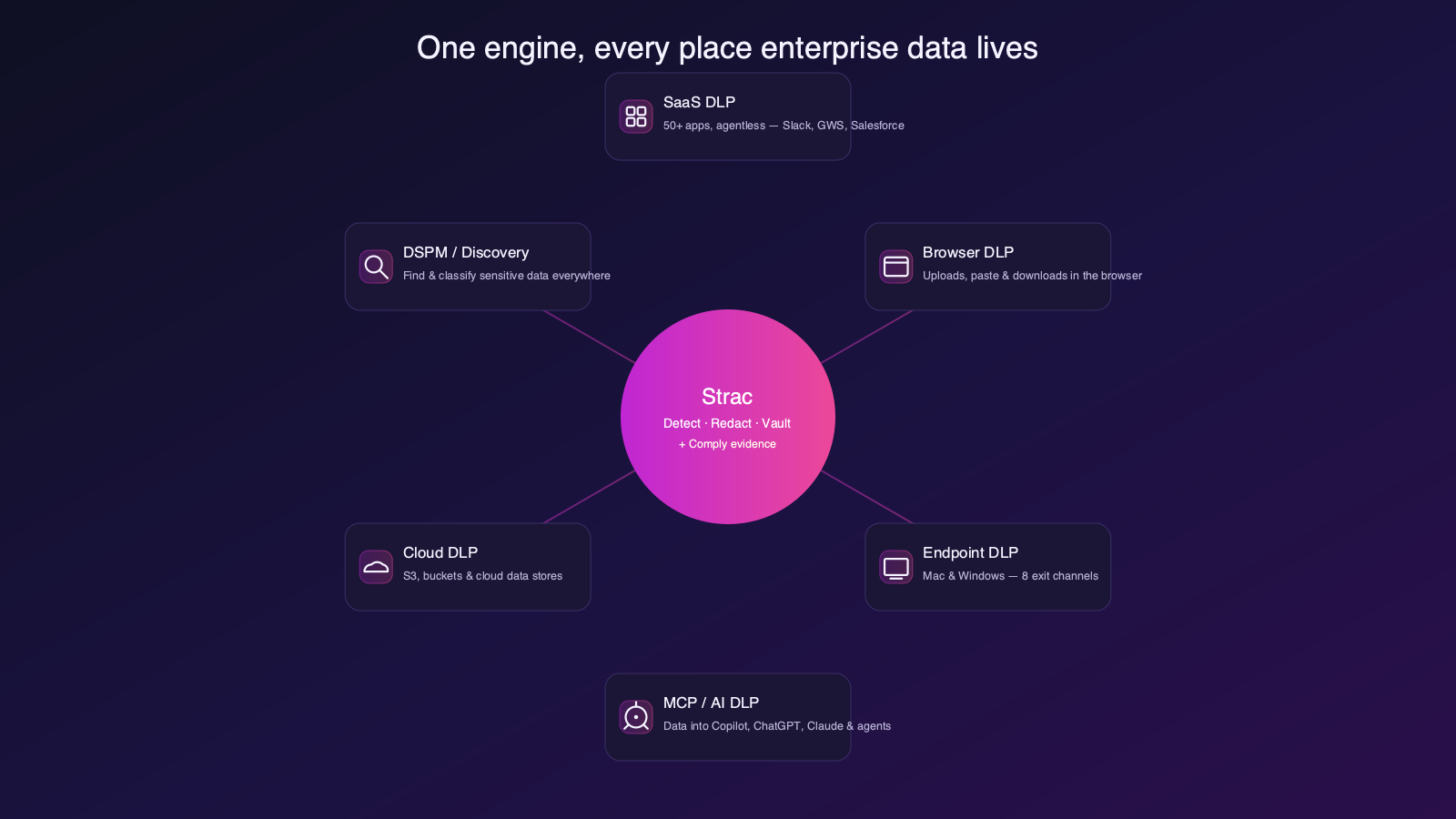
Strac discovers and protects PHI across every surface it moves through — email DLP, SaaS, cloud, endpoints, and browser and GenAI DLP — from one agentless platform. It classifies 191 data element types (including PHI identifiers), and instead of just alerting, it remediates in real time: redact, mask, tokenize, block, or warn. Every detection is logged for your audit trail, and policies map to the HIPAA safeguards above. For the full product view, see Strac HIPAA DLP and our guide to ePHI protection.
Strac detecting and redacting PHI in real time — the remediation that turns a HIPAA policy into actual enforcement.
The reason this matters: a policy document doesn’t protect a patient — enforcement does. Strac is the layer that makes “we don’t allow PHI in ChatGPT” or “PHI can’t leave over personal email” a rule the system enforces automatically, with the evidence to prove it at audit time.
One Strac policy protects ePHI across email, SaaS, cloud, endpoint, browser, and GenAI — the full surface HIPAA DLP has to cover.
HIPAA DLP Implementation Checklist
Discover PHI everywhere. Scan email, SaaS, cloud, and endpoints — not just the EHR — to find where ePHI actually lives.
Classify by PHI identifier. Detect the HIPAA identifiers in text, files, and images, including unstructured data.
Set policies to the safeguards. Map access, transmission, and minimum-necessary rules to real enforcement.
Remediate, don’t just alert. Redact, tokenize, block, or warn at the point of exposure.
Cover GenAI. Stop PHI from being pasted or uploaded into AI tools that have no BAA.
Keep the audit trail. Log detections and remediations as HIPAA evidence.
🌶️ Spicy FAQs on HIPAA DLP
Does HIPAA require DLP?
Not by name. HIPAA’s Security Rule is technology-neutral and never says ‘DLP.’ But it requires technical safeguards - access control, audit controls, integrity, and transmission security - and in a cloud/SaaS/AI environment, DLP is the practical way to enforce them for ePHI.
What counts as ePHI for DLP purposes?
Any of the 18 HIPAA identifiers in electronic form - names, dates, MRNs, device IDs, even full-face photos - when tied to health information. That’s why HIPAA DLP has to detect PHI in unstructured text, documents, and images, not just database fields.
Can DLP stop PHI from going into ChatGPT or Claude?
Yes. Browser and GenAI DLP detects PHI in prompts and uploads in real time and redacts or blocks it before it reaches the AI tool - which matters because those tools generally have no BAA.
Is email encryption enough for HIPAA?
No. Encryption protects data in transit, but it doesn’t stop PHI from being sent to the wrong recipient or to a service with no BAA. DLP inspects the content and redacts or blocks the PHI itself before it sends.
Does DLP replace a HIPAA risk assessment?
No - it supports it. A risk assessment identifies where ePHI is exposed; DLP is a primary control you implement to reduce that risk, and its audit logs become evidence that the safeguard is working.
The Bottom Line
HIPAA doesn’t name DLP, but DLP is how you turn its technical safeguards into enforcement that actually happens — across email, SaaS, cloud, endpoints, and AI. Strac discovers PHI on every surface and remediates in real time, with the audit trail to prove it. See Strac HIPAA DLP or healthcare DLP for the healthcare-wide view, or book a demo to see it on your own environment.
Does HIPAA require DLP?
Not by name. HIPAA’s Security Rule is technology-neutral and never says ‘DLP.’ But it requires technical safeguards - access control, audit controls, integrity, and transmission security - and in a cloud/SaaS/AI environment, DLP is the practical way to enforce them for ePHI.
What counts as ePHI for DLP purposes?
Any of the 18 HIPAA identifiers in electronic form - names, dates, MRNs, device IDs, even full-face photos - when tied to health information. That’s why HIPAA DLP has to detect PHI in unstructured text, documents, and images, not just database fields.
Can DLP stop PHI from going into ChatGPT or Claude?
Yes. Browser and GenAI DLP detects PHI in prompts and uploads in real time and redacts or blocks it before it reaches the AI tool - which matters because those tools generally have no BAA.
Is email encryption enough for HIPAA?
No. Encryption protects data in transit, but it doesn’t stop PHI from being sent to the wrong recipient or to a service with no BAA. DLP inspects the content and redacts or blocks the PHI itself before it sends.
Does DLP replace a HIPAA risk assessment?
No - it supports it. A risk assessment identifies where ePHI is exposed; DLP is a primary control you implement to reduce that risk, and its audit logs become evidence that the safeguard is working.
Discover & Protect Data on SaaS, AI, MCP, Endpoints & Cloud
Strac provides end-to-end data loss prevention for all SaaS and Cloud apps. Integrate in under 10 minutes and experience the benefits of live DLP scanning, live redaction, and a fortified SaaS environment.


.webp)








.avif)


.webp)


.gif)
