Intercom MCP Server: Secure Setup for Claude & AI Agents (2026)
The Intercom MCP server lets Claude, Cursor, ChatGPT, and AI agents read conversations, contacts, tickets, and attachments. Setup, the real security risks, and how to deploy with DLP-grade redaction at the MCP layer.
The Intercom MCP server is the path for AI agents (Claude, Cursor, ChatGPT, Perplexity, custom agents) to read and act inside Intercom via the Model Context Protocol — conversations, contacts, companies, tickets, attachments, articles, and macros.
Intercom is one of the highest-PII-density SaaS surfaces in any enterprise. Customer support conversations routinely contain names, email addresses, phone numbers, account IDs, credit cards (pasted by customers), health information (in healthcare apps), API keys, and screenshots with sensitive content. The moment an AI agent reads those conversations via MCP, all of it is in the model context window — outside Intercom's native controls.
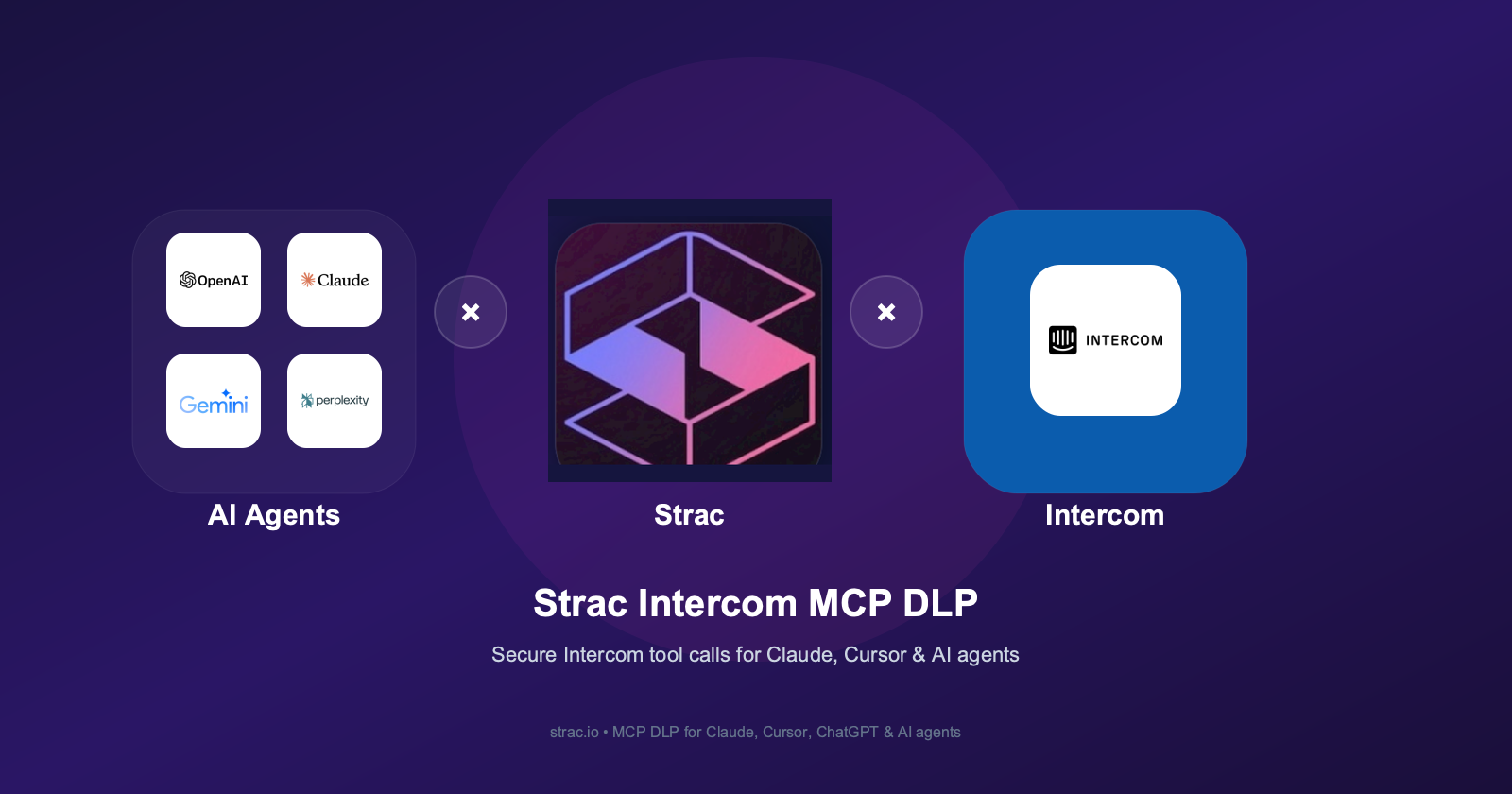
Strac Intercom MCP DLP is the governance layer for AI-agent access to Intercom. It sits as a gateway in front of the Intercom MCP server and governs every tool call — controlling which agent can take which action (allow, block, or require approval on high-risk actions), protecting the customer PII and payment data in conversations via redaction, masking, and vaulting before it reaches the model, and logging every call as audit evidence. Strac has shipped Intercom DLP for the broader Intercom surface for years; the MCP layer extends the same control model into the AI agent path.
Setup is agentless and under 10 minutes per workspace. No application code changes, no agent SDK changes, no Intercom re-permissioning.
✨ What Is the Intercom MCP Server?
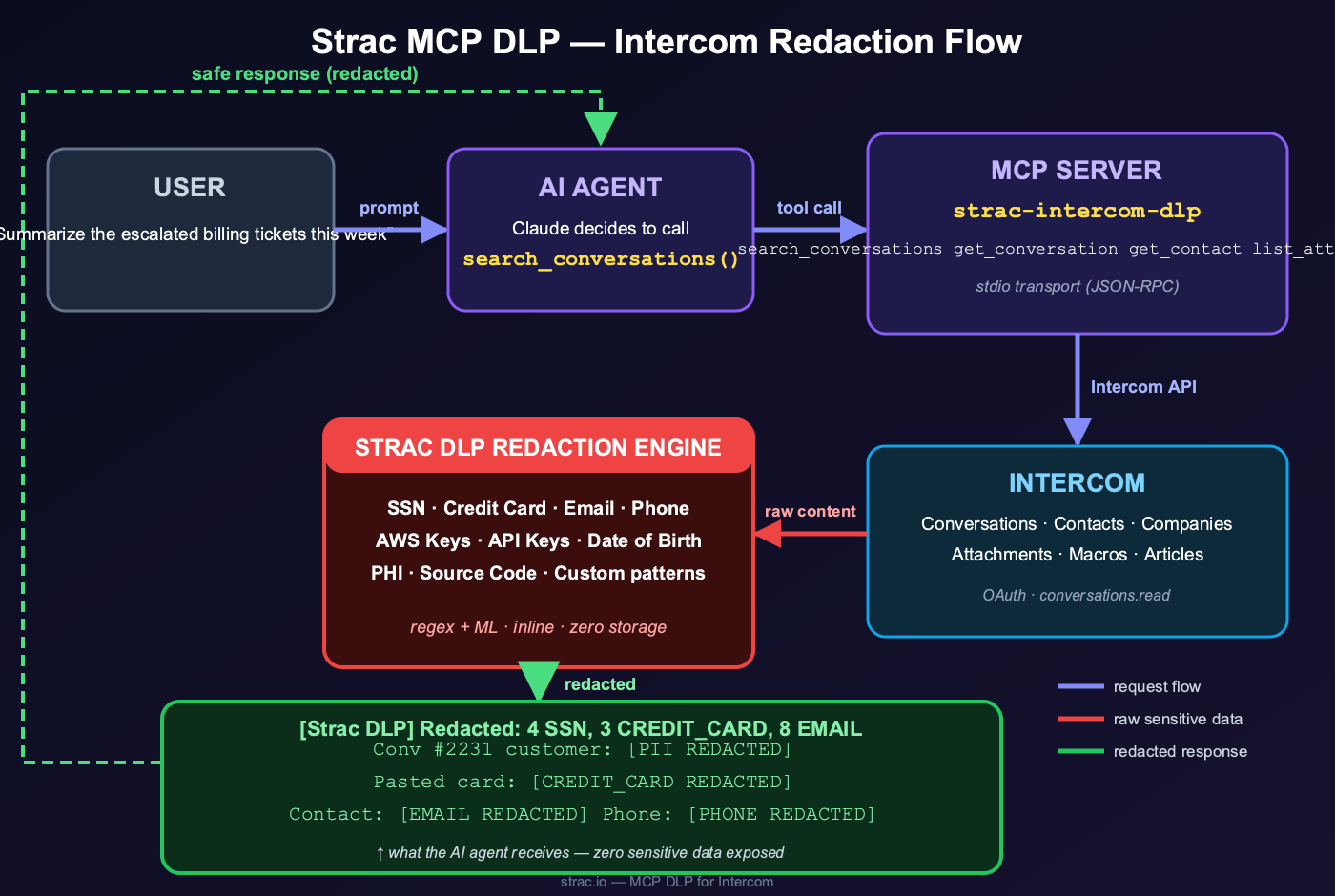
The Intercom MCP server is a Model Context Protocol implementation that exposes Intercom's API as a standardized set of tools to AI agents. Once connected, an agent like Claude can perform search_conversations, get_conversation, get_contact, list_attachments, and macro operations on the authenticated user's behalf — turning Intercom's API surface into AI-actionable capabilities.
The setup pattern is consistent with other MCP integrations: an Intercom OAuth app registered in the Developer Hub, the appropriate scopes (conversations.read, contacts.read, depending on use case), and the server starts serving tool calls.
From the user's perspective, the AI agent suddenly knows every customer conversation in the org. From the security perspective, the AI agent now has read access — and often write access — to every conversation, contact record, and attachment the user can touch in Intercom.
That's the value. It's also where security teams need a control layer.
Beyond redacting or blocking, Strac can also pseudonymize or de-identify the data on a Intercom MCP tool call — swapping PII, PHI, and PCI for realistic, format-preserving fakes — so a team can keep using the data in an AI model, analytics, or a test environment while the real records never leave your control. See Data Pseudonymization.
What AI Agents Can Actually Do With Intercom MCP
Forget the risk for a second — this is what the agent actually does. Once Claude or another agent is connected to the Intercom MCP server, it stops being a chat window and starts acting on your support data directly. The concrete workflows that drive adoption:
Summarize conversations and customer history. "Catch me up on this account" pulls the full conversation thread plus prior tickets and resolutions, so an agent reads the whole relationship in seconds instead of scrolling.
Draft replies (write). The agent composes a reply in-thread — proposing the refund wording, the troubleshooting steps, the apology — ready for a human to send or auto-send under policy.
Search conversations and contacts. Natural-language queries like "find every churn-risk thread from this quarter" or "which contacts reported the billing bug" resolve across the workspace, not just the open inbox.
Surface account context for a customer. Given an email or contact, the agent assembles plan, company, lifecycle stage, and custom attributes into a single brief before the rep replies.
Triage the inbox by priority. The agent reads the open queue and ranks it — VIP accounts, refund disputes, security reports first — so the team works the highest-stakes conversations first.
That reach is exactly why governance has to come with it. Each agent's access and actions need to be controlled, the customer data inside those conversations protected, and every call audited — otherwise the same connector that summarizes an account also exfiltrates it.
The Real Security Risks of the Intercom MCP Server
The risks fall into four categories that every healthcare, fintech, and consumer-app security team should price into the deployment.
1. Conversation search returns regulated payloads.search_conversations for "refund", "can't log in", or "payment" matches across every conversation the user can read — including conversations where customers have pasted full credit card numbers, account credentials, screenshots with PHI, and identity documents. The agent retrieves the matches and writes them into the model context.
2. Contact records carry full PII.get_contact returns email, phone, location, attributes, and custom fields. Healthcare apps store PHI in custom contact fields. Fintech apps store account identifiers. All of it flows back to the model on a single tool call.
3. Attachments include screenshots and image-based PDFs.list_attachments returns image-content (screenshots customers send to demonstrate a bug), image-based PDFs (insurance cards, IDs), and document attachments — all of which can contain regulated data invisible to text-only DLP.
4. Macros, articles, and AI Fin training data leak internal context. Internal-only macros and Help Center drafts often contain process notes, internal account IDs, and references to customer escalation patterns. An agent retrieving "summarize how we handle billing disputes" can pull internal-only operational content into the model.
The traditional DLP a company already runs does not sit in the MCP path. The tool response goes straight from Intercom into the AI agent's context window. That's the gap Strac Intercom MCP DLP fills.
Intercom MCP for Claude (Claude Desktop, Claude Code, Claude Cowork)
The most common Intercom MCP deployment in 2026 is Claude as the AI client — particularly for "summarize today's escalations" or "find patterns in churn-risk conversations" workflows. The setup pattern:
Register an Intercom OAuth app with the required scopes (conversations.read, contacts.read, articles.read, depending on use case).
Add the Intercom MCP server as a custom connector in Claude Desktop, Claude Code (CLI), or Claude for Cowork.
Claude can now call search_conversations, get_conversation, get_contact, and related tools on the user's behalf.
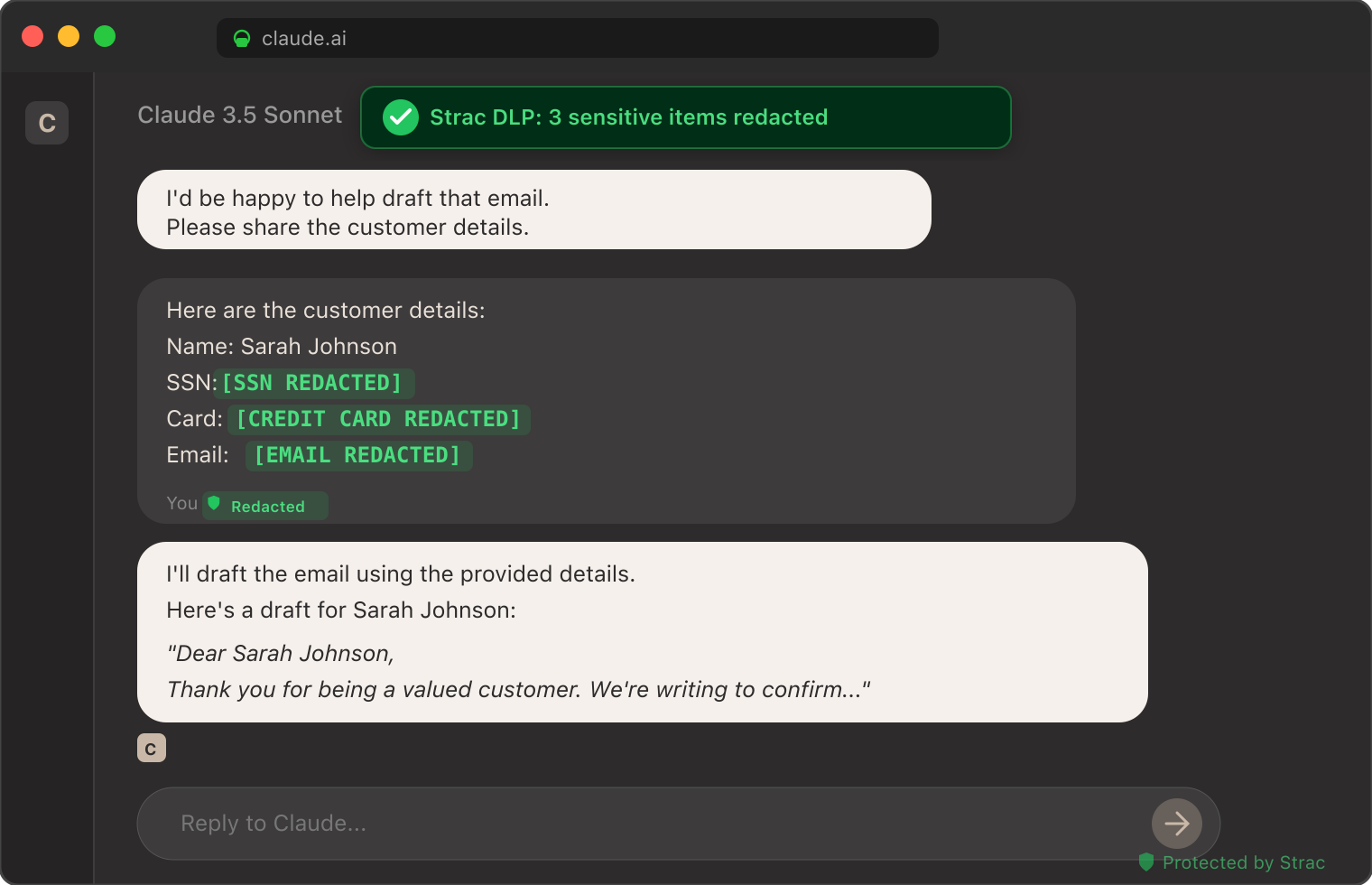
The Claude Cowork BAA gap matters here, especially for Intercom. Anthropic does not currently offer a Business Associate Agreement (BAA) for Claude consumer or Claude Cowork plans. For healthcare apps running Cowork against Intercom (where customer conversations routinely contain PHI), that's HIPAA exposure the moment a tool call crosses into the model context. Strac Intercom MCP DLP redacts PHI at the tool-call boundary so the model never sees the regulated data in the first place — closing the gap without depending on Anthropic to ship a BAA. See Is Claude HIPAA compliant? for the full vendor breakdown, and MCP security for the broader architecture.
For Claude Code / Cursor / ChatGPT deployments, the same Strac control plane applies — vendor-independent.
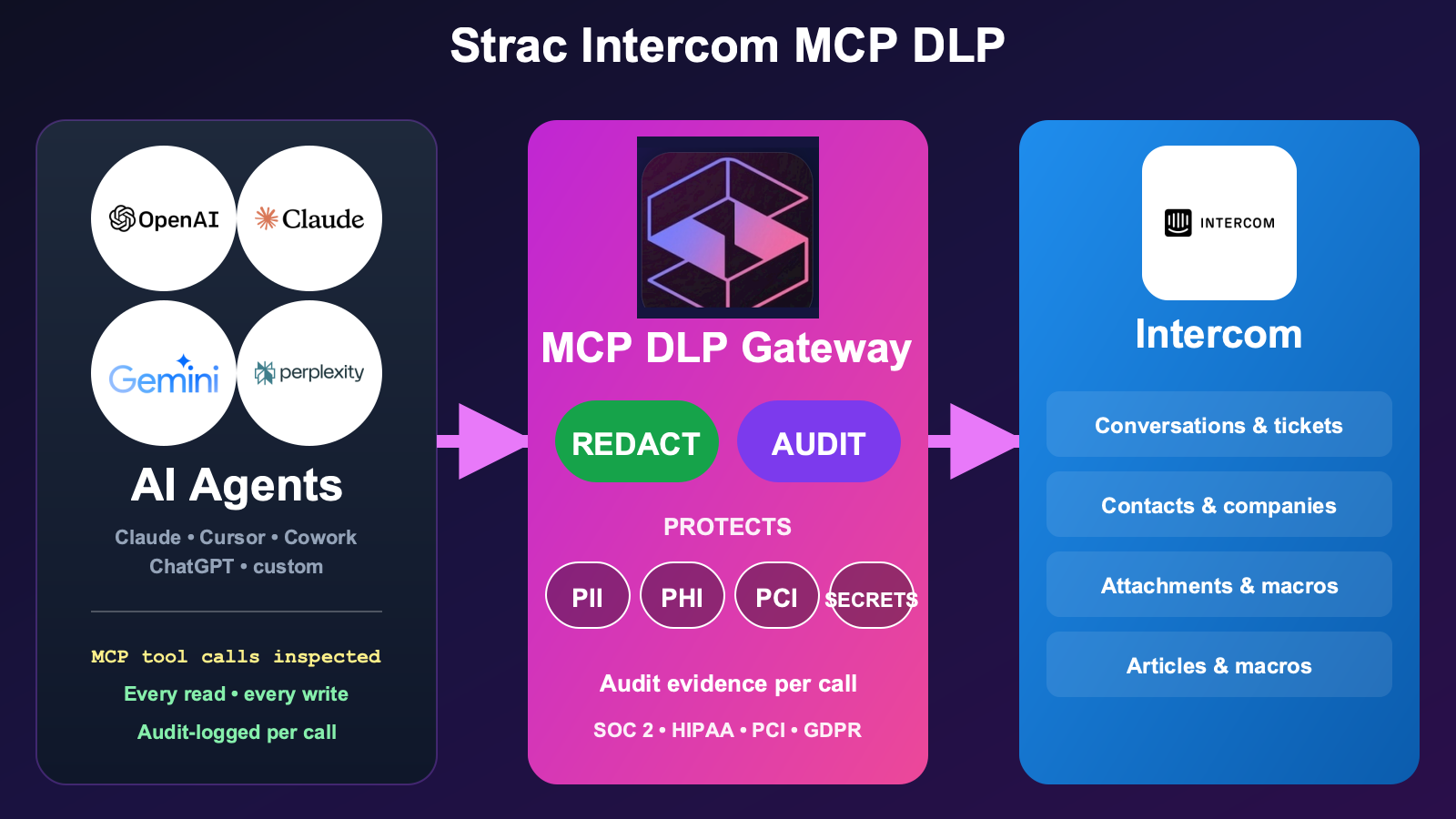
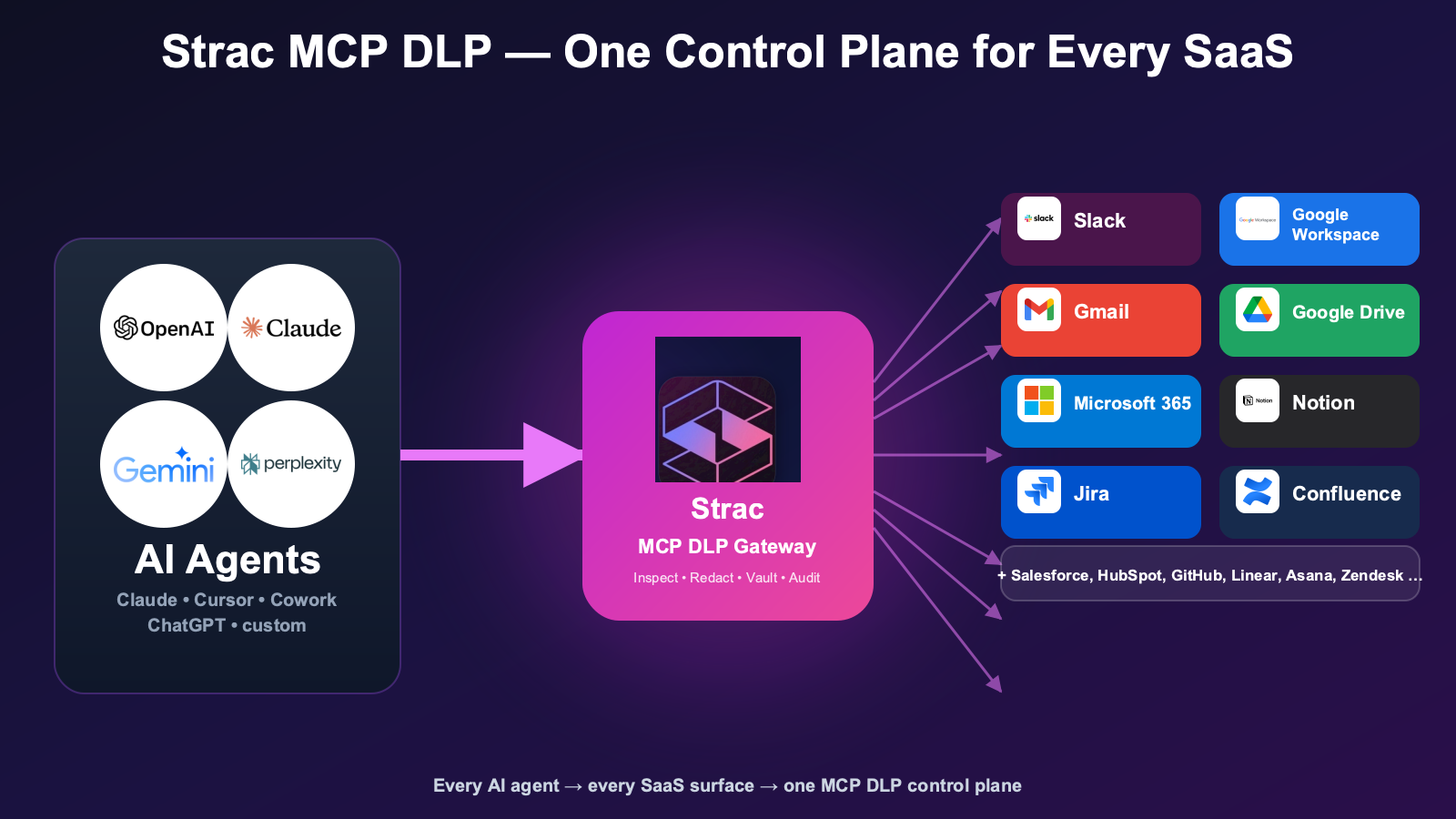
Strac is the governance layer for AI-agent access to Intercom — it lets you See every tool call between an agent and Intercom, Control which agent can take which action (allow, block, or require approval on high-risk actions like writes and bulk reads), Protect the customer data in every response by redacting, masking, or vaulting it before it reaches the model, and Prove it all with an audit log of every call. Strac wraps the official Intercom MCP server as a gateway: every tool call from an AI agent passes through Strac before reaching Intercom, and every Intercom response passes through Strac before reaching the model.
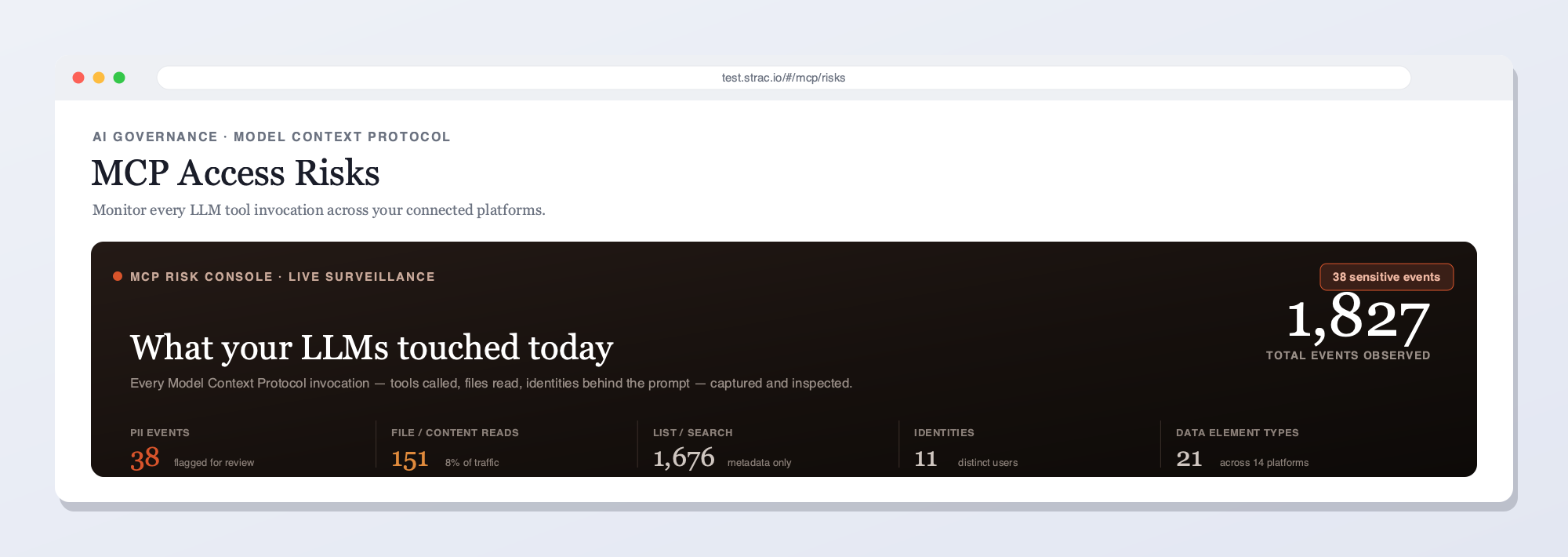
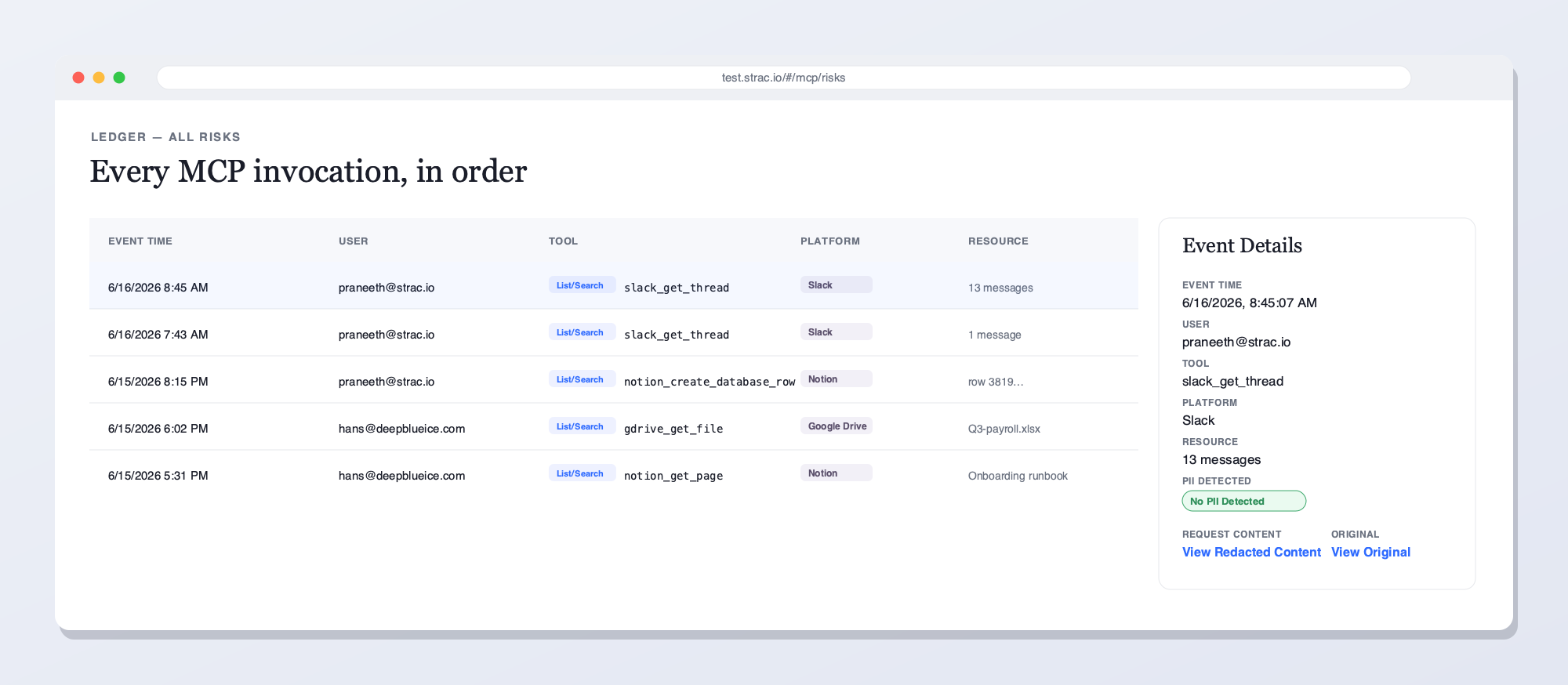
Strac's live MCP Access console — every AI agent tool call touching Intercom and your other connected platforms, captured and inspected for sensitive data in real time. See what your LLMs reached for, who prompted, and what was flagged.Every MCP invocation in order — user, tool, platform, and the sensitive data found — with redacted vs. original content and a full audit trail. This is what Strac shows on Intercom that access-only gateways can't: the data in each call, not just the call.
Access control alone is not enough
Knowing an agent ran a Intercom tool does not stop the PII in a customer conversation from reaching the model. Strac governs the access and the data: it remediates sensitive content in every response — redact, mask, block, delete, or revoke access — and enforces allow/block per agent, and proves it with a per-call audit log that access-only gateways cannot produce.
What Strac does on every Intercom tool call
One inline pass over each MCP response — five actions, enforced by your policy:
Detect — finds PII in a conversation and any PII, PHI, PCI, secrets, or source code in the payload, including text inside images via OCR.
Redact or mask — replaces the sensitive elements inline, so the agent still gets its answer and the model never sees the raw data.
Block or require approval — stops a high-risk action like a message send or contact export, or routes it for sign-off before it runs.
Alert — notifies your team and streams the event to your SIEM (Splunk, Microsoft Sentinel, Datadog) in real time.
Audit — logs who, which agent, which tool, what data, and the action taken — evidence mapped to SOC 2, HIPAA, PCI DSS, and GDPR.
Inspect every tool call payload using Strac's catalog of sensitive data elements — PII, PHI, PCI, credentials, source code, and any custom data class you define.
Redact sensitive fields inline, or tombstone entire responses based on policy. Conversation bodies with pasted credit cards are masked. Screenshots attached to bug reports are OCR-inspected for embedded PHI. Contact records with regulated custom fields are filtered.
Vault redacted content in Strac's encrypted store, with re-identification gated by RBAC for the small subset of users who need the raw value.
Audit every call with full provenance: agent identity, tool name, timestamp, returned-data classification, and remediation action. The same audit feed powers compliance evidence for SOC 2, HIPAA, PCI, ISO 27001, GDPR, and the EU AI Act.
Setup is agentless and under 10 minutes per Intercom workspace.
Strac Intercom DLP — The Broader Surface
Strac's Intercom protection is not new. Strac ships Intercom DLP for the broader Intercom surface — real-time inspection of every conversation message, attachment, and macro for sensitive data, with redaction at the point the data enters Intercom (not just when an agent reads it). The MCP layer extends that protection into the AI agent path:
Real-time inspection of every conversation message, attachment, and macro for PII, PHI, PCI, secrets.
OCR inspection of screenshots and image-based PDFs attached to conversations.
Automatic remediation — redact, mask, alert, or block — based on policy.
Audit logs mapped per finding to SOC 2 CC6, HIPAA Security Rule, PCI Req. 3/4/7/10, GDPR.
The MCP layer adds: agent-aware redaction at the tool-call boundary, on top of the message-time redaction that Strac Intercom DLP already provides.
✨ The Strac MCP DLP Constellation
Intercom joins Strac's MCP DLP coverage across every major SaaS surface AI agents touch:
Two requirements decide an Intercom rollout. You control how data is scrubbed — mask a customer's details, redact PII in a conversation, or write a custom regex — via a managed contextual classifier rather than a Presidio or Bedrock stack you maintain. And the protection wraps the MCP tools your team builds on Intercom data, internal and external alike, beyond the connector.
🌶️ Spicy FAQs for Intercom MCP Server
Can I use the Intercom MCP server with Claude Desktop or Claude Code?
Yes. The Intercom MCP server is set up as a custom connector in Claude Desktop, Claude Code, or Claude for Cowork — the same pattern as other MCP integrations. You register an Intercom OAuth app, paste the client ID/secret into the Claude connector config, and Claude can call search_conversations, get_conversation, get_contact, and related tools. For HIPAA-regulated content, route the connector through Strac Intercom MCP DLP so PHI is redacted before reaching the model context. See Is Claude HIPAA compliant? for the BAA picture.
Is the Intercom MCP connector the same as the Intercom MCP server?
Interchangeable. The MCP spec says server; Claude's Connectors directory calls it the Intercom connector. It opens the same conversations and customer history under either name, and Strac's Intercom MCP connector masks PII and payment data before the model reads a thread.
Intercom MCP vs Fin AI Agent — what's the difference?
They sit on opposite sides of the boundary. The Intercom MCP server is how external AI agents — Claude, Cursor, ChatGPT — reach into Intercom over the Model Context Protocol to read and act on your conversations. Fin is Intercom's native AI support agent, running inside the Intercom tenant on Intercom's own infrastructure and controls. With MCP, the moment Intercom hands a tool-call result back to the external client, that data leaves Intercom's perimeter and lands in the model context. That hand-off back to the external client is exactly where Strac Intercom MCP DLP governs — controlling which agent can call which tool, protecting the customer data in the response via redaction, masking, and vaulting, and auditing every call.
How does Strac handle customer-pasted credit cards in Intercom conversations?
Customers routinely paste full credit card numbers into Intercom chat ("here's the card I was trying to use"). This is one of the most common PCI compliance failures in customer-facing apps. Strac Intercom DLP catches the paste at the conversation layer; Strac Intercom MCP DLP catches the same data again at the tool-call layer when an AI agent retrieves the conversation. Layered, agent-aware, audit-ready.
Does Strac inspect Intercom attachments and screenshots?
Yes. Strac inspects every attachment via OCR — screenshots customers send to demonstrate a bug, image-based PDFs of insurance cards or IDs, document attachments. Sensitive data inside images is detected and redacted at the MCP boundary.
How is Intercom MCP DLP different from Intercom's native AI features (Fin, AI Copilot)?
Intercom's native AI features (Fin, AI Copilot) run inside the Intercom tenant on Intercom's infrastructure under Intercom's controls. The Intercom MCP server is the path where external AI clients (Claude, Cursor, ChatGPT) read Intercom data. Strac Intercom MCP DLP protects that external path — what Intercom's own AI controls cannot see, because the data has left Intercom's perimeter.
Can I use the Intercom MCP server with Cursor, ChatGPT, or Perplexity?
Yes. The MCP protocol is vendor-independent. Strac's Intercom MCP DLP sits between any MCP-aware client (Claude, Cursor, ChatGPT, Perplexity, custom agents) and the Intercom API.
What about Intercom AI Fin training data?
Internal-only macros, Help Center drafts, and operational notes are sometimes used as Fin training data. An MCP-connected external agent retrieving "summarize our billing dispute process" can pull that internal context into the model. Strac filters internal-only content categories per policy so they don't leak out to external AI clients.
Is the Intercom MCP server safe for healthcare use?
The Intercom MCP server itself is just a transport layer. Safety for healthcare depends on three things: (1) the Intercom tenant has a BAA in place (Intercom supports HIPAA on certain plans); (2) the AI client has its own BAA (ChatGPT Enterprise, M365 Copilot, Gemini Workspace yes; Claude Cowork no); (3) sensitive data is redacted at the MCP tool-call boundary before reaching the model. Strac handles (3). See MCP security for the full risk landscape.
How fast is the deployment?
Under 10 minutes per Intercom workspace. Agentless: no application code changes, no Intercom re-permissioning, no agent SDK rewrites.
Does Strac log every Intercom MCP tool call?
Yes. Every tool call generates an audit event with full provenance — agent identity, tool name, timestamp, returned-data classification, and remediation action. Audit logs export to SIEM and GRC platforms; pre-built mappings cover SOC 2 CC6, HIPAA Security Rule, PCI Req. 3/4/7/10, GDPR Art. 5/25/30/32, EU AI Act Article 12, and ISO 42001 Annex A.8.
What's the difference between Strac Intercom DLP and Strac Intercom MCP DLP?
Strac Intercom DLP enforces user-facing policy at the Intercom conversation layer — real-time scanning of customer-pasted content, redaction of credit cards in messages, attachment OCR. Strac Intercom MCP DLP enforces agent-facing policy at the MCP tool-call layer — inspects and redacts what AI agents retrieve from Intercom. Most enterprises deploy both for full coverage — message-time + agent-time.
Strac keeps Intercom agents honest on three fronts: per-user identity so teammate and inbox permissions apply, response-leg inspection so indirect prompt injection in Intercom results is caught, and endpoint visibility into which Intercom servers are actually configured. The same endpoint agent that guards the browser also reads MCP client configs, so identity, prompt-injection defense, and shadow-MCP discovery all hold whether the traffic passes a gateway or not.
The Bottom Line
Intercom is the PII-richest SaaS surface in most consumer-facing apps. The 2026 risk is agent-aware: AI clients reading customer conversations via MCP get all of that PII in the model context. Strac is the data-layer control that closes the gap — built on top of Strac's existing Intercom DLP integration.
Can I use the Intercom MCP server with Claude Desktop or Claude Code?
Yes. The Intercom MCP server is set up as a custom connector in Claude Desktop, Claude Code, or Claude for Cowork — the same pattern as other MCP integrations. You register an Intercom OAuth app, paste the client ID/secret into the Claude connector config, and Claude can call search_conversations, get_conversation, get_contact, and related tools. For HIPAA-regulated content, route the connector through Strac Intercom MCP DLP so PHI is redacted before reaching the model context. See Is Claude HIPAA compliant? for the BAA picture.
Is the Intercom MCP connector the same as the Intercom MCP server?
Interchangeable. The MCP spec says server; Claude's Connectors directory calls it the Intercom connector. It opens the same conversations and customer history under either name, and Strac's Intercom MCP connector masks PII and payment data before the model reads a thread.
Intercom MCP vs Fin AI Agent — what's the difference?
They sit on opposite sides of the boundary. The Intercom MCP server is how external AI agents — Claude, Cursor, ChatGPT — reach into Intercom over the Model Context Protocol to read and act on your conversations. Fin is Intercom's native AI support agent, running inside the Intercom tenant on Intercom's own infrastructure and controls. With MCP, the moment Intercom hands a tool-call result back to the external client, that data leaves Intercom's perimeter and lands in the model context. That hand-off back to the external client is exactly where Strac Intercom MCP DLP governs — controlling which agent can call which tool, protecting the customer data in the response via redaction, masking, and vaulting, and auditing every call.
How does Strac handle customer-pasted credit cards in Intercom conversations?
Customers routinely paste full credit card numbers into Intercom chat ("here's the card I was trying to use"). This is one of the most common PCI compliance failures in customer-facing apps. Strac Intercom DLP catches the paste at the conversation layer; Strac Intercom MCP DLP catches the same data again at the tool-call layer when an AI agent retrieves the conversation. Layered, agent-aware, audit-ready.
Does Strac inspect Intercom attachments and screenshots?
Yes. Strac inspects every attachment via OCR — screenshots customers send to demonstrate a bug, image-based PDFs of insurance cards or IDs, document attachments. Sensitive data inside images is detected and redacted at the MCP boundary.
Discover & Protect Data on SaaS, AI, MCP, Endpoints & Cloud
Strac provides end-to-end data loss prevention for all SaaS and Cloud apps. Integrate in under 10 minutes and experience the benefits of live DLP scanning, live redaction, and a fortified SaaS environment.


.webp)





.avif)




.gif)
