September 18, 2026

7
min read
Understanding Data Loss Prevention Development Toolkit
Discover the importance of a Data Loss Prevention Development Toolkit and how Strac’s advanced features enhance data protection and compliance for organizations.
· A data loss prevention development toolkit givesengineering teams programmatic detection, redaction, tokenization andremediation, so sensitive data is handled correctly inside the product ratherthan cleaned up after it leaks.
· The risk moved into code. Customer records nowflow through support tools, logs, LLM prompts and MCP DLP connectors that thedeveloper wired up, and no network appliance sits in that path.
· Most DLP products were built for securityadmins, not for developers. They scan after the fact and expose little that anengineer can call from a service.
· Strac pairs a developer toolkit (detect, redact,tokenize, vault and proxy APIs) with a no code DLP platform across SaaS, Cloud, Browser, GenAI and MCP,so one detection engine covers both the code you ship and the tools yourcompany runs.
· This post is the builder's slice of AI data governance.Read it alongside the guide to DLP APIs.
A data loss prevention development toolkit, often shortened to DLP toolkit or DLP development kit, is a collection of services a developer can call to identify sensitive data and do something about it. Detection answers what the data is. Remediation decides what happens next: mask it, replace it with a token, block the request, or alert someone.
The difference from a classic DLP product is who holds the controls. A security admin configures a policy in a console and waits for alerts. A developer calls a DLP API at the exact moment a record is written, sent, logged or passed to a model.
Two short examples. A fintech app stores card numbers only as tokens, and its support team sees the last four digits and nothing more. A healthcare platform redacts patient identifiers from every message before it lands in a ticketing tool, which keeps that tool out of HIPAA scope.
Older guides describe a DLP toolkit as a scanner, a set of regex rules and a compliance report. That model assumed data sat in known places and moved through a network you owned. Neither is true anymore.
Three changes broke it.
Data moves through APIs, not networks. A webhook posts a customer record to a third party. A log line captures a full request body. A sync job copies a table into a warehouse. Each path is code, and each one is invisible to a gateway.
Generative AI became a destination inside the product. Teams add summarization, search and chat features that send user content to a model. If the prompt carries an unredacted record, the model provider now holds it. That is the problem AI DLP exists to solve.
Agents became callers. An agent reaches a helpdesk, a repository or a database through an MCP server, and the tool response carries whatever the record contained. There is no human in the loop to notice. Securing that path is what MCP DLP is for.
Here is the shift in one line. The old toolkit watched the exits; the new one makes the data safe before it ever reaches an exit.
A toolkit worth adopting in 2026 has six parts. Missing any one of them pushes work back onto your engineers.
1. Detectors that understand context. Built in detectors for PII, PHI, PCI data, credentials and API keys, backed by a published catalog of sensitive data elements. Good detectors use surrounding context, not just a pattern, which is what keeps false positives low.
2. Custom detectors. Nobody ships a detector for your internal customer ID or account format. You need to define your own without a services engagement, and apply them everywhere the built in ones run.
3. Coverage beyond plain text. PDFs, Word files, spreadsheets, zip archives, screenshots and scanned images. Optical character recognition matters here, because a photo of a passport is still a passport. A PII scanner that reads only text will miss the riskiest files.
4. Remediation, not just detection. Redaction, data masking, tokenization, blocking, alerting and deletion, each callable from code. A finding with no action attached is just a longer to do list.
5. A vault and a proxy. Tokenization is only useful if the originals live somewhere safe and your services can still use them. A proxy lets your backend send a token to a payment processor or partner API while the real value is swapped in outside your systems.
6. Feedback and evidence. An API to mark false positives, query findings and pull audit events, so detection improves over time and your SOC 2, ISO 27001, PCI DSS and NIST evidence comes from the same system that enforced the policy.
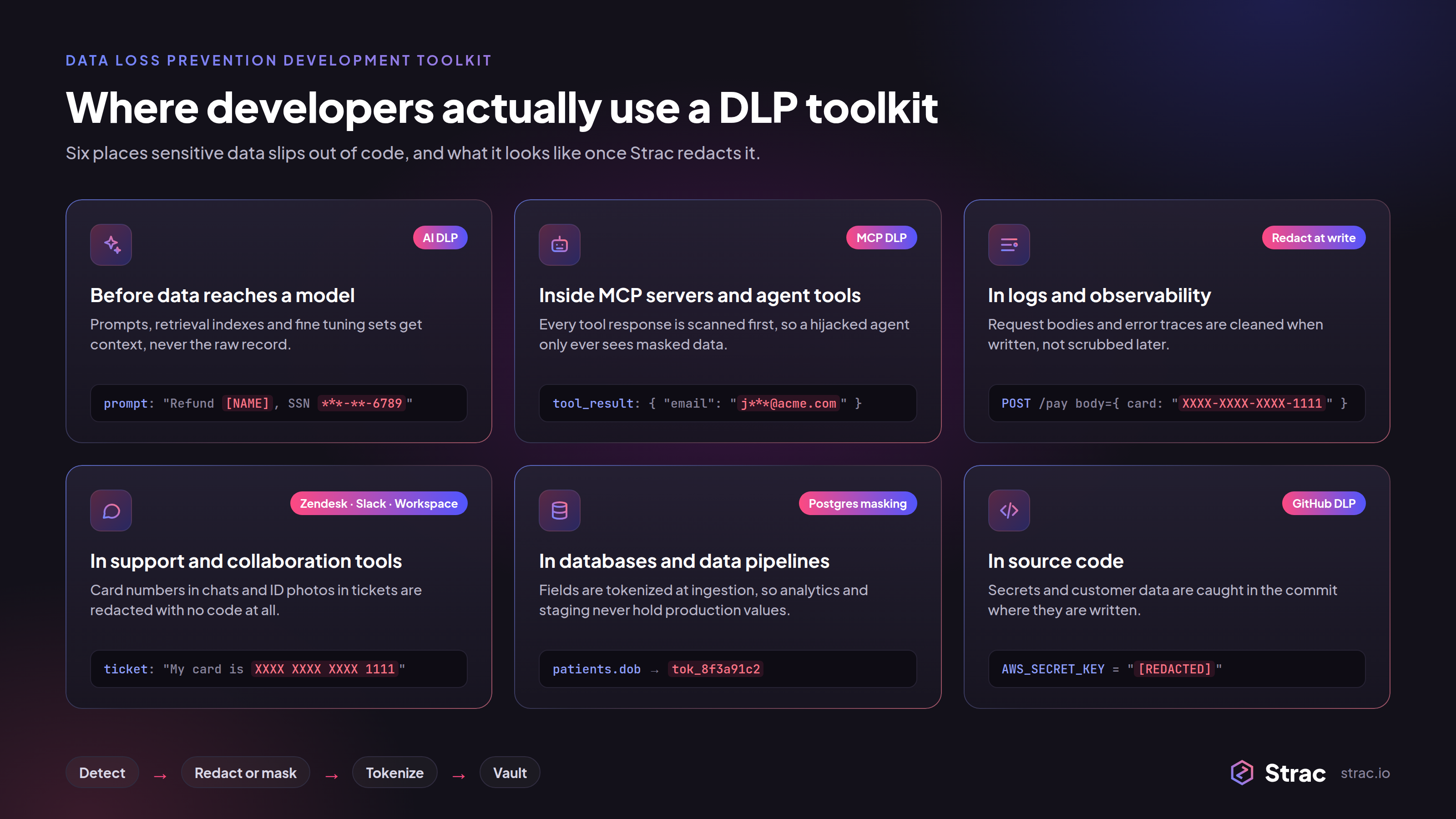
The use cases have narrowed to a handful that show up in almost every engineering team.
Before data reaches a model. Redact names, identifiers and secrets from user content before it goes into a prompt, a retrieval index or a fine tuning set. The model still gets useful context. It never gets the raw record. This is the core of AI DLP for teams building their own AI features.
Inside MCP servers and agent tools. Wrap the tool response so that anything returned to an agent is scanned and redacted first. A hijacked agent can then pull only masked data, which is why MCP DLP belongs in the server, not bolted on afterwards.
In logs and observability. Request bodies and error traces are one of the most common places sensitive data ends up by accident. Redacting at write time is far cheaper than scrubbing a log store later.
In support and collaboration tools. Customers paste card numbers into chat widgets and attach ID photos to tickets. Automatic redaction in Zendesk DLP, Slack DLP and Google Workspace DLP handles this without any code at all.
In databases and data pipelines. Tokenize or mask fields at ingestion so analytics and staging environments never hold production values. Postgres data masking is a common starting point.
In source code. Secrets and customer data committed to repositories are a quiet, long lived exposure. GitHub DLP catches them where they are written.
The test of a toolkit is how little code it takes to go from raw input to safe output.
In practice the flow looks like this. Your service sends a document or a block of text to the detect endpoint. The response lists each finding with its type and location. You then call redact with the mode you want: blank the value, mask all but the last characters, replace it with a label, or swap it for a token that links back to the vault. For card data or identity numbers you want to keep, you tokenize instead, store the token, and let the outbound proxy put the real value back only when a trusted third party needs it.
Most teams skip the two step version entirely and call redact directly, because detection and remediation in one request is what keeps latency acceptable inside a user facing path.
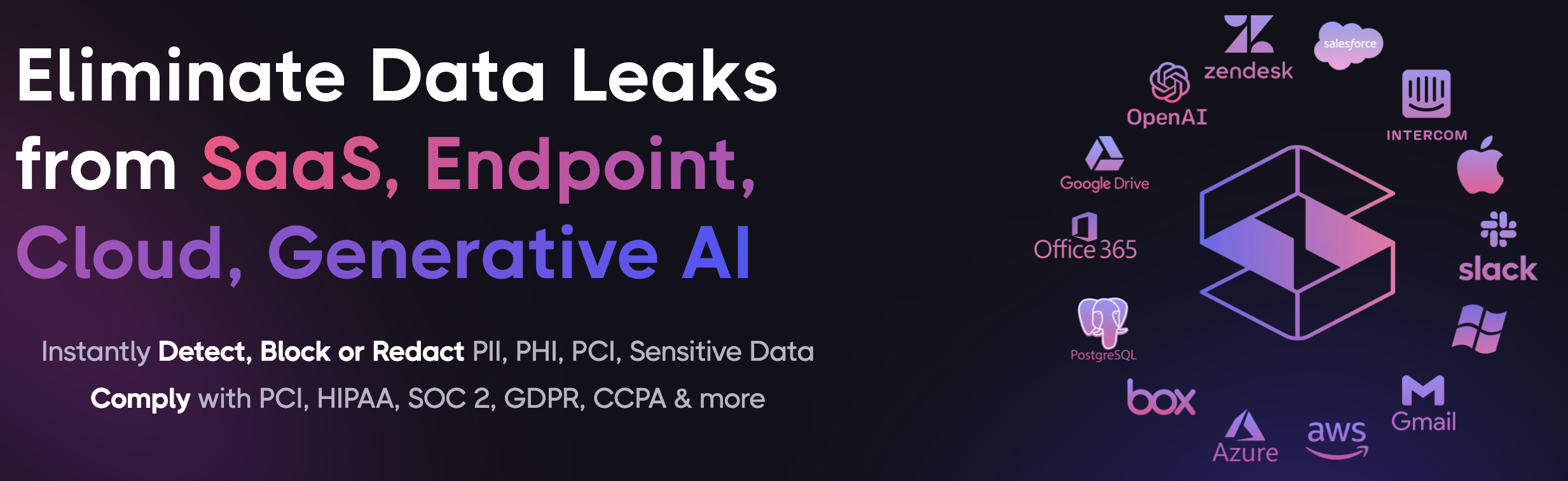
Strac is a Data Loss Prevention (DLP), Data Discovery and DSPM platform covering SaaS, Cloud, Browser, GenAI and MCP, with automated remediation. For engineering teams it is also a toolkit, and both run on the same detection engine.
For developers, the Strac API docs cover detect, redact and redact text endpoints, tokenization and detokenization, a document vault, and outbound, inbound, webhook and SFTP proxies that let your systems work with tokens instead of raw values. A data security risk API and an audit events API expose findings and activity, and a false positive endpoint feeds corrections back into detection.
For security teams, the same engine runs without code. Sensitive data discovery and classification scans SaaS apps, AWS, Azure, GCP, databases and file shares, including historical data. Endpoint DLP covers Mac, Windows and Linux. Browser DLP inspects pastes and uploads in Chrome and Edge. Prompts to ChatGPT DLP, Claude DLP, Gemini and Copilot are inspected before they leave the device, and shadow AI tools are discovered along the way. MCP integrations put the same checks on agent traffic, and data lineage tracks where a sensitive file came from and where it went.
Remediation runs in a fixed order across every surface:
The practical result is one policy language and one set of findings. A detector you write for your own customer ID applies to your API calls, your Slack workspace and your agents at the same time. Browse the full list of integrations to see what connects out of the box.
Days 1 to 10, map the data paths. List every place your product sends user content: third party APIs, logs, LLM calls, MCP tools, support tools and analytics. Run data classification on the stores you already have so you know what is sitting there today.
Days 11 to 20, redact the riskiest path. Pick the single path with the most sensitive data, usually LLM prompts or support tickets, and put redaction in front of it. Measure false positives before you tighten anything.
Days 21 to 30, tokenize and prove. Move card and identity numbers to tokens, route outbound calls through the proxy, and connect findings to your SIEM. Write the rules down as a DLP policy so security and engineering work from the same document.
Before you call it done, check:
Related reading: DLP APIs, AI DLP, MCP DLP, shadow AI, best DLP tools.
A data loss prevention development toolkit is no longer a scanner and a compliance template. It is the set of calls your engineers make so that prompts, logs, tickets and agent responses never carry raw sensitive data in the first place. Identity, model and network controls will fail at some point, and the data layer is the backstop when they do. Strac gives developers the APIs and gives security teams the platform, on one engine across SaaS, Cloud, Browser, GenAI and MCP. Book a demo to see it redact your own data in real time.
Not quite. A DLP API is one part of the toolkit, usually detection and redaction. A full toolkit adds tokenization, a vault, proxies, custom detectors and evidence, so developers can protect data end to end instead of only finding it.
Most DLP products were designed for admins scanning email, endpoints and file shares after the fact. They rarely expose low latency APIs a service can call inline, and they do not see LLM prompts, logs or MCP tool responses your code generates.
Not in a way users notice when it is placed correctly. Redact on the paths that carry sensitive data, not on every request, and use a single detect and redact call. Redaction keeps features working; blocking is what breaks them.
No. Free text is open ended and no detector finds everything a person can type. That is why the data layer matters: tokenize what you store and redact what you send, so a missed finding or a compromised service cannot expose raw records in bulk.
It is the enforcement layer for the AI features and agents you build yourself. Governance sets the rules; the toolkit applies them on every prompt and tool call. Start from the pillar on AI data governance.
.avif)


.gif)


.webp)