AI Agent Identity Governance: NHIs, Least Privilege & the Data Layer (2026)
AI agent identity governance gives every agent a scoped, revocable identity — but identity alone cannot stop sensitive data from flowing through an authorized action. Here is how to close the gap.
AI agent identity governance is the practice of giving every AI agent a managed identity — with scoped credentials, least privilege, rotation, and revocation — so you always know which agent did what, and can shut it off.
Agents are non-human identities (NHIs), and they now outnumber human identities in many orgs. Ungoverned, they become standing, over-permissioned credentials.
Identity governance answers who the agent is and what it can access — but not what sensitive data flows through an authorized action.
That is the data-layer gap: a correctly-scoped agent can still pull PII, PHI, or secrets through a legitimate tool call.
Strac governs the data layer — redacting sensitive data on every MCP DLP call — so identity governance and data governance together actually close the loop.
✨ What Is AI Agent Identity Governance?
AI agent identity governance is the set of controls that give each AI agent a first-class, managed identity and govern its lifecycle: how it is provisioned, what credentials and scopes it holds, how those are rotated, and how access is revoked. It extends identity and access management (IAM) from humans to the fast-growing population of autonomous agents that now act on your systems. It is one pillar of AI agent governance — the others being discover AI agents, protect AI agents, and monitor AI agents.
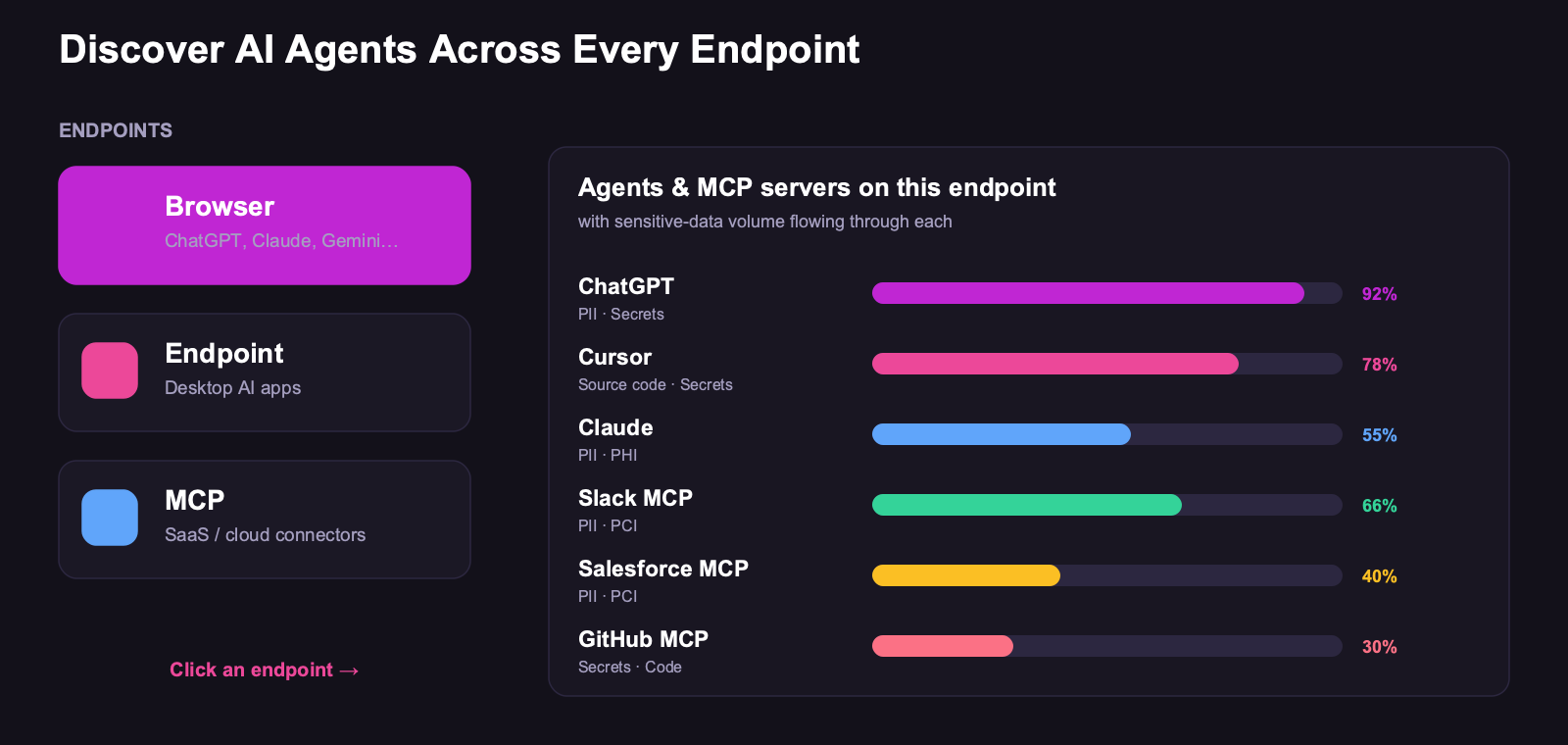
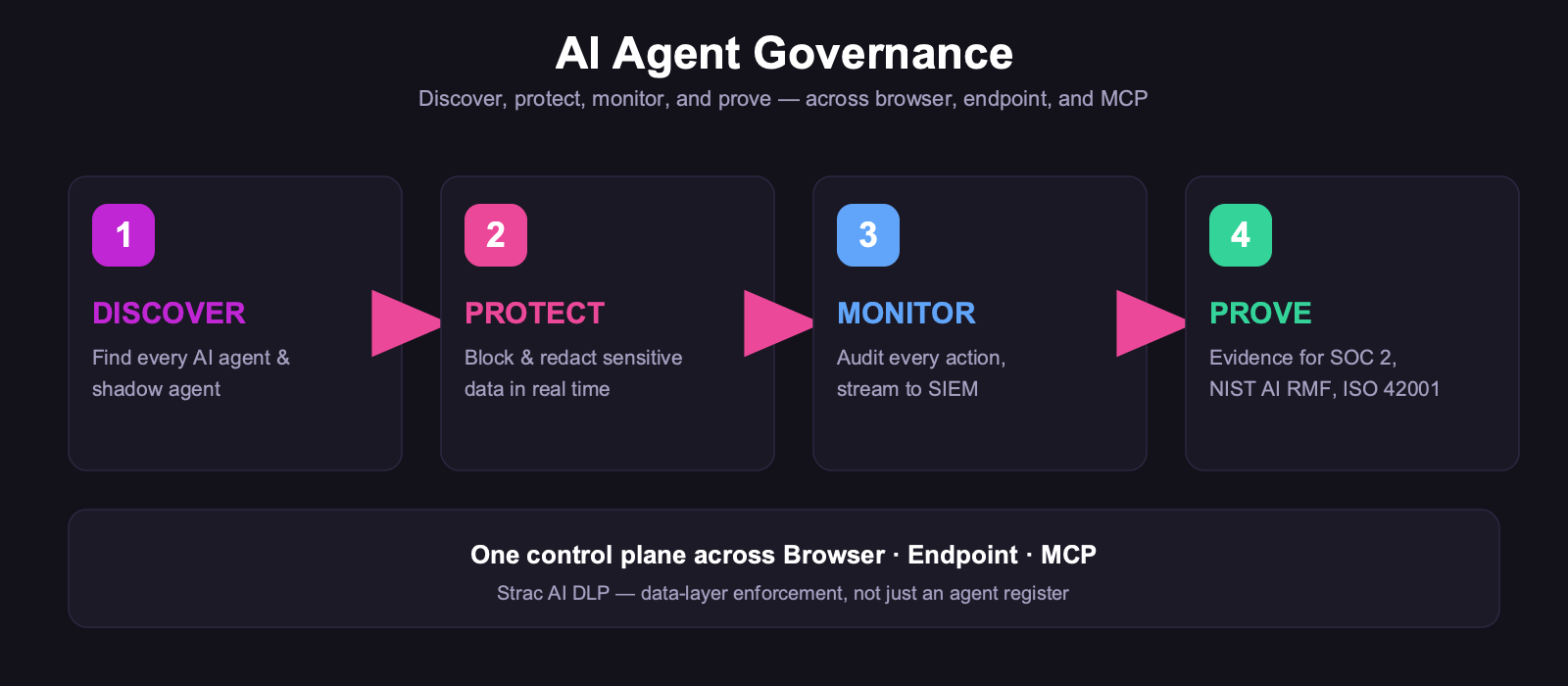
AI agent governance spans discovery, identity, data protection, and monitoring — identity is one pillar.
Why AI Agents Need Their Own Identities
Every agent that calls an API, queries a database, or invokes an MCP tool is acting as someone. When agents borrow a human's credentials or share a generic service account, you lose attribution, you over-grant access, and you cannot revoke one agent without breaking others. Treating agents as non-human identities (NHIs) — each with its own identity, scopes, and audit trail — is what makes governance possible. In many enterprises NHIs already outnumber human identities by a wide margin, and AI agents are the fastest-growing category.
The AI Agent Identity Lifecycle
Governing an agent identity means managing it end to end:
Stage
What it means for an agent
Provision
Issue a distinct identity and the minimum credentials the agent needs — never a shared or human account
Scope
Grant least-privilege access: only the tools, data, and actions this agent's job requires
Authenticate
Use short-lived tokens (OAuth, workload identity) rather than long-lived static keys
Rotate
Automatically rotate secrets so a leaked token has a short blast radius
Monitor
Attribute every action to the agent identity and watch for anomalies
Revoke
Kill a single agent's access instantly without disturbing others
Least Privilege for Autonomous Agents
Least privilege is harder for agents than for humans because an agent's job can change with a single prompt. An agent granted broad read access to a CRM or a data warehouse can, in one instruction, pull far more than intended. Good identity governance scopes agents narrowly — per data source, per action, ideally per task — and prefers just-in-time grants over standing access. But scoping controls reach, not content: within its allowed reach, an agent still sees whatever sensitive data lives there.
✨ The Gap: Authorized Is Not the Same as Safe
This is the limit of identity alone. Suppose an agent is perfectly scoped — it can read exactly one support-ticket system, nothing more. That ticket system is full of customer PII and the occasional PHI or secret. When the agent reads a ticket over MCP, the identity layer sees a fully authorized action and waves it through — and the PII flows straight into the model's context, which may sit outside your compliance boundary. Identity governance did its job. The data still leaked. Closing that gap needs AI DLP at the data layer.
Strac inspects the content of an authorized action and redacts sensitive data before it reaches the model.
🎥 Governing the Data Layer, Not Just the Identity
Strac sits at the data layer and complements your identity stack — it does not replace Okta, Entra, or your NHI platform. While identity decides who and what can be reached, Strac decides what data is allowed to move. On every MCP DLP tool call, Strac inspects the response and redacts PII, PHI, PCI, and secrets before the agent — or the model behind it — ever sees them, vaulting the original for authorized retrieval. The result: an over-broad scope no longer means an over-broad leak.
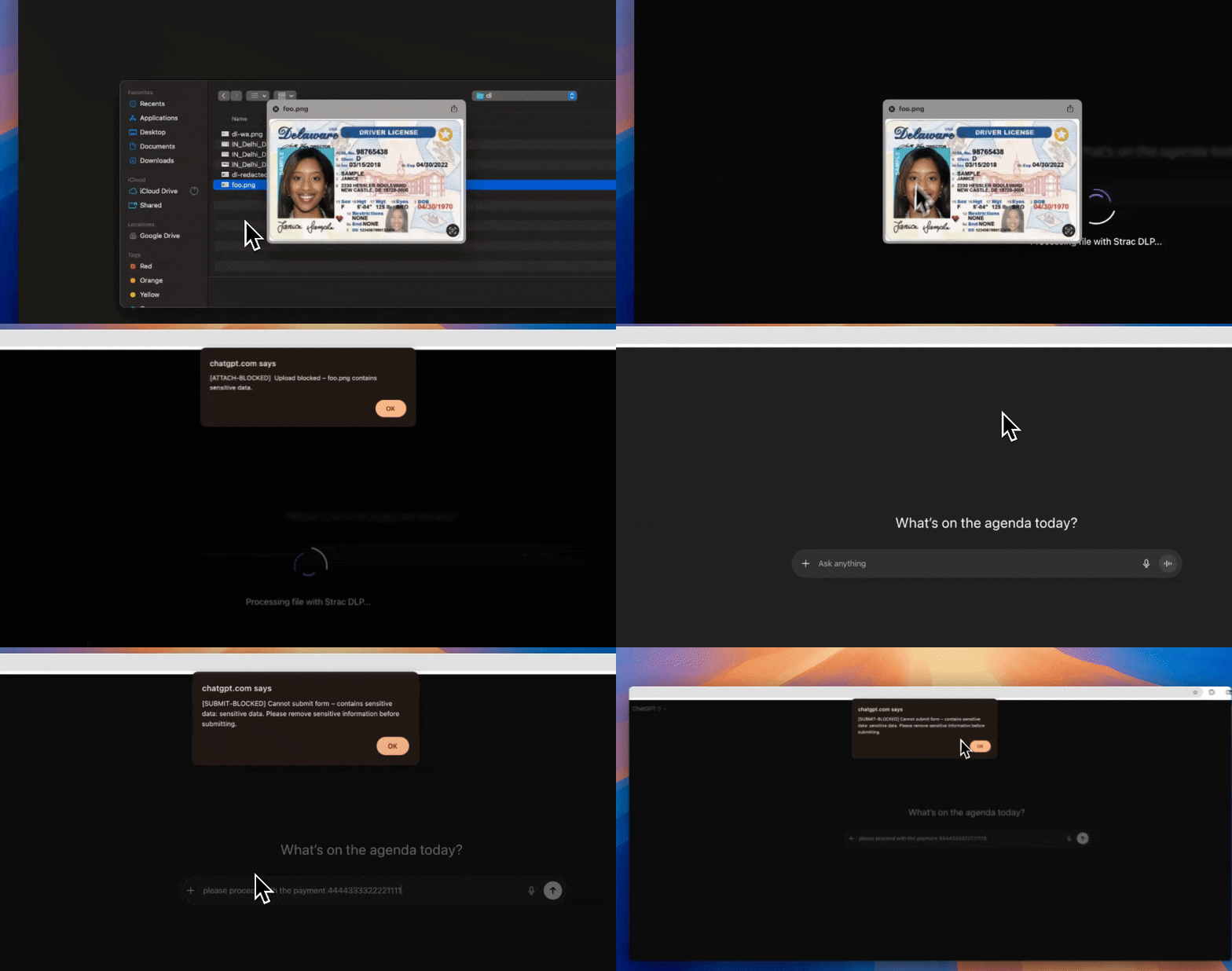
Strac detects and redacts sensitive data in real time on the path to an AI agent.
✨ Identity Governance + Data Governance: How They Fit
The two layers are complementary, and you need both. Identity governance gives every agent a scoped, revocable identity; data governance ensures that whatever the agent is authorized to touch, sensitive values are redacted or blocked in flight. Together they give you a complete answer: which agent did what, to which data, with sensitive values protected the whole way. See how this ties into protect AI agents and monitor AI agents.
Identity scopes the agent; Strac governs the data flowing through every action it takes.
Implementing AI Agent Identity Governance
A practical rollout:
Inventory:discover AI agents — find every agent, service account, and MCP connection in use.
Assign identities: give each agent a distinct NHI; retire shared and human-borrowed credentials.
Scope to least privilege: narrow each agent to the data sources and actions its task requires; prefer short-lived tokens.
Add the data layer: put MCP DLP in front of every tool call so authorized actions still cannot exfiltrate raw sensitive data.
Monitor and revoke: attribute actions to identities, alert on anomalies, and keep one-click revocation ready.
AI Agent Identity Governance Checklist
Control
In place?
Every agent has a distinct non-human identity
☐
No agent uses a human's or a shared account
☐
Access is least-privilege and time-bound
☐
Secrets rotate automatically
☐
Sensitive data is redacted on every MCP tool call
☐
Every action is attributable and instantly revocable
☐
🌶️ Spicy FAQs for AI Agent Identity Governance
Is AI agent identity governance the same as IAM?
It is IAM extended to non-human, autonomous identities. The lifecycle (provision, scope, rotate, revoke) is familiar; the hard parts are scale and how fast an agent's behavior can change.
Does Strac replace Okta or my NHI platform?
No. Strac is the data layer and complements identity tools. Identity decides who the agent is and what it can reach; Strac decides what data is allowed to move through an authorized action.
If an agent is correctly scoped, isn't the data safe?
No — that is the core misconception. A perfectly scoped agent still sees all the sensitive data inside its allowed reach. Redaction at the data layer is what keeps PII, PHI, and secrets out of the model.
What is a non-human identity (NHI)?
Any identity that is not a person — a service account, API key, workload identity, or AI agent. NHIs already outnumber humans in many orgs, and agents are the fastest-growing kind.
Identity governance tells you which agent acted and bounds what it can reach — but it cannot stop sensitive data from flowing through an authorized action. Pair it with Strac's data-layer governance and you close the loop: scoped, revocable agent identities and redacted data on every call. Book a demo to see Strac govern the data your agents touch.
Is AI agent identity governance the same as IAM?
It is IAM extended to non-human, autonomous identities — same lifecycle (provision, scope, rotate, revoke), but at far greater scale and with agents whose behavior changes per prompt.
Does Strac replace my identity provider?
No. Strac is the data layer and complements Okta, Entra, and NHI platforms. Identity governs who and what-can-be-reached; Strac governs what data is allowed to move.
If an agent is scoped correctly, is the data safe?
No. A scoped agent still sees all sensitive data inside its allowed reach. Data-layer redaction keeps PII, PHI, and secrets out of the model on every MCP call.
What is a non-human identity?
Any non-person identity — service account, API key, workload identity, or AI agent. Agents are the fastest-growing category of NHIs.
How do I start?
Inventory every agent, assign distinct identities, scope to least privilege, then add MCP-layer DLP so authorized actions cannot exfiltrate raw sensitive data.
Discover & Protect Data on SaaS, AI, MCP, Endpoints & Cloud
Strac provides end-to-end data loss prevention for all SaaS and Cloud apps. Integrate in under 10 minutes and experience the benefits of live DLP scanning, live redaction, and a fortified SaaS environment.


.webp)



.avif)



.gif)
