Playwright MCP Server: Secure Setup for AI Agents (2026)
The Playwright MCP server lets AI agents drive browsers, run tests, and read traces. Here's the setup, the real credential and data-leakage risks in test automation, and how Strac governs every tool call with secrets detection and audit.
The Playwright MCP server lets AI agents drive a real browser — navigate, fill forms, run tests, and read traces, screenshots, and network captures. It's one of the most popular MCP servers for coding agents.
The risk isn't PII — it's test credentials, environment variables, and recorded session data. Playwright traces and network captures hold logins, tokens, and whatever real data flowed through the test.
Strac Playwright MCP DLP governs every tool call: see what each agent runs, control and block risky actions, remediate the secrets and data in traces and captures, and prove it with a full audit log.
Agentless, deploys in under 10 minutes.
What Is the Playwright MCP Server?
The Playwright MCP server exposes browser automation to AI agents over the Model Context Protocol. An agent can open pages, interact with the DOM, run and debug tests, and read the artifacts Playwright produces — traces, screenshots, videos, and network logs. It's how a coding agent like Cursor or Claude Code can write and verify end-to-end tests on its own.
That autonomy is the value. It also means the agent handles your test credentials and everything those tests touch.
What AI Agents Can Do With Playwright MCP
Drive the browser — navigate, click, type, and submit forms (including login flows).
Run and debug tests — execute suites and read failures.
Read traces and recordings — the full trace viewer data: DOM snapshots, network calls, console output.
Capture screenshots and video — visual artifacts that can contain on-screen data.
Each of those touches credentials or data that shouldn't end up in a model's context unfiltered.
The Real Security Risks — Credentials & Test Data
1. Test credentials and env vars. Playwright tests authenticate with real logins, API keys, and tokens stored in config and environment variables — which an agent can read and surface.
2. Traces capture network calls. A Playwright trace records requests and responses, including auth headers and tokens — the same HAR-style secret leakage, persisted to disk.
3. Recorded sessions hold real data. Tests run against staging or prod-like data; recordings and screenshots can include real customer records and PII.
4. Storage state files. Playwright's saved auth state (storageState) is literally a serialized session — cookies and tokens an agent can read.
Traditional DLP doesn't sit in the MCP path — the trace goes straight into the model's context. See the ingress shift.
✨ Strac Playwright MCP DLP — Governance for Test Automation
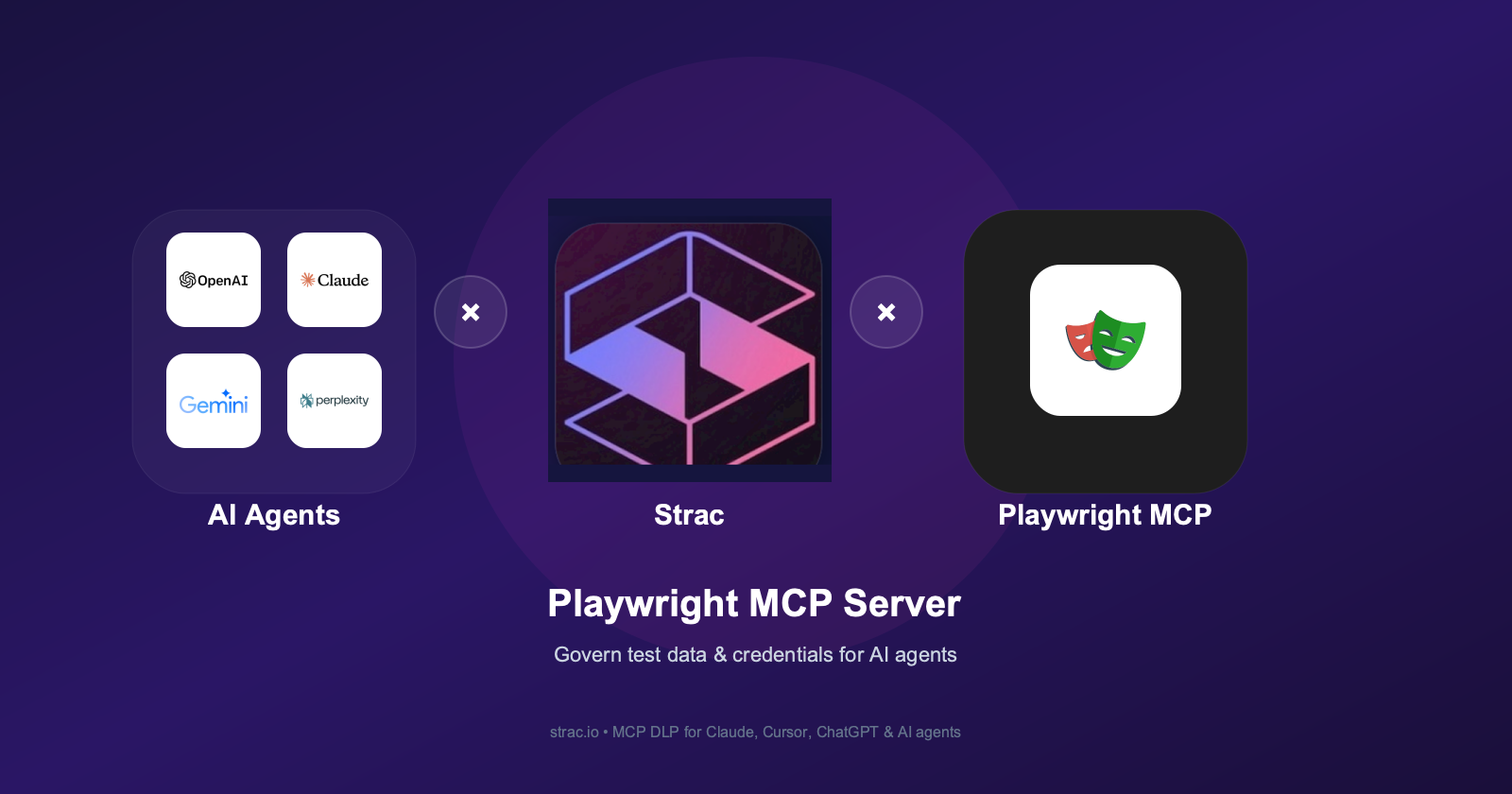
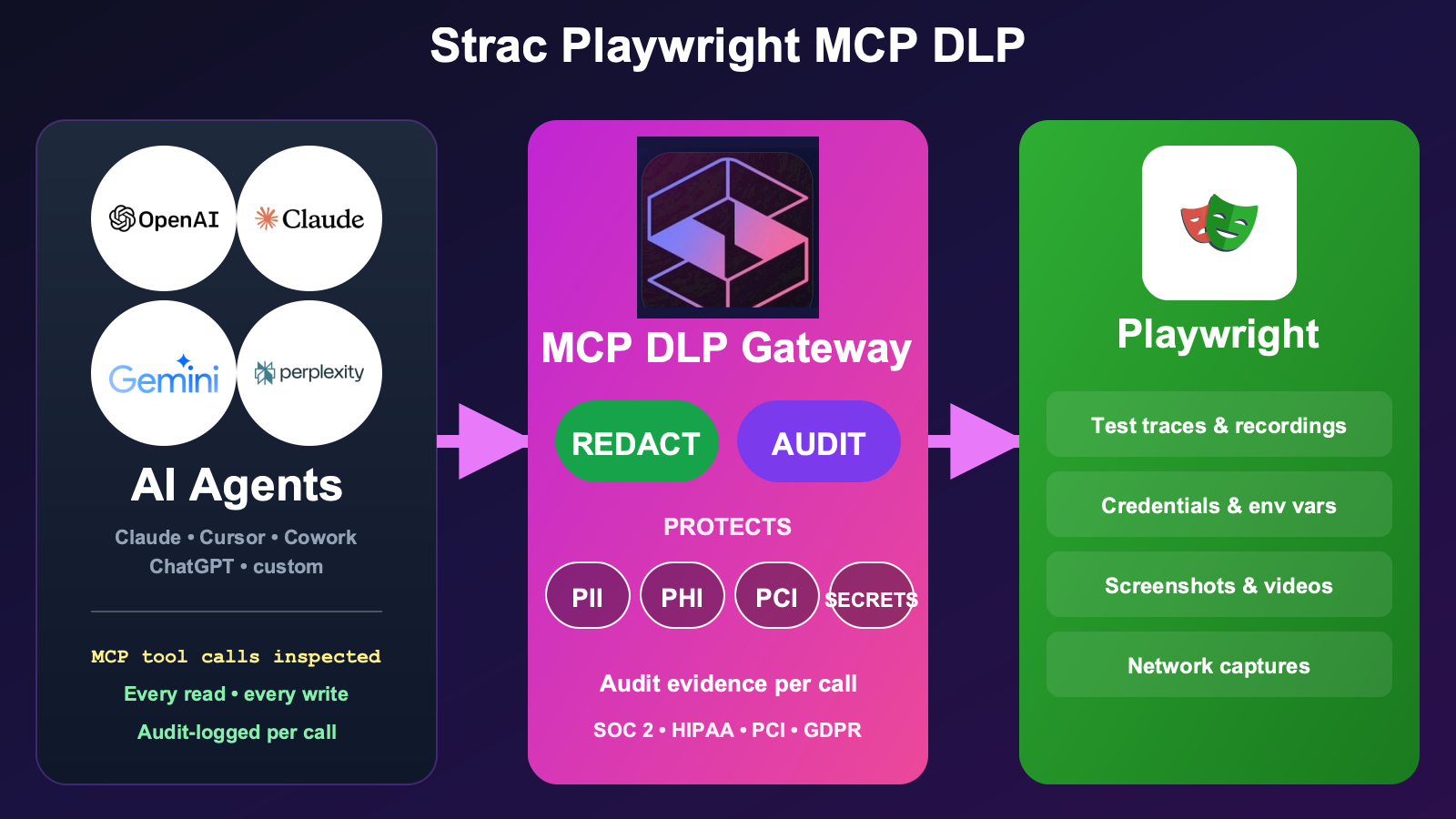
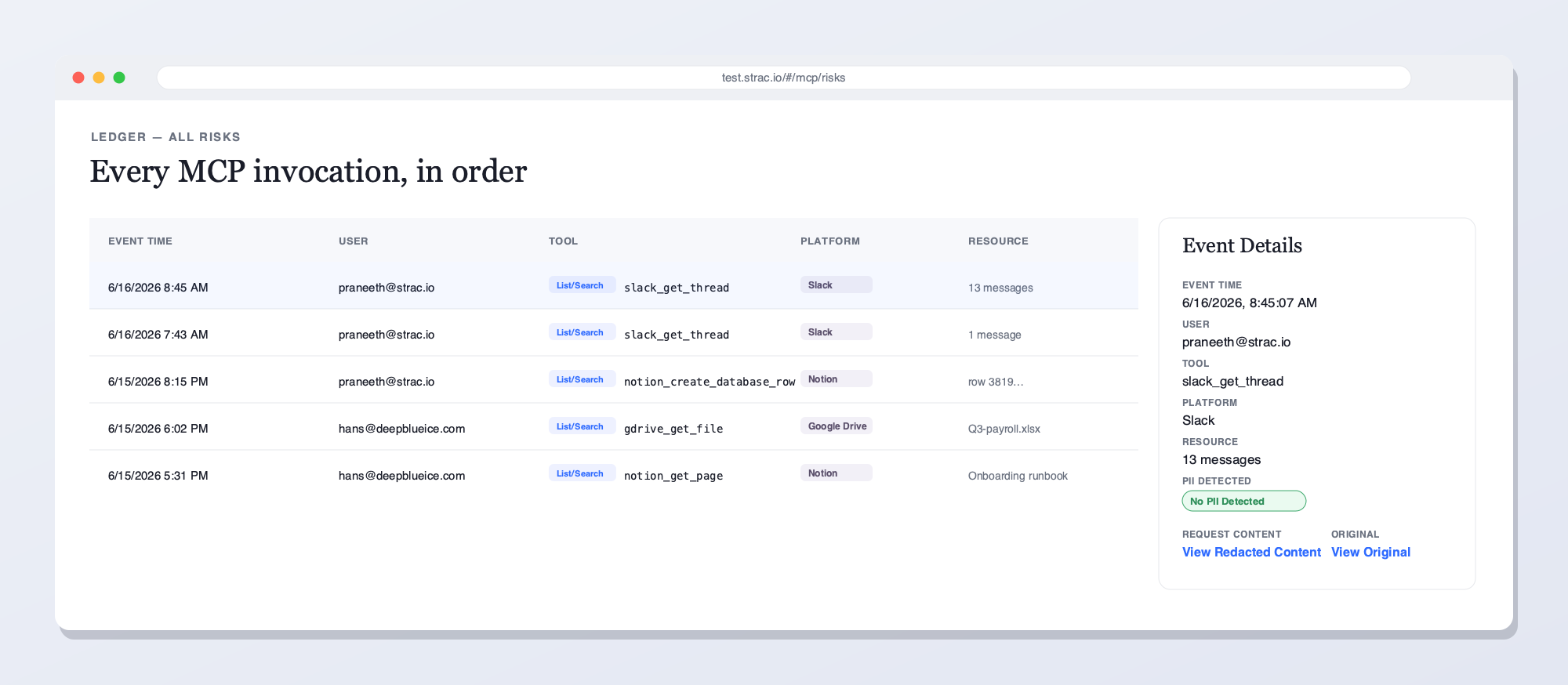
Strac is the governance gateway between AI agents and the Playwright MCP server. You see every action each agent runs. You control what it can execute and block risky calls. You protect the artifacts — credentials, tokens, and data in traces and recordings are remediated inline. And you prove it with a full audit log.
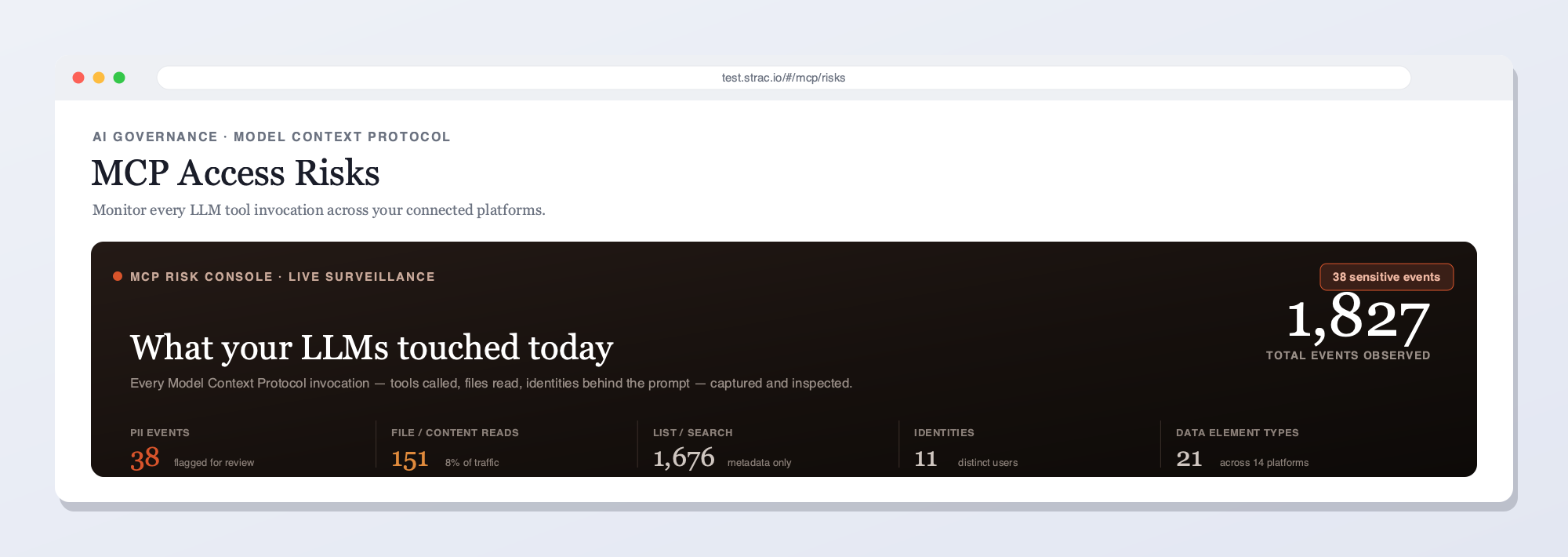
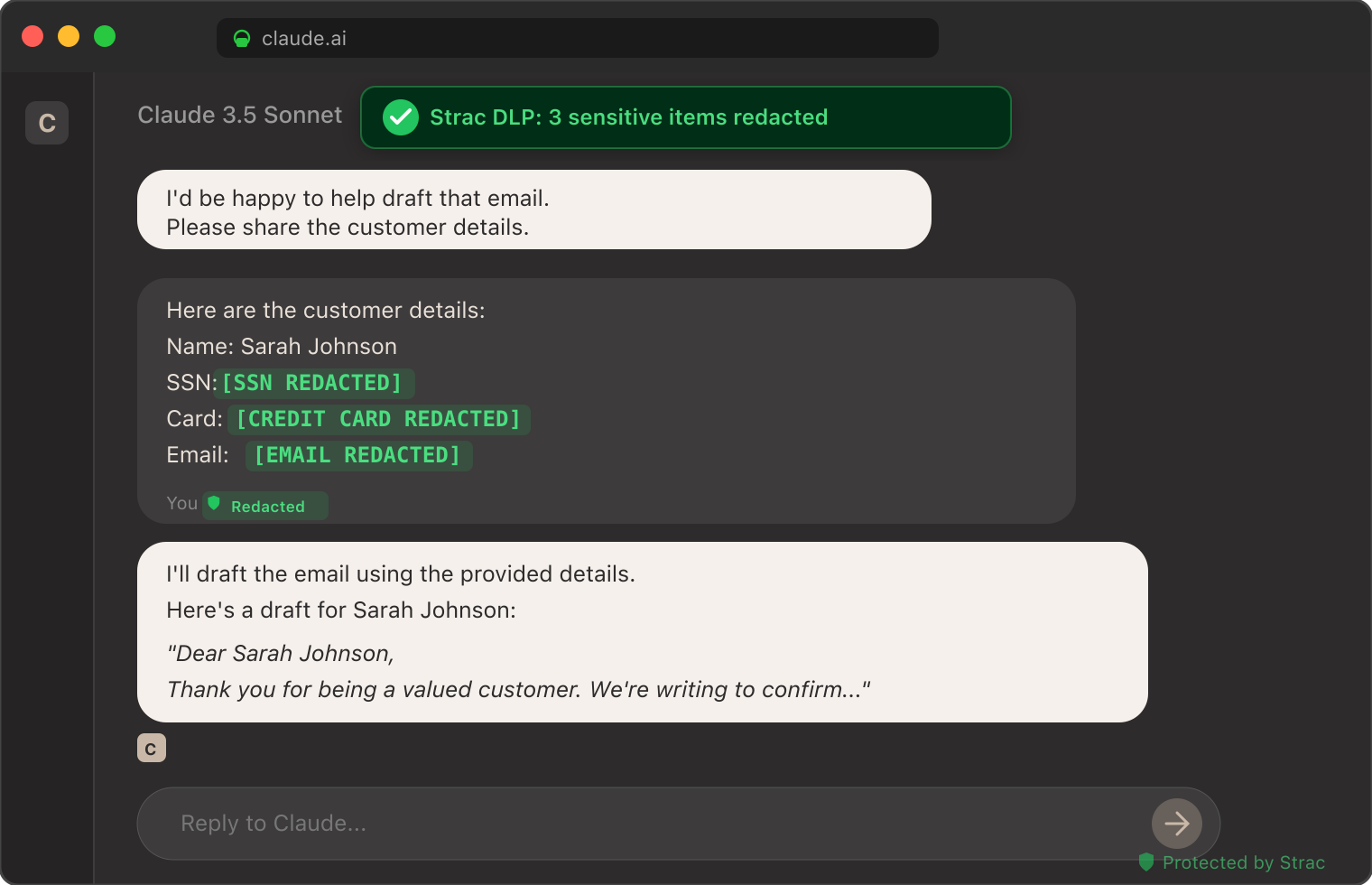
Strac intercepts every Playwright tool call — test credentials, tokens in traces, and data in recordings are remediated before the agent reads them.Strac's live MCP Access console — every AI agent tool call touching Playwright and your other platforms, captured and inspected for secrets and sensitive data in real time.Every Playwright MCP invocation in order — user, tool, and the secrets or data found — with remediated vs. original content and a full audit trail. The data in each call, not just the call.
Beyond redacting or blocking, Strac can also pseudonymize or de-identify the data on a Playwright MCP tool call — swapping PII, PHI, and PCI for realistic, format-preserving fakes — so a team can keep using the data in an AI model, analytics, or a test environment while the real records never leave your control. See Data Pseudonymization.
48+ secret patterns (API keys, OAuth tokens, JWTs, private keys), plus PII and source code, remediated inline — including text inside screenshots via OCR.
Strac vs. access-only MCP gateways
A gateway that only governs access can tell you an agent ran a Playwright test — but not that a storage-state file full of session tokens came back in the trace. Strac inspects the content of every call, remediates the secrets and data before the model sees them — redact, mask, block, or revoke — and still logs the full access trail. You get access control and the data layer, in one place.
What Strac does on every Playwright tool call
One inline pass over each artifact — five actions, your policy:
Detect — finds test credentials, tokens, secrets, and any PII in traces, recordings, and storage state, including text in screenshots via OCR.
Redact or mask — replaces the sensitive elements inline so the agent still runs and reads tests, without the raw secrets.
Block or require approval — stops a high-risk action like reading a production storage-state file.
Alert — notifies your team and streams the event to your SIEM (Datadog, Splunk, Sentinel).
Audit — logs who, which agent, which tool, what secret class, and the action taken — evidence for SOC 2, HIPAA, PCI, and GDPR.
Authorize Strac and point your AI client's MCP config at the Strac gateway endpoint.
Pick a policy for secrets, credentials, and PII.
Done — every Playwright tool call flows through Strac, audit-logged from the first call.
🌶️ Spicy FAQs for Playwright MCP Server
What is the Playwright MCP server?
A Model Context Protocol server that lets AI agents drive browsers, run Playwright tests, and read traces, screenshots, and network captures — popular with coding agents for end-to-end testing.
Is the Playwright MCP server safe to use?
Not by itself. Tests use real credentials and tokens, and traces/recordings capture session data — all of which the server can surface to a model. An MCP-layer control like Strac remediates that before it reaches the agent.
Do Playwright traces contain secrets?
Yes — traces record network requests with auth headers and tokens, and storageState files hold session cookies and JWTs. Agent access to them needs inspection.
Does Strac Playwright MCP DLP work with Claude Code, Cursor, and ChatGPT?
Yes — Strac exposes a standard MCP gateway endpoint, so any MCP-aware client routes Playwright tool calls through it with one config change.
What does Strac detect in Playwright artifacts?
48+ secret patterns, PII, and source code across traces, recordings, screenshots, and storage-state files.
A Model Context Protocol server that lets AI agents drive browsers, run Playwright tests, and read traces, screenshots, and network captures — popular with coding agents for end-to-end testing.
Is the Playwright MCP server safe to use?
Not by itself. Tests use real credentials and tokens, and traces/recordings capture session data — all of which the server can surface to a model. An MCP-layer control like Strac remediates that before it reaches the agent.
Do Playwright traces contain secrets?
Yes — traces record network requests with auth headers and tokens, and storageState files hold session cookies and JWTs. Agent access to them needs inspection.
Does Strac Playwright MCP DLP work with Claude Code, Cursor, and ChatGPT?
Yes — Strac exposes a standard MCP gateway endpoint, so any MCP-aware client routes Playwright tool calls through it with one config change.
What does Strac detect in Playwright artifacts?
48+ secret patterns, PII, and source code across traces, recordings, screenshots, and storage-state files.
Discover & Protect Data on SaaS, AI, MCP, Endpoints & Cloud
Strac provides end-to-end data loss prevention for all SaaS and Cloud apps. Integrate in under 10 minutes and experience the benefits of live DLP scanning, live redaction, and a fortified SaaS environment.


.webp)





.avif)




.gif)
