October 1, 2026

5
min read
Is DocuSign HIPAA Compliant?
Is DocuSign HIPAA compliant? Yes — DocuSign signs a BAA, so it can be used for PHI when configured correctly. See BAA status, where PHI ends up, the AI/MCP gap, and how Strac protects it.
Yes, conditionally. DocuSign will sign a Business Associate Agreement (BAA) with customers legally required to comply with HIPAA, so its core eSignature workflow can carry PHI on eligible paid plans once the BAA is executed. But the newer AI layer and the MCP server sit outside that coverage. HIPAA compliance is never automatic — it depends on a signed Business Associate Agreement with the vendor plus how you configure and use the tool. Below is exactly where DocuSign stands, where PHI ends up, the AI/MCP gap most teams miss, and how to close it. Verified August 2026.
DocuSign states it “will sign a Business Associate Addendum with customers who are required by law to comply with HIPAA.” It is not self-service — you request it through your account team and execute it before any PHI is sent. Secondary-source consensus in 2026 is that BAA eligibility starts at the Business Pro and Enterprise plans; Personal and Standard tiers do not qualify. Confirm your specific plan’s eligibility in writing.
| Product / surface | PHI status |
|---|---|
| ✅ eSignature envelope workflow | Encryption at rest and in transit, access controls, document audit trails, and breach-notification terms under the executed BAA |
| ❌ Docusign Iris AI features | Not automatically confirmed as BAA-covered — scope in contracting |
| ❌ IAM & Navigator agentic features | Newer add-ons that must be explicitly scoped |
| ❌ MCP server / Cowork integration | Can push agreement data to an LLM outside the eSignature BAA |
Source: DocuSign Healthcare. Vendor terms change — reconfirm your plan’s eligibility in writing before sending PHI.
Even teams that never intend to handle PHI accumulate it in DocuSign. The common places it lands:
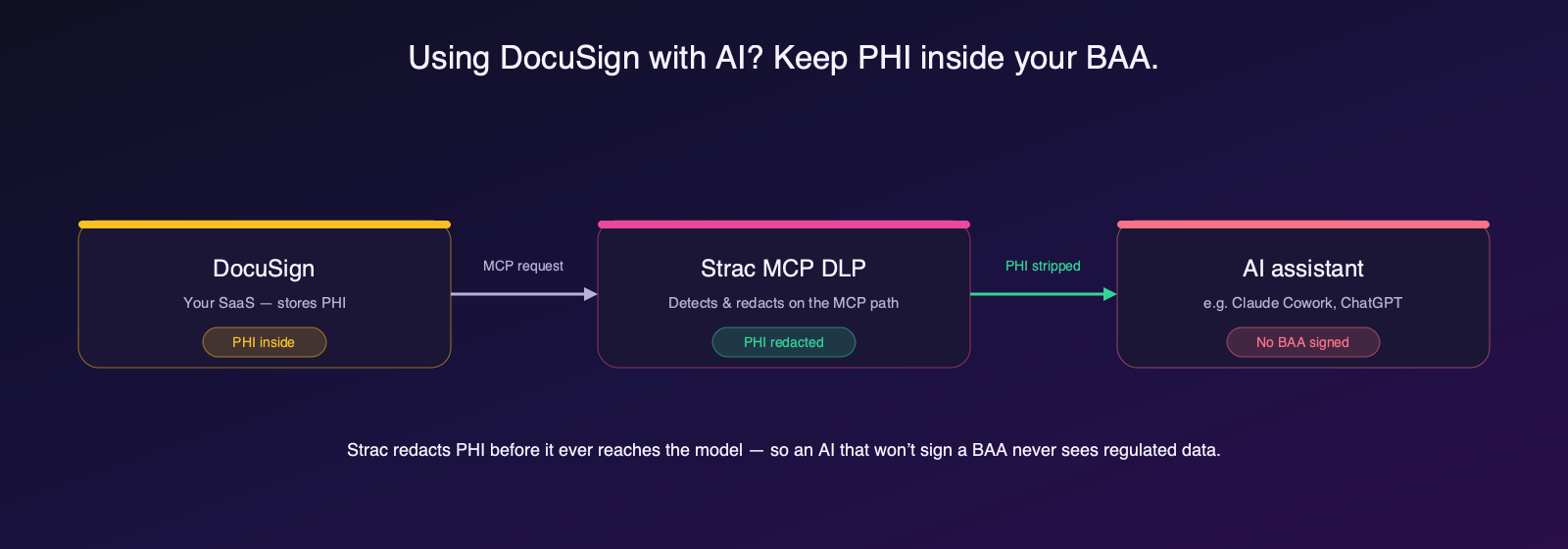
DocuSign launched an official MCP Server at Momentum 2026 that bridges LLMs to its agreement platform — create, send, sign, and query agreements in natural language from Claude, Claude Code, and others — and its Feb 2026 Anthropic partnership brings DocuSign into Claude Cowork. The Docusign Iris AI engine extracts and analyzes agreement data. Each of these can move a signed consent form or intake packet into an LLM.
Signing the BAA covers the eSignature envelope — but Iris AI, IAM/Navigator, and the MCP/Cowork integration are the gap: they are not automatically in scope and can push PHI-bearing agreements to a model with no BAA behind it. This is the leak path traditional HIPAA controls were never designed to see: the data does not breach outward, it is pulled inward by an AI agent on a legitimate, authenticated tool call. Read more on MCP data loss prevention and DocuSign DLP.
A BAA is a contract — it makes the vendor liable for the data it holds. It does not inspect your data, and it does not follow PHI into the AI features, integrations, or exports that sit outside its scope. Whether or not DocuSign signs one, three gaps remain: PHI a user pastes or uploads where it should not go; PHI an AI agent pulls out over MCP; and PHI already sitting in DocuSign that no one has found. Closing them needs data-layer DLP, not just paperwork.
Strac closes the exact gaps a DocuSign BAA leaves open, across every surface PHI can move:

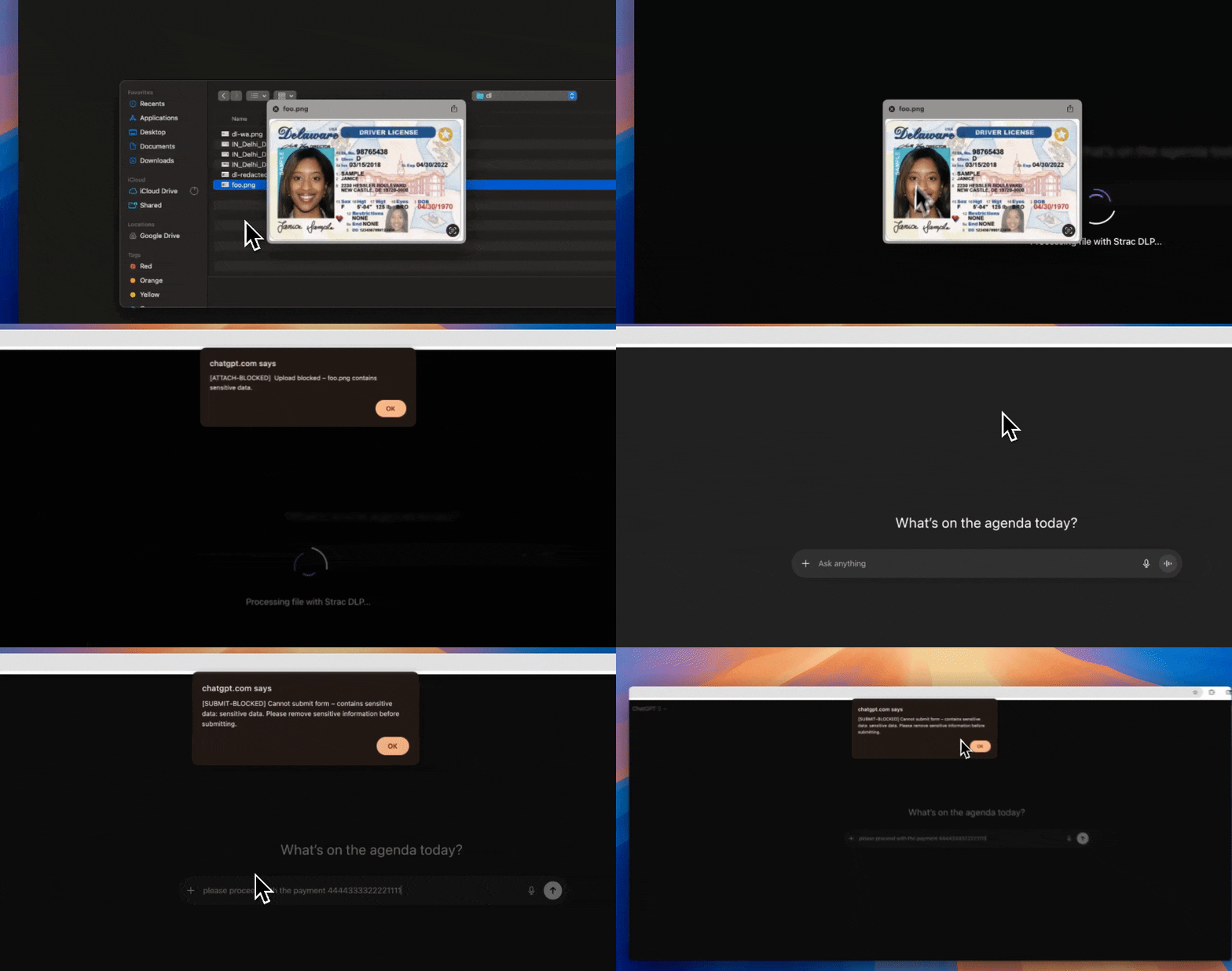
Detection alone does not stop a HIPAA violation — remediation does. Strac does not just alert; it acts the moment PHI appears:

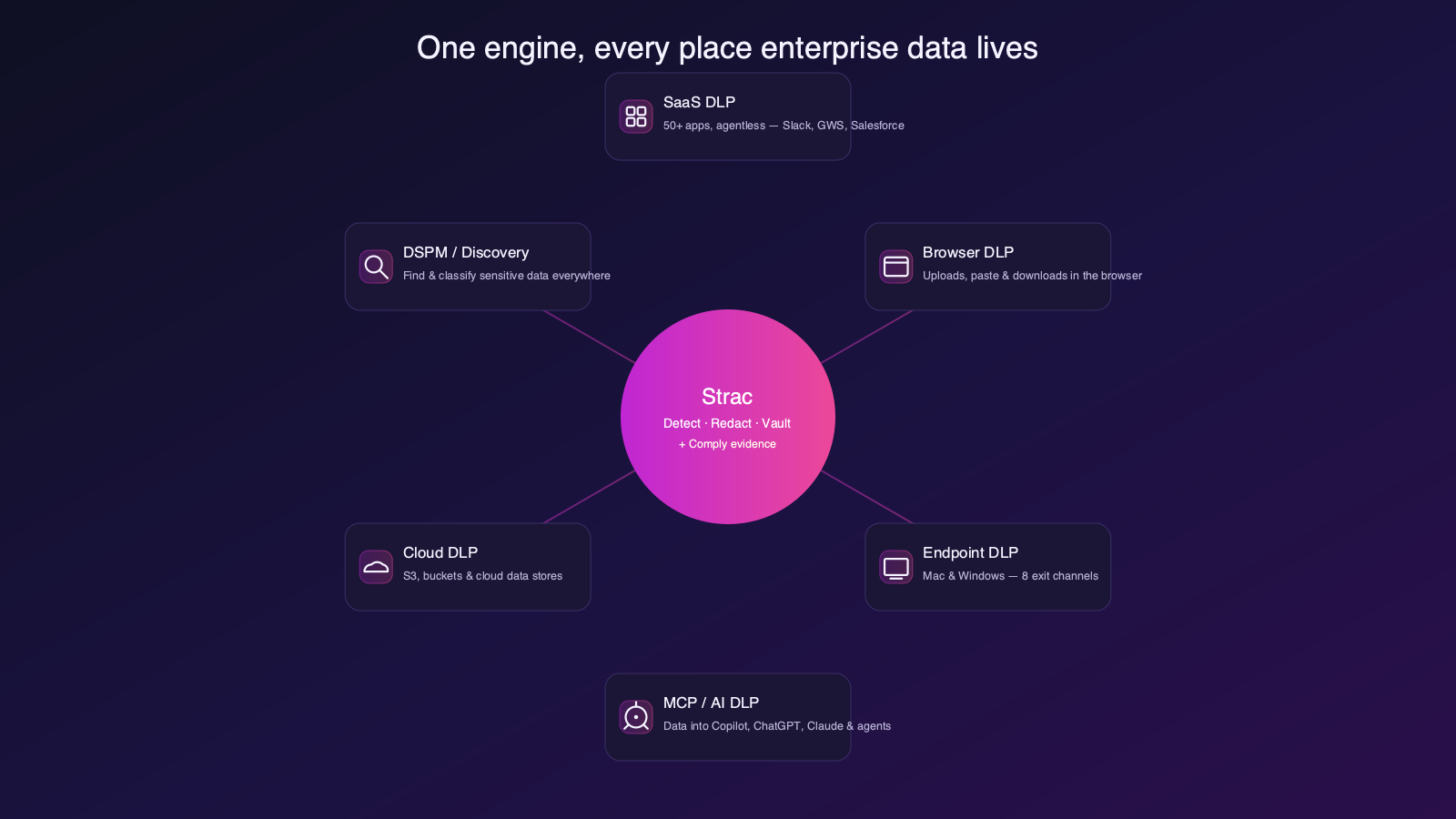
PHI does not stay inside DocuSign. It flows into email, chat, cloud storage, GenAI tools, and AI agents — so point fixes leave gaps. Strac is one agentless-plus-endpoint platform covering SaaS, cloud, browser, GenAI, endpoint, and MCP under a single policy and classifier, live in minutes.
| Question | Answer |
|---|---|
| Does DocuSign sign a BAA? | Yes — eligible plans, executed BAA required |
| Is the AI / MCP layer covered? | No — outside the BAA; the main leak path |
| Can PHI be used safely? | Yes, on an eligible plan with a BAA plus data-layer controls |
| What closes the gap? | Strac MCP + Browser + Endpoint DLP and DSPM |
No tool is. You must be on an eligible plan, execute the BAA, and configure controls before PHI.
No. That is the single most common misread — the AI/MCP layer sits outside the core BAA and is the most likely place PHI leaks to a model.
Yes. DocuSign’s official MCP server lets an agent read data on an authenticated tool call. Strac redacts PHI on that path before the agent sees it.
No. A BAA assigns liability; it does not inspect your data or follow PHI into AI, integrations, or exports. You still need data-layer DLP.
Strac layers on without slowing DocuSign down — redacting PHI at the MCP layer, blocking it in the browser and on the endpoint, and finding PHI already stored via DSPM.
Related reading:
DocuSign can be used with PHI on an eligible plan with a signed BAA — but the BAA stops at the core workflow, while the AI/MCP layer keeps moving PHI. Strac closes the gap on every surface — redacting PHI at the MCP layer, blocking it in the browser and on the endpoint, and finding what is already stored. Book a demo to see it on DocuSign.
.avif)


.gif)


.webp)