October 1, 2026

7
min read
GDPR Compliance: Effective Data Classification Techniques
Discover how proper data classification aligns with GDPR requirements, helping organizations manage and protect personal data more effectively.
As organizations manage an exponentially increasing volume of data, data classification becomes more critical. According to a report by IDC, even in the challenging conditions of the pandemic, considering the worst case in centuries, a staggering 64.2 ZB of data was created or replicated. This growth underscores the importance of effective data management strategies that include robust classification systems.
Organizations can better tailor their security measures and governance controls by distinguishing between personal and sensitive data. This approach not only aids in compliance with laws like the GDPR but also inspires businesses about the potential of optimizing data analytics and decision-making processes. The proper categorization of data not only helps adhere to legal frameworks but also enhances security protocols that protect against unauthorized access and breaches. This blog will explore how data classification assists with GDPR compliance and much more. Let's begin.
Data classification is a systematic process of organizing data based on its sensitivity and the risk it poses, making it an essential component of GDPR compliance. Personal data, such as an EU resident's home address or contact information, is categorized to ensure that it is treated with the required level of security. Similarly, more sensitive categories, termed sensitive personal data under GDPR, include details like genetic or health information, which are subject to stringent processing regulations. The primary objectives of data classification include:
The process entails creating a classification schema that defines various data categories and the criteria for each, including public, internal use, restricted, and confidential. Organizations identify structured and unstructured data and allocate an appropriate classification level to each item.
GDPR compliance involves adhering to the regulations set by the European Union's General Data Protection Regulation (GDPR). The primary goals of GDPR include:
For compliance, organizations must:
Non-compliance with GDPR can lead to severe penalties, including fines of up to 4% of the organization's worldwide annual revenue or €20 million, whichever is greater.Thus, GDPR compliance is essential for any organization that handles the personal data of EU citizens, regardless of where it is based.Why is Data Classification for GDPR Important? Data classification is crucial for GDPR compliance because it helps organizations identify and categorize the personal data they collect, enabling them to apply appropriate security measures and comply with specific GDPR requirements. By classifying personal data, organizations can:
Data classification is essential to a privacy program that enables organizations to manage personal data and comply with GDPR efficiently. It provides visibility into the data landscape, supports compliance efforts, and helps reduce the risks and costs associated with data breaches and misuse.
GDPR data classification starts with understanding what data you are legally responsible for, not just what lives in your databases. The regulation applies to any information that can identify a person directly or indirectly; across systems, formats, and workflows. Organizations that limit classification to structured records almost always miss their highest-risk exposure points.
In practice, GDPR requires classification across both structured and unstructured data, including data that moves through collaboration tools, customer support systems, file uploads, and modern AI workflows. This is where most compliance gaps occur; not because teams ignore GDPR, but because they underestimate how widely personal data spreads.
At a minimum, GDPR data classification must include:
| Personal data | Names, email addresses, phone numbers, IP addresses, device identifiers, and account IDs; classified to meet GDPR Article 4 and enable access controls and data minimization. |
|---|---|
| Special category data (Article 9) | Health data, biometric identifiers, ethnicity, genetic data, and other sensitive attributes; requires heightened protection and stricter processing controls. |
| Customer communications | Emails, chat messages, support tickets, and contact form submissions; a major source of unstructured personal data frequently reviewed during audits. |
| Files and attachments | PDFs, spreadsheets, screenshots, CSV exports, and shared documents; often contain bulk personal data and pose high oversharing risk. |
| Operational metadata and logs | Activity logs, access logs, and usage metadata; can indirectly identify individuals when linked to users or devices. |
| AI-generated and derived data | AI prompts, responses, embeddings, and summaries created from personal data; remain in scope under GDPR even after transformation. |
If this data exists anywhere in your environment, GDPR expects it to be identified, classified, and protected accordingly.
GDPR data classification is not an abstract best practice; it is the mechanism that enables compliance with specific GDPR articles. Auditors and regulators do not assess whether data is “labeled nicely”; they assess whether organizations can demonstrate control over personal data as defined by the regulation.
Several core GDPR articles depend directly on accurate, continuous data classification:
Without classification, these articles cannot be operationalized. With static or incomplete classification, they cannot be enforced consistently.
Data classification is crucial to GDPR compliance, enabling organizations to identify, manage, and protect personal data effectively. Here's a detailed explanation of how data classification can support GDPR compliance:
Identify and remove redundant, outdated, or trivial (ROT) data that is no longer needed, reducing the attack surface and storage costs. Also, ensure that personal data is only collected and retained for legitimate, specified purposes, as GDPR's data minimization principle requires.
Integrate data classification with security and monitoring tools to enforce access controls, detect anomalies, and respond to potential data breaches. Plus, leverage classification metadata to generate reports and demonstrate GDPR compliance.
Accurately identify personal data, including special categories of personal data, to apply appropriate security measures and access controls. Once done, classify data based on sensitivity levels (e.g., public, internal, confidential, restricted) to prioritize protection efforts.
Implement access controls, encryption, and other security measures tailored to the sensitivity level of the personal data. It also ensures that only authorized personnel can access and process personal data based on the principle of least privilege.
Data classification is used to support GDPR compliance activities, such as data subject access requests, data portability, and data breach notifications. Soon after, demonstrate the organization's ability to protect personal data and comply with GDPR principles.
Enhance data visibility, control, and accountability through effective data classification. And facilitate data lifecycle management, including secure data retention and deletion, to comply with GDPR's storage limitation principle.
It is important to leverage data classification to conduct Data Protection Impact Assessments (DPIAs) and identify and mitigate risks associated with personal data processing. So, improving the organization's overall data governance and risk management capabilities becomes a cakewalk.
Established under Executive Order 13526 issued by former President Obama in 2009. The United States government has three primary classification levels for national security information:
These classification levels indicate increasing degrees of sensitivity and restrictions on access.
The overview of the key compliance guidance for data classification across several major frameworks is:
The Payment Card Industry Data Security Standard (PCI DSS) requires organizations that handle credit card data to classify and protect cardholder data (CHD) and Sensitive Authentication Data (SAD).Key PCI DSS data classification requirements include:
The Health Insurance Portability and Accountability Act (HIPAA) mandates that covered entities and business associates classify and safeguard protected health information (PHI).HIPAA data classification guidelines include:
The California Consumer Privacy Act (CCPA) requires businesses to identify and protect California residents' personal information (PI).Key CCPA data classification considerations:
The National Institute of Standards and Technology (NIST) provides a standard framework for federal agencies to classify information assets. The NIST data classification levels are:
The Cybersecurity Maturity Model Certification (CMMC) is a DoD standard that requires defense contractors to classify and protect controlled unclassified information (CUI).CMMC data classification involves:
Data classification is crucial to an effective data management and security strategy. Here are some of the best practices for implementing a robust data classification program:
Adopt intelligent data classification systems that automatically scan and categorize data according to established policies. These systems utilize advanced technologies like pattern recognition, machine learning, and natural language processing for precise and consistent data classification. This automation minimizes human error and maintains accurate data labeling throughout its lifecycle.
To maintain a precise data inventory that's well documented, it is essential to:
Structure your data classification strategy to align with NIST standards, including:
Formulate a comprehensive data classification policy that defines the goals, procedures, roles, responsibilities, and compliance mandates. Ensure the policy is thoroughly documented, effectively communicated and uniformly enforced across the organization.
Educate staff about the significance of data classification and their specific roles within the process. Regularly conduct training to keep everyone informed about classification policy and practice updates. Promote a culture of data stewardship and security awareness throughout the organization.
Frequently reassess and update the data classification scheme to reflect changes in data, regulations, and business needs. Then, regular audits will be performed to verify the accuracy and efficacy of the classification system. Continuously enhance the classification processes and controls based on feedback and observed outcomes.Data classification is a crucial component for achieving GDPR compliance. In regard to this, Strac's leading DLP and classification solutions can help organizations identify, categorize, and protect personal data to meet GDPR requirements and mitigate non-compliance risks.
GDPR data classification helps organizations organize, label, and protect personal data according to its sensitivity level; however, implementing and maintaining an effective classification system is often more complex than it seems. Many businesses struggle with fragmented data, evolving SaaS environments, and unclear accountability for compliance. These challenges can expose companies to compliance risks, data breaches, and regulatory fines if not addressed with the right tools and processes.
One of the biggest challenges with GDPR data classification is identifying all personal data across SaaS, cloud, and on-prem environments. Many teams rely on manual methods or legacy discovery tools that only cover partial system; leaving hidden PII in chat messages, attachments, or cloud backups undiscovered.
Strac solves this with agentless, automated discovery that scans across all data sources; SaaS apps like Slack, Salesforce, Zendesk, and Google Workspace, as well as cloud and endpoint environments; ensuring no sensitive data is missed.
Traditional classification systems use static regex or keyword-based patterns that often generate high false positives and false negatives. This results in alert fatigue and wasted security resources.
Strac eliminates this problem with content-aware ML and OCR-based detection, accurately identifying sensitive data in text, images, and attachments without the noise of outdated regex models.
Detecting violations without being able to act on them instantly leaves organizations vulnerable to exposure. In GDPR contexts, delays in remediation can result in non-compliance and reputational damage.
Strac integrates inline redaction, masking, and blocking directly into workflows, ensuring that personal data is remediated in real time; before it ever leaves the system.
Many companies use separate tools for data discovery, DLP, and compliance tracking, creating data silos and blind spots. This fragmented approach makes it difficult to maintain an accurate picture of where sensitive data lives and who has access to it.
With unified DSPM + DLP functionality, Strac provides a single dashboard for visibility and control, connecting discovery, classification, and enforcement in one seamless workflow.
GDPR compliance is not a one-time effort; it requires ongoing visibility and policy enforcement as data flows across systems and evolves over time. Manual audits or periodic scans are not enough.
Strac enables continuous classification and monitoring, automatically re-evaluating data when files are created, shared, or modified; helping teams stay compliant even as their SaaS and cloud footprint grows.
Bottom Line:
Common GDPR data classification problems stem from incomplete discovery, inaccurate detection, and slow remediation; Strac resolves them with automated, ML-powered discovery, real-time redaction, and unified visibility across SaaS, cloud, and endpoints. This ensures not only compliance, but also consistent protection of personal data in a fast-moving digital environment.
Strac's data classification and protection solutions significantly enhance an organization's ability to comply with the General Data Protection Regulation (GDPR). Here's how:
Strac includes pre-built detectors for common data types such as PII, PHI, PCI, and GDPR-specific categories, enabling organizations to align with GDPR standards quickly. Additionally, custom detectors can be created to meet specific organizational needs and GDPR requirements, ensuring tailored data handling and classification.
It directly aids compliance with 12 key GDPR articles, helping organizations meet legal obligations and business objectives. This tool supports identifying, categorizing, and protecting personal data, which is crucial for GDPR compliance and reducing non-compliance risks.
Strac's data classification solutions are designed for ease of use and minimal disruption, allowing seamless integration with existing data security frameworks. This integration enhances overall data protection without impeding daily operations, making it a convenient addition to any security system.
Utilizing advanced machine learning and natural language processing, Strac accurately classifies data and enforces security measures such as redacting or masking sensitive information. This prevents unauthorized access and ensures data privacy.
The platform extends its capabilities across various SaaS platforms, allowing organizations to maintain consistent data protection and compliance throughout their digital environments. This comprehensive integration ensures that data is protected regardless of its location or method of access.
By incorporating AI and machine learning, Strac continuously monitors user behavior and detects anomalies that could signal potential breaches. This proactive approach helps organizations swiftly address security incidents, aligning with GDPR's 72-hour breach notification requirement.
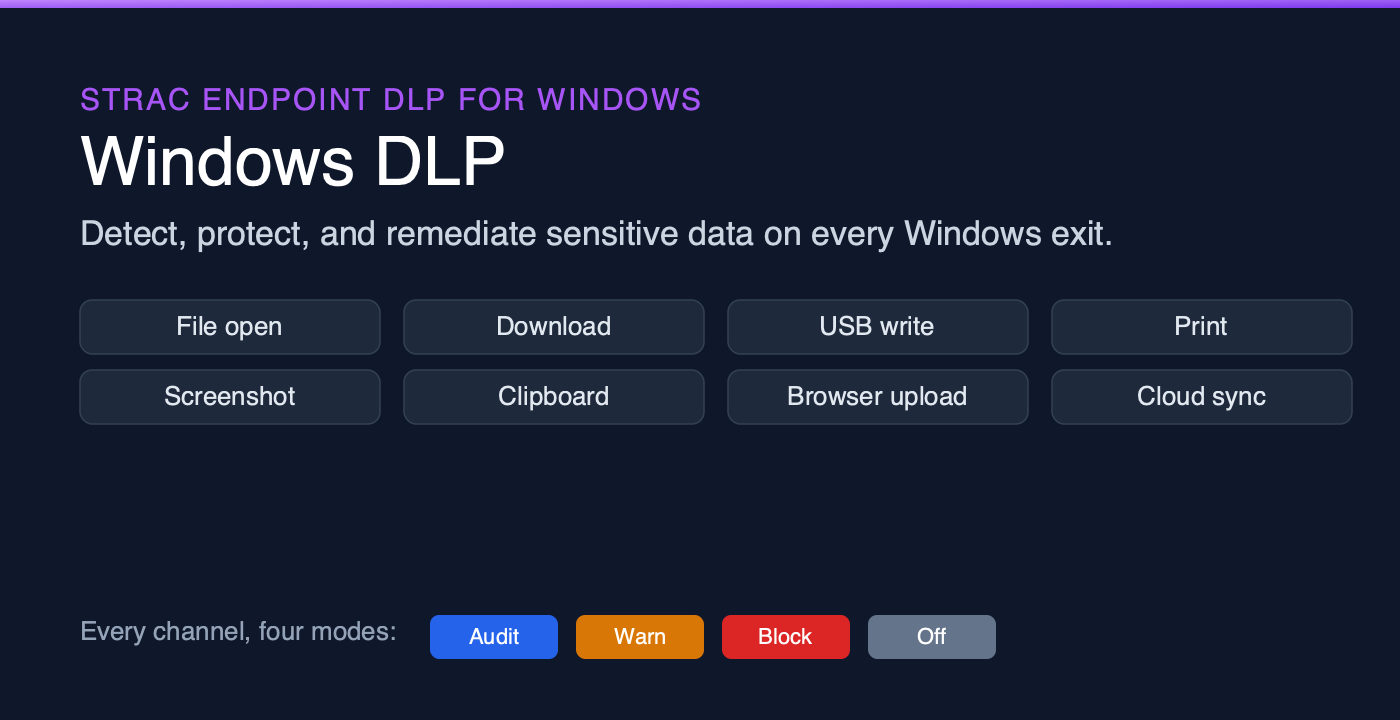
Strac's endpoint DLP features enable organizations to monitor and regulate how data is handled on employee devices, ensuring that data access and processing are restricted to authorized personnel only. This aligns with GDPR's principles of access control and data minimization.By leveraging Strac's advanced detection technologies and comprehensive SaaS integrations, organizations can ensure that their data management practices are compliant and conducive to their broader business objectives.
Thus, adopt Strac's solutions today and schedule a demo without further ado. Pave the way to success via best-in-class security that is unbreachable and irreplaceable.
Data classification is the process of identifying, labeling, and organizing information based on its sensitivity and business value. Under GDPR, organizations must know what personal data they hold, where it resides, and who has access to it; without classification, compliance efforts are fragmented and risky. Accurate classification enables data protection measures to be applied consistently and efficiently.
When implemented correctly, GDPR data classification helps organizations:
GDPR compliance depends on visibility, control, and proof of protection; and Strac delivers all three in one platform. It discovers and classifies personal data across SaaS, cloud, and endpoints automatically, ensuring nothing slips through the cracks. Beyond detection, Strac enforces data policies in real time with inline redaction, masking, and blocking.
It also provides built-in GDPR templates and reporting dashboards, enabling teams to:
Effective GDPR data classification requires a structured approach combining automation, governance, and continuous monitoring. Businesses must define sensitivity levels, assign ownership, and deploy technology that scales across their SaaS ecosystem.
Best practices include:
GDPR defines personal data broadly, but certain categories; known as “special category data”; require heightened protection and explicit consent. These include sensitive identifiers that could reveal personal, financial, or health-related details. Understanding and labeling them accurately is essential to compliance.
Examples include:
Strac enhances GDPR data security by combining DSPM (Data Security Posture Management) and DLP (Data Loss Prevention) into a single, unified platform. It continuously discovers and classifies sensitive information while enforcing real-time remediation across SaaS, cloud, GenAI, and endpoint environments. This prevents leaks, misconfigurations, and unauthorized sharing before they escalate into compliance incidents.
Through ML-powered detection, agentless deployment, and continuous monitoring, Strac ensures data protection is both frictionless and verifiable; delivering measurable compliance and peace of mind for security teams.
For a deeper comparison, see our guide to the best GDPR compliance software.
.avif)


.gif)


.webp)
.webp)