August 30, 2026

min read
Differential Privacy Explained: Epsilon, Noise & How It Works (2026)
.webp)
Last updated: August 2026
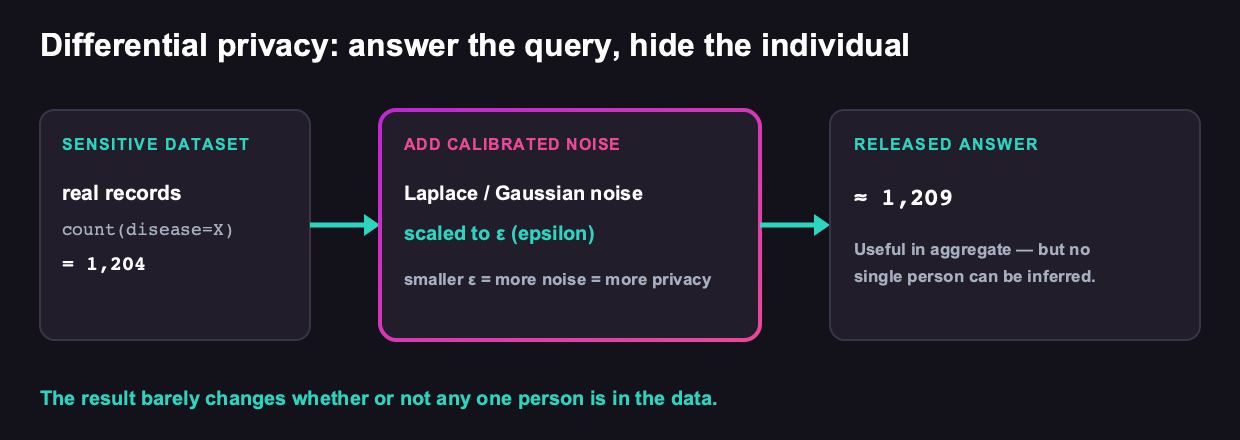
Differential privacy is a mathematical guarantee that the result of an analysis reveals almost nothing about any single individual — achieved by adding carefully calibrated random noise, tuned by a parameter called epsilon (ε), the "privacy budget."
Differential privacy is a formal, provable definition of privacy for statistical analysis. Instead of trying to strip identifiers from data (which is fragile), it makes a mathematical promise about the output: an attacker who sees the result cannot tell whether any specific person’s record was included. The intuition is the "with or without you" test — if a query returns essentially the same answer whether or not your data is in the set, your presence can’t be inferred from it.
Differential privacy is achieved by adding random noise to a query result before releasing it. Two things determine how much:
count by 1, so its sensitivity is 1.The noise is drawn from a calibrated distribution — the Laplace mechanism for pure differential privacy, or the Gaussian mechanism for the (ε, δ)-variant. Because each query spends privacy budget, differential privacy also has a composition rule: run many queries and the budgets add up, so systems track a running total.
| Central (global) DP | Local DP | |
|---|---|---|
| Who adds noise | A trusted curator, to query results | Each user’s device, before sending |
| Trust model | You trust the data holder | No trust in the collector |
| Accuracy | Higher (less total noise) | Lower (noise per record) |
| Used by | Census, internal analytics | Apple, Google (RAPPOR) telemetry |
These solve different problems — the right choice depends on whether you need aggregate insight or usable row-level data.
| Approach | Protects | Output | Best for |
|---|---|---|---|
| Differential privacy | Individuals in aggregate results | Noisy statistics / models | Analytics, ML, data release |
| Pseudonymization | Identities in the records | Realistic, consistent fake data | Testing, AI on record-level data |
| Anonymization | Re-identification, irreversibly | Generalized / suppressed data | Public datasets, research |
Differential privacy is powerful for statistics, but it is not a way to get realistic, row-level data. The noise that protects individuals also degrades accuracy, tuning ε is genuinely hard, and you cannot hand a developer a "differentially private copy of the customer table" to test against — the rows are perturbed. For that, you need pseudonymization, which keeps the data realistic and referentially intact.
Strac focuses on the record-level problem: pseudonymizing production data into a safe, realistic copy your team can test, analyze, and feed to AI. Differential privacy and pseudonymization are complementary — use DP when you are releasing aggregate statistics, and pseudonymization when you need working data. Either way, the first step is the same: find every sensitive field, which is exactly what Strac’s detection engine does across all your data.
For privacy, yes — but a very small ε adds so much noise the results become useless. Real deployments pick an ε that balances privacy and utility, often in the 0.1–10 range depending on sensitivity.
Not exactly. Anonymization transforms the data itself; differential privacy protects the answers to queries over the data. DP is the stronger guarantee for released statistics because it is robust to auxiliary information that breaks naive anonymization.
.avif)


.gif)