Automated Data Mapping: Map Sensitive Data Without Spreadsheets
Automated data mapping discovers and classifies sensitive data by scanning your systems instead of surveying teams. Why manual mapping fails, how automation works, and how Strac maps your data into a live RoPA.
Automated data mapping discovers and classifies your sensitive data by scanning your systems — instead of interviewing teams and typing answers into a spreadsheet.
Manual data mapping is the most-hated chore in privacy and compliance: slow, incomplete, and stale the moment it’s finished.
Automated mapping stays accurate because it reflects what’s actually in your systems, and it updates continuously.
Strac maps your data automatically across SaaS, cloud, endpoints, and email — and turns it into a live data inventory and RoPA.
✨ What Is Automated Data Mapping?
Automated data mapping is the practice of building your data map — the record of what sensitive data you hold and how it flows — by scanning your systems rather than surveying your people. A tool connects to your apps, cloud, databases, and endpoints, discovers the actual PII, PHI, cardholder data, and secrets, classifies it, and traces where it lives and moves. The output is the same artifact you’d build by hand — a data inventory or RoPA — except it’s complete, verifiable, and current.
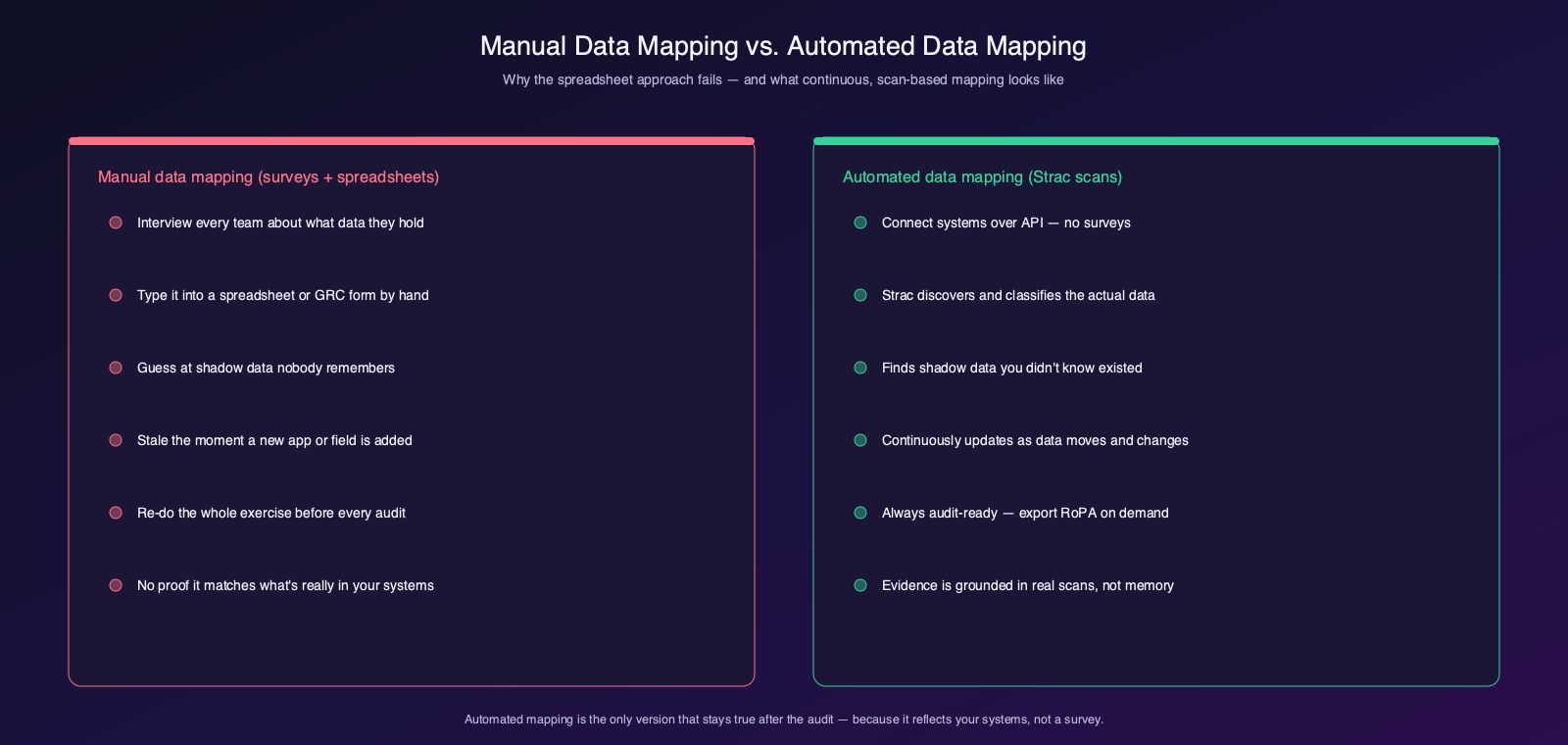
Manual data mapping is a survey that’s stale by the next sprint; automated data mapping reflects what’s really in your systems.
Why Manual Data Mapping Doesn’t Work
The traditional method — questionnaires to every team, answers pasted into a spreadsheet or a GRC form — fails for structural reasons, not effort:
Manual mapping problem
Consequence
Relies on human memory
Shadow data, old systems, and new fields get missed
Point-in-time snapshot
Out of date the moment anything changes
Unverifiable
Nothing proves the map matches reality
Labor-intensive
Re-run before every audit — a recurring tax
✨ 💻 How Automated Data Mapping Works
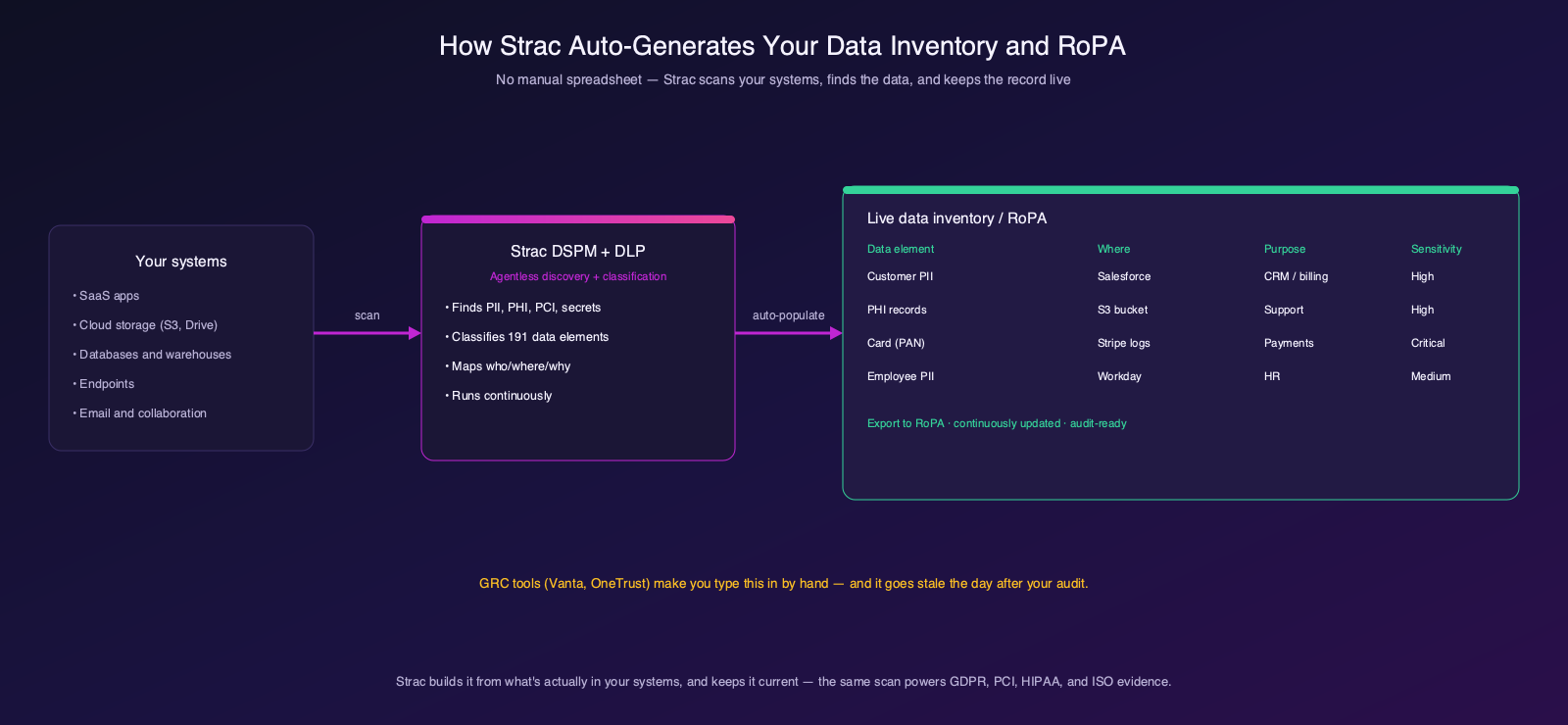
An automated data-mapping tool follows a repeatable pipeline: connect to data sources over API, discover sensitive data at rest and in motion, classify it by type and sensitivity, map who accesses it and where it flows, and maintain the map continuously as data changes. The result feeds directly into your data inventory and RoPA guide, your PCI scope, and your ISO asset inventory. Strac does exactly this — see DSPM and data discovery tools for the discovery engine underneath.
Automated data mapping in practice: Strac scans your systems, classifies the data, and keeps a live inventory / RoPA.
✨ Automated Data Mapping with Strac
Strac is a DSPM/DLP platform, so data mapping isn’t a form to fill in — it’s the product. Connect your SaaS, cloud, databases, endpoints, and email; Strac discovers and classifies 191 data element types, maps location, access, and flow, and keeps the map live. When you need a RoPA, PCI scope, or ISO asset inventory, you export it — grounded in real scans. That’s the difference from a GRC tool: it gives you a template; Strac gives you the mapped data automatically.
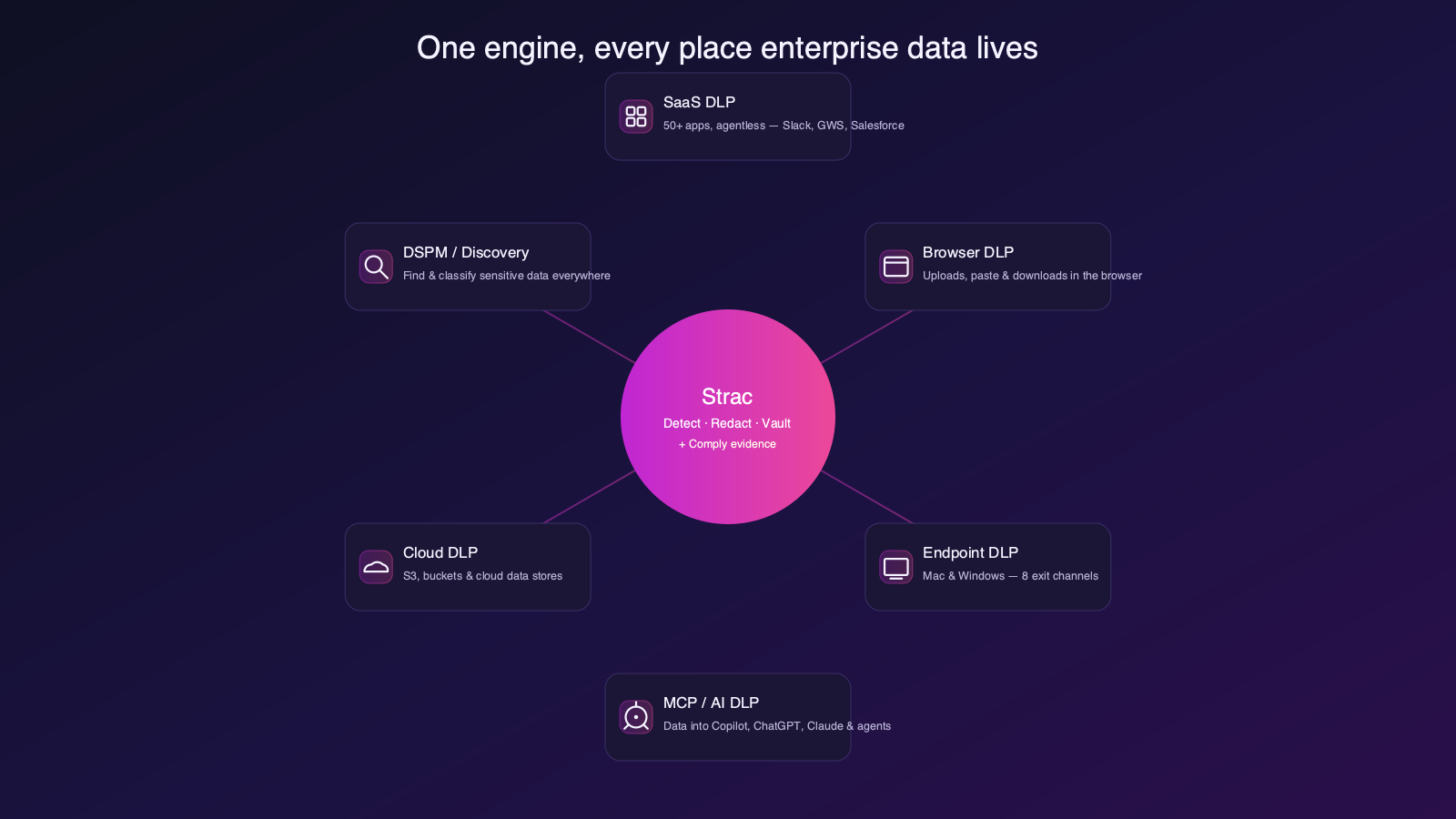
Strac maps sensitive data across SaaS, cloud, endpoint, email, browser, and AI in one continuous scan.
🌶️ Spicy FAQs on Automated Data Mapping
What is automated data mapping?
Automated data mapping discovers and classifies your sensitive data by scanning your systems - SaaS, cloud, databases, endpoints - instead of surveying teams and filling in a spreadsheet. The output is a complete, current data inventory or RoPA.
How is automated data mapping different from manual?
Manual mapping relies on questionnaires and human memory, producing a stale, unverifiable snapshot. Automated mapping scans the actual systems, finds shadow data, and stays current - so it reflects reality, not a survey.
Does automated data mapping help with GDPR?
Yes. It builds and maintains the Record of Processing Activities (RoPA) that GDPR Article 30 requires, and keeps it accurate as your data changes - instead of a once-a-year manual refresh.
What tools do automated data mapping?
DSPM/data-security platforms like Strac scan and classify data automatically. Traditional GRC tools (Vanta, OneTrust) provide the form but not the scanning, so you still map manually alongside them.
How long does automated data mapping take?
Because it’s API-based, discovery starts in minutes and the map builds as scans complete - versus weeks of interviews and spreadsheet work for a manual exercise.
Manual data mapping produces a map that’s wrong by the time you finish it. Automated data mapping — scanning your systems and keeping the map live — is the only version that stays true. Strac maps your data automatically and turns it into an audit-ready inventory and RoPA. Book a demo to see it map your environment.
What is automated data mapping?
Automated data mapping discovers and classifies your sensitive data by scanning your systems - SaaS, cloud, databases, endpoints - instead of surveying teams and filling in a spreadsheet. The output is a complete, current data inventory or RoPA.
How is automated data mapping different from manual?
Manual mapping relies on questionnaires and human memory, producing a stale, unverifiable snapshot. Automated mapping scans the actual systems, finds shadow data, and stays current - so it reflects reality, not a survey.
Does automated data mapping help with GDPR?
Yes. It builds and maintains the Record of Processing Activities (RoPA) that GDPR Article 30 requires, and keeps it accurate as your data changes - instead of a once-a-year manual refresh.
What tools do automated data mapping?
DSPM/data-security platforms like Strac scan and classify data automatically. Traditional GRC tools (Vanta, OneTrust) provide the form but not the scanning, so you still map manually alongside them.
How long does automated data mapping take?
Because it’s API-based, discovery starts in minutes and the map builds as scans complete - versus weeks of interviews and spreadsheet work for a manual exercise.
Discover & Protect Data on SaaS, AI, MCP, Endpoints & Cloud
Strac provides end-to-end data loss prevention for all SaaS and Cloud apps. Integrate in under 10 minutes and experience the benefits of live DLP scanning, live redaction, and a fortified SaaS environment.


.webp)





.avif)


.gif)
