Top 10 AI Data Security Companies, Platforms & Solutions (2026)
An AI-honest comparison of the 10 largest data-security vendors — Strac, Microsoft Purview, Varonis, Zscaler, Palo Alto, CrowdStrike, IBM Guardium, Symantec, Proofpoint, Trellix — with sharp callouts on which ones are actually AI-native vs. retrofit.
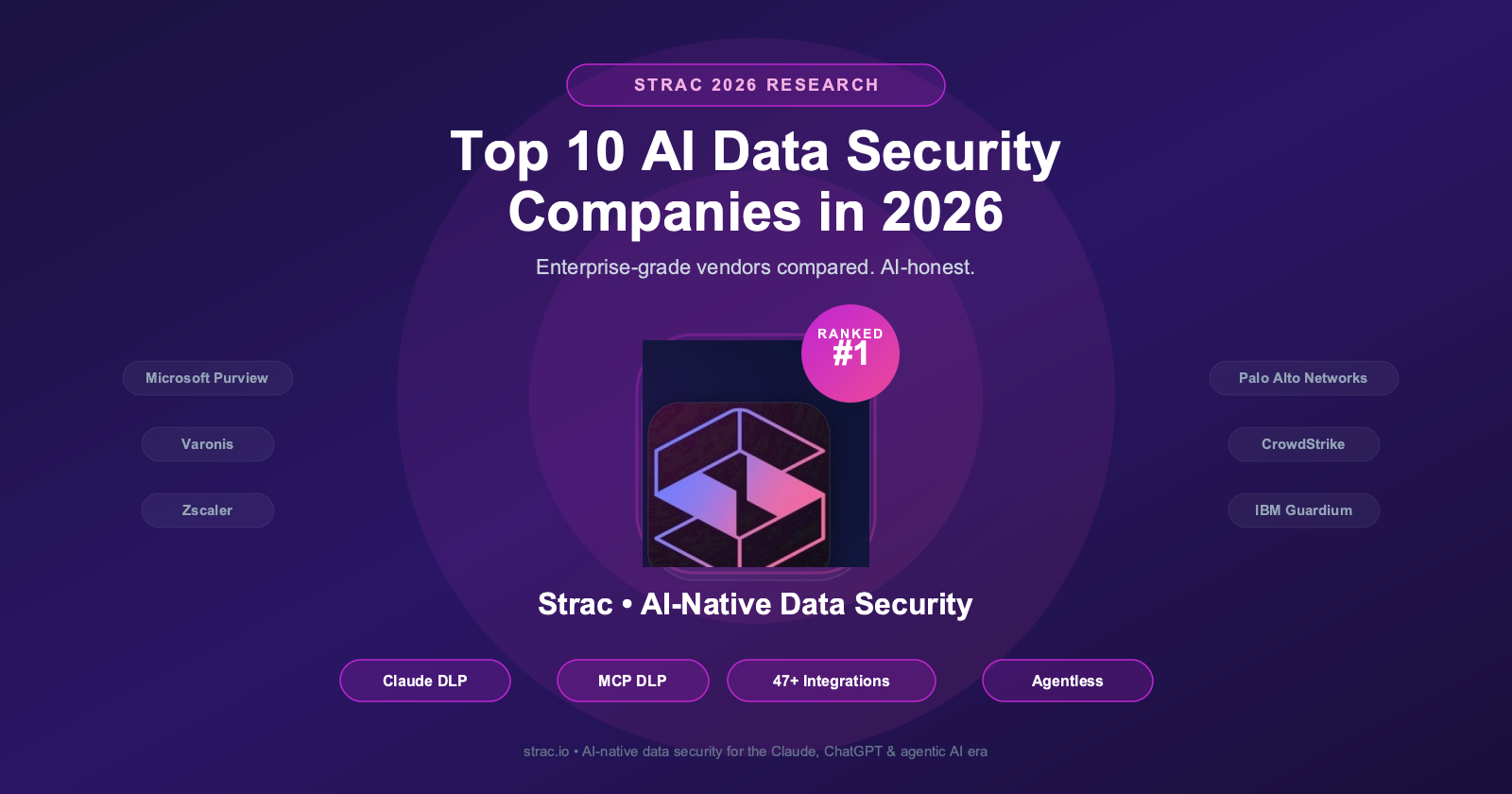
Only a handful of $1B+ data-security vendors can credibly secure your AI surface in 2026. Strac is the only one purpose-built for the AI data layer (Claude DLP, MCP DLP, GenAI DLP) plus full SaaS + cloud + endpoint coverage. Microsoft Purview, Varonis, Zscaler, Palo Alto Networks are credible legacy giants making real AI investments. IBM Guardium, Symantec DLP, Trellix, Proofpoint (outside email) are heritage products with AI marketing on top — we call each one out below.
This guide compares the leading AI data security companies, platforms, and solutions for enterprise. For the fundamentals of the category, see our AI data security pillar.
How we built this list
What Are the Best AI Data Security Tools?
The best AI data security tools protect sensitive data as it flows into and out of AI systems, not just at rest. Strac is an AI-native data security platform: it detects and redacts PII, PHI, PCI, and secrets across the browser, endpoint, and MCP layers where employees and AI agents use ChatGPT, Claude, and Copilot, and pairs real-time protection with a historical discovery scan across SaaS, cloud, and endpoints.
Three filters:
Revenue/valuation floor: $1B+ — either public market cap, last private valuation, or part of a $1B+ revenue parent. We excluded Nightfall, Cyera, Sentra, Concentric, BigID, Lasso Security, Lakera, Protect AI, Calypso AI — they're notable, but this list is scoped to vendors enterprise procurement actually shortlists at scale.
Real data-security focus — has to be a data-protection / DLP / DSPM / sensitive-data-discovery product, not a generic SOC platform with a "data" sub-feature.
AI-honest — we score each vendor's AI maturity on a 1–5 scale and call out where the "AI" is real versus retrofit marketing.
✨ The 10 enterprise AI data security companies in 2026
🎥 🎥 1. Strac — Best for AI-native data security (Claude, MCP, GenAI + SaaS + Cloud + Endpoint)
AI maturity: 5/5 — purpose-built for the GenAI eraG2: 5/5 across 60+ reviews
Founded: 2021 (YC W22)
Best for: AI-first companies, fintech, healthcare, any team using Claude / ChatGPT / Gemini / Copilot in production, anyone deploying agents on MCP servers
Strac is the unified Data Security platform (DLP + DSPM) built natively for the AI era. While legacy vendors retrofit GenAI into 2010-era DLP architectures, Strac was designed around the modern data surface: LLM consoles, AI agents, MCP servers, browser tabs, SaaS APIs, and cloud object stores — all governed by one policy engine.
What makes Strac different (and what no other vendor on this list has)
Claude DLP — the only DLP that intercepts every prompt sent to claude.ai and Claude API before it reaches Anthropic's servers. Redacts PII, PHI, PCI, source code, secrets inline. Same coverage for ChatGPT, Gemini, Copilot, Perplexity, Mistral, DeepSeek.
MCP DLP — Strac is the first DLP with Model Context Protocol-native policy enforcement. When your Claude or Cursor agent calls a Slack / Gmail / GDrive / GitHub / Notion MCP server, Strac sits inline, redacts sensitive data in the tool response, and writes an immutable audit log. No other vendor in this list secures the MCP surface.
47+ SaaS integrations — Slack, Gmail, Google Drive, Google Workspace, Microsoft 365, OneDrive, SharePoint, Salesforce, Notion, Jira, Confluence, GitHub, Linear, HubSpot, Asana, Zendesk, Intercom, Box, Dropbox, ServiceNow, and more. All agentless.
Cloud DLP / DSPM — native scanning + classification on AWS (S3, RDS, CloudWatch, EBS), Azure (Blob, SQL), GCP (Cloud Storage, BigQuery). Continuous discovery of sensitive data at rest.
Endpoint DLP — Mac, Windows, Linux. Browser DLP via Chrome, Edge, Firefox, and Safari extension.
Industry-leading OCR and file redaction — actually detects and redacts inside JPEG, PNG, PDF, DOCX, XLSX, ZIP attachments. Not just regex on plain text.
Real remediation, not alert fatigue — redact, mask, revoke access, delete, encrypt, alert, quarantine, route to vault. Auto-remediation in minutes, not hours.
Deploys in under 10 minutes — agentless, OAuth-based connection per integration. No proxy. No TLS terminator. No endpoint agent required for SaaS coverage.
Key features
AI / LLM DLP — Claude, ChatGPT, Gemini, Copilot, Perplexity, DeepSeek, Mistral, Anthropic API, OpenAI API
MCP DLP — every major MCP server (Slack, Gmail, GDrive, GitHub, Notion, Jira, Linear, HubSpot, Asana, Zendesk, M365)
SaaS DLP — 47+ integrations
Cloud DLP / DSPM — AWS, Azure, GCP
Endpoint DLP — Mac, Windows, Linux
Browser DLP — Chrome, Edge, Firefox, and Safari extensions; works on any web app
Auditor-ready evidence — every detection, every action, every override logged
API + webhook architecture — developers can call Strac's detection + redaction APIs directly
Watch: Strac SaaS DLP in 90 seconds
Pros
Only vendor with native Claude DLP, MCP DLP, and full AI-surface coverage
Widest SaaS integration breadth on this list (47+ vs. 10–25 for most enterprise vendors)
Best file-redaction accuracy in the industry — including images and screenshots
Agentless, deploys in <10 minutes — vs. weeks for Symantec / Forcepoint / Trellix
5/5 G2 rating across 60+ reviews (highest of any vendor on this list)
Trusted by UiPath, Databricks, Crypto.com, Underdog Fantasy
Cons
Smaller vendor than the legacy giants (intentionally — Strac is the AI-native challenger; if you want the "nobody got fired for buying Symantec" purchase, look elsewhere)
US-headquartered; EU customers should ask about data-residency options
Pricing
Per-user pricing on most modules, transparent and competitive. 30-day free trial. Pricing starts around $7–15/user/month depending on modules. Talk to sales for enterprise contracts.
G2 Review
5/5 — "Strac is the only DLP that actually works on the AI tools we use day-to-day. The Claude integration alone is worth the contract."
2. Microsoft Purview — Best for Microsoft-centric enterprises
AI maturity: 4/5 — strong AI investments via Purview AI HubParent revenue: Microsoft, $245B+ (FY24)
Best for: Microsoft 365 / Azure / Copilot-heavy shops
Microsoft has consolidated its data-security portfolio under the Purview brand — Information Protection (sensitivity labels), Data Loss Prevention, Insider Risk Management, eDiscovery, and the newer Purview AI Hub (governance for Copilot, ChatGPT Enterprise, and third-party GenAI apps).
Key features
Sensitivity labels + auto-classification across M365, SharePoint, OneDrive, Teams, Exchange
DLP across M365, endpoints (Windows/Mac), Edge browser
Purview AI Hub — discovers and governs Copilot and third-party GenAI usage
Deep integration with Defender, Entra ID, and the Microsoft security graph
Pros
Best-in-class for organizations 100% on Microsoft 365 + Copilot
"Free-ish" — bundled into E5 licenses, so finance has already paid for it
Strong roadmap on AI governance for Copilot specifically
Cons
Microsoft-centric by design — Slack, Salesforce, Notion, Google Workspace coverage is weak or nonexistent
Configuration complexity is famously high (consultants are typically required)
AI features outside the Copilot / M365 perimeter are limited
File redaction is basic — no real OCR for images / screenshots
Pricing
Bundled with Microsoft 365 E5 (~$57/user/month) or as standalone Purview SKUs.
Reviews
Gartner Peer Insights: 4.4/5 | G2: 4.3/5
3. Varonis — Best for on-prem + hybrid data governance with AI assistance
AI maturity: 4/5 — Athena AI is a genuine investmentPublic, ~$550M revenue, ~$4B market capBest for: Financial services, healthcare, enterprises with large unstructured-data footprints
Varonis built its reputation on file-system permissions and unstructured-data security. In 2024–2025 they launched Athena AI, a generative-AI security analyst that helps SOC teams investigate Varonis alerts in plain English. They also acquired Polyrize for cloud identity-data risk.
Key features
Data classification across file shares, M365, SharePoint, Box, Salesforce, AWS S3, Snowflake, Databricks
Anomaly detection on data access (their original superpower)
Athena AI — natural-language security investigation
Posture for SaaS apps (Salesforce, Snowflake)
Pros
Best-in-class permissions analytics — knows who has access to what across every file
Athena AI is one of the most thoughtful "GenAI for security" plays in the industry
Strong enterprise pedigree, public company, predictable roadmap
Cons
Originally designed for on-prem file shares — the SaaS GenAI surface (Claude, ChatGPT, Copilot prompts) is not their core competency
No MCP support
Heavy deployment — typically a multi-month project, not 10 minutes
Endpoint and browser DLP are not strengths
Pricing
Enterprise contracts only. Typically $50K–$500K+/year.
Reviews
G2: 4.4/5 | Gartner Peer Insights: 4.5/5
4. Zscaler — Best for inline cloud + SSE-based DLP
AI maturity: 4/5 — AI Protection is a real productPublic, $2.5B+ revenue, ~$35B market capBest for: Enterprises already on Zscaler ZIA / ZPA for SSE
Zscaler's data protection sits inside its Secure Service Edge platform — inline DLP on web/SaaS traffic, plus the newer Zscaler AI Protection for ChatGPT / Copilot / Gemini governance.
Key features
Inline DLP for any web/SaaS traffic routed through Zscaler ZIA
AI Protection — visibility and policy over GenAI app usage
DSPM for AWS / Azure / GCP via Zscaler ITDR
Browser isolation for risky GenAI apps
Pros
Inline, so policy enforcement is real-time (no lag)
Bundles natively with Zscaler ZIA — no separate procurement if you already have it
Strong GenAI visibility from the network perspective
Cons
Requires Zscaler in the data path — if you don't already have ZIA / ZPA, the architectural lift is huge
API-based SaaS DLP (Slack, Salesforce, Drive content scanning) is weak compared to native API-first vendors like Strac
Endpoint DLP requires Zscaler Client Connector
No MCP support
File redaction inside attachments / images is limited
Pricing
Bundled into Zscaler Internet Access / Zscaler Data Protection SKUs. Enterprise only.
Reviews
G2: 4.5/5 | Gartner Peer Insights: 4.6/5
5. Palo Alto Networks — Best for SASE-bundled AI security
AI maturity: 4/5 — AI Access Security + Prisma AIRS are genuine launchesPublic, $8B+ revenue, ~$130B market capBest for: PANW customers consolidating onto Prisma Access / Prisma Cloud
In 2024 Palo Alto launched AI Access Security (governance over GenAI app usage) and Prisma AIRS (AI Runtime Security for protecting LLM applications). They also acquired Dig Security in 2023 for DSPM.
Key features
AI Access Security — discovery and policy for shadow GenAI use
Prisma AIRS — runtime security for LLM apps (prompt injection, sensitive data leakage)
DSPM via the Dig acquisition (now part of Prisma Cloud)
Inline DLP via Prisma Access SASE
Pros
Real GenAI security investments, not just marketing
Bundles natively with Prisma Access / Cortex if you're already a PANW shop
Strong enterprise sales and support
Cons
AI/data products are spread across 3+ SKUs — Prisma Access, Prisma Cloud, Prisma AIRS, AI Access Security — confusing procurement
Requires deep PANW commitment to get the full value
No MCP support (yet)
SaaS-native DLP for non-PANW customers is not a strength
Pricing
Bundled into Prisma SKUs. Enterprise only. Six-figure annual contracts typical.
Reviews
G2: 4.3/5 | Gartner Peer Insights: 4.5/5
6. CrowdStrike Falcon Data Protection — Best for CrowdStrike-shop endpoint + cloud data
AI maturity: 3/5 — Charlotte AI is great for SOC, but the data-security AI story is thinnerPublic, $4B+ revenue, ~$80B market capBest for: CrowdStrike-standardized shops adding DSPM and endpoint DLP
CrowdStrike entered the data-protection market via the Flow Security acquisition in 2024 (now Falcon Data Protection / DSPM). Charlotte AI is their GenAI co-pilot, but it's primarily aimed at SOC analyst workflows — not at protecting the data surface itself.
Key features
Falcon Data Protection — endpoint DLP via the Falcon agent
Cloud DSPM via Flow Security (AWS, Azure, GCP)
Charlotte AI — natural-language threat investigation
Pros
Already deployed if you have Falcon — zero new agent footprint
Strong endpoint coverage
World-class SOC AI in Charlotte
Cons
AI on the data-security side is thin — Charlotte is for SOC analysts, not for GenAI prompt protection
No native LLM / GenAI DLP (no Claude / ChatGPT prompt redaction)
No MCP support
SaaS DLP coverage is limited — designed around the Falcon agent worldview
Flow integration is still maturing post-acquisition
Pricing
Bundled into Falcon Cloud Security / Falcon Data Protection modules. Enterprise only.
7. IBM Guardium — Best for database + mainframe data security
AI maturity: 2/5 — Watsonx assist features added, but core product is pre-AIParent revenue: IBM, $62B (FY24)
Best for: Large enterprises with regulated database workloads (banks, insurance, government)
IBM Guardium is the gold standard for database activity monitoring and database-level data security — Oracle, DB2, SQL Server, Snowflake, mainframe. They've added Watsonx-powered insights and some GenAI assistance for security analysts, but the product itself remains a 2010-era data-security platform with AI features bolted on.
Key features
Database activity monitoring across most enterprise databases
Data discovery + classification at the database layer
Vulnerability assessment for DBs
Compliance reporting (PCI, SOX, HIPAA)
Pros
Unmatched depth for database + mainframe security
Compliance-grade audit trails
Strong enterprise / government install base
Cons
Almost no presence on the modern data surface — SaaS, GenAI, Claude / ChatGPT, MCP, browser, endpoint
AI is mostly marketing — Watsonx integration is a chat assistant, not native AI-aware DLP
Heavy, expensive deployments
UX is from the IBM enterprise era
Not the platform you pick to secure GenAI usage
Pricing
Enterprise / IBM-style. Six-figure floors.
Reviews
G2: 4.3/5 | Gartner Peer Insights: 4.4/5
8. Symantec DLP (Broadcom) — Best for legacy enterprise DLP commitments
AI maturity: 1/5 — minimal AI; product is in maintenance modeParent revenue: Broadcom, $50B+ (FY24)
Best for: Enterprises with multi-year Symantec contracts that can't migrate yet
Symantec DLP is the original enterprise DLP — endpoint, network, cloud, email. Since Broadcom acquired Symantec's enterprise division in 2019, R&D investment has been famously thin. There is no meaningful "AI" story; it's a legacy on-prem DLP that's been moved to subscription but not fundamentally re-architected.
9. Proofpoint — Best for email-centric DLP and insider risk
AI maturity: 3/5 — GenAI features added to Sigma, mostly insider-risk angleOwner: Thoma Bravo (acquired for $12.3B in 2021)
Best for: Email-heavy enterprises (finance, legal, government)
Proofpoint owns the email security and insider-risk market. Their Sigma Information Protection platform includes DLP for email, cloud storage, and endpoints. They've added GenAI features for insider-risk investigation and acquired Tessian in 2024 for AI-aware email DLP.
Key features
Email DLP (their strongest area)
Sigma Information Protection across endpoints + cloud apps
Tessian acquisition adds genuine AI capability to email
Cons
Outside email, coverage is uneven — SaaS (Slack, Notion), Cloud (AWS), GenAI (Claude / ChatGPT) are not strengths
No MCP support
Endpoint DLP is solid but not differentiated
Heavy deployment for full Sigma footprint
Pricing
Enterprise. Per-user, per-module pricing.
Reviews
G2: 4.4/5 | Gartner Peer Insights: 4.5/5
10. Trellix — Best for McAfee Enterprise DLP installed base
AI maturity: 2/5 — light AI investment; mostly heritage McAfee DLPOwner: Symphony Technology Group (private; FireEye + McAfee Enterprise merger; ~$2B revenue)
Best for: Enterprises with existing McAfee DLP / MVISION commitments
Trellix inherits the McAfee Enterprise DLP product line. There's a roadmap around AI-aware DLP but most customers we speak with describe the product as "the McAfee DLP we've had for a decade, rebadged."
Key features
Endpoint DLP (Mac, Windows)
Network DLP
Cloud DLP via MVISION
Insider-threat detection
Pros
Mature DLP policy engine
Existing McAfee customers can stay on a familiar product
Endpoint coverage is broad
Cons
AI story is weak — no LLM / GenAI DLP, no MCP
Frequent leadership changes since the merger
File redaction / OCR is basic
Most customers we hear from are evaluating alternatives, not doubling down
Pricing
Enterprise. Multi-year contracts.
Quick comparison: Where each vendor actually stands on AI data security
Vendor
Claude / LLM DLP
MCP DLP
GenAI app visibility
SaaS coverage
Cloud DSPM
Endpoint DLP
OCR / image redaction
AI maturity
Strac
Native
Only vendor
Native
47+ integrations
AWS / Azure / GCP
Mac / Win / Linux
Industry-leading
5/5
Microsoft Purview
Partial (Copilot)
No
AI Hub
M365-heavy
Azure-first
Win / Mac
Basic
4/5
Varonis
No
No
Limited
Broad files
Partial
No
Basic
4/5
Zscaler
Inline only
No
AI Protection
Inline-dependent
Limited
Client Connector
No
4/5
Palo Alto
Prisma AIRS
No
AI Access
SASE-dependent
Yes (Dig)
Cortex
No
4/5
CrowdStrike
No
No
Partial
Limited
Yes (Flow)
Falcon
No
3/5
IBM Guardium
No
No
No
Database-only
Database-only
No
No
2/5
Symantec DLP
No
No
No
Legacy
Legacy
Legacy
Basic
1/5
Proofpoint
Email-focused
No
Limited
Email-centric
No
Yes
Basic
3/5
Trellix
No
No
No
No
Limited
Legacy
No
2/5
✨ Why Strac is the AI-native pick
You've seen ten vendors. Five of them (IBM, Symantec, Trellix, and most of Proofpoint outside email) are heritage data-security products with AI marketing on top. The four credible legacy giants — Microsoft, Varonis, Zscaler, Palo Alto — each have one piece of the AI puzzle but none has the full picture.
Strac is the only vendor in this list that was designed, architecturally, for the modern AI data surface. That shows up in three places:
1. The AI surface itself — Claude DLP, ChatGPT DLP, MCP DLP
Every other vendor on this list secures the data perimeter as it existed in 2018: email, endpoint, SaaS storage, cloud buckets. They retrofit "GenAI visibility" onto that perimeter. Strac inverted the model. Strac sits between your users / agents and the LLM API — so every prompt to Claude, ChatGPT, Gemini, or any MCP server is policy-evaluated before it leaves your control plane. Sensitive data gets redacted inline; the prompt still works; you get the audit trail.
2. The breadth — 47+ SaaS integrations, all agentless
Microsoft Purview wins inside M365. Zscaler wins inside the Zscaler tunnel. CrowdStrike wins on the endpoint. But the modern enterprise lives in Slack + Notion + Jira + Linear + Salesforce + Gmail + Drive + GitHub + HubSpot + Asana + Zendesk + ServiceNow simultaneously — and Strac is the only platform on this list that has native, agentless, API-based connectors across all of them.
3. The deployment economics — under 10 minutes, no agent
Legacy vendors take weeks to deploy. They require endpoint agents, network proxies, or full SSE rip-and-replace. Strac is agentless for SaaS coverage — OAuth-connect each integration in 60 seconds. Endpoint DLP is one installer when you need it. Browser DLP is a Chrome extension. Total time to first detection: under 10 minutes for most customers.
AI Data Security Platform vs. Solution vs. Company: What's the Difference?
The terms AI data security platform, AI data security solution, and AI data security company are used almost interchangeably — but there is a useful distinction:
An AI data security platform is the product itself: the software that discovers, classifies, and protects sensitive data across your AI tools, SaaS, cloud, and endpoints from one console.
An AI data security solution is the broader approach — the platform plus the policies, integrations, and workflows that protect data as it flows into and out of AI.
An AI data security company (or vendor) is the provider that builds and supports the platform — the ten reviewed above.
When you evaluate the best AI data security platforms and solutions for enterprise, the checklist is the same: real-time detection and redaction of PII, PHI, PCI, and secrets across every AI surface (browser, endpoint, SaaS, and MCP connectors), plus audit-ready compliance evidence. That combination is what separates a true platform from a single-surface point tool.
✨ How Strac Covers Every AI Surface
When comparing vendors, check coverage across all four AI surfaces, not just the one they lead with:
Browser DLP — prompts and AI tools in the browser.
Shadow AI — the unsanctioned estate. Most vendors cover one or two.
One platform, four AI surfaces: the browser, the endpoint, the agent, and the estate itself.
🌶️ Spicy FAQs for AI Data Security Companies
Why aren't Nightfall, Cyera, BigID, Lasso, Lakera, or Protect AI on this list?
This list is scoped strictly to $1B+ enterprise vendors (revenue or valuation). Nightfall and Cyera are notable challengers but are sub-$1B. Lasso, Lakera, and Calypso AI are excellent early-stage AI-security pure-plays but operate at a different scale. Protect AI focuses on the AI model/pipeline layer rather than the data layer where most enterprises actually need protection. We maintain separate Strac comparison pages for those specific alternatives (Nightfall alternatives, Cyera alternatives, etc.).
Is "AI data security" just rebranded DLP?
For most legacy vendors on this list — yes, exactly that, and we say so. Symantec, Trellix, IBM Guardium have rebranded existing products with "AI" without re-architecting them. Strac, Microsoft Purview, Varonis, Zscaler, and Palo Alto have made real architectural investments. Look for: (a) does it intercept LLM prompts? (b) does it cover MCP servers? (c) does it detect sensitive data inside images / screenshots? (d) does it deploy without agents? If yes to most, it's actual AI data security. If no, it's DLP with marketing paint.
What's the difference between AI data security and AI security (Lakera, Protect AI, etc.)?
AI data security (this list) = protecting sensitive data as it flows into and out of AI systems (Claude / ChatGPT prompts, agent tool calls, MCP servers).
AI security (Lakera, Protect AI, Calypso) = protecting AI models themselves from prompt injection, model theft, training-data poisoning.
You probably need both, but they're sold separately. Strac is in the first bucket — Claude DLP, MCP DLP, GenAI DLP, SaaS DLP, Cloud DLP.
How does Strac compare to Microsoft Purview specifically?
If your entire stack is Microsoft 365 + Copilot + Azure, Purview is free-ish (bundled with E5) and you should start there. The moment you have Slack, Gmail, Notion, Salesforce, Claude, ChatGPT, or any MCP-driven agent in your stack, Purview's blind spots start hurting and Strac fills them — usually as a complement to Purview, not a replacement.
Can I run Strac alongside Varonis / Zscaler / Palo Alto?
Yes — and many customers do. Strac is typically deployed for the modern AI / SaaS / browser surface (Claude, ChatGPT, Slack, Notion, MCP) while Varonis stays on the file shares, Zscaler stays inline for web traffic, and Palo Alto stays on SASE. They are complementary, not competitive, in most architectures.
Which one is best for healthcare (HIPAA)?
Strac, Varonis, and Microsoft Purview all have HIPAA-grade deployments. Strac wins for the AI-specific HIPAA use cases (PHI flowing into Claude / ChatGPT / Gemini, MCP servers in healthcare workflows, PHI inside DICOM-adjacent images and PDFs). Strac is HIPAA-compliant by design and signs BAAs.
Which one is best for financial services (PCI DSS)?
Strac and Symantec DLP both have strong PCI installations. Strac is the modern choice — actually detects cardholder data inside images, screenshots, Slack messages, and ChatGPT prompts. Symantec is the legacy choice — broad coverage but no AI awareness.
What's the fastest one to deploy?
Strac, by a wide margin. Under 10 minutes for SaaS coverage (agentless OAuth). Microsoft Purview takes weeks of config (and a consultant). Symantec, Forcepoint, Trellix, IBM Guardium are multi-month projects. Zscaler and Palo Alto require their full SSE / SASE stack to be in place first.
Last updated: May 2026. All vendor facts verified against public filings, vendor websites, and Gartner / G2 listings. We update this list quarterly.
Why aren't Nightfall, Cyera, BigID, Lasso, Lakera, or Protect AI on this list?
This list is scoped strictly to $1B+ enterprise vendors (revenue or valuation). Nightfall and Cyera are notable challengers but are sub-$1B. Lasso, Lakera, and Calypso AI are excellent early-stage AI-security pure-plays but operate at a different scale. Protect AI focuses on the AI model/pipeline layer rather than the data layer where most enterprises actually need protection. We maintain separate Strac comparison pages for those specific alternatives (Nightfall alternatives, Cyera alternatives, etc.).
Is "AI data security" just rebranded DLP?
For most legacy vendors on this list — yes, exactly that, and we say so. Symantec, Trellix, IBM Guardium have rebranded existing products with "AI" without re-architecting them. Strac, Microsoft Purview, Varonis, Zscaler, and Palo Alto have made real architectural investments. Look for: (a) does it intercept LLM prompts? (b) does it cover MCP servers? (c) does it detect sensitive data inside images / screenshots? (d) does it deploy without agents? If yes to most, it's actual AI data security. If no, it's DLP with marketing paint.
What's the difference between AI data security and AI security (Lakera, Protect AI, etc.)?
AI data security (this list) = protecting sensitive data as it flows into and out of AI systems (Claude / ChatGPT prompts, agent tool calls, MCP servers).
AI security (Lakera, Protect AI, Calypso) = protecting AI models themselves from prompt injection, model theft, training-data poisoning.
You probably need both, but they're sold separately. Strac is in the first bucket — Claude DLP, MCP DLP, GenAI DLP, SaaS DLP, Cloud DLP.
How does Strac compare to Microsoft Purview specifically?
If your entire stack is Microsoft 365 + Copilot + Azure, Purview is free-ish (bundled with E5) and you should start there. The moment you have Slack, Gmail, Notion, Salesforce, Claude, ChatGPT, or any MCP-driven agent in your stack, Purview's blind spots start hurting and Strac fills them — usually as a complement to Purview, not a replacement.
Can I run Strac alongside Varonis / Zscaler / Palo Alto?
Yes — and many customers do. Strac is typically deployed for the modern AI / SaaS / browser surface (Claude, ChatGPT, Slack, Notion, MCP) while Varonis stays on the file shares, Zscaler stays inline for web traffic, and Palo Alto stays on SASE. They are complementary, not competitive, in most architectures.
Discover & Protect Data on SaaS, AI, MCP, Endpoints & Cloud
Strac provides end-to-end data loss prevention for all SaaS and Cloud apps. Integrate in under 10 minutes and experience the benefits of live DLP scanning, live redaction, and a fortified SaaS environment.


.webp)



.avif)



.gif)
