August 10, 2026

9
min read
Agent vs. Agentless Monitoring and Security
Learn the differences between agent-based and agentless security, their pros and cons, and why modern organizations need both to protect SaaS, AI, browsers, and cloud data.
· Agent-based and agentless security solvedifferent problems. Endpoint agents protect devices, while agentlesssecurity protects SaaS applications, cloud platforms, browsers, AI tools, andAPIs.
· Modern data rarely stays on the endpoint.Sensitive information now moves through cloud storage, collaboration tools,GenAI platforms, browser sessions, and AI agents, requiring broader visibilitythan endpoint agents alone can provide.
· AI and browser security have reshaped DLP.Organizations need protection for AI prompts, uploaded files, browser uploads,and automated AI workflows to prevent sensitive data leaks in real time.
· The best security strategy combines bothapproaches. Agent-based DLP secures managed devices, while agentless DLPextends protection across cloud, SaaS, browser, GenAI, and MCP-connectedenvironments.
· Choosea platform built for today's data landscape. Look for AI-powered detection,unified DSPM and DLP, browser security, deep content inspection, real-timeremediation, and comprehensive coverage across SaaS, cloud, AI, and endpointenvironments.
In today's digital landscape, protecting sensitive data is a paramount concern for organizations. With the increasing adoption of cloud-based services and the growing complexity of endpoint devices, the debate between agent-based and agentless monitoring and security solutions has intensified. This post delves into the distinctions between these two approaches, particularly in the context of Data Loss Prevention (DLP). We'll explore the strengths and limitations of both methodologies, and why the choice between them can significantly impact your organization's security posture.
At the core, the difference between agent-based and agentless DLP solutions lies in their operational focus:

A growing percentage of sensitive data no longer leaves the organization through traditional endpoint channels. Instead, it flows through web browsers, AI assistants, cloud applications, and automated workflows. Employees upload files to AI platforms, copy customer records into chatbots, collaborate through browser-based SaaS applications, and increasingly rely on AI agents connected to enterprise systems.
While endpoint agents remain valuable for monitoring activity on managed devices, they often lack the visibility required to inspect these cloud-native interactions. Agentless DLP complements endpoint security by monitoring and enforcing policies where modern business actually happens—inside SaaS applications, browser sessions, APIs, and AI services.
Deploying endpoint agents is often a complex and cumbersome process, especially in large organizations:
Most enterprise devices already run multiple security agents, including endpoint protection, vulnerability management, identity verification, VPN clients, remote management tools, and endpoint detection and response (EDR). Every additional agent consumes system resources, introduces compatibility challenges, and increases operational overhead for IT teams.
As organizations continue expanding their SaaS footprint, many security leaders are prioritizing lightweight, agentless architectures where possible. Reducing endpoint complexity not only improves the user experience but also accelerates deployments and simplifies ongoing maintenance.

One of the most significant drawbacks of endpoint agents is their inability to protect SaaS and cloud applications. As organizations increasingly move their critical data and operations to the cloud, the risk exposure in these environments grows. Key limitations include:
The modern browser has become the primary workspace for most employees. Whether users are uploading documents to Google Drive, submitting forms through Salesforce, collaborating in Slack, or interacting with AI platforms like ChatGPT and Claude, much of today's sensitive data moves through browser sessions rather than traditional desktop applications.
Similarly, AI assistants introduce an entirely new category of data exposure. Employees routinely paste source code, contracts, customer records, financial reports, and internal documentation into large language models. Traditional endpoint agents were not designed to understand AI prompts, responses, or the context surrounding those interactions.
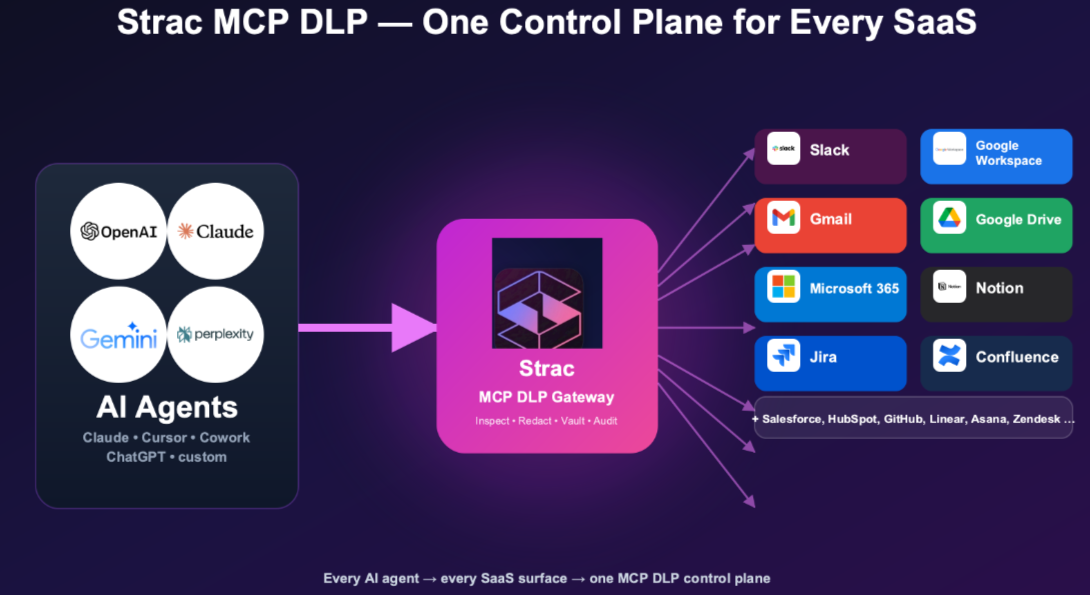
Another rapidly emerging challenge is the rise of AI agents and Model Context Protocol (MCP) servers. These autonomous systems can access enterprise applications, retrieve sensitive information from multiple sources, and perform actions on behalf of users. Protecting these AI-driven workflows requires security controls that operate beyond the endpoint and directly within the applications, APIs, and cloud services where the data resides.
Agentless DLP solutions offer several advanced capabilities that go beyond traditional endpoint-based protection, providing organizations with robust tools to safeguard sensitive data across SaaS and cloud environments. These features make agentless solutions particularly powerful in addressing the complexities of modern data protection:
Built-In & Custom Detectors: Agentless DLP solutions come equipped with a comprehensive set of detectors for sensitive data elements, including those required for compliance with PCI, HIPAA, GDPR, and other regulatory frameworks. In addition to built-in detectors, these solutions allow for customization, enabling organizations to configure their own data elements based on specific needs. This flexibility ensures that the DLP solution can adapt to unique business requirements and evolving data protection demands.
Image and Document Deep Content Inspection: One of the standout features of advanced agentless DLP solutions is their ability to perform detection and redaction not only on text but also on images and complex document formats. This includes the capability to inspect and redact sensitive data from JPEGs, PNGs, screenshots, PDFs, Word documents (DOC, DOCX), Excel spreadsheets (XLSX), and even compressed files like ZIPs. Such deep content inspection ensures that no sensitive information slips through, regardless of the file type.
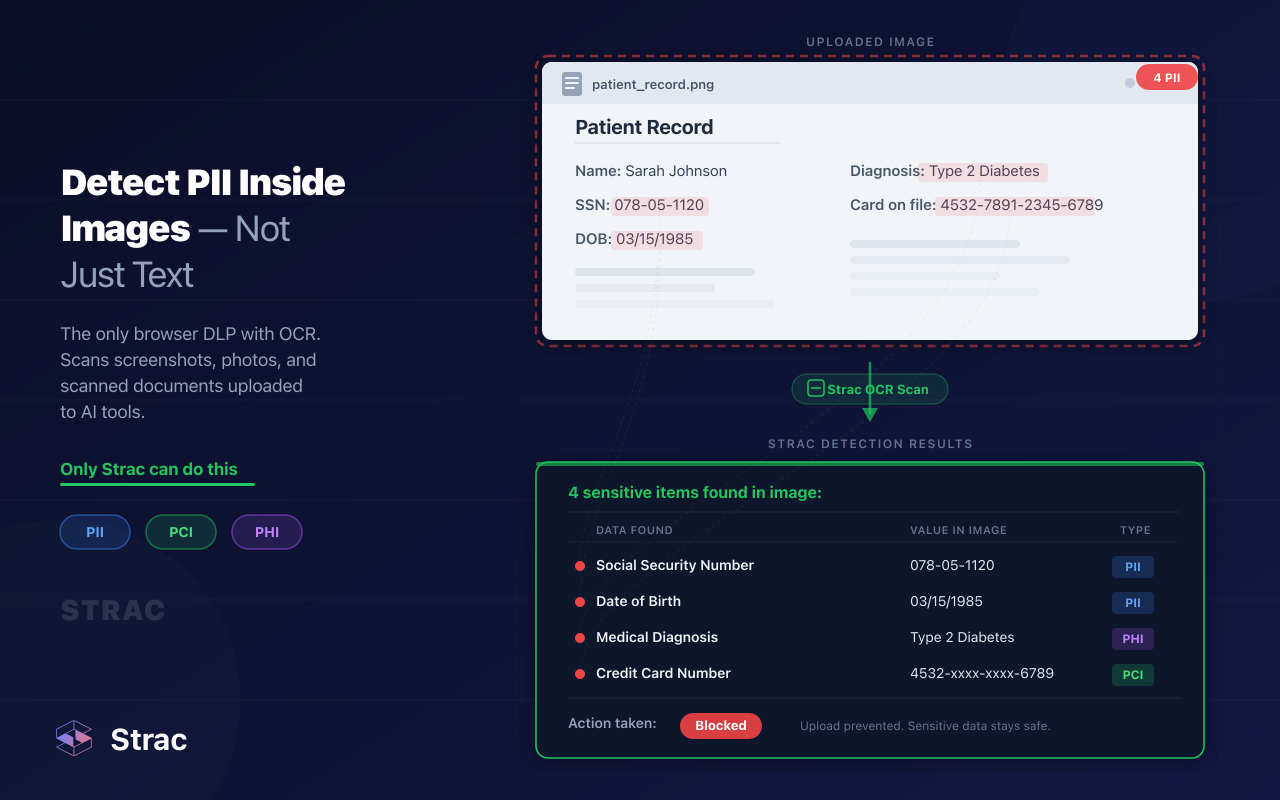
Compliance Support: These solutions are designed to help organizations achieve and maintain compliance with a wide range of regulatory standards, including PCI DSS, SOC 2, HIPAA, ISO 27001, CCPA, GDPR, and NIST frameworks. By automating compliance-related data protection measures, agentless DLP solutions reduce the burden on security teams and provide peace of mind that regulatory requirements are being met.
Ease of Integration: Advanced agentless DLP solutions offer seamless integration with existing SaaS and cloud environments, within 10-15 minutes. This rapid deployment allows organizations to quickly implement live scanning and real-time redaction capabilities across their applications, minimizing disruption to operations and accelerating the time to value.

Accurate Detection and Redaction: Leveraging custom machine learning models specifically trained on sensitive data types, these solutions provide highly accurate detection and redaction capabilities. This results in fewer false positives and false negatives, ensuring that sensitive information is effectively protected without unnecessary interruptions to business processes.

Rich and Extensive SaaS Integrations: Agentless DLP solutions offer a wide range of integrations with SaaS and cloud applications, providing comprehensive coverage across the most commonly used platforms. This extensive integration ensures that all vectors of data exposure are addressed, making it easier to enforce consistent data protection policies across the entire organization.

Generative AI and LLM Integration: In addition to traditional SaaS and cloud integrations, these solutions also support integration with AI and large language models (LLM) platforms, such as ChatGPT, Google Bard, and Microsoft Copilot. This capability allows organizations to extend their data protection efforts to AI-driven applications, safeguarding sensitive data even in advanced, AI-based environments.
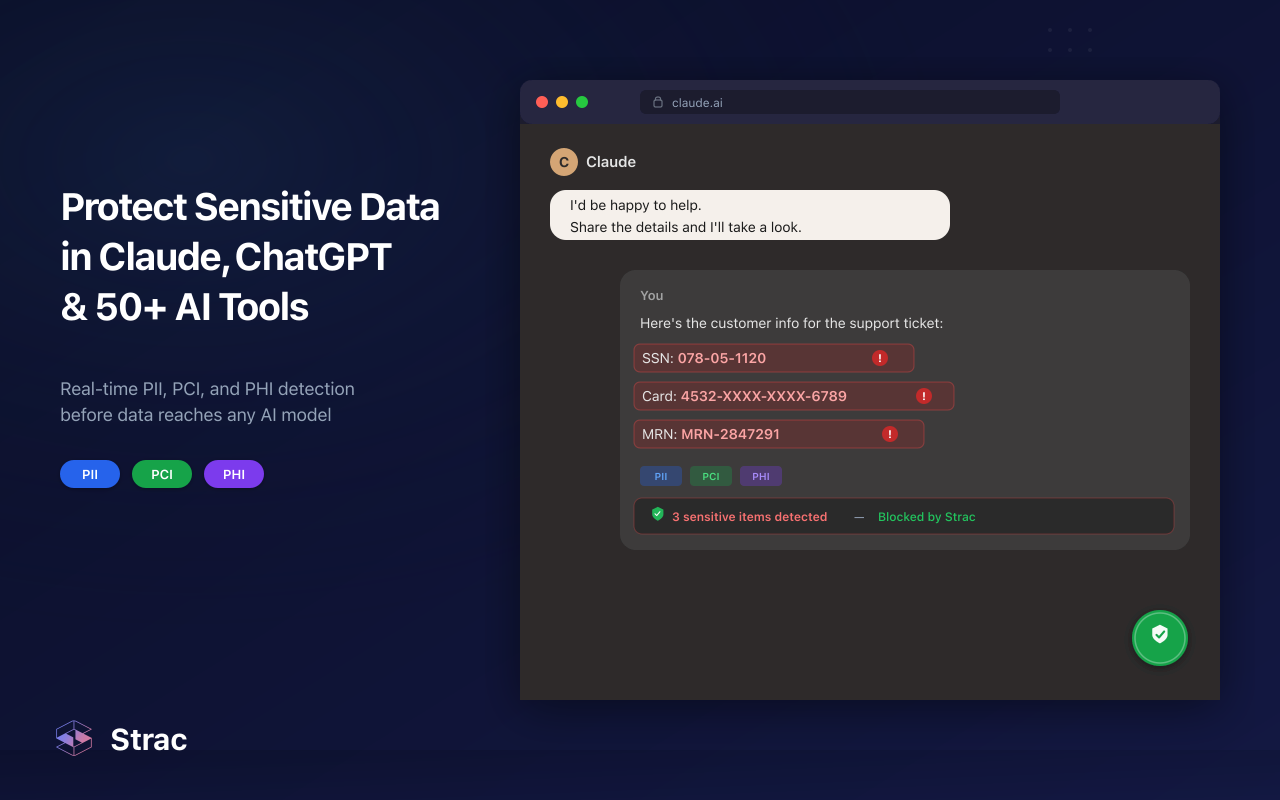
MCP DLP: Detects, redacts, or blocks sensitive data flowing between AI agents (ChatGPT, Claude, Copilot, Cursor) and connected SaaS applications through MCP servers before data reaches the AI model.
Inline Redaction: These solutions can perform inline redaction, which means they can mask or blur sensitive text within any attachment before it is accessed or shared. This feature is particularly useful for preventing data breaches in real-time, as it ensures that sensitive information is not exposed during file sharing or collaboration.
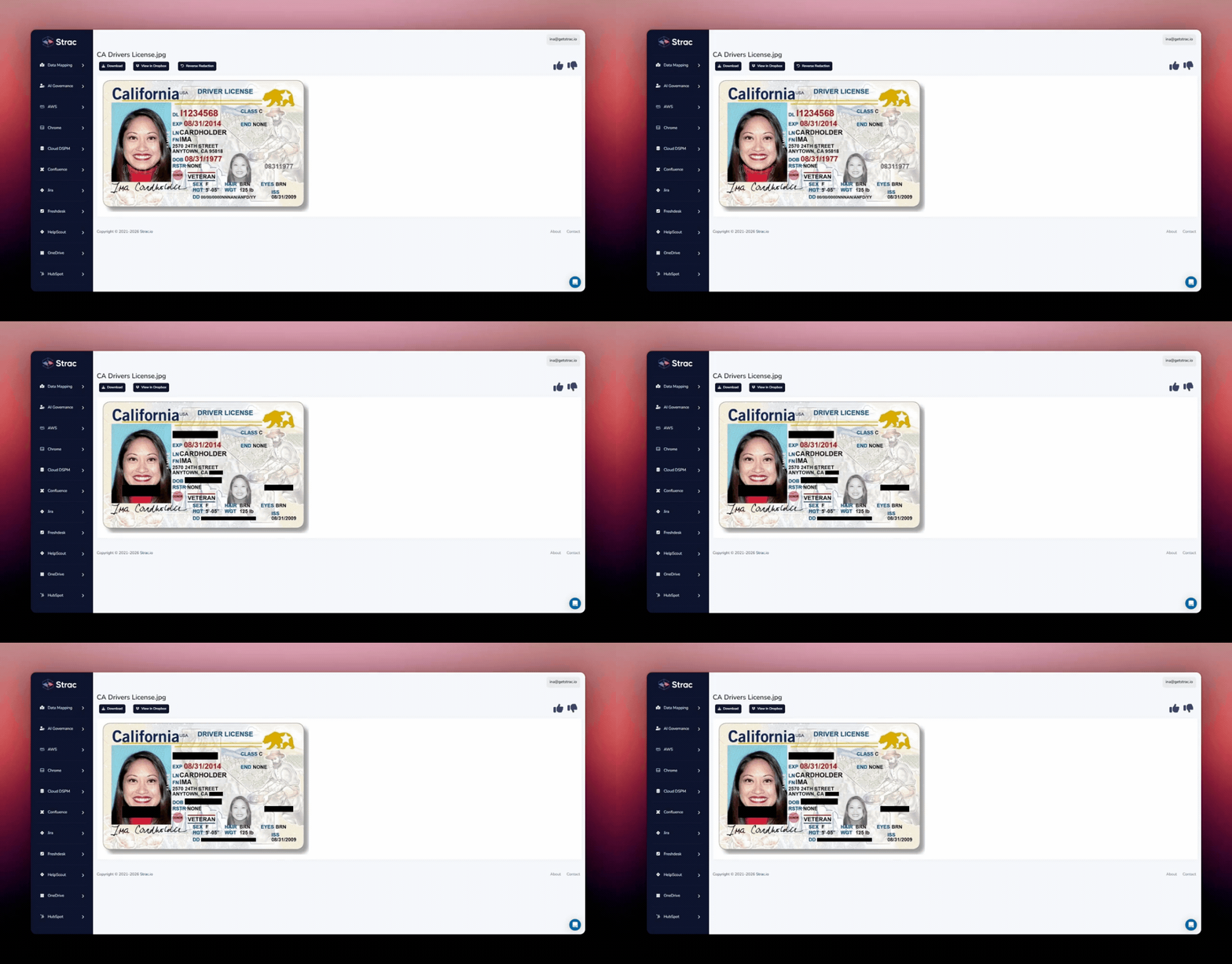
Customizable Configurations: Agentless DLP solutions offer out-of-the-box compliance templates that detect and redact all necessary sensitive data elements. Additionally, they provide customizable configurations, allowing organizations to tailor the solution to their specific business needs. This ensures that data protection measures are aligned with the organization's unique requirements and risk profile.
Comprehensive Remediation Capabilities: One of the key strengths of agentless DLP solutions is their extensive remediation options. These include redaction, where sensitive data is masked or removed; masking, where sensitive information is obfuscated; blocking, which prevents sensitive data from being shared or accessed; alerting, which notifies security teams of potential breaches; and deletion, which ensures that sensitive data is permanently removed when no longer needed. These remediation actions can be automatically applied based on predefined policies, significantly reducing the risk of data exposure.

Alerts and Integration with SIEM: Agentless DLP solutions are designed to work seamlessly with existing security infrastructures, including Security Information and Event Management (SIEM) systems. They provide detailed alerts and logs that can be integrated into SIEM platforms, allowing for centralized monitoring and response. This integration enhances visibility across the entire security ecosystem, enabling faster detection and resolution of potential threats. By consolidating alerts within a SIEM, organizations can maintain a unified view of their security posture and respond more effectively to incidents.
API Support for Developers: Advanced agentless DLP solutions provide robust API support, allowing developers to integrate data detection and redaction capabilities directly into their applications. This flexibility enables organizations to extend data protection measures to custom-built applications and workflows, ensuring comprehensive coverage across all digital assets. See docs.strac.io
These advanced capabilities highlight the significant advantages of agentless DLP solutions, particularly in protecting modern SaaS and cloud environments. By offering a combination of built-in and custom detectors, deep content inspection, comprehensive remediation options, and seamless integration with SIEM platforms, these solutions provide a comprehensive and adaptable approach to data protection that traditional endpoint agents cannot match.
The rapid adoption of generative AI has fundamentally changed how organizations think about data security. Employees now interact with AI assistants throughout their workday, uploading documents, summarizing customer conversations, generating code, and analyzing sensitive business information. These interactions rarely occur within traditional endpoint applications, making them difficult for legacy security controls to monitor.
Modern data protection strategies must therefore extend beyond the device itself. Organizations need visibility into AI prompts, responses, uploaded files, and AI-generated content to prevent sensitive information from being unintentionally shared with external models. Agentless security plays an increasingly important role by providing policy enforcement directly within AI platforms and cloud services where these interactions occur.
For many employees, the browser has effectively replaced the traditional desktop application. CRM systems, support platforms, document management, collaboration tools, AI assistants, and productivity suites all operate inside the browser, making it one of the largest sources of potential data exposure.
Protecting browser activity allows organizations to monitor uploads, downloads, clipboard actions, file sharing, and web-based collaboration without relying solely on endpoint controls. As browser-first work continues to grow, browser DLP has become a critical component of a modern security strategy.
.png)
AI agents are rapidly becoming trusted digital coworkers capable of retrieving information, interacting with enterprise applications, and completing business tasks autonomously. Through technologies such as Model Context Protocol (MCP), these agents can connect to CRMs, cloud storage, ticketing systems, developer platforms, and internal databases.
While these capabilities dramatically improve productivity, they also introduce new pathways for sensitive information to move between systems. Organizations must ensure AI agents only access appropriate data and that sensitive information remains protected throughout automated workflows. Extending DLP policies to AI agents and MCP-connected environments is becoming an essential part of enterprise security.
The answer is rarely one or the other. Endpoint agents remain highly effective for protecting managed devices, preventing local data exfiltration, and monitoring activity occurring directly on employee endpoints. Agentless security complements these capabilities by protecting cloud applications, SaaS platforms, browser activity, AI interactions, APIs, and modern collaboration tools.
For most organizations, the strongest security posture combines both approaches. Agent-based security protects the device, while agentless security protects the growing ecosystem of cloud services, AI platforms, and automated workflows where sensitive information increasingly resides.
The debate between agent-based and agentless security is no longer about choosing one over the other—it's about understanding where each provides the most value. Endpoint agents remain essential for protecting managed devices and monitoring local activity, but today's data rarely stays on the endpoint. It moves through SaaS applications, cloud storage, browsers, AI assistants, and increasingly through AI agents connected via MCP. To keep pace with how modern organizations work, security teams need visibility and control across every layer where sensitive data lives and moves. By combining endpoint protection with agentless DLP, DSPM, browser security, and AI-aware controls, organizations can build a future-ready security strategy that reduces risk without slowing down the business.
Neither is universally better—they solve different problems. Agent-based DLP protects endpoint devices by monitoring data in use on laptops and desktops, while agentless DLP protects SaaS applications, cloud storage, browsers, AI platforms, and APIs. Most organizations achieve the strongest security posture by using both together.
Organizations are increasingly adopting cloud applications, browser-based work, generative AI, and AI agents. These environments are difficult for traditional endpoint agents to monitor. Agentless security provides faster deployment, broader cloud visibility, lower operational overhead, and protection across modern collaboration and AI workflows.
Traditional endpoint agents have limited visibility into AI prompts, uploaded files, and generated responses. Modern AI DLP solutions inspect prompts and responses in real time, helping prevent employees from exposing sensitive information to external AI models while maintaining productivity.
Yes. AI agents connected through Model Context Protocol (MCP) can access multiple enterprise systems, retrieve sensitive information, and perform automated actions across applications. Securing these workflows requires data protection that extends beyond the endpoint into SaaS platforms, APIs, cloud environments, and AI interactions.
A modern DLP solution should go beyond endpoint monitoring and include sensitive data discovery, AI-powered classification, browser DLP, SaaS and cloud protection, GenAI security, AI agent and MCP coverage, deep inspection of documents and images, real-time remediation, and unified DSPM capabilities. Solutions that combine discovery, classification, monitoring, and automated enforcement provide the most comprehensive protection against today's data loss risks.
.avif)


.gif)


.webp)