SOC 2 Consultant vs Software: Which Do You Need? (2026)
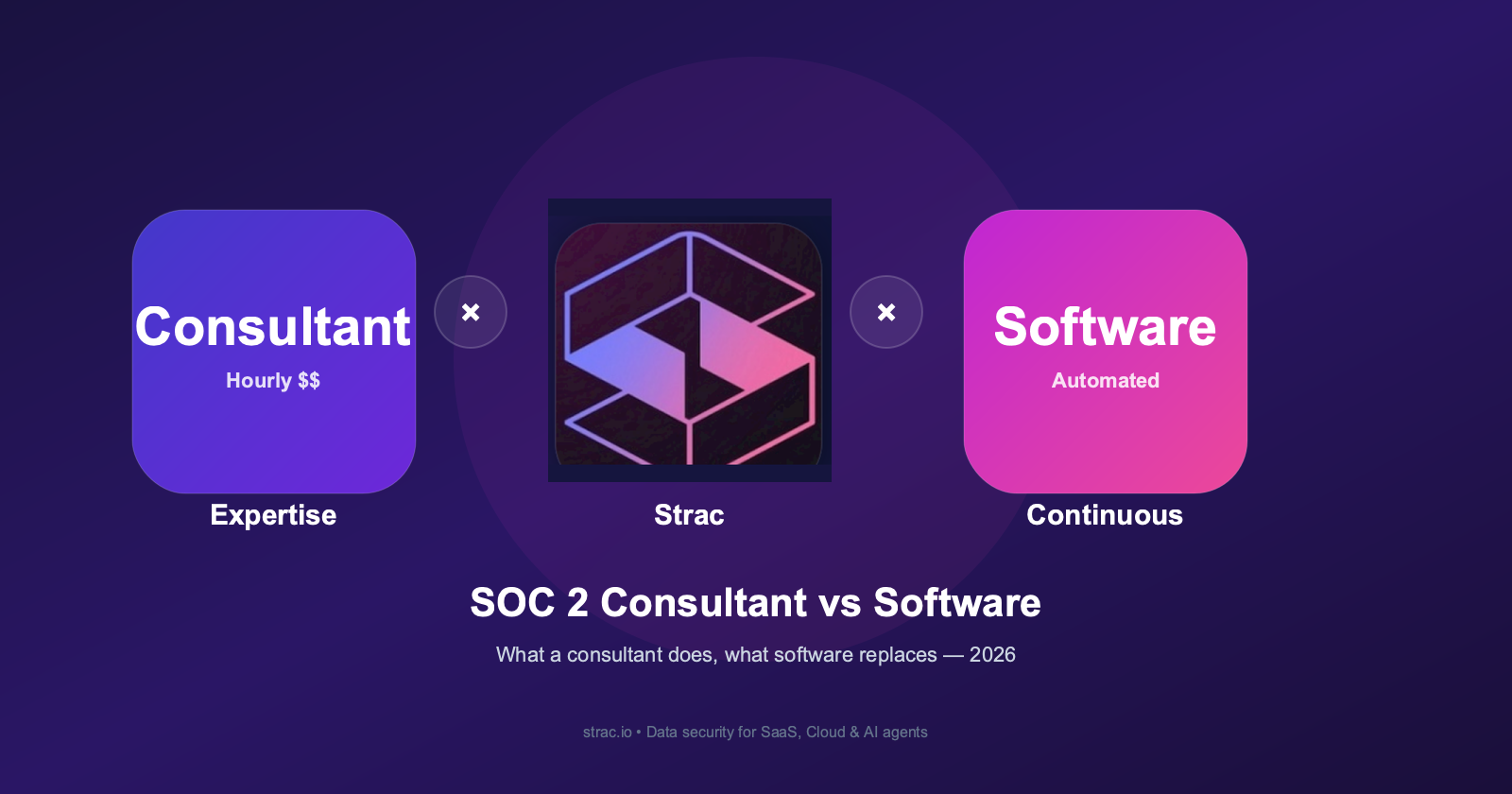
SOC 2 consultant vs software in 2026: what a consultant does, what software now automates, real costs, and when you actually need a human. Most startups can skip the standalone consultant.
A SOC 2 consultant is a person (or boutique firm) you pay hourly or per-project to guide scoping, write policies, run a gap assessment, and prep you for the audit. Typical range: $10K–$50K+.
SOC 2 compliance software automates the repeatable parts , policy templates, control mapping, continuous evidence collection , for a predictable subscription.
Neither is the auditor. A licensed CPA firm must perform the actual SOC 2 examination; a consultant cannot audit work they helped build (independence).
The reframe: most of what early-stage teams hire a consultant for is now done better and continuously by software. Hire a consultant for judgment calls; buy software for the 90% that’s repeatable.
Strac Comply bundles the software and guided workflows, so most startups skip the standalone consultant entirely.
✨ SOC 2 Consultant vs Software: Which Do You Actually Need?
If you searched “SOC 2 consultant” or “SOC 2 consulting,” you’re really asking a budget question: who or what gets me to a SOC 2 report fastest, for the least money and risk? The honest 2026 answer is that the work splits into two buckets , repeatable execution and human judgment , and the smartest spend matches each bucket to the right tool.
Repeatable execution (policies, control mapping, evidence collection, reminders) → software does this faster, cheaper, and continuously.
Human judgment (interpreting an ambiguous control, negotiating scope with an auditor, board-level risk decisions) → a consultant or vCISO adds real value.
Most startups overspend by hiring a consultant to do bucket-one work that software now automates. Let’s break down what each actually does.
What a SOC 2 Consultant Does
A SOC 2 consultant (sometimes a vCISO or a boutique compliance firm) typically helps with:
Scoping , which Trust Services Criteria to include, how to draw your system boundary.
Gap assessment , comparing your current state to the SOC 2 Common Criteria.
Policy writing , drafting the required security, access, change-management, and incident-response policies.
Remediation guidance , advising what to fix and how.
Audit prep and liaison , getting you ready for fieldwork and translating auditor requests.
Cost: commonly $10K–$50K+ depending on engagement length and seniority, often billed hourly or per project. The catch: a consultant’s output is point-in-time. They hand you policies and a plan, then leave , but SOC 2 Type II requires continuous evidence over months, which is precisely the part a one-time engagement can’t cover.
✨ What SOC 2 Compliance Software Does
SOC 2 compliance software automates the repeatable execution that otherwise eats consultant hours:
Prebuilt policy templates mapped to each Common Criteria , the consultant’s policy-drafting deliverable, productized.
Automated control mapping and gap detection against the criteria, refreshed continuously rather than once.
Continuous evidence collection across your stack so the Type II observation window builds itself.
Audit-ready exports the auditor can trace control-by-control.
Cost: a predictable annual subscription, typically far less than a full consulting engagement , and it keeps working after the first audit. See the full landscape in our SOC 2 compliance software guide.
✨ Consultant vs Software vs Hybrid: Side by Side
SOC 2 Consultant
Compliance Software
Software + Guided (Hybrid)
Policies
Hand-written, point-in-time
Templated, mapped to criteria
Templated + expert review
Evidence collection
Manual, you maintain it
Automated & continuous
Automated & continuous
Ongoing coverage
Ends with engagement
Continuous
Continuous
Human judgment
Strong
None on its own
Built-in advisory
Typical cost
$10K-$50K+ per project
Predictable subscription
Subscription + light advisory
Best for
Complex/regulated edge cases
Most B2B SaaS startups
Teams wanting both, one vendor
When You Actually Need a Consultant
Genuinely complex scope , multiple products, regulated data, unusual architecture where a wrong scoping call is expensive.
No security owner at all , nobody internally can make risk decisions, and you want a vCISO in the loop.
A stalled or failed prior audit , you need a human to diagnose what went wrong.
For everyone else , the typical Series A SaaS chasing its first SOC 2 , software covers the work, and a few hours of advisory (often included with the platform) covers the judgment calls.
One Thing Both a Consultant and Generic Software Miss
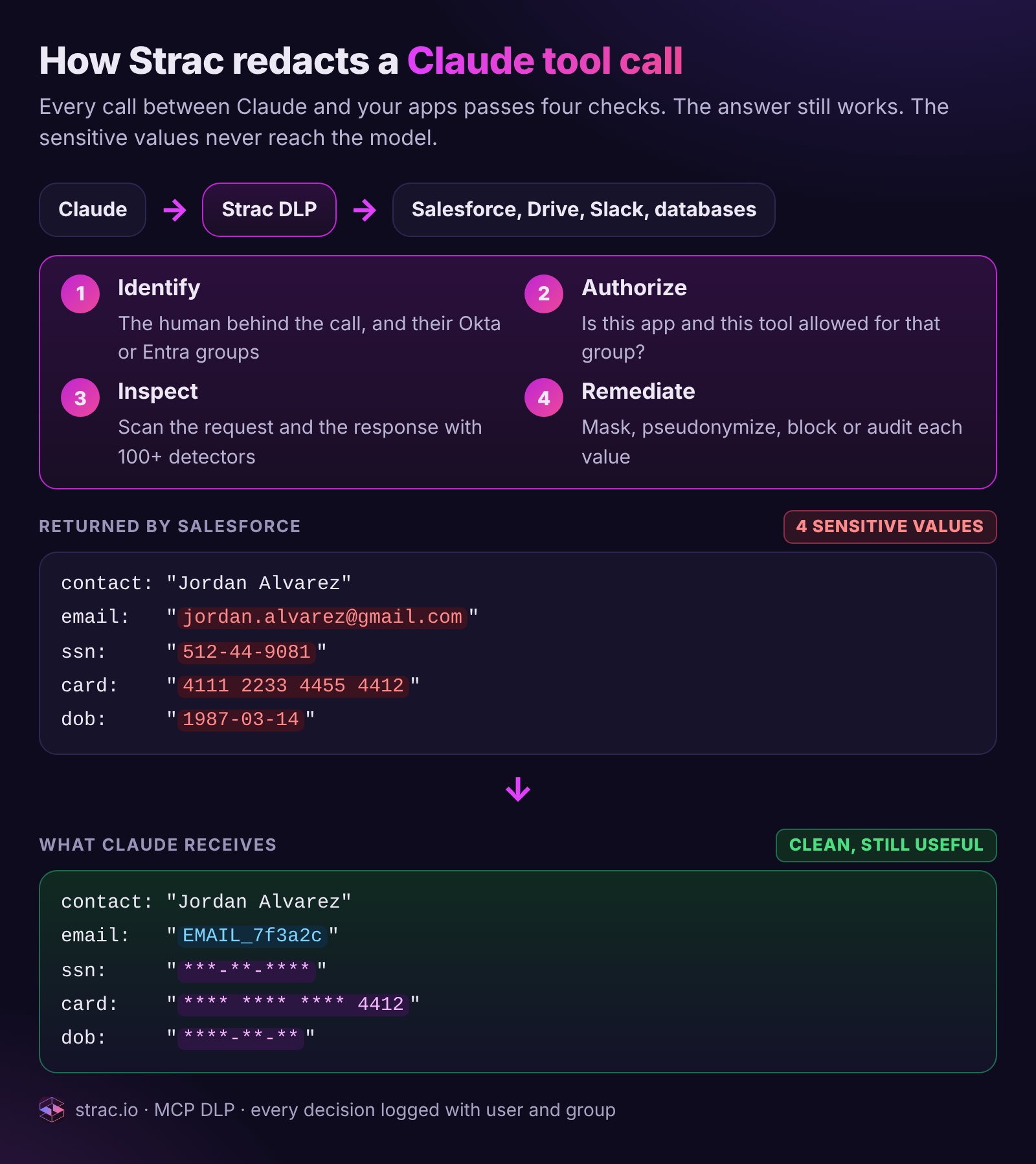
Neither a traditional consultant nor a checklist-only platform actually protects your data , they document controls. SOC 2 CC6.7 (data protection) increasingly demands proof that sensitive data is controlled across SaaS, cloud, and AI tools. A consultant writes the policy; generic software tracks the task; but only a platform with built-in DLP and DSPM can show the control actually working , redacting PII in Slack, blocking it from AI agents, and generating that evidence automatically.
✨ How Strac Comply Replaces Most of the Consultant
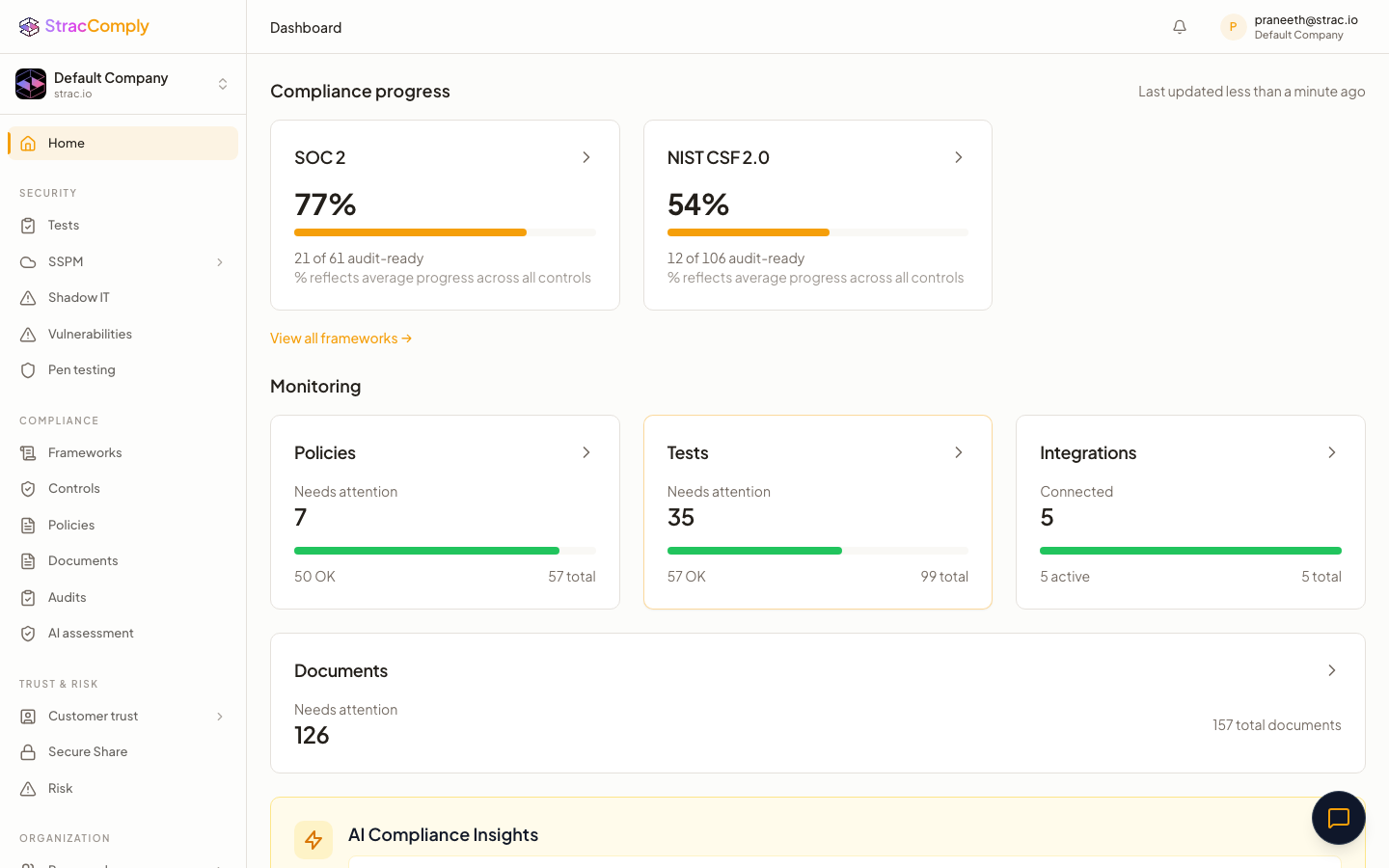
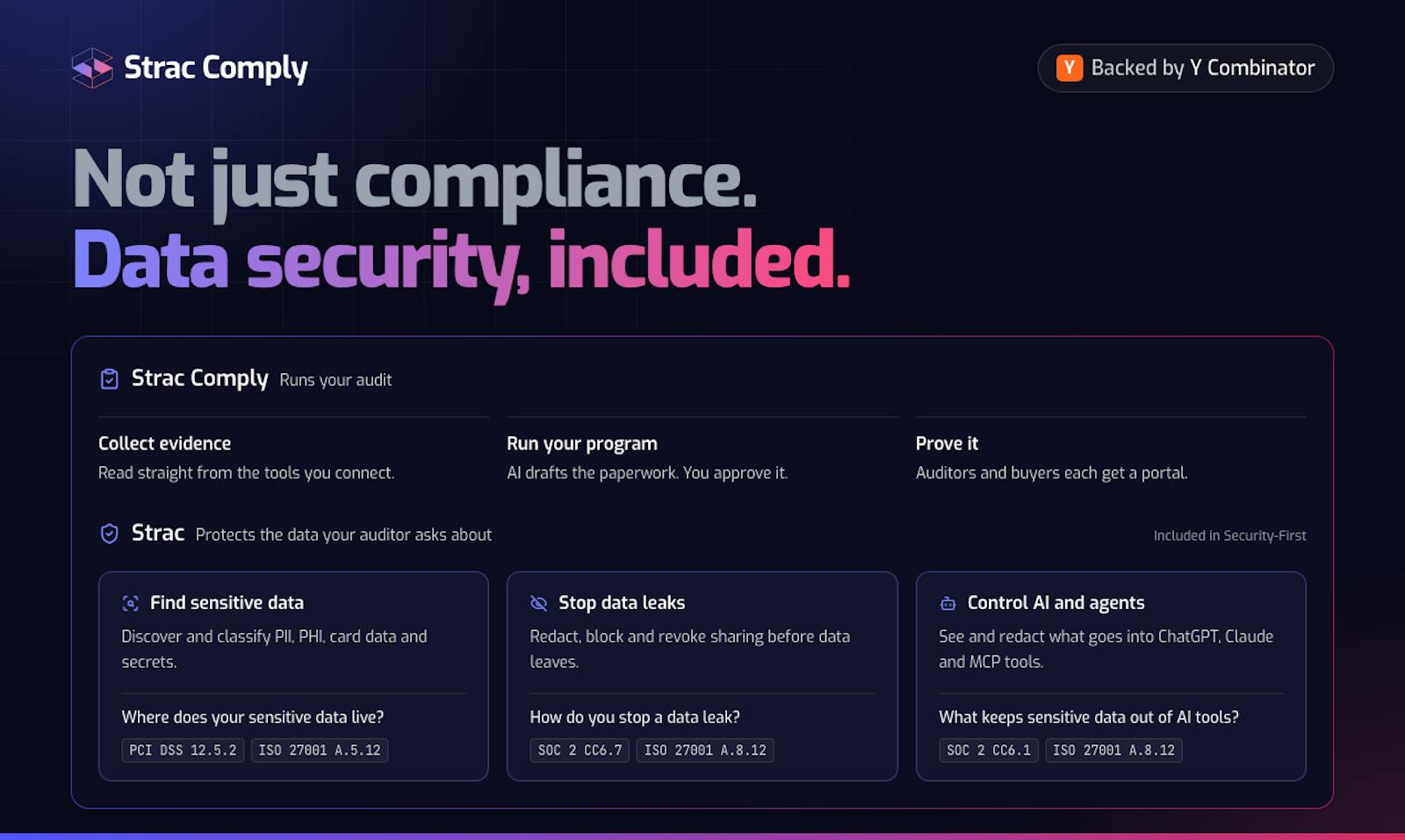
Strac Comply is built to be the software and the guided workflow, so most startups skip the standalone consultant. It ships the policy templates and control mapping a consultant would hand you, collects Type II evidence continuously, and auto-drafts the security questionnaires that usually eat a vCISO’s hours , while Strac’s data security layer enforces and proves the data-protection controls a consultant can only document.
The result: the execution a consultant charges $10K–$50K for, productized into a predictable subscription that keeps working after the first audit , and the data-protection evidence neither a consultant nor a generic tool can generate. Pair it with a quality SOC 2 platform comparison and a licensed auditor, and you have the full path.
Skip the consultant bill. Keep the expertise.
Strac Comply productizes the policies, control mapping, and continuous evidence a SOC 2 consultant delivers , plus the DLP and DSPM proof neither a consultant nor a generic tool can generate. Predictable subscription, audit-ready, always on.
A SOC 2 consultant charges five figures to interpret controls and chase evidence. Strac Comply does both in software, with an AI vCISO that tells you exactly what to fix, at a published price.
✨ Run your compliance from your AI agent
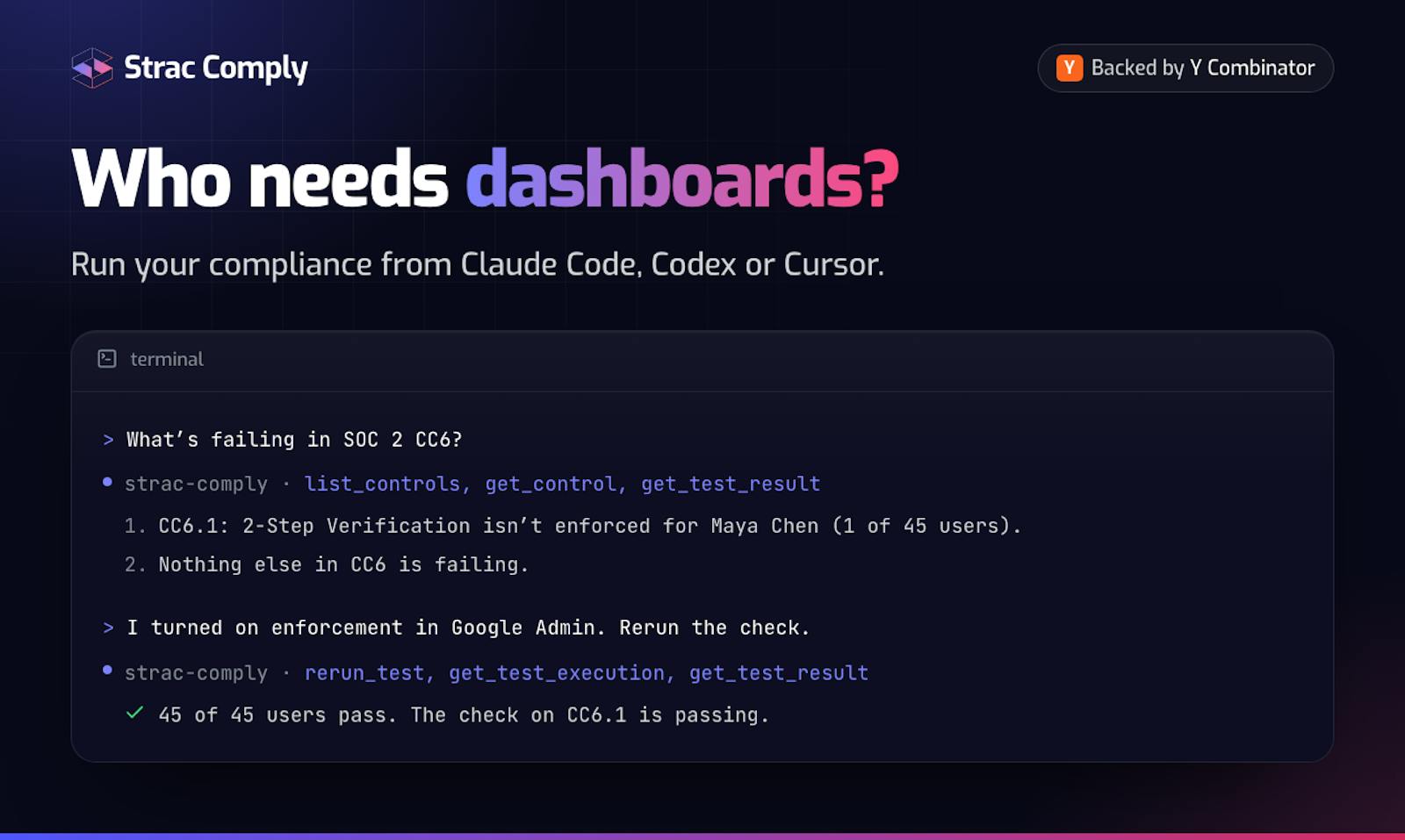
Strac Comply ships an MCP server, so you can ask Claude Code, Codex, or Cursor what is failing in SOC 2, fix it, and rerun the check without leaving your terminal.
Ask your AI agent what is failing, fix it, and rerun the test.
✨ 100+ automated tests that name exactly what to fix
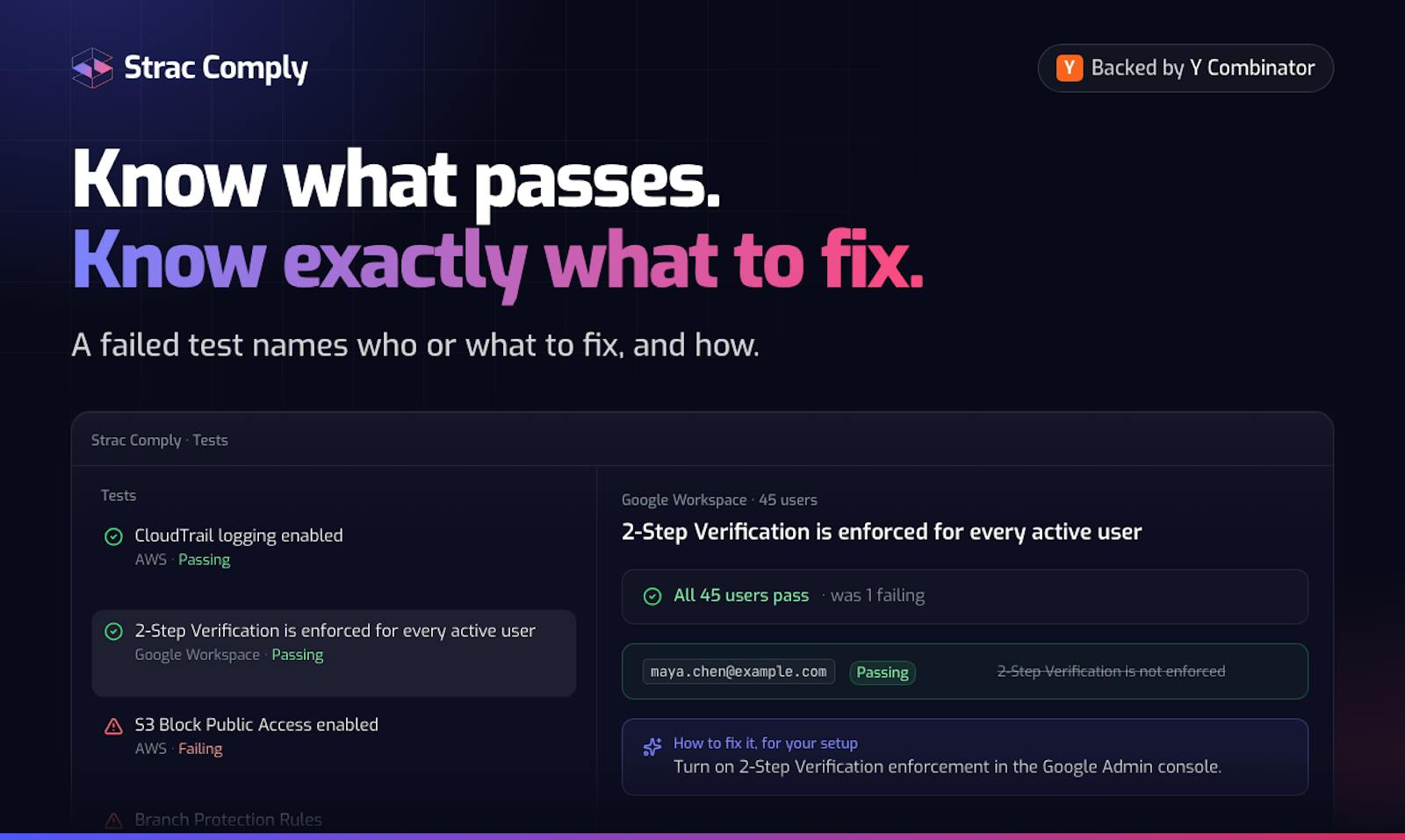
Strac Comply runs 100+ tests daily against your real systems and maps them to SOC 2. When one fails, it names who or what to fix and how, so the work is a short list, not a hunt.
A failed test names who or what to fix, and how.
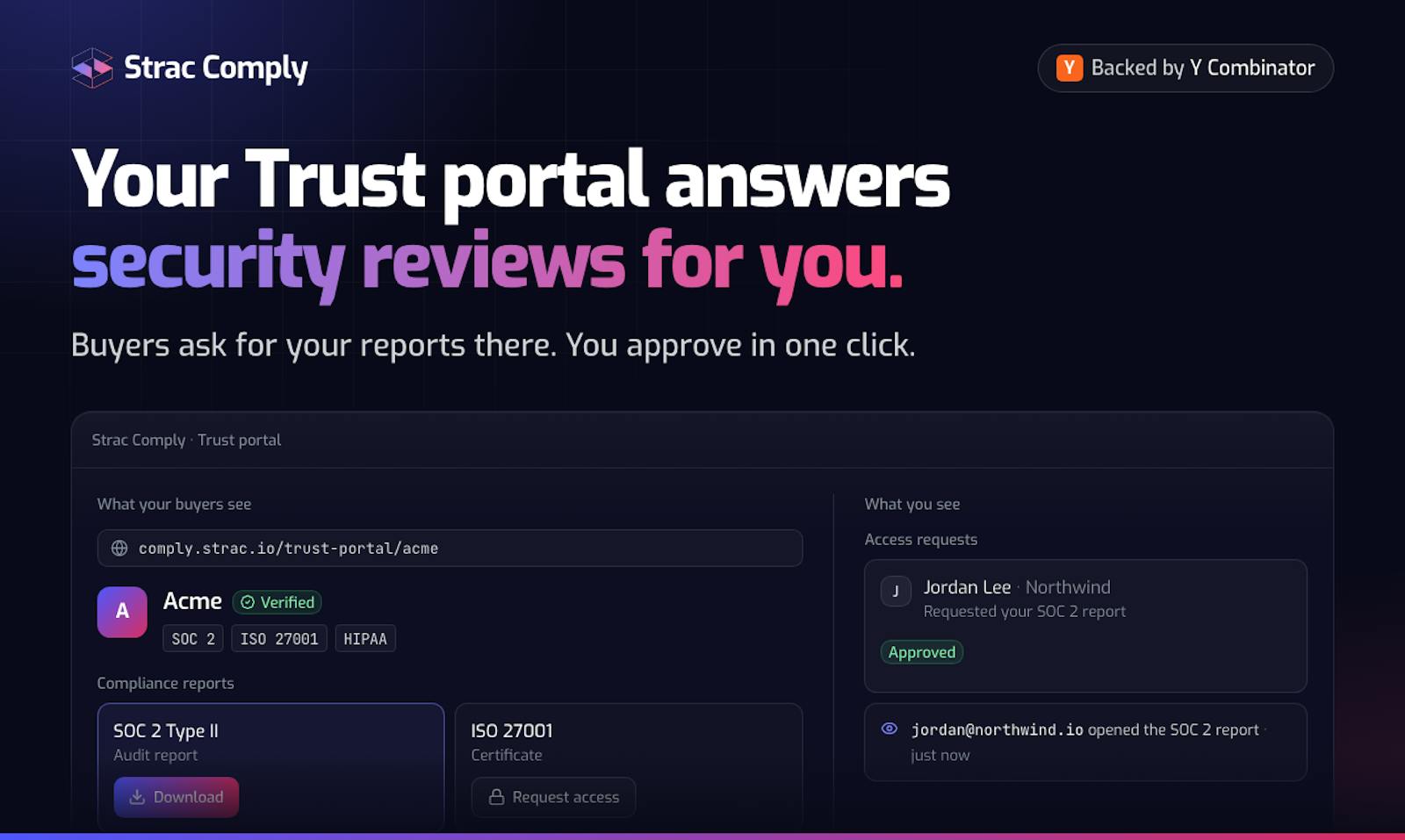
✨ A trust portal that answers security reviews for you
Buyers request your SOC 2 report in your trust portal and you approve access in one click, instead of emailing PDFs around.
Buyers ask for your reports in the trust portal. You approve in one click.
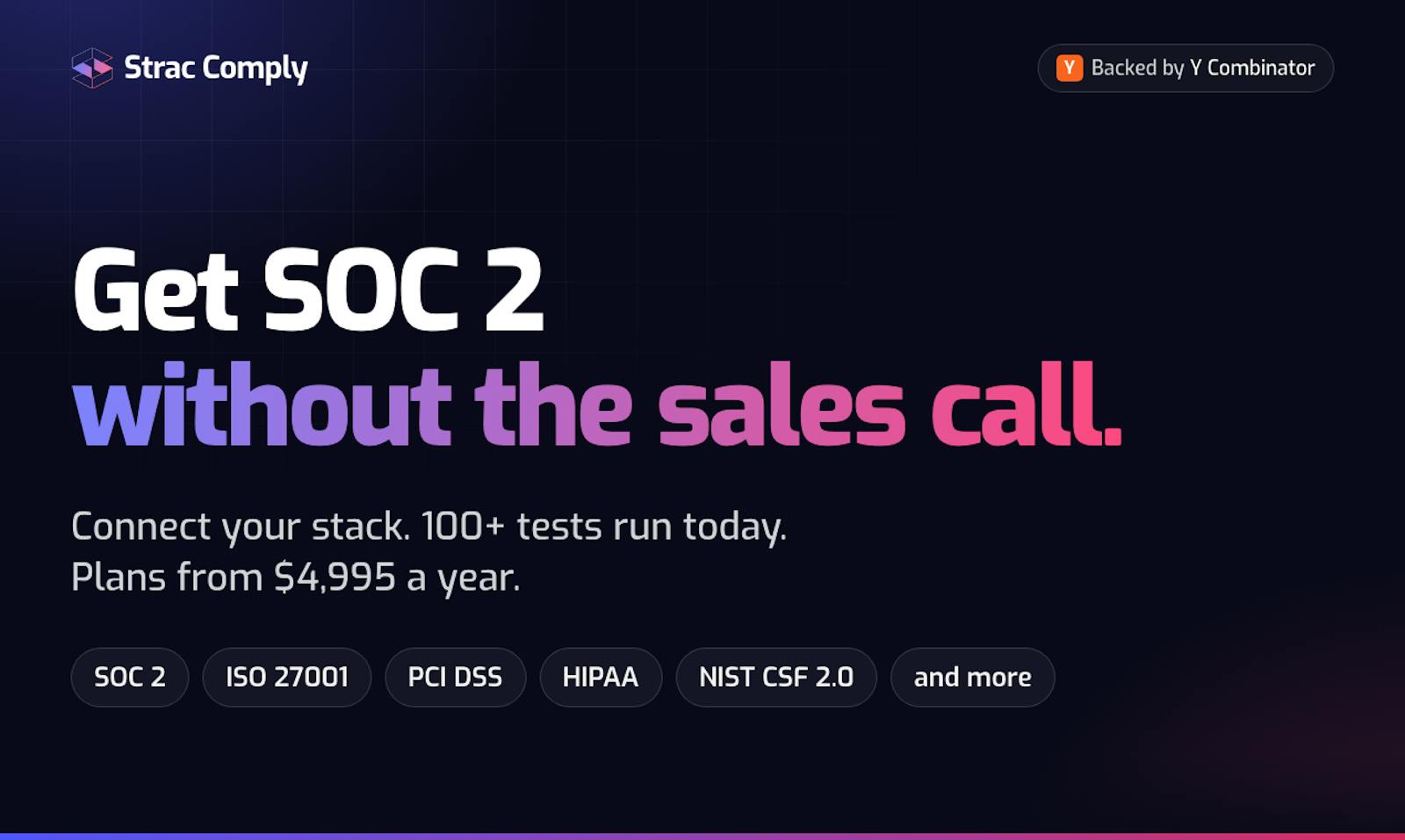
✨ Strac Comply pricing: transparent, no sales call
Instead of a consulting retainer, Strac Comply is $4,995/yr for the Platform (bring your own auditor) or $8,995/yr for Certified (audit by an independent licensed CPA firm on one invoice), or $12,995/yr for Security-First (adds a human-led penetration test and Strac DLP for Slack, Google Workspace, and AI tools). All five frameworks (SOC 2, ISO 27001, PCI DSS, HIPAA, NIST CSF 2.0) are included at one price, no per-framework fees, on plans for up to 10 employees, with a free trial and no credit card. Note: those plan prices cover Strac Comply, the software that replaces the consultant. Strac’s DLP and DSPM are a separate product with separate pricing.
Published pricing, a free trial, and no sales call.
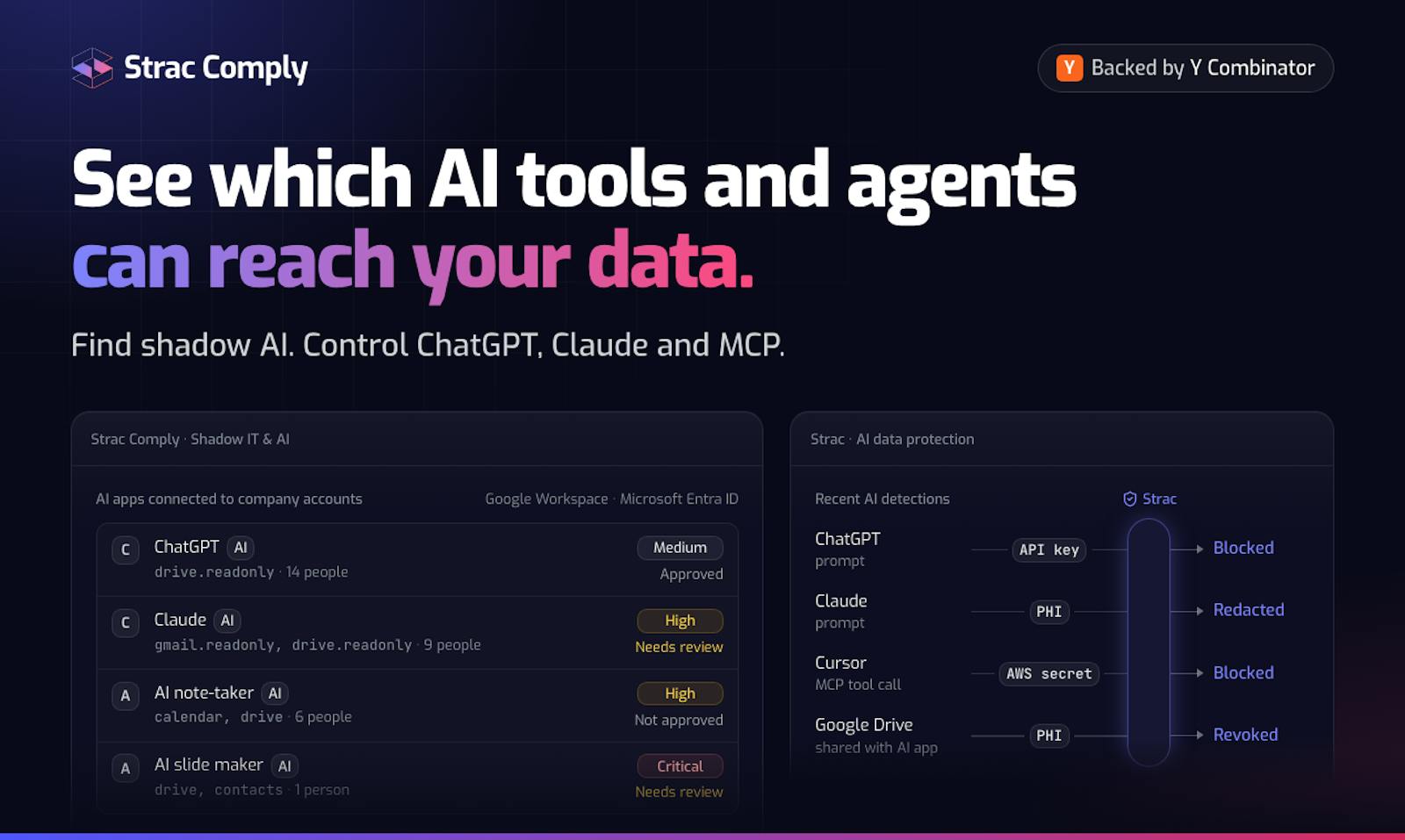
✨ Discovery a consultant cannot match
A consultant interviews people to find shadow IT; Strac Comply detects the SaaS and AI tools automatically from real data flows, which is faster and far more complete.
Discovery a consultant cannot match.
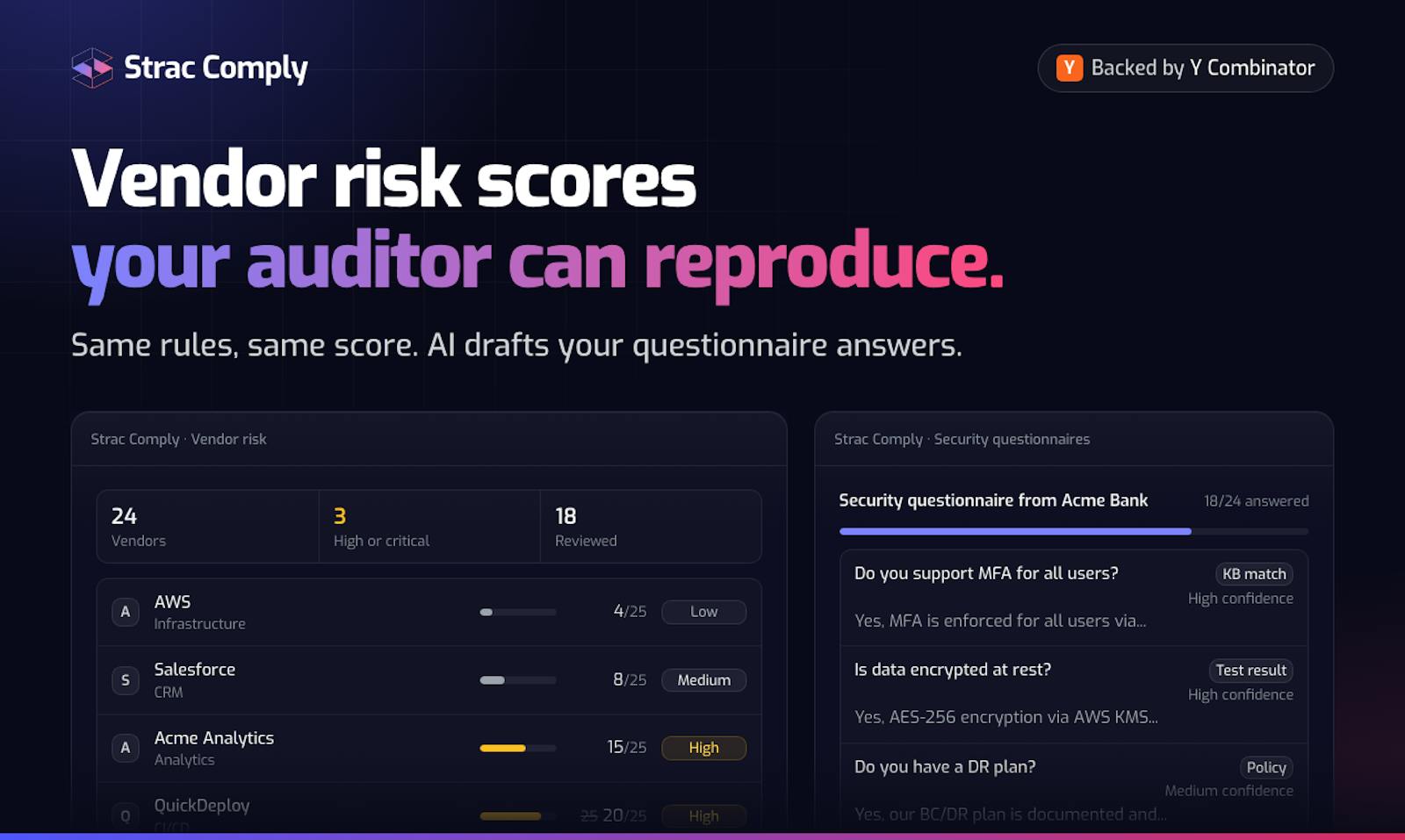
✨ Vendor risk without the consulting retainer
Reproducible vendor scoring and AI-drafted questionnaires replace the spreadsheet a consultant would bill you to maintain, inside the same platform as your evidence.
Vendor risk without the consulting retainer.
✨ Data security the software does, not the consultant
Comply finds sensitive data and governs AI access mapped to SOC 2 CC6.7 automatically, work a consultant would otherwise do by hand every quarter.
Data security the software does, not the consultant.
🎥 Watch Strac Comply get you to SOC 2 without the sales call
🌶️ Spicy FAQs for SOC 2 consultant vs software
Do I need a SOC 2 consultant?
Usually no , not as a standalone hire. For a typical Series A SaaS, compliance software covers the repeatable execution (policies, control mapping, continuous evidence) that consultants used to bill for, and a few hours of built-in advisory covers the judgment calls. Reserve a dedicated consultant for genuinely complex scope, no internal security owner, or a recovery from a failed audit.
How much does a SOC 2 consultant cost?
Commonly $10K–$50K+ depending on engagement length and seniority, billed hourly or per project. Remember this is on top of the auditor’s fee , a consultant prepares you, a licensed CPA firm performs the actual examination.
Can software replace a SOC 2 consultant?
For most of the work, yes. Software replaces the policy drafting, control mapping, gap detection, and , critically , the continuous evidence collection a one-time consultant engagement can’t sustain. A platform like Strac Comply adds guided workflows so you keep the expertise without the hourly bill.
What’s the difference between a SOC 2 consultant and an auditor?
A consultant helps you prepare , scoping, policies, remediation. An auditor (a licensed CPA firm) independently examines your controls and issues the SOC 2 report. The same firm can’t do both for you: a consultant can’t audit work they helped create, because the auditor must be independent.
Is it cheaper to use a consultant or software for SOC 2?
Software is almost always cheaper and keeps working after the first audit, while a consulting engagement is a larger one-time cost that ends when they leave. The lowest-risk, lowest-cost path for most startups is software with built-in guidance, plus a consultant only for specific complex decisions.
Do I need a SOC 2 consultant?
Usually not as a standalone hire. For a typical Series A SaaS, compliance software covers the repeatable execution (policies, control mapping, continuous evidence) consultants used to bill for, and built-in advisory covers judgment calls. Reserve a dedicated consultant for complex scope, no internal security owner, or recovering from a failed audit.
How much does a SOC 2 consultant cost?
Commonly $10K-$50K+ depending on engagement length and seniority, billed hourly or per project, on top of the auditor's fee. A consultant prepares you; a licensed CPA firm performs the actual examination.
Can software replace a SOC 2 consultant?
For most of the work, yes. Software replaces policy drafting, control mapping, gap detection, and the continuous evidence collection a one-time consultant engagement can't sustain. Platforms like Strac Comply add guided workflows so you keep the expertise without the hourly bill.
What's the difference between a SOC 2 consultant and an auditor?
A consultant helps you prepare, scoping, policies, remediation. An auditor (a licensed CPA firm) independently examines your controls and issues the report. The same firm can't do both: an auditor must be independent of the work, so a consultant can't audit what they helped build.
Is it cheaper to use a consultant or software for SOC 2?
Software is almost always cheaper and keeps working after the first audit, while a consulting engagement is a larger one-time cost that ends when they leave. The lowest-cost path for most startups is software with built-in guidance, plus a consultant only for specific complex decisions.
Discover & Protect Data on SaaS, AI, MCP, Endpoints & Cloud
Strac provides end-to-end data loss prevention for all SaaS and Cloud apps. Integrate in under 10 minutes and experience the benefits of live DLP scanning, live redaction, and a fortified SaaS environment.


.webp)








.avif)



.gif)
