How Much Does PCI Compliance Cost? PCI DSS Pricing 2026
PCI compliance cost depends on merchant level: from a cheap SAQ to a $15K to $50K QSA audit. Full PCI DSS cost breakdown and how Strac Comply automates it from $4,995.
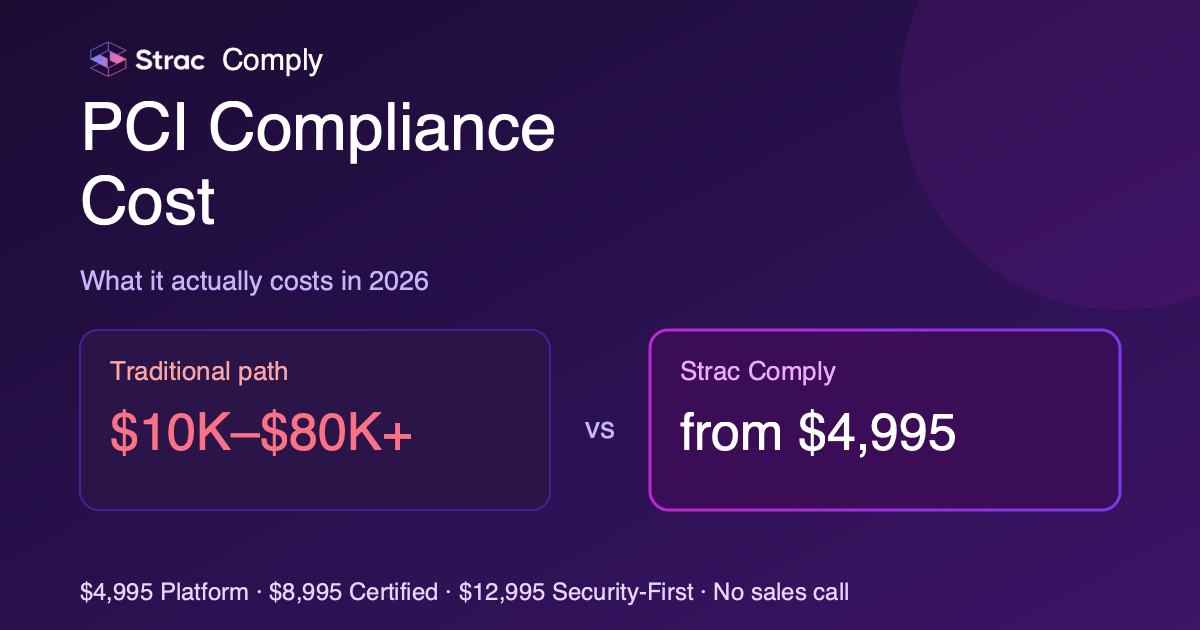
Short answer:PCI compliance cost depends on your merchant level. A small merchant filing a Self-Assessment Questionnaire (SAQ) may spend a few thousand dollars, while a Level 1 merchant needing a Qualified Security Assessor (QSA) audit can spend $15,000 to $50,000 or more with ASV scans, a penetration test, and tooling. Strac Comply automates PCI DSS v4.0 evidence and cardholder data discovery from $4,995 per year. This post breaks down every line item so you can compare apples to apples.
Self-serve from $4,995 a year, no sales call. All five frameworks, 100+ tests running on day one.
Worth clarifying, as this sits on Strac.io. These figures price Strac Comply: $4,995 for the platform, $8,995 with the SOC 2 audit included, and $12,995 with a penetration test plus Strac DLP (Data Loss Prevention) for Slack, Google Workspace, and AI tools. Strac’s wider data-security platform, endpoint DLP, cloud DSPM (sensitive data discovery), and MCP DLP, is licensed on its own, so $4,995 is not what Strac’s DLP or DSPM costs.
Get compliant with Strac Comply, from $4,995 all-in
SOC 2, ISO 27001, PCI DSS, HIPAA, and GDPR in one platform. Transparent pricing, a 14-day free trial, and no mandatory sales call, unlike Vanta and Drata.
"PCI compliance cost" and "PCI DSS cost" scale with your merchant level and how much cardholder data you touch. Here is the full stack with typical market ranges and what each costs inside Strac Comply.
Cost component
Typical market range
With Strac Comply
Self-Assessment Questionnaire (SAQ) or QSA audit
$0 (SAQ) to $50,000+ (QSA, Level 1)
Evidence and controls automated; QSA fee separate
Compliance automation platform
$7,500 to $25,000 / year
$4,995 / year (all 5 frameworks)
Approved Scanning Vendor (ASV) scans
$1,000 to $6,000 / year
Integrates with your scan results
Cardholder data discovery (PCI 12.5.2)
$5,000 to $20,000 (manual)
Included via Strac’s data layer
Penetration test
$4,000 to $15,000
Included on $12,995 Security-First (or $3,995 add-on)
Typical first-year total
$10,000 to $80,000+ by level
$4,995 for automation + any required QSA/ASV fees
Strac Comply runs the PCI DSS readiness work itself and shows exactly where you stand.
PCI DSS does not have one price because it scales with your merchant level and how much cardholder data you touch. The line item that balloons on its own is finding and inventorying cardholder data for requirement 12.5.2. Because Strac is a data-security platform, Strac Comply discovers that data automatically instead of a consultant doing it by hand. See our PCI DSS compliance software guide.
✨ What your PCI compliance cost buys inside Strac Comply
From $4,995 a year, Strac Comply automates PCI DSS v4.0 from cardholder data discovery to evidence.
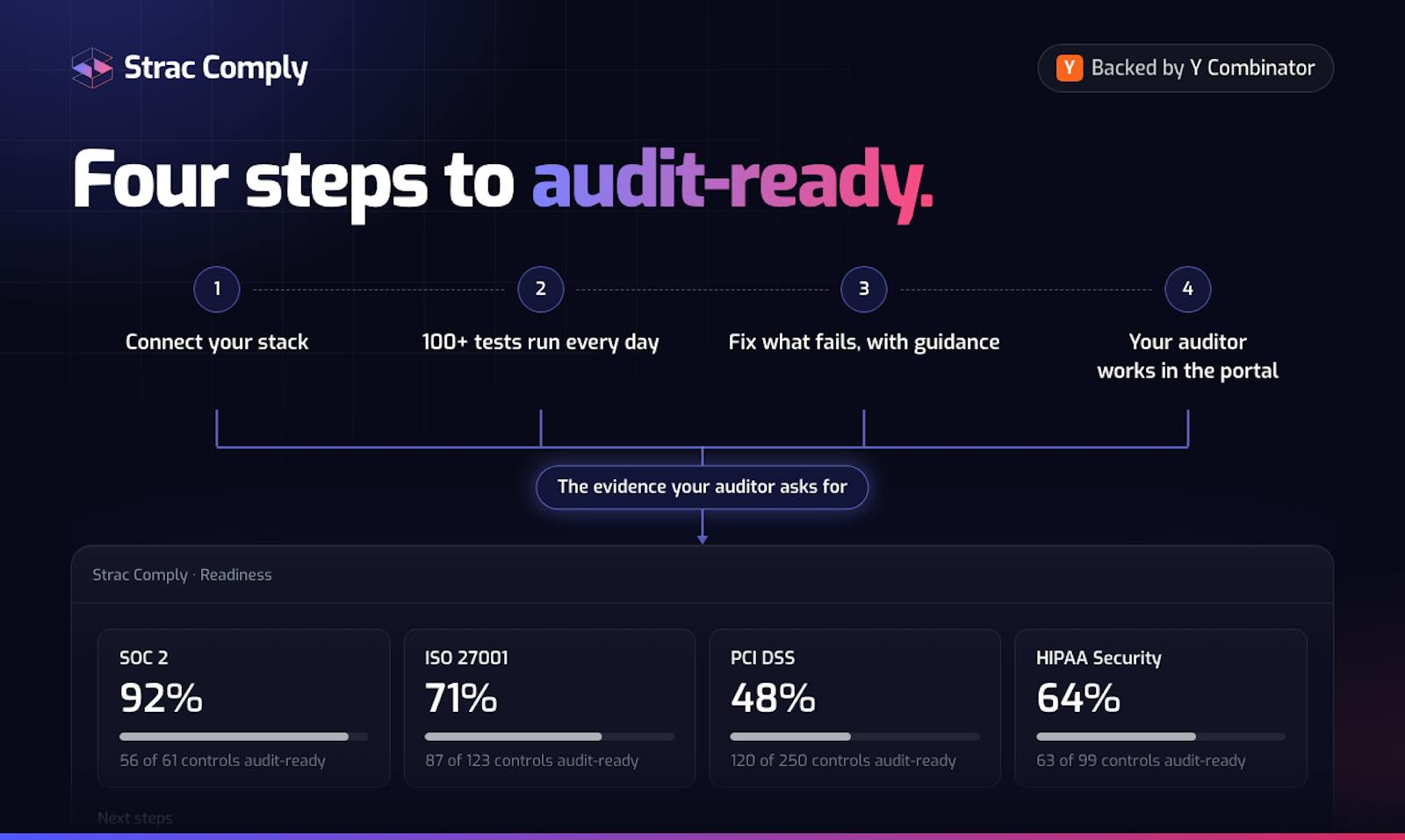
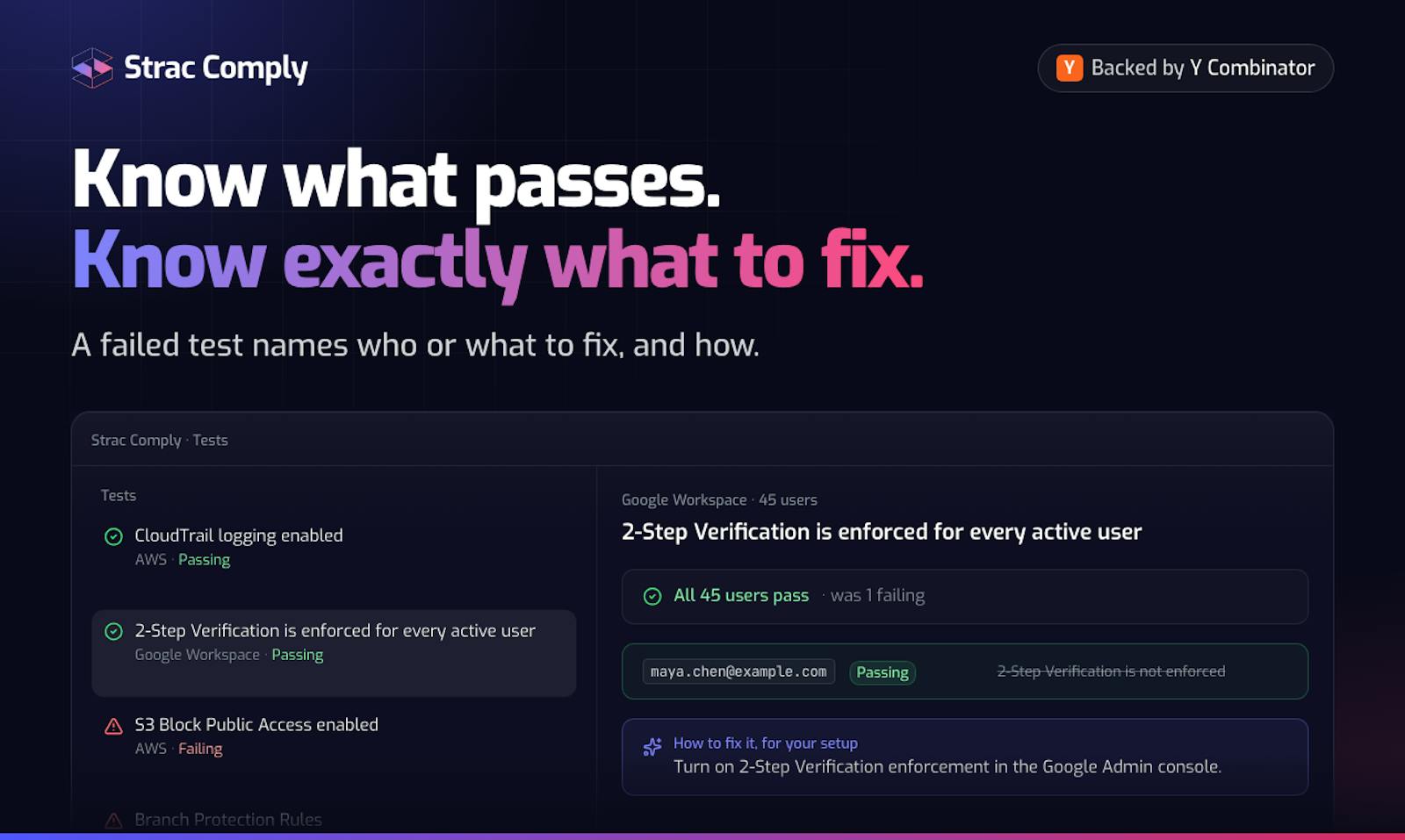
Requirement-by-requirement testing
Strac Comply maps 100-plus automated checks to PCI DSS v4.0 requirements and, when one fails, tells you precisely what to change, so you are not interpreting the standard by hand.
Requirement-by-requirement testing.
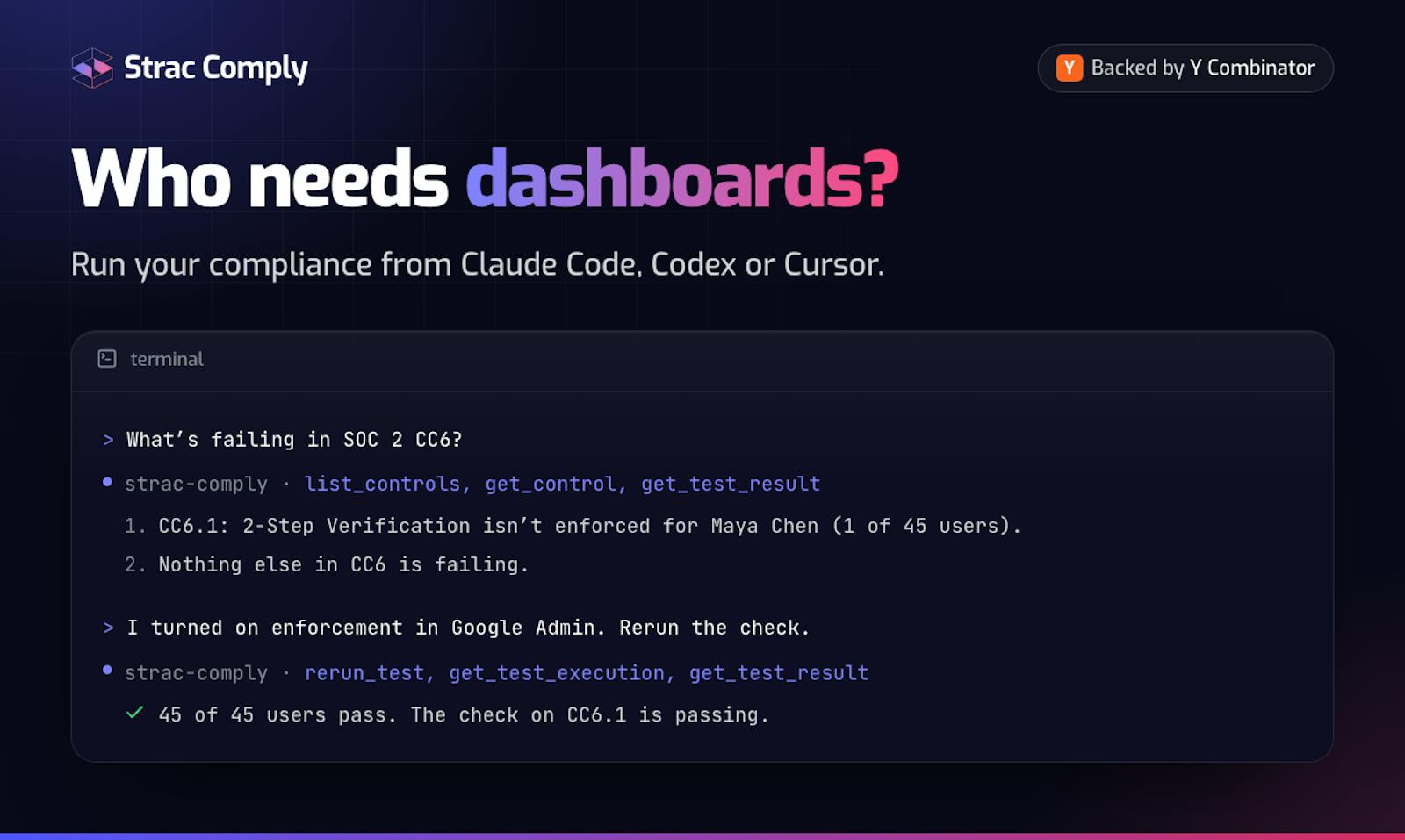
Query PCI status from your terminal
Using the MCP server, you can ask an AI agent whether requirement 12.5.2 is passing and fix it in place, which is something Vanta, Drata, and Sprinto do not support.
Query PCI status from your terminal.
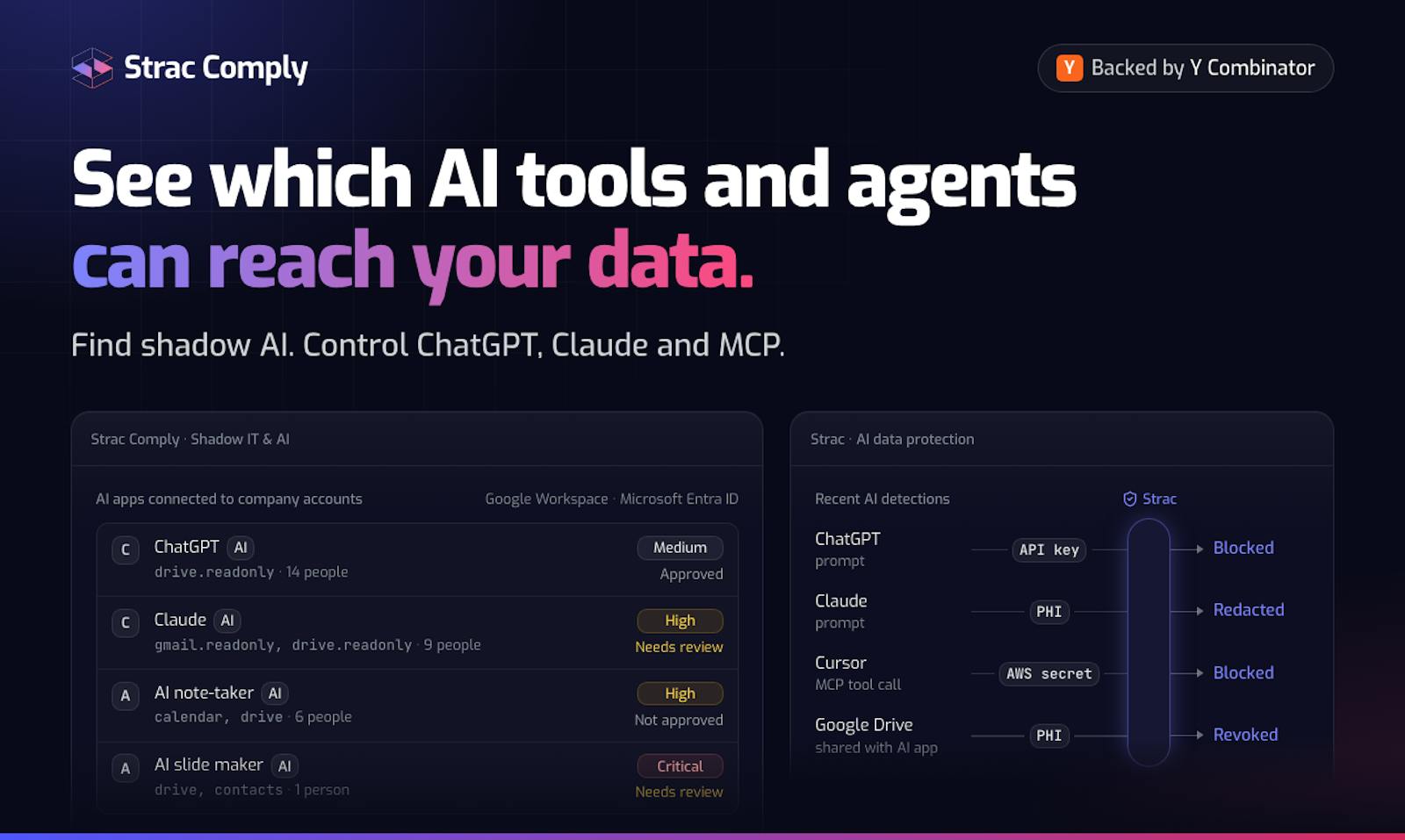
Find the shadow systems touching card data
Strac Comply reveals unmanaged apps and AI tools that could quietly expand your cardholder data environment, available on the $12,995 Security-First plan.
Find the shadow systems touching card data.
Prove compliance to acquirers fast
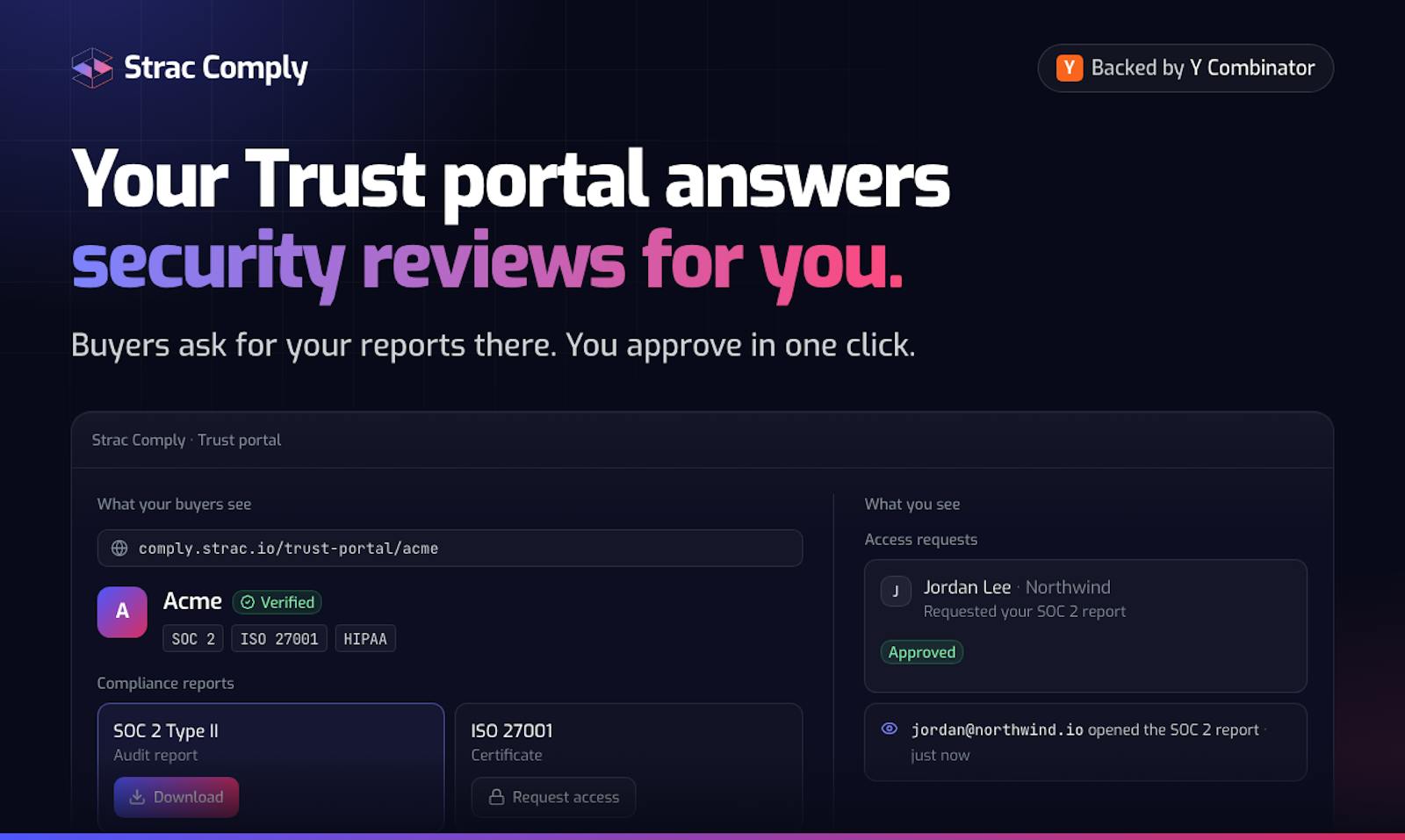
Partners and acquirers verify your status through the trust portal with one-click access, instead of waiting on emailed attestations.
Prove compliance to acquirers fast.
Vendor risk your QSA can reproduce
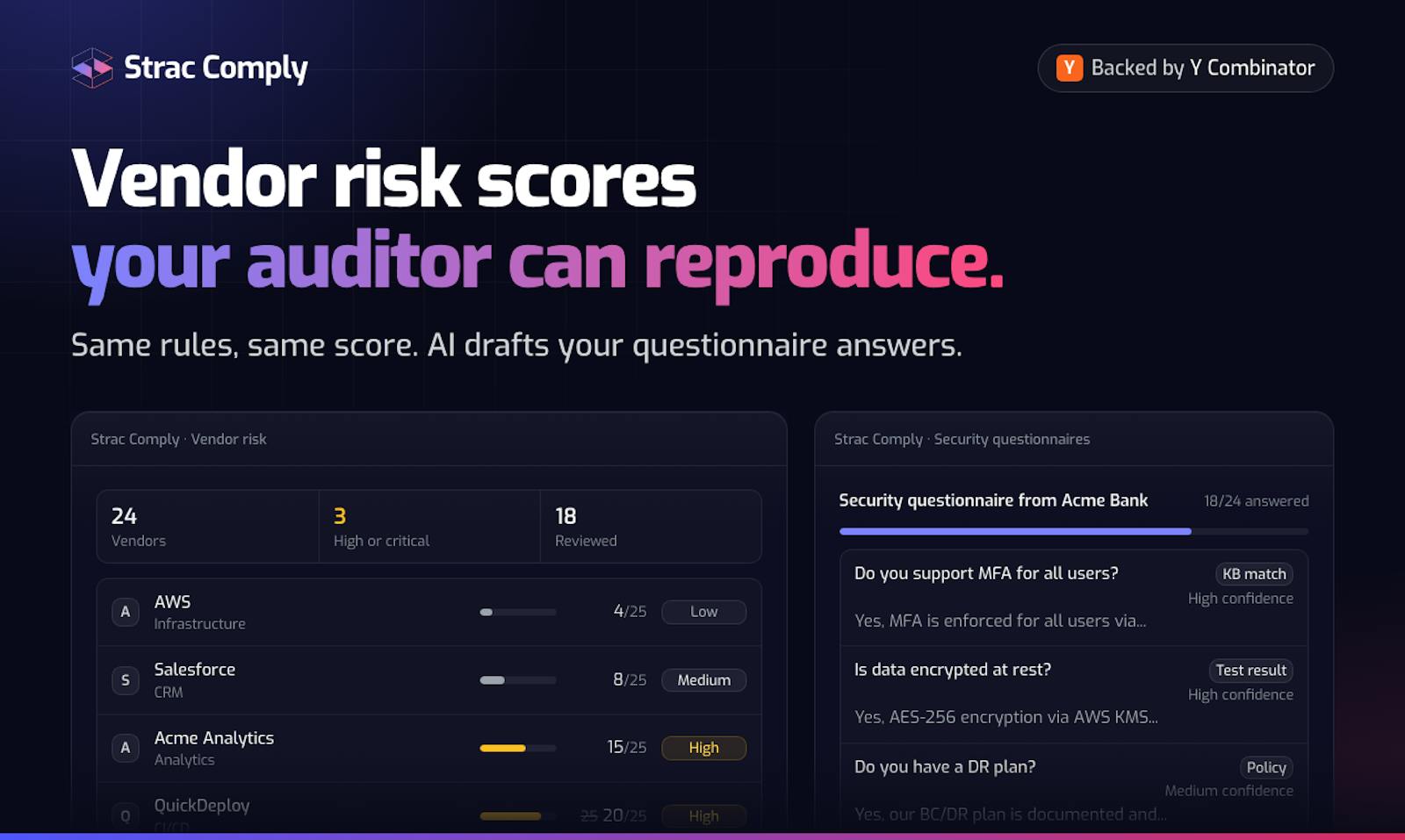
vendor risk scoring is rule-based and reproducible, and it sits alongside your PCI evidence while the AI drafts questionnaire answers.
Vendor risk your QSA can reproduce.
Cardholder data discovery for 12.5.2
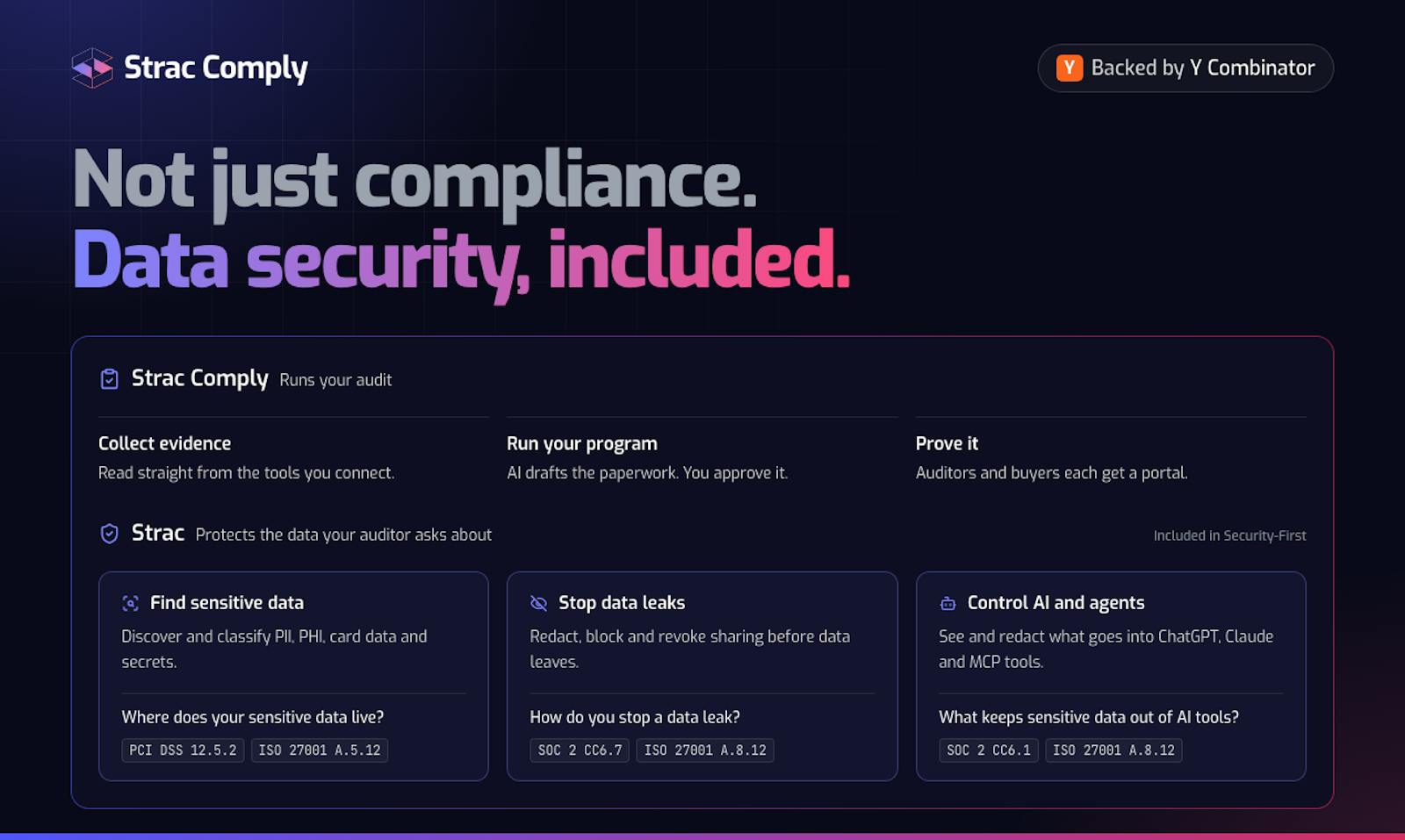
Because Strac is a data-security platform, Strac Comply automatically finds and inventories cardholder data for PCI DSS 12.5.2, the task that balloons when a consultant does it by hand.
Cardholder data discovery for 12.5.2.
What determines your PCI compliance cost: merchant level
PCI DSS cost depends first on your merchant level, set by annual card transaction volume. The level decides whether you self-assess or pay for a full on-site assessment:
Level
Transaction volume
What is required
Level 1
6M+ transactions a year
Annual Report on Compliance (ROC) by a QSA, quarterly ASV scans
Level 2
1M to 6M
SAQ or ROC, quarterly ASV scans
Level 3
20K to 1M e-commerce
SAQ, quarterly ASV scans
Level 4
Under 20K e-commerce
SAQ, scans as required by your acquirer
A self-assessment questionnaire (SAQ) is far cheaper than a Qualified Security Assessor (QSA) audit, so your level is the single biggest cost driver.
✨ Hidden PCI compliance costs teams underestimate
The assessment is only part of the bill. These line items add up:
Strac Comply maps PCI DSS v4.0 requirements and tracks evidence, so hidden work does not pile up.
Hidden cost
What it is
Typical range
QSA audit (Level 1 / ROC)
On-site assessment by a Qualified Security Assessor
$30,000 to $100,000+
ASV scans
Quarterly external scans by an Approved Scanning Vendor
$1,000 to $6,000 / year
Penetration test
Required annually for many merchants
$4,000 to $15,000
Cardholder data discovery
Finding everywhere card data lives (Requirement 12.5.2)
Often manual and costly
Remediation
Fixing gaps found during assessment
Varies by findings
Scope reduction and tooling
Segmentation and tools to shrink scope
Recurring
One-time vs ongoing PCI costs
Cost type
Examples
Notes
One-time
Gap assessment, segmentation, remediation
Year-one heavy
Recurring
Annual SAQ or ROC, quarterly ASV scans, pen test
Every year
Variable
Scope size, systems touching card data
The lever you control
PCI compliance cost by merchant size
Profile
What drives the cost
Typical first-year
Small merchant (SAQ)
Self-assessment plus quarterly scans
~$5,000 to $20,000
Mid-size
SAQ or partial ROC, pen test, remediation
~$20,000 to $60,000
Level 1 (ROC)
QSA audit, full scope, multiple systems
$50,000 to $200,000+
✨ Where cardholder data discovery saves the most
The biggest cost lever in PCI is scope: every system that stores, processes, or transmits card data must be assessed. Most teams do not know everywhere card data has leaked, so they over-scope and over-pay. Finding and minimizing cardholder data (PCI DSS Requirement 12.5.2) shrinks the assessment and the bill.
Strac Comply finds cardholder data automatically, so you scope tightly and pay less.
Because Strac Comply includes data security, it discovers and inventories cardholder data for you, the task that balloons when a consultant does it by hand. See SOC 2 cost if you are pursuing both.
PCI compliance cost checklist
Confirm your merchant level and whether you need a SAQ or a ROC.
Find all cardholder data and reduce scope before you assess.
Budget for quarterly ASV scans and an annual penetration test.
Automate evidence so you are audit-ready year-round.
Segment your network to keep systems out of scope.
How to lower your PCI compliance cost
Reduce your cardholder data footprint first; less data in scope means a smaller, cheaper assessment.
Automate data discovery so you are not paying a consultant to find cardholder data by hand.
Confirm your merchant level before buying a QSA audit you may not need.
Keep evidence continuous so you are audit-ready instead of scrambling each year.
💳 PCI compliance cost, made transparent: Strac Comply pricing
Strac Comply publishes its full price ladder, no sales call required to see a number:
Platform, $4,995 per year (or $499 per month): all five frameworks, 100+ automated tests, 100+ integrations, policies, risk register, vendor risk, trust portal, AI vCISO, and an MCP server. Self-serve with a 14-day free trial, no credit card, bring your own auditor. Sign up at comply.strac.io.
Certified, $8,995 per year (most popular): everything in Platform plus one SOC 2 Type I or Type II audit a year by an independent licensed CPA firm, and a human vCISO to get you audit-ready.
Security-First, $12,995 per year: everything in Certified plus a human-led penetration test with retest, shadow IT and AI discovery, and Strac DLP for Slack, Google Workspace, and AI tools.
Every plan covers up to 10 employees (11 to 200 adds $1,995 a year) and has no per-framework fees. Platform is self-serve; Certified and Security-First are set up on a short call. Backed by Y Combinator.
Start free in minutes.Sign up at comply.strac.io and begin your 14-day free trial of the Platform plan. Self-serve, no credit card, no sales call.
Worth clarifying, as this sits on Strac.io. These figures price Strac Comply: $4,995 for the platform, $8,995 with the SOC 2 audit included, and $12,995 with a penetration test plus Strac DLP for Slack, Google Workspace, and AI tools. Strac’s wider data-security platform, endpoint DLP, cloud DSPM, and MCP DLP, is licensed on its own, so $4,995 is not what Strac’s DLP or DSPM costs.
🎥 Watch: get PCI compliance without the sales call
Strac Comply: transparent pricing, no sales call.
Ready to start? Sign up at comply.strac.io and begin a 14-day free trial of the Platform plan, self-serve, no credit card, no sales call.
Reduce scope. The fewer systems that touch cardholder data, the smaller your assessment. Qualifying for a self-assessment questionnaire instead of a QSA audit, and discovering and minimizing where card data lives, are the biggest levers. Strac Comply automates the data discovery that drives scope.
Does PCI compliance require a QSA?
Only Level 1 merchants (6 million-plus transactions a year) need a Qualified Security Assessor to produce a Report on Compliance. Smaller merchants usually complete a self-assessment questionnaire, which is far cheaper.
Is PCI compliance a one-time or annual cost?
Annual. You validate every year with a SAQ or ROC, run quarterly ASV scans, and typically a yearly penetration test. Automating evidence and keeping scope small keeps the recurring number down.
How much does PCI compliance cost in 2026?
It depends on your merchant level. A small merchant on a SAQ might spend a few thousand dollars, while a Level 1 merchant needing a QSA audit can spend $15,000 to $50,000 or more with ASV scans, a penetration test, and tooling. Strac Comply automates PCI DSS v4.0 evidence and cardholder data discovery from $4,995 per year, with any required QSA or ASV fees separate.
Do I need a QSA, or can I self-assess?
Most smaller merchants can file a Self-Assessment Questionnaire. Level 1 merchants (roughly 6 million-plus transactions a year) need an onsite audit by a Qualified Security Assessor. Strac Comply produces the evidence either path needs.
What is the most expensive hidden part of PCI compliance?
Finding and inventorying cardholder data for requirement 12.5.2. Done by hand it runs $5,000 to $20,000. Strac Comply discovers it automatically through Strac's data layer, included from $4,995.
Is Strac Comply a QSA?
No. Strac Comply automates the evidence, control monitoring, and cardholder data discovery. If your level requires a QSA audit, that assessor fee is separate, but you walk in audit-ready.
What is the cheapest way to get PCI DSS?
A flat-priced platform that bundles readiness, tooling, and (on the Certified plan) the audit is the cheapest route. Strac Comply is $4,995 per year for the Platform and $8,995 Certified with the audit, all five frameworks included and up to 10 employees, versus sales-led tools that quote $7,500 to $30,000 or more before the audit.
Is there an affordable PCI DSS option for startups on a budget?
Yes. Strac Comply is $4,995 per year, self-serve with a 14-day free trial and no sales call, backed by Y Combinator. For a small team it is usually a fraction of a Vanta or Drata quote, which is why budget-conscious startups pick it.
Is a cheaper PCI DSS lower quality?
No, and with Strac Comply it is the opposite. Strac Comply is self-serve and transparently priced, but it is built by a data-security company. Behind the compliance automation sits real DSPM and DLP that discovers and redacts PII, PHI, and secrets across SaaS, cloud, and endpoints, plus agentic AI security such as shadow-AI discovery and MCP DLP. Most compliance tools stop at a checklist. You pay less and get the data-security platform that actually proves the controls.
Customer story
“Don’t just alert on problems, fix them.”
Scott Roberts, Chief Information Security Officer, UiPath
Discover & Protect Data on SaaS, AI, MCP, Endpoints & Cloud
Strac provides end-to-end data loss prevention for all SaaS and Cloud apps. Integrate in under 10 minutes and experience the benefits of live DLP scanning, live redaction, and a fortified SaaS environment.