August 10, 2026

min read
K-Anonymity and Quasi-Identifiers Explained (2026)
.webp)
Last updated: August 2026
K-anonymity is a privacy model where every record is indistinguishable from at least k−1 others based on its quasi-identifiers — so no individual can be singled out. It is a foundation of statistical de-identification.
K-anonymity is a way to measure and enforce how hard it is to single someone out in a dataset. A dataset is k-anonymous if, for every record, there are at least k−1 other records that share the same values across the quasi-identifiers. With k=3, any combination of quasi-identifiers points to at least three people — so an attacker can’t tell which one is their target.
Removing names and SSNs is not enough. Quasi-identifiers are fields that aren’t unique on their own but become identifying in combination. The classic example: roughly 87% of Americans can be uniquely identified by just ZIP code + date of birth + gender. Direct identifiers (name, SSN) are obvious; quasi-identifiers are the ones that quietly break de-identification.
You achieve k-anonymity through two operations on the quasi-identifiers:
You repeat until every quasi-identifier combination appears at least k times. The table below shows a dataset generalized to k=3.
| Age | ZIP | Gender | Condition |
|---|---|---|---|
| 30–39 | 981** | F | Asthma |
| 30–39 | 981** | F | Diabetes |
| 30–39 | 981** | F | Asthma |
| 40–49 | 980** | M | Hypertension |
| 40–49 | 980** | M | Asthma |
| 40–49 | 980** | M | Diabetes |
Each quasi-identifier group (age range + ZIP prefix + gender) now contains three records, so no individual stands out.
K-anonymity has blind spots. If all three people in a group share the same sensitive value (say, all have the same diagnosis), an attacker still learns it — the group is k-anonymous but not diverse. L-diversity requires each group to contain at least l distinct sensitive values; t-closeness further requires the distribution of sensitive values in each group to resemble the overall distribution.
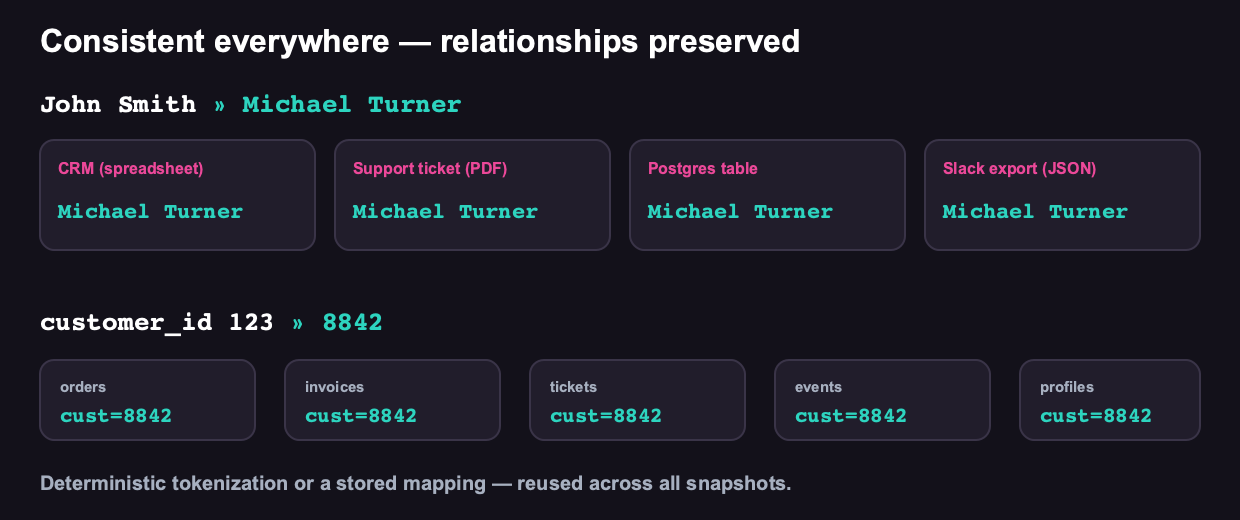
K-anonymity is an anonymization technique — it generalizes data so individuals can’t be singled out, at the cost of precision. Pseudonymization takes a different path: it keeps data realistic and record-level by swapping identifiers for consistent fakes, which is what testing and AI need. See pseudonymization vs anonymization for the full comparison.
Any k-anonymity or de-identification effort starts by finding the quasi-identifiers — and that detection is the hardest part. Strac’s engine identifies direct and quasi-identifiers across records, documents, and images, so you know exactly what has to be generalized, suppressed, or pseudonymized.

Higher k means stronger privacy but more generalization (less useful data). k=5 is a common baseline; sensitive releases use higher. The right value depends on the data and the risk tolerance.
It helps, but not on its own — you also need l-diversity/t-closeness to prevent attribute disclosure, and you must correctly identify every quasi-identifier first.
.avif)


.gif)